Normally when you give yourself to great love,
You're setting yourself on a path of great suffering.
Welcome to The One You Feed.
Throughout time,
Great thinkers have recognized the importance of the thoughts we have.
Quotes like,
Garbage in,
Garbage out,
Or you are what you think ring true.
And yet,
For many of us,
Our thoughts don't strengthen or empower us.
We tend toward negativity,
Self-pity,
Jealousy,
Or fear.
We see what we don't have instead of what we do.
We think things that hold us back and dampen our spirit.
But it's not just about thinking.
Our actions matter.
It takes conscious,
Consistent,
And creative effort to make a life worth living.
This podcast is about how other people keep themselves moving in the right direction,
How they feed their good wolf.
Thanks for joining us.
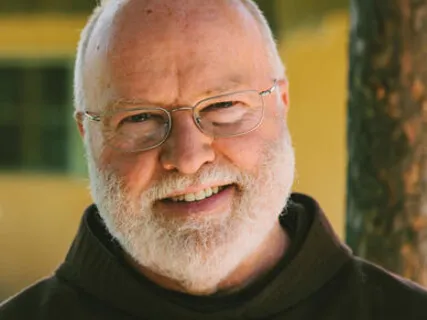
Our guest on this episode is Father Richard Rohr,
A globally recognized ecumenical teacher bearing witness to the universal awakening within Christian mysticism and the perennial tradition.
He is a Franciscan priest of the New Mexico province and founder of the Center for Action and Contemplation.
Richard's teaching is grounded in the Franciscan alternative orthodoxy,
Practices of contemplation and self-emptying,
Expressing itself in radical compassion,
Particularly for the socially marginalized.
He is the author of numerous books,
Including The Naked Now,
Falling Upward,
Immortal Diamond,
And his newest book,
The Divine Dance,
The Trinity,
And Your Transformation.
If you value the content we put out each week,
Then we need your help.
As the show has grown,
So have our expenses and time commitment.
Go to oneufeed.
Net support and make a monthly donation.
Our goal is to get to 5% of our listeners supporting the show.
Please be part of the 5% that make a contribution and allow us to keep putting out these interviews and ideas.
We really need your help to make the show sustainable and long-lasting.
Again,
That's oneufeed.
Net slash support.
Thank you in advance for your help.
And here's part two of our interview with Richard Rohr.
Picking up from kind of where we left off talking about changing ourselves as a primary thing,
One of the things that usually drives us to want to change ourselves is suffering.
You talk a great deal about suffering being one of the main tools of transformation.
You actually talk about love and suffering as the two.
You say,
Almost without exception,
Great spiritual teachers will always have strong direct guidance about love and suffering.
If you never go there,
You'll never know the essentials.
You always quote me so well.
No.
You wrote it.
I just got to repeat it.
You know,
First of all,
Let me give my simple non-dramatic definition of suffering.
It's whenever you're not in control.
So you have to practice not being in control or frankly,
You become a control freak.
And it's situations where you're not in control where you can hand over control to someone else.
I'm sure we learned this in every relationship.
For a marriage to survive,
You have to learn it.
But I think for a relationship with the divine,
You have to learn it too.
That if you're going to allow someone else to steer your ship,
You have to at least on occasion give up self-steering.
So that's called suffering.
I use the silly example of a red light where for 30 seconds you don't get your way.
You want to get across that street.
And who of us doesn't know that experience?
It's essential messaging.
It's foundational learning.
People who don't learn that become entitled narcissistic control freaks,
As I said before.
Now,
I think none of us want major suffering,
But I think that's when it gets hard to understand why is so much asked of some.
For the last two years,
I've been thinking of the women and children in Syrian refugee camps.
Why?
Why?
Why should anybody have to suffer that much?
I don't have a rational answer for that.
Mystically,
I can see it as the eternal suffering of God,
And God is going to transform all of it.
See,
I see Jesus as a map,
A map of the human journey.
Carl Jung said that too.
And we came forth from God,
And we will return to God.
And there's suffering in between.
If I couldn't see that,
That this suffering is going towards some kind of transformation,
It would be very hard for me not to be very cynical,
Very negative,
Very disbelieving.
I have to believe that there's meaning.
And I use that word meaning with all the meaning I can put into the word meaning.
If there isn't some meaning to suffering,
You have every good reason to be a bitter person,
Especially once it happens to your family or your child or your partner.
But apparently you've heard me say the normal two paths of expanding the soul are great love and great suffering.
And normally when you give yourself to great love,
You're setting yourself on a path of great suffering.
It's almost inevitable.
Now,
The way I teach contemplation is that I don't think you have to learn my sophisticated or Zen Buddhist sophisticated way of teaching meditation or contemplation.
But I'll tell you this,
If you do learn it,
It is a way of sustaining what you learn in great love and great suffering over the long haul.
You see,
Great love,
As you all know,
The honeymoon cannot be maintained,
That wonderful period of the honeymoon.
And the unique liminal space we're in after,
In grief too,
In great suffering.
Thank God that can't be maintained in that level of sadness or depression.
But you are in a non-dual state during those periods,
In the honeymoon period and the grief period.
Now,
What you're learning in contemplative practice,
Strictly called,
Is learning how to stay there.
The wisdom you learn of holding the field open.
I don't need to divide to what I like and what I don't like.
It is what it is,
What it is,
And it's okay.
That,
For contemporary men and women,
Has to be learned,
Has to be taught.
Otherwise,
You lose the honeymoon,
You lose the wisdom of suffering.
Usually a matter of months,
Sometimes weeks,
Sometimes days.
Well,
I think it was Thomas Merton,
And I'm just going to paraphrase,
I think you mentioned it in one of your books,
This,
You know,
Watch out for success.
Oh,
Yeah.
You know,
It's one of the surest ways to avoid transformation is to be very successful.
Because you don't,
Why change if you feel like things are going well?
That's why Jesus says it's so hard for a rich man to know what he's talking about.
Because a rich man is a man who's given his whole life to his personal success.
Normally.
Yeah.
Suffering as a path to transformation is relatively well known.
Krista Tippett,
Who does On Being,
I think you had a conversation with her not too long ago.
Yes,
It's supposed to come out around Easter,
She told me.
Yeah.
I can't wait to hear that one.
But she says something along the lines of,
You know,
We don't become great in spite of our suffering,
But because of our suffering.
But you also use a phrase that says if you don't transform your suffering,
It becomes a wound.
You transmit it.
You transmit it.
So what happens,
One person becomes another person and they become wonderful and warm and loving,
And somebody else becomes bitical,
Bitical.
That's a word for bitter and cynical together.
A bitical person.
What are the elements that cause transformation to occur?
You know,
I said to the class last week,
When I see people change for the good is when there's this,
I'm going to call it judicious combination of feeling safe and okay with conflict.
You have to feel safe and okay or you won't have a big enough soul to embrace the conflict.
But there has to be conflict.
The way I've been teaching it to the students for growth to happen,
I say picture three boxes.
Order,
Disorder,
Reorder.
And there's no nonstop flight from the first box to the third box.
To grow up,
You must go through conflict,
Disorder.
Now,
Christian language would be the cross.
That a wrench has to be thrown into your neatly constructed first box of so-called order.
Your salvation project,
As Thomas Merton calls it.
It has to fall apart because you're not in love with God at that point.
You're in love with the idea of being in love and you're in love with yourself.
You don't know that when you're young,
But of course you are.
You only can see that later and say,
I did not yet know how to love,
And yet God used me anyway and God grew me up anyway.
It doesn't mean it was wrong.
So when there's this wonderful combination of enough conflict and enough safety,
Just put it that way,
That's when it moves to the next level.
When there's too much conflict and not enough safety,
You just get cynical.
You get angry.
You get rebellious.
You have to feel yourself being held,
Being sustained,
Being believed in.
And that's what a partnership does for you.
Okay,
I can't believe in myself right now,
But she smiled at me.
You understand?
That'll hold me for another half day.
And that's why we have to give that to one another,
Because we can't always engender it inside of ourselves.
So we need to mirror the best for one another.
That's what friendship means.
That's what love means.
I think back on my moments of,
My big moments of suffering,
You know,
Heroin addiction,
A divorce.
And I'm thinking about what was holding me in those moments.
And I think the first one was Alcoholics Anonymous.
AA was holding me.
So many have told me that.
And I think the second one,
Funny enough,
Was Pema Chodron,
Even though I don't know her.
But there was something about her wisdom and that belief in your essential goodness underneath of it all.
She's a marvelous teacher.
She sure is.
Wow,
Well,
Good for you.
Both make sense to me.
But God gave you that to hold you.
I'm going to read something else you say,
Because I mean,
You say it so well,
I can't help it.
But the loss and renewal pattern is so constant and ubiquitous that it should hardly be called a secret at all.
Yet it is still a secret,
Probably because we do not want to see it.
We don't want to embark on a further journey if it feels like going down,
Especially after we have put so much sound and fury into going up.
Yeah,
That's the gist of my book,
Falling Upward.
Now,
The Catholic language for that,
Which most people don't understand,
Was the Paschal Mystery.
And it was called a mystery because it isn't logical.
It isn't common sense that the way up is the way down,
That the way through is the way of letting it fall apart.
The previous stage always has to disappoint you,
Fall apart for you,
To go on to the next stage.
You know,
If I had to say,
No offense if you were raised in the Protestant tradition,
But the great Achilles heel of Protestantism,
Because of the period of history it emerged in after the 16th century,
Where we were all climbing and capitalizing and achieving and performing,
Is there's almost no theology of darkness.
Almost none.
You have to go to the Catholic mystics.
You have to go to the first 1,
500 years to get all the teaching on darkness.
And that might be the greatest single liability of Protestant spirituality,
That when suffering,
Darkness,
Absurdity,
Desolation,
Tragedy come,
There aren't the tools to know how to deal with it.
You can't just quote a scripture quote.
There have to be inner tools.
And that's why the recovery movement has been so important,
Because I think the recovery movement brought a language of darkness,
If you will,
Powerlessness was their word,
To a Protestant world that didn't understand any tools for dealing with powerlessness whatsoever.
So thank God,
I would say when the spirit isn't getting through the main line,
The spirit comes through the ductwork,
Has to come through indirectly,
Like Course in Miracles,
Pema Shadrin,
12-step program,
Those are all works of the spirit.
Thomas Aquinas taught us in the Catholic tradition,
When you hear truth,
Don't ask who said it,
Because that will prejudice you.
Just ask,
Is it true?
And if it's true,
It's always from the Holy Spirit.
If it's true,
It's all,
How could that not be true?
If it's true,
It's of the Holy Spirit.
I don't care if Pema Shadrin said it,
And she's Buddhist,
Who cares?
Jesus said it and he was a Jew.
So if I'm just going to take Christians,
I'm in trouble.
Yeah,
I try and do the same thing with listening to music.
Like if I put on a Spotify or whatever and it's playing,
I'll hear a song,
Before I go to see who it is,
I want to listen to it.
I want to experience it without.
.
.
Because as soon as I know who it is,
I immediately have some.
.
.
Oh,
He's going to be good,
She's going to be terrible.
You've just taught me something,
I like that.
That makes sense.
Because I can see my mind work that way.
Well,
I won't like him.
Yeah,
I can't hear it clearly once I know what it is.
One of the things that you talk about is necessary versus unnecessary suffering.
I think that's a theme on the show a lot.
I talk a lot about the second arrow parable from Buddhism.
I don't know if you're familiar with that one where we get shot with the first arrow and that's kind of what life does to us,
Right?
And then we tend to shoot ourselves with the second arrow.
And the second arrow is what all this means.
Oh,
You know,
I break my leg and I'm the kind of person who always breaks my leg.
Or why does this happen to me?
And you talk about,
You quote Young saying that so much unnecessary suffering comes into the world because we won't accept the legitimate suffering.
Again,
Don't take offense.
I don't mean to say Jesus is my only teacher.
But I think it was important in the Christian mythology,
The Christian storyline,
That Jesus' suffering be undeserved,
Be unjust.
That's crucial to the story because of the very point you made.
Because if it's just,
Well,
He deserved it,
That changes it.
But to deal with undeserved suffering,
Which is most of it,
Let's be honest.
Sure.
Almost all of it.
Who deserves anything?
That's the breakthrough to that Jesus was the willing victim even though he was not the unworthy person.
That takes such a high level of transformation to accept that when we're in it,
When we're in that position.
Everything in us wants to say,
You know,
I was jailed chaplain here for 14 years in Albuquerque.
And I would say I never knew whether it was true.
But my suspicion was half of the people I worked with should not have been in jail,
Maybe more than half,
For all kinds of reasons.
But a lot of them,
They didn't do it.
You understand?
And I just would have to work through that with them,
Sitting there every day,
Knowing you didn't do it.
Yeah,
I can't imagine.
I know.
What it must take to not be bitter.
Yeah.
And some people manage to not be,
Which blows my mind.
Yeah.
Or when a friend lied about you,
Bore false witness against you.
Can you imagine the kind of holiness,
I don't know what other word to use,
Wholeness and holiness with the same word,
That it takes to to wake up each day and be happy?
I was just on the phone with a prisoner yesterday,
A young man who was,
I'm quite sure,
Falsely imprisoned.
You know,
He thinks he might be there the rest of his life.
He's just in his early 20s.
Oh,
So I'm not really answering your question.
I'm talking around it.
But if we can't deal with necessary suffering,
The cost of being a human being,
Which is I don't always get my own way.
I get old.
My body doesn't work like it used to when I was your age.
And all of that is so hard to accept.
And I can't change it.
You know,
It is that way.
But if I can't surrender to those things,
Imagine if if I'm falsely accused tomorrow and whoo.
So you've got to use every chance of not getting your own way,
Not being in control.
You've got to use it as a practice,
As a practicing so that you don't turn bitter and you can help other people not turn bitter because the natural movement of the human journey is it devolves.
You know,
The the rejections,
Betrayals,
Abandonments of life,
The people who've lied about you,
Walked away from you,
Starting in your childhood,
They pile up.
And I'm about to turn 74 in a few weeks.
And I there's a lot of pile up there now by the grace of God.
I don't think I'm bitter.
I don't think I'm cynical,
But I have to fight it every day,
Every day.
Not always consciously,
But you know,
Like I said,
I wake up yesterday feeling just I think that's all that leftover hurt.
When I gave the male initiation rights,
We had a whole day devoted to grief work.
And I define grief as I talk to those men as unfinished hurt.
And I would just talk to them for a while to find how much unfinished hurt they had in their life.
You would not believe men who were completely healthy,
Normal,
Happy,
Successful,
Smiling once they were given space,
Once they were given permission to go there.
I mean,
I saw a lot of men sobbing,
Unfinished hurt.
And I think we all have to compartmentalize it because we got to get through another day.
I don't have time to feel this.
And we men are especially good at that,
As you probably know,
Compartmentalizing it,
Putting it to a side.
And so wanting somewhere to be a little boy again and just cry it through.
But that's what a lot of my men's work was,
Helping men do that.
But nothing in this American system gives them that freedom,
Space or permission.
So by the time they're my age,
They're highly stuffed men.
No wonder they become addicts.
I'd drink vodka every night,
Too,
Or something,
If all of that is just eating away at you.
Whoa,
Slow down.
Easy on that trigger finger on the fast forward button on your podcast player.
Because I've got more good news.
That was very Casey Kasem of you.
It was pretty good.
I used to I love I boy that was you love Casey Kasem.
I do love Casey Kasem.
And I can't form a complete sentence when you bring him up.
He could though.
He was very good at forming complete,
Very good.
I'm sorry.
Go ahead.
The winner of the first week of the book giveaway is Dominic.
So Dominic,
I've sent you an email.
Get back in touch and I will ship you your five free books and we're going to do it again for yet another week.
So if you pledge at any level,
You will be entered into a contest to win five free books from when you feed authors.
You've got pretty good odds of winning this much better than the lottery or anything else,
Because you've got about a one in 15 chance of winning.
So when you feed dot net slash support pledge at any level,
You're entered into the contest to win the five free books and more good news.
The one you feed shop has been relaunched.
We've got coffee cups.
We've got t shirts.
We've got posters.
We've even got a onesie for a baby.
And you can buy a date with me,
Chris,
If you would like to make a baby if you don't have one.
But you want to make a baby and then you can use that onesie.
No,
No,
No,
No.
I have a wonderful girlfriend.
I'm sorry.
Just go ahead.
So the one you feed shop,
One you feed dot net slash shop,
Lots of fun things to purchase out there.
And the last bit of news is that we are now on Instagram,
Which seems to drive some people crazy with joy.
So go to at one underscore you underscore feed.
So it's at one you feed with underscores between the words on Instagram.
And that is all for now.
So again,
Remember one you feed dot net slash support to enter the contest.
And now back to the wonderful show with Richard Roar.
Some people call him Papa Bear.
So I'm not quite sure why.
But just leave it alone,
Chris.
Papa Bear.
Actually,
This is the rest of the show with Papa Bear part two,
Because last week was Papa Bear part one.
A lot of us turn to spirituality with the hope of never hurting again.
And I think that's why a lot of people it feels to me like on a spiritual bunny hop.
One thing to the next to the next,
Because I'm waiting for it to take all the pain away.
And as I've gotten older,
I think I've recognized it's going to take unnecessary pain away,
But it's not going to take the pain of my mother dying away.
That's going to happen.
It's just the way life is.
And the comfort,
I think,
Comes from knowing that's part of being human and not taking that stuff personally.
And I think that's what like,
You know,
Your work does,
I think,
For people also is like this is going to happen.
And it's not personal.
Yeah.
You know,
I take what's rather common American occurrence,
But I've just known so many people just in the last year.
The dumb thing of a car wreck.
Why did that have to happen to me?
And why now?
I was on the way to this.
It was a normal day and my entire not just day,
But the next few months are thrown into complete disarray because of that stupid guy.
Right.
And a red light.
Oh,
You want to talk about unnecessary suffering,
But of a mundane nature.
You know,
You weren't even hurt,
Maybe,
But it's a lot of pain.
Yeah.
Insurance and sucks.
But we do have a we do have a very strong tendency to make it worse.
I'd be the same way.
I'd be pissing and moaning if I got hit by a car.
I've never been in a serious accident because we like to go on the course we're on,
Don't we?
And we don't want anything to be interrupting it.
Yep.
Yeah.
And I guess that is human nature.
That can be the power of suffering is it interrupts your course.
You have to you know,
To think as you know,
I preached in much of the world for many years and without any doubt,
People in poor countries and poor villages are much more practiced and not getting their own way.
They just don't show that immediate pushback and resentment that we do.
It's oh,
Yeah.
Well,
This is what every day is.
I don't get my own way.
Yeah,
I was watching the Sopranos.
And in the show,
There's this fascinating part where there's a Russian woman who's talking to Tony Soprano.
And she says,
The problem is you Americans expect that nothing bad is going to happen.
And the rest of the world,
We expect that mostly bad is going to happen.
Yes,
Yes.
And it ends up sometimes being a grace.
Now,
I know it can be fatalism.
I know it can be a negative worldview.
But very often they can maintain peace easier than we can.
And I think if you tie it back to this,
You know,
Middle way thinking is to recognize it's not all suffering and it's not all wonderful.
It's very good.
Very good.
That's right.
I want to talk about clear seeing,
About seeing things clearly is another phrase,
I think,
That comes through your work a lot.
And you say that postmodern people,
The universe is not inherently enchanted as it was for the ancients.
We have to do all the enchanting ourselves.
This leaves us alone,
Confused and doubtful.
You know,
Owen Barfield,
Who was the spiritual teacher of J.
R.
R.
Tolkien,
C.
S.
Lewis and T.
S.
Eliot,
He spoke of original participation.
And he says there's strong evidence that the ancient peoples who naturally felt that they belonged to the forest,
To the family,
To the universe,
To the sky.
It was an enchanted universe for them and they were a part of the enchantment.
Salvation came,
To use that Christian word,
Overused word,
It came much more naturally.
We grow up,
You used the word postmodern too,
We grow up in a world that is disenchanted.
Where we're,
And the philosophers call it the state of alienation,
You know,
That we don't feel we belong to the universe,
To the forest,
To the animals,
To even our families.
I mean,
Most people are alienated.
I'm told most people have strong alienation from their own family,
You know,
Just because we don't have the skills of human relationship,
Even at that level.
So that creates a very incoherent universe where you're grasping for belonging,
Meaning,
Goal,
Purpose,
Identity.
It's no surprise to me that we have such a high amount of mental and emotional illness.
I'm sure any of us can name ten people we know who,
Frankly,
We're not trying to put them down,
But they're not real stable or not real.
.
.
One of them might be behind a microphone right now.
I don't think so.
But it breaks our,
My heart,
The amount of unhappy,
Unstable people our culture is producing.
And I find,
As someone who has worked in the healing ministry,
Trying to pray for people's healing and counsel them toward healing,
That it's very hard to heal an individual when the whole culture is so unhealthy.
You send them back after a wonderful weekend retreat,
And they're right back into the cynicism,
The negativity,
The consumerism is going to make me happy,
Which will never work.
But everybody thinks it will,
So they buy it again,
You know.
Yeah,
It works temporarily.
Just for a few minutes.
If it didn't work at all,
It'd be so much easier.
That's a good way to put it.
If it didn't work,
It works a teeny bit.
Just a little bit.
Just enough.
Yeah,
Placebo.
What is clear seeing?
What is.
.
.
Oh,
Yeah,
That was your question.
See,
You're being so kind to me.
You're letting me off the hook.
Clear seeing would be,
Now this sounds obvious,
It would be to see the whole picture without my filters of rejection,
Denial,
Resentment,
Blocking,
Filtering out.
It is what it is,
What it is,
What it is.
Now,
We all have created our filters.
You have to to survive.
But when your filters so dominate that all it gets in is what you already agree with,
What does not threaten your ego,
And will give you immediate comfort,
Your seeing is so narrow,
So limited.
You're going to be stupid.
I have to say it.
You're not going to see reality or yourself or other people very well.
So much of the work of teaching contemplation is helping people recognize those blockages,
Those resistances,
Those filters,
And quietly let go of them.
So what can get in is both the good and the bad,
Which everything holds.
I don't have to just let in the good.
Now,
Once you can learn that,
Frankly,
You're capable of love.
See,
I don't think you can love just perfect things.
Love applies to imperfect,
Ordinary,
Broken,
Human things.
And I don't know why someone didn't tell us that early.
If you're not a non-dual thinker,
You can't love anything.
You'll wait around for,
I don't know,
Mr.
Perfect or,
You know,
A princess or something.
And then you'll find out she isn't a princess anyway.
It's just we were done such a number by being given this expectation of finding objects that would be worthy of our immense and perfect love.
In fact,
What God gives us things which make us learn how to love because they're imperfect.
And that grows us both up,
Hopefully.
So that's clear seeing.
To see,
You know,
When Jesus has some of his banquet stories,
He tells the disciples to go out the highways and the byways and invite everybody to the banquet,
Good and bad alike.
In Matthew's gospel,
It says good and bad alike.
I think to have your table fully set,
As it were,
The table of your mind and heart,
You have to invite everybody to the table,
Both good and bad.
The parts of yourself you like.
And there's there's qualities of my temperament and personality that I started disliking when I was 19.
Like my one energy on the Enneagram.
I wish I weren't that way,
That I'm so idealistic,
Perfectionistic,
Pushy,
Judgmental,
Demanding mostly of myself.
Now,
I admit at this age,
It's become my greatest gift,
Too,
But I still suffer that it's my greatest fault.
Yeah,
I don't know you can untie those two.
That's my point.
You got it.
You cannot untie those two.
I have to carry the big black bag of what I don't like about myself.
Some of the medieval Catholic mystics in their writings spoke of carrying the burden of self.
It was a common phrase,
The burden of self.
Now,
You and I were raised in a psychological age where we thought we could heal the self.
And you can to believe me,
I've had wonderful therapists in my life,
Wonderful spiritual directions,
Wonderful healing programs.
But I still have to carry the burden of Richard.
And I think we all do.
And when we say Jesus was fully human and fully divine,
I think the divinity of Jesus had to carry the burden of the humanity of Jesus.
And he loved it.
He accepted it.
He forgave it.
All the evidence is.
But most of us had little training.
We thought it was to eliminate the human part,
Which largely meant the sexual part,
The emotional part,
The physical part,
The eliminate it.
No,
Spirituality of elimination and exclusion is over.
We tried it for too many centuries and all it created was an exclusionary religion,
Which was always looking for,
You know,
Who are the sinners or heretics or black people or gay people that we can exclude now.
There was always a group that we could exclude.
The world doesn't have time for that anymore.
You use the word sin there,
And I've heard you at different points refer to it in a variety of different ways.
That's a place that is really easy to get hung up on is,
You know,
If you're a sinner,
It means you're this bad,
Worthless person.
Right.
And you put you put it in terms to me that seem like a useful like I look at that and I go,
Yeah,
I don't I don't want to be like that.
That's good.
Yeah.
You know,
So what you want to hit me with a couple of your little things.
Okay.
First of all,
The word that's used in the Bible,
Ha martia in Greek,
Literally means when you're shooting an arrow and you miss the bullseye.
That's very helpful.
And that doesn't mean a culpable thing that makes God not like you.
And now that's the way if any of us were raised Christian.
That's the way in my early understanding of sin.
There are certain actions somewhat arbitrary,
I might add that this whimsical God has decided upset him.
I don't know if you've read my recent book on the Trinity.
No,
It's a divine dance.
You know,
That's the reason we use him because we don't have a Trinitarian notion of God.
You make God masculine almost all the time.
So I was mainly concerned about upsetting God as if I could.
You know,
It was giving myself an awful lot of power that I could upset God.
Culpability.
So it built on parental practices of parenting,
Which if I were a parent,
I'd probably do the same thing.
But most parenting till the very recent West,
And I mean very recent West,
And I don't mean all of the West even,
More of the sophisticated West.
And even there,
Most parenting was punitive and shaming.
That's the way you control children.
I probably would have done the same thing if I'd been a young parent.
Because in the short run it works.
So all of that got projected onto God the Father,
You know,
Especially if you had a shaming father too.
You were just programmed to believe that.
That's why I make so much of prayer.
Because unless you go on an inner,
Interior,
Mutual,
Give and take journey of prayer with God,
Most people will settle with a shaming,
Judging,
Guilt-based notion of God.
That's such a waste of time.
It really is.
It takes much of your life to get beyond it.
But once you see that clergy,
And here I'm going to be very critical of my own group,
I don't think we were that motivated to move people beyond that.
And you probably know what I'm going to say.
It kept the laity codependent,
To use that very good word,
Which only emerged 30 years ago by the way,
This understanding of how you create relationships based on guilt and shame and you owe me.
It's not love.
It passes for love,
But it isn't.
And I mean,
I've been a priest 47 years.
And I've worked with every group.
Much of religion,
Catholic and Protestant,
Is massive codependency of the laity upon the clergy.
And we perpetuate that.
I'm not trying to be cynical or unkind.
I'm really not.
But we perpetuate that without realizing it,
And largely in the name of job security.
If we want to keep them coming back every Sunday,
The best way to keep the tether,
To keep them tied to us,
Is shame and guilt and fear of God,
Fear of going to hell.
The lowest level of motivation.
And so when you appeal to the lowest level of motivation,
I'm sorry to say this,
But you get a lot of people in the Christian world who are very lowly motivated people.
You follow the logic?
Any world.
Yeah,
Any world.
I don't think we can get by if there is a future to Christianity with motivating people by fear of God.
Because the God they end up with is not God.
So the whole thing falls apart.
The real people who pray,
The mystics,
All know that God is infinite love.
Infinite.
Remember,
That's one of the five.
We can't form concepts of infinity.
So we don't know how to imagine infinite love.
So we pull God down into a quid pro quo,
Tit for tat.
Okay,
If I obey the Ten Commandments,
Then He'll love me.
Who of us wasn't trained to think that way?
But it has nothing to do with the gospel.
It's not the gospel at all.
It's cleaning up.
But it's not growing up.
It's not waking up.
And it's not showing up.
Yeah,
You talk about,
You say the shape of evil is much more superficiality and blindness than the usually listed hot sins.
You know,
I've even refined that a little bit in recent.
Maybe it's what we've been through the last 18 months.
I find that evil is almost always absolutely sure of itself.
Evil suffers no self-doubt.
Yeah.
I think that's a Bertrand Russell quote,
Right?
Is it?
Boy,
I'm going to miss it.
The problem with the world is that the cocksure are so full of certainty and the other are so full of doubt.
I've mangled that.
Okay,
But it's the same point.
It's the same point,
I mean.
Yeah,
And see,
Faith,
As I understand the biblical concept of faith,
Is to balance knowing with not knowing.
Now,
When I say Protestantism didn't teach the not knowing very well at all,
That's what we're up against in fundamentalist Christianity.
This insistence on knowing and being absolutely certain,
That's the character of evil.
What you and I,
If we're going to be people of faith,
What we have to endure is faith.
And the word faith implies not knowing,
You understand?
And being able to live with not knowing because,
Quite frankly,
God knows.
And I can trust God's goodness enough.
If God knows,
Then I can live with it,
You understand?
And I don't need to know.
So it's not only not knowing,
But not even needing to know that you grow in.
That's the journey you see in Mother Teresa at the end of her life.
You see in Thomas Merton.
You see in all of the great mystics that I would respect.
They can live without being certain.
But people who do evil suffer no uncertainty.
And that this has invaded so much of fundamentalist Christianity is what scares me.
That they call themselves believers.
Not in the classic sense.
They're believing in a system that aggrandizes them.
But believing in a loving God despite all the contrary evidence,
I don't see much of that.
Because anything that's outside their comfort zone,
People of another race,
People on the other side of the border,
People who are handicapped,
They don't seem to have much love for them.
That's the giveaway that we're not dealing with faith anymore.
One of your phrases,
We moved from wondering to answering,
Which has not served us well at all.
The other definition of sin that you've used was refusing to go into depth on particularly holy things.
I've said that for many years.
I think the great sin of America is superficiality.
We're not malicious people.
We're really not.
And we're really very kind in terms of generalized charity and philanthropy.
We surpass most countries.
We really are.
There's so much good about America.
But I would still say that the stereotype that most people have of Americans is we're nice people but very superficial.
And I think that's true.
And that's what happens when you cannot embrace the dark side of things.
You have to remain on the likeable,
Superficial level.
To go to the depth of anything is to see its dark side.
And I don't mean that means you have to hate it.
I just mean you see it's not perfect.
Now I could also say the contrary.
To go to the depths of anything is to see its good side.
So maybe they're both equally true.
What do they say that most of our television,
The commercials,
And the vocabulary of Even of the Evening News,
And all the sitcoms are aimed for 14-year-olds,
14-year-old minds.
What can we expect?
But what we're getting now,
When the constant pandering is to dumb down the population.
And that,
You know,
Even Thomas Jefferson said this whole thing of democracy would only work if we had an educated populace.
Some degree of awareness.
Let me just use the word awareness.
So it doesn't sound like I'm talking about you got to go to Harvard.
I'm not saying Harvard,
But to have the beginnings of critical thinking.
The beginnings of seeing things at a level of truth.
And not just a level of how do they advantage me.
So a lot of this we've talked about contemplation,
We've talked about prayer,
We've talked about non-dual thinking.
What are some of the practices in these things?
So people who listen to the show have been exposed to plenty of Buddhist meditation teachers.
So I think that part's been covered.
I'm interested in the things from the Christian tradition that are under this umbrella.
Let me tell you the big difference.
Even though I have learned so much from my Buddhist friends and Eastern religions about shedding of thoughts and letting go of my filters and all.
You know if the Spanish word for emptiness or nothingness is nada,
The Spanish word for somethingness or things is cosa.
And we Franciscans in particular said ours isn't the way of nothingness,
It's a way of finding God in things.
That's the incarnation.
Why God came,
We Christians believe,
As a person,
A thing,
A human.
He wasn't wanting to take us away from the world,
But trying to help us find God in the things of this world.
So I would still learn much from the practice of Eastern meditation to get Richard out of the way.
So he can see with the clarity you talked about.
But I still want to see things and I don't need to call those trees secular or merely natural.
For me there's nothing merely natural.
There's only the supernatural.
You know the early Eastern fathers in Christianity,
They didn't limit the incarnation to the body of Jesus.
They say the body of Jesus was the symbol of what God was doing everywhere all the time.
God took on flesh,
As John 1.
14 says.
God took on materiality.
God took on physicality.
That matter and spirit are two sides of the same mystery.
That the hiding place for spirit is matter.
They've never been separate since the Big Bang.
This is going to be my next book.
So if you hear me getting excited in my talk,
Because this is filling me right now.
I've already talked about it but now I've got to make it complete.
So Christian meditation is the freeing of yourself from yourself so that you can see God in everything.
Even your enemy,
Even failure,
Even the dark side.
That's good seeing.
And it frees us from these centuries of Christianity where we've tried to get out of this world for heaven.
I think that's heresy.
You look at the life of Jesus.
Jesus healing people in this world for today.
There's hardly any passages where he's talking about an evacuation plan for another world.
You want to talk about destroying the Gospel.
We did it with that.
A lot of Christians grew up with that understanding.
It was all about an evacuation plan for the next world.
Once we recognize it's how to live with freedom and joy and love today in this world.
Now you've got a real agent of transformation for the world.
People who love this world,
Who love the earth.
And don't think of that as being secular.
I meet people,
Research scientists and lawyers,
Honestly,
Who don't go to church on Sunday.
And who are more passionate about their neighbor and the future of the planet than people who go to church every dang Sunday.
And don't care about anybody except their own salvation.
I don't have time for that Christianity anymore.
Because I don't think it's Christianity.
I don't think they learned either the good meditation would have freed them from themselves.
And so they interpreted the whole Gospel in a very limited,
Self-serving way.
Which allowed them to barely love themselves because they couldn't love their own dark side.
But only to be able to find God in other people who are just like them.
Which usually meant white,
Middle class,
Successful,
Heterosexual and what else?
Not disabled.
That means God loves very little of God's own world.
Very little.
It's not a very big number.
No,
It's not very hopeful.
And that we've produced so many Christians who live at that level.
God must just cry.
That's all I can say.
That we could have missed the message that much.
But all I can do is work to do it better myself.
I can't point the finger at other people.
Because I know I've wasted days there.
I've wasted more than days,
Weeks and months.
Tell me about the true self briefly.
Oh yeah,
I jumped over that.
You alluded to it before.
The true self is your objective self.
Your ontological self.
I know that's a big word.
Your metaphysical self.
Your eternal self.
Your self which doesn't rise and fall.
It's who you are,
To use religious language,
It's who you are in the eyes of God from all eternity.
You can't do anything to adjust that.
You can't push it higher,
You can't push it lower.
It's defined eternally with its divine DNA as a creature of God.
It's the anchored self.
It's the absolute self.
I'm just grabbing for different metaphors.
Is my true self different than your true self?
Yes.
We've got to maintain uniqueness.
But the true self is also utterly united.
And it took until the 7th century for the church to put that in the creed.
I believe in the communion of saints.
That's what they were saying.
That once you get to the true self,
We're all one.
So I'm glad you put it that way.
And yet I have to protect uniqueness.
I'm still Richard and you're still Eric.
And that's okay.
That's why the title of my next book is Just This.
Just This.
Now,
You can only fully understand it in contradistinction to the false self.
So the false self,
First of all,
Let me say it is not the bad self.
It is not the self to be rejected.
I know the false might imply that.
But it's just the raw material that God uses to break you through to your true self.
But it's contingent.
It's temporary.
It's transitional.
It's relative.
It's psychological.
It's passing.
It's cultural.
It's learned.
It's your Myers-Briggs typology,
Your anagram number,
Your gender.
Your gender too.
And that's what a lot of people can't accept.
Your gender is not your true self.
We could have dealt with gender issues much better if we'd known that.
But we define gender even in a binary way,
You know,
Eliminating a whole bunch of people who must have had very hard lives in all of history.
Until we started talking about it in the last century.
Just started talking about it.
That's how attached we are to our binary understanding of reality.
So many things that we define as the essential self,
Role,
Title,
Bodily shape,
Appearance,
Skin color,
Those are all the things that are going to die when you die.
They're not absolute truth.
And we go through this world advertising our skin color and our good looks and our hair,
Lack of hair,
All of that.
You're going to lose.
You're going to lose if you stay there because all of it is passing away.
And if you don't fall into the true self,
The substantial self,
The God self,
The Buddha self,
I don't care what word you use.
You're like a movable famine.
You're just constantly grabbing for identity,
Grabbing for who am I now?
Who am I now?
Can you hear me now?
Am I significant now?
I do think the boomer generation that immediately followed me,
I think the next 10 years,
I can only predict suicide increasing in this country and addiction increasing.
Because they really,
Well every generation does,
But certainly the boomer generation put all their eggs in the false self basket.
Success,
Power,
Money,
Control,
Health,
Good looks,
That's all the false self.
Again,
Let me repeat,
I'm not saying it's the bad self.
But you don't pitch your tent there.
You transition through it and you don't take it too seriously or it ends up making you settle for very little.
Yeah,
I love the word the small self as a term for it.
It's like the little,
It's there,
It's real,
It's important and it's not even bad,
But it's so limited.
Small self,
Big self is very good,
Which is why Jung capitalized the one self and small s.
For the other self.
Well thank you so much for spending this much time for us,
Having us out to your lovely place.
Glad you could come to the land of enchantment.
We are proud of our state.
There's something spiritual about New Mexico.
Everybody who comes here,
Not everybody,
But an awful lot of people say that.
So thank you both.
You're a joy to me.
God bless you.
Thank you.
You too.