So now we're going to sit for meditation.
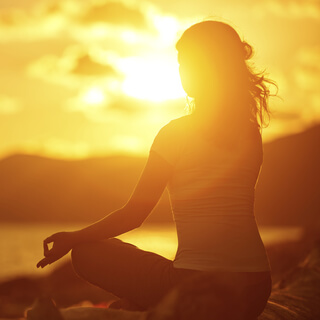
If you'd like to find a comfortable position for yourself in meditation,
With your right leg on your left leg,
Your right hand on your left hand,
The index finger of your right hand touching against the thumb of your left hand,
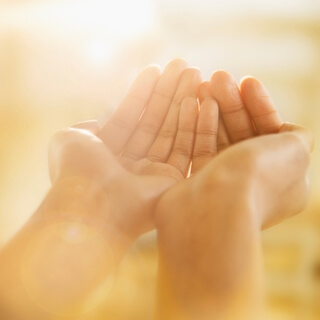
With your palms facing upwards and your hands resting in a relaxed way in your lap.
Close your eyes very gently.
Close your eyes as if you were going to go to sleep.
Adjust your body to make it appropriate for meditation,
Because the sort of posture which is suitable for meditation must be relaxed in every way.
Therefore imagine that your body is relaxed completely.
Relax so that there is no remaining part of your body which has any stress or tension anymore,
All the way from the muscles of your eyes,
Forehead,
Temples,
And they all be completely relaxed.
The muscles of your shoulders,
Both arms,
Right down to the tips of your fingers.
Make sure they're all completely relaxed.
Relax the muscles of your body,
Chest,
Trunk,
And abdomen,
Making sure they're all completely relaxed,
All the way down to the tips of your toes.
Adjust your posture so that it's suitable for meditation,
Both stable and relaxed.
If you're able to adjust your body properly,
You'll have the feeling that you're not leaning too far forward or too far back,
Not too far to the right,
Not to the left,
But you'll feel stable,
Rather like a mountain,
Unshaken by the winds blowing from the four directions.
You'll be able to sit for a long time without having to move around too much.
This is the proper sort of position which we're aiming for.
I'm sitting with your right leg on your left leg,
Your right hand on your left hand,
With the index finger of your right hand touching against the thumb of your left hand.
In fact,
It's the most perfect position,
Which has been modelled from the posture of the body of enlightenment.
The living Buddha inside us sits in exactly the same position.
He has an upright position,
Sitting cross-legged in a perfect position of poise.
Therefore,
Adjust your body properly before you sit for meditation any further.
You shouldn't pay attention to any external distractions.
You have to make sure your body is properly adjusted before continuing with the next stages of the practice.
Once your body is completely relaxed,
We turn our attention to relaxing the mind,
Because meditation is mostly about training the mind.
Make sure your mind is relaxed,
So that it can be a suitable receptacle for mindfulness,
Wisdom and tranquility.
The mind appropriate for meditation is always a mind which is empty of any extraneous thought,
With no anxieties or worries,
Whether it be thoughts about family,
Work or studies.
We mustn't allow any worries about these things to stir up our mind anymore.
If we are to have a mind empty of all of these anxieties,
We would be better thinking about the teaching of the Lord Buddha,
That all things,
Whether animate or inanimate,
Trees,
Animals,
The world,
The sun and the moon,
Or even the people living in the world,
Whether it's our parents,
Grandparents or close family,
Whether it's the other living beings in the world,
All of these things arise,
Perpetuate and then decay.
They are all changing all of the time.
They are never permanent.
They can remain the same even if they want to.
They are all the nature of suffering.
They are not our true self because they are changing the whole of the time.
If they were really our true self,
Really the core of our being,
It would have to be something stable.
We are not like a diamond which becomes more mature with age.
All things are changing the whole of the time.
If we remind ourselves of this for a minute or two,
Before we get down to the meditation practice,
Reflecting in this way will allow our mind to become empty.
And it's a mind which will be suitable for meditation because before long,
If our mind becomes dispassionate and detached,
We will be able to attain the Dharma inside ourselves easily.
As for those who are already familiar with the meditation instructions,
You can continue with your own practice.
But for those of you who are new,
Please listen carefully to the instructions which are to follow.
You should imagine a bright clear object at the centre of your body,
Such as a bright clear crystal ball,
Rather like a polished diamond sphere,
Without any scratches or blemishes on it.
If we create such an image in our mind,
The image of a large diamond about the same size as the tip of your little finger,
And imagine it at the centre of the body,
Then this will be helpful as an anchor for the mind.
We imagine this diamond or crystal ball,
Bringing our mind to a standstill at the clear centre of the ball,
While repeating the mantra to ourselves silently with the words,
Samma arahang,
Samma arahang,
Samma arahang,
Over and over again.
No matter how many tens or hundreds or thousands of times we have to repeat the mantra to ourselves,
You'll have to keep on repeating it over and over again.
For as long as it takes for our mind to come to a standstill,
And to see a clear bright crystal ball,
Arising spontaneously at the centre of ourselves,
Seeing it with the same clarity that we would see it with our own eyes.
If we catch sight of such a crystal ball,
There will be no real need to continue with the mantra anymore.
We should make sure we see the crystal ball at the centre of the body the whole of the time.
The fact that we need to bring our mind to a standstill at this point,
Rather than anywhere else,
Is because this seventh base of the mind is the only place in the world,
Which is the starting point of the pathway towards Nirvana.
If we want to attain Nirvana or attain the Dhammakaya,
We have to start from this point and nowhere else.
If Nirvana is going to arise for us,
It has to arise at this point.
If we are going to extinguish suffering,
Then we have to extinguish it at this point.
If we want to find true happiness,
Then we have to find it here at the seventh base of the mind.
Stopping the mind at the centre is thus the starting point for meditation.
If we don't manage to achieve this,
Then it's going to be hard to go any further with the meditation.
We have to go at it patiently.
We have to make sure that we get it right.
Today as we meditate,
We take the opportunity to explore something of the oft misunderstood subject of the nature of Nirvana.
The word Nirvana refers to a place or a state of mind where all defilements have been extinguished.
It is a place beyond the reach of the three prisons of the triple world.
Nirvana can have two shades of meaning.
It can refer to the state of mind of a person with no further defilements or it can refer to a place where those who have freed their mind of defilements can go to partake of eternal bliss.
Nirvana as a state of mind or sa upadhi se sa nirvana,
Is a living experience of an enlightened person.
Thus they don't have to die first and be reborn to attain it.
For such a person to touch upon nirvana,
They must have purified their mind from all defilements,
But their five aggregates or khanda have not yet broken up.
The makaya will be manifest inside them,
Imparting the same happiness as if they were really inside nirvana as a realm of existence.
But they are still alive in their human body.
Nirvana as a realm of existence or anupadhi se sa nirvana,
Is a location which exists as a realm outside the body and mind.
Sometimes it is called posthumous nirvana because you can only go there after the breaking up of your five aggregates for the last time,
And entering it you will not be reborn again.
At the end of their final lifetime,
The body of enlightenment of a person who has become unified with nirvana as a state of mind,
Will be drawn to the centre of the body and enter upon nirvana as a realm of existence,
Something which is the quest of all the noble ones.
Nirvana is an empty area outside the triple world,
Which is beyond the reach of suffering.
The place is the abode of all the bodies of enlightenment of all the fully enlightened buddhas,
Pacheka buddhas and arahants,
Who have attained enlightenment in the past.
Nirvana is full of all their bodies of enlightenment.
In that place there is only happiness,
Because no suffering can reach there.
There is no rebirth,
Ageing,
Sickness or death,
Because everything is made up of dhamma aggregates.
This place cannot support people or angels or brahmas,
Because such beings are not made up of dhamma aggregates.
Only bodies of enlightenment can enter their own.
This is the type of nirvana that you can only attain when you are an arahant,
A pacheka buddha or a fully enlightened buddha,
Who passes away from this world for the last time.
When the five aggregates of their physical body break up at death,
Their body of enlightenment will be attracted directly into nirvana.
Nirvana actually exists,
But is not made up of normal elements like earth,
Water,
Wind and fire,
In the same way as the things we can see with the naked eye.
It is neither in this world nor another world.
It is not the sun,
The moon or the stars,
Because all of those things are still within the three spheres or pavha,
And are hence mundane or lokya.
Nirvana is outside the three spheres and is transcendental or lokuttara.
In nirvana there is no movement,
No coming or going.
Those who have attained nirvana are able to see past buddhas sitting deep in meditation or nirodha samapati,
More numerous than all the grains of sand in the four cosmic oceans.
All that remains of them are their dhamma bodies,
But their dhamma bodies are more exquisite than any dhamma body you can perceive within yourself.
Dhamma bodies that are self-sufficient with boundless happiness,
Independent of any outside influence,
Because the minds of all those buddhas have transcended all suffering entirely and have attained the true fulfillment of life.
In this respect,
The scriptures of the uttana explain there is the existence of a sphere in which earth,
Water,
Fire,
Air,
The sphere of infinity of space,
The sphere of infinity of consciousness,
The sphere of nothingness,
The sphere of neither perception nor non-perception,
This world,
The next world,
The moon,
The sun,
Have no part.
In that place there is no coming,
Going,
Existence,
Arising,
Falling away.
In that place that has no abode,
Without feeling,
But it is the end of suffering.
Most of our knowledge of the difference between the terms sa upadisesa nirvana and anupadisesa nirvana comes to us courtesy of the commentary by the great Abbot of Wat Phuk Nam,
Pasit Jaron,
Or Phra Mon Khon Te Boon Nhi.
Without understanding this distinction,
The more you read about nirvana in the textbooks,
The more confused you will become.
The reason is that most textbooks have been based on interpretation of older texts rather than being based on experience.
Some texts even go through the virus to say that nirvana doesn't exist.
They say it is just a metaphor for having come to an end of defilements.
Some even say that animals can go to nirvana.
However,
If we have an accurate understanding of nirvana,
It can boost our inspiration to cultivate ourselves until being able to attain nirvana for ourselves.
When our mind becomes completely united with the body of enlightenment,
It is at that point that we will be able to see nirvana both as a mental state and as a location.
With the understanding that goes hand in hand with such an experience,
We will be able to lead our lives in a way that doesn't lead to harm.
We will not be attached to the worldly vicissitudes like wealth and loss of wealth,
Honour and loss of honour,
Praise and insult,
Suffering and happiness.
To see the Dhamma in the beginning,
It means that we have to acknowledge suffering first of all.
Once we see suffering for what it is,
We will be able to become dispassionate concerning suffering.
And we will become inspired to practice meditation to the point that we will attain the Patama Magga sphere inside.
Once we reach this point,
After this we will be seeing the Buddha inside.
But if we are unable to see the Patama Magga sphere,
We have no chance of seeing the Buddha inside.
In the words of the Buddhist scriptures,
He who sees the Dhamma will be able to see the Buddha.
In fact,
These words were first said to a disciple of the Lord Buddha called Vakali.
Vakali belonged to a Brahmin family of Savatthi and became proficient in the Vedas.
Usually people are inspired to faith by one or more of four attributes of a monk,
The appearance,
The voice,
The humble manner of dress or the teachings he gives.
Vakali,
However,
Was inspired to faith by the appearance of the Lord Buddha alone.
After seeing the Buddha only once,
He could never again tire of looking at him and followed him about everywhere.
Any day he could not see the Buddha,
He felt low.
In order to become closer to him,
He became a monk and spent all his time,
Apart from mere times and bathing,
In contemplation of the 32 signs of the great man,
Or Mahāpuriṣa-lakkhāna,
Which was so well exemplified by the Buddha's person.
He was satisfied simply to see the Buddha and had no further thought of listening to the Buddha's teachings or striving for liberation.
The Buddha waited for the right opportunity to teach him because what he had to say would surely upset Vakali.
But at the same time these things must be said for Vakali's benefit.
One day,
When the right time came,
He banished Vakali to a place where he could no longer see the Buddha.
And Vakali was so upset by the Buddha's retort that he prepared to commit suicide by jumping over a cliff on the vulture's peak.
Fully aware of Vakali's intentions,
Before he was able to jump,
The Buddha went to him and appeared to him teaching with the words ālāṃ vakali kīṁ te imiṇā bhūti-kāyena dīteṇā yoko vakali dhammaṃ pāsati so māṃ pāsati yomāṃ pāsati so dhammaṃ pāsati The sight of my foul body is useless.
He who sees dhamma sees me.
He who sees me sees the dhamma.
Filled with joy by this teaching,
Vakali rose in the air,
Pondering on the Buddha's words,
And realised our handship in mid-air.
Thus,
Anyone who sees the precursor of the dhamma,
Nenidh patthamaṃ māgaṃ sphere,
Before long they will be seeing the body of enlightenment inside,
Because the thing that changed,
Prince Siddhātā into the Buddha,
Was none other than attaining the body of enlightenment inside.
It is a thing which changes worldlings who are still thick with defilements into those who are on the path of Buddhist sainthood.
Changing ourselves to be someone who has a supreme life and a supreme mind.
The lowest level of the body of enlightenment is called Gautrapūdhammakāya.
This means the body of enlightenment,
Which has broken free of being a worldling,
But it's still not at the point of Buddhist sainthood.
It is a halfway point between being a stream-enterer and a worldling.
It is like having one foot in each camp,
One foot in the world and the other foot in nirvana.
With such an attainment,
You will be able to get the comparison between the two sorts of existence,
Between the two sorts of aggregates,
The conventional aggregates and the dhamma aggregates,
Because at this point we are still subject to different emotions in the mind,
But at the same time we are able to see things according to their true nature.
We will be far from the four forms of prejudice because of greed,
Hatred,
Delusion or fear,
But there will still be subtle forms of defilements remaining in the mind.
Once we come to the Gautrapūdhammakāya body of enlightenment,
We will be able to see things according to their reality.
We will not be subject to their prejudices anymore.
Once we accept things for what they are,
We will start to see the body of enlightenment of a higher level of purity.
We see that the five aggregates are rather like a mask which we wear in order to perform on stage,
But when we remove the mask,
Then we see who we really are.
So now,
May all of you be fulfilled in your wish to attain a triple gem inside yourself.
Each thorough meditation now for a few more moments in silence until we come to the appropriate time.