Okay,
So today we're going to do a mindfulness and awareness meditation and it's literally to address exactly what you said.
Our minds are designed to be on constant alert and to be constantly scanning and making sure that we're safe.
That's the whole point of your mind and its being in your body.
Your mind has a very,
Very difficult time focusing.
It is just the nature of the beast.
So when we do mindfulness and awareness meditation,
We're engaging in a training process for our minds and that training process is simply,
It's deceptively simple but it's really hard to do.
And the process is you just keep bringing your attention back to the object of your focus.
And for many meditation classes,
The object of the focus is your breath.
Sometimes at home,
People like to sit and have a candle lit in front of them and simply focus on the candle flame.
And what happens if you're doing it for longer than two seconds is your brain starts thinking.
It starts going off to what you have to do later in the day or something that happened earlier or chores that you haven't completed or a million other things,
A conversation you had,
Right?
That's what brains do.
So with kindness,
What we want to do is say,
Come back.
I'm here.
And you just keep coming back to whatever that focus is.
So as I said,
We're going to do a mindfulness meditation today where we're just going to practice that.
So I'm going to give you three different ways that you can do this and that way you have options when you go home and want to do meditations on your own.
Practice it.
My meditations typically run,
It'll be a little short today because we're starting a little later,
Typically run about 25 minutes.
And when you are first starting out doing a practice at home,
Start with five minutes.
And if you can't do five minutes,
If that's not comfortable for you,
Start with three or two.
Whatever you can do is where you need to start.
There is no right.
There is no wrong.
There's no failing if you don't do five minutes or half an hour or an hour,
Right?
Because remember what we said.
This is a process and we're building up our focus muscle,
If you will,
To be able to sit for longer and focus for longer.
So I'm going to use the word kindness several times because we tend to be really hard on ourselves when we don't get something right immediately and that really is not super helpful.
So you just kindly bring your attention back when you notice that it's wandered.
The awareness part means you noticed,
Great,
That's awesome,
You noticed that your mind wandered off somewhere,
Right?
Just bring it back.
So we'll do three versions of mindfulness and awareness today.
And as I said,
You guys can just experiment.
Pick and choose.
Decide what you like.
Blend them up.
It's all good.
So let's start with just getting comfortable.
Comfort I like to say is queen.
Comfort allows you to really relax and get into your body and that's what allows you really the ease of being able to get into your focus.
So arrange yourself so that you're seated evenly on your sit bones.
You need to kind of adjust a bit,
Do so.
Sit forward a bit on your cushion if you're on one so that you don't have a lot of pressure on the backs of your thighs.
That's when your foot will fall asleep after a little bit and that's of course uncomfortable.
And sit up straight but not rigid.
Just allow yourself to easefully sit upright and maybe imagine a cord drawing up through your center line out the top of your head and gently lifting you so that you're fairly straight and aligned.
And when you're ready,
If you're comfortable doing so,
You can gently close your eyes and if that's not comfortable for you,
Just pick a spot three or four feet in front of you.
Let your eyes gently drop and rest on that and go into soft focus.
So we're going to start where I always like to start with grounding.
And grounding is just the practice of rooting yourself down to the earth.
It allows you to feel more stable.
If you can envision,
Use your imagination,
A root dropping down into the earth like a tree and just rooting yourself in your spot and allowing yourself to come to stillness.
The first awareness practice that we'll do is counting your breaths.
So we'll count backward from 10 to 1 and we'll start by breathing in and as you breathe out,
Count 10 and breathing in and breathing out,
9 and breathing in and out,
8 and now at your own pace,
I'll allow you the space to count down to 1.
Now release the counting.
Allow your breath to return to normal and just notice how your breath is flowing.
Notice if it feels a little slower,
A little softer maybe than it was when you first sat.
Now we're going to move to our second awareness practice and this is noticing the breath from the inside out.
What I mean by that is we're going to pay attention to the feeling of the breath.
We're going to pay attention to the sound of your breath,
The rhythm.
So start by bringing your attention to the very tip of your nose and notice how you can feel the air as it flows in to your nose.
Notice the coolness of the air as it flows in.
Notice that the air is warmer as it leaves your body.
If your mind has wandered,
Just kindly bring it back to the very tip of your nose.
Now let's follow the breath a little deeper.
Can you notice it hitting the back of your throat as you breathe in?
Can you notice as it flows down into your lungs?
Notice the rising and falling of your upper chest as it fills with air.
Notice if your belly expands as you inhale and deflates as you exhale.
Just follow the air and as you're breathing in,
Notice do your shoulders rise a little?
And as you exhale,
Can you notice them fall down a little bit,
Just a little further away from your ears?
Now let's see if it feels different when you breathe through your mouth.
Breathing in through your mouth and exhaling through your mouth.
Sense of coolness across your tongue as you inhale.
Feeling of the warm air coming up the back of your throat and out through your mouth.
Just keep noticing and keep bringing your attention back to your breath.
How it feels in your body.
How it moves your body.
How it slows your body as you watch it.
Now I'll give you a moment in silence to just watch your own body as you breathe.
And when your mind wanders,
Just bring it back to your breath.
Now the third focus awareness that we're going to do is your body.
Noticing how your body feels.
We did a little of that.
Noticing how it feels when you breathe.
Can you bring your attention inside your body?
Many times we are focused outside things that are going on around us.
Bring your attention inside and listen.
Listen to your breathing.
As you're noticing your body,
If you feel you need to shift position to be comfortable,
Please feel free to do it.
Just pay attention to your body.
Notice the sounds you hear.
In your focus,
Can you allow the sounds to just be without attaching or even really naming them?
Can you notice maybe by scanning down through your body,
You're listening.
Now maybe scan down to your shoulders and notice your shoulders.
Notice if they're forward or back.
Maybe roll them back a bit and down.
Notice your arms.
Can you allow your arms to just be heavy,
Resting on your legs?
Notice where your hands touch.
Notice if your hands are cool or warm.
Bring your awareness to your upper chest,
To the heart space there at the center of your chest.
If you're very quiet and you listen to your heart space,
Can you hear your heart?
Or maybe it's a sensation of feeling your heartbeat.
Continue scanning your attention down to your mid-belly,
To your mid-back,
Down to your lower belly,
Your lower back.
Can you notice if there's tension or holding in any of these places?
If you notice that,
Can you consciously relax it?
Just let it go.
Notice your hips,
Your buttocks,
Where you are sitting on your cushion or blanket,
Or where they're touching as you're lying down.
And can you allow that to relax and release just a bit more?
Listening to your thighs,
The tops,
The backs,
And down to your knees,
Down to your calves,
Around to your shins,
Noticing if you can,
Any tension or holding that you can let go of.
Down to your ankles,
Where they may touch the floor.
Down to your heels,
Your mid-foot,
Top of your foot,
Your toes.
Can you notice,
Are they cool or warm?
Do you perhaps feel a tingling or a buzzing in your feet?
Now can you take an observer's position,
As if you were standing in front of your body,
Sitting here,
Watching your body.
Noticing how it sits,
Noticing the posture,
The state of relaxation,
Noticing the breath flowing in and out,
And as the body expands and contracts.
Now bring your attention back to your heart space,
The center of your chest,
And let's take three heart breaths,
Breathing in from the back of your heart,
Between your shoulder blades,
Chest rise,
And breathing out through the front of your heart.
Breathing in and out,
All of your attention at your heart space,
Breathing in and breathing out.
And as we come to the close of our meditation,
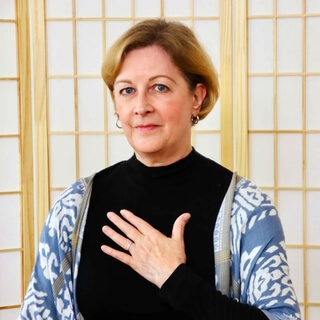
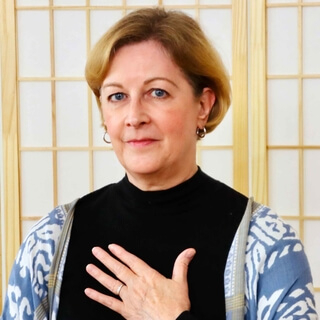
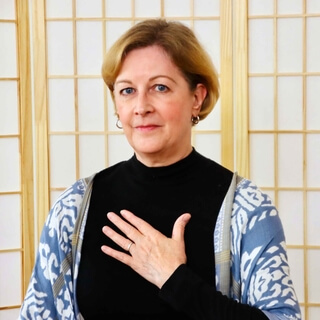
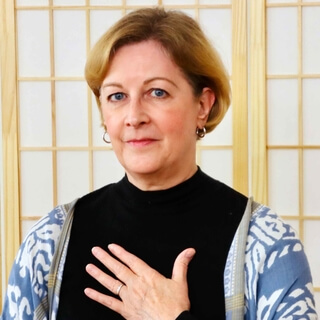
Ask you to place your hands on your heart.
Send yourself some thanks for taking the time today to have a little peace,
To train your attention and your awareness,
To focus on what's important for yourself.
Thank you.
And bring your hands to prayer position in front of your heart.
And I offer you a blessing.
May you be happy.
May you be healthy.
May you know peace.
Namaste.