The world’s largest free audio library for everyday wellbeing
Attention & Awareness
Jangama Dhyana is a concentration meditation that keeps attention fixed on the point between the eyebrows, the ajna point, without mantra, imagery, or verbal repetition.
Last Updated
2 Jul 2026
We are still reviewing this page. Our research team checks every technique page for accuracy and evidence quality before final release. Details may change as that review completes. The evidence badge shows our current reading of the published research.
RECOMMENDED DOSE
A short 5-to-10 minute session is a sensible starting point for newcomers, prioritising consistency over duration
A 15-to-20 minute session reflects a standard step up for establishing a regular meditation routine
A 30-minute daily practice represents a committed maintenance level for experienced practitioners.
Session length
Session length: 5–10 minutes
5
MIN
How long each individual practice session should last from start to finish.
Frequency
Frequency: 3–4 days
3
DAYS
The number of days per week to fit a session into your routine.
Session length
Session length: 15–20 minutes
15
MIN
How long each individual practice session should last from start to finish.
Frequency
Frequency: 5–6 days
5
DAYS
The number of days per week to fit a session into your routine.
Session length
Session length: 30 minutes
30
MIN
How long each individual practice session should last from start to finish.
Frequency
Frequency: 7 days
7
DAYS
The number of days per week to fit a session into your routine.
About this card. Direct dose-response literature for Jangama Dhyana is limited; frequency guidance is extrapolated from closely related yoga-based meditation studies and session lengths are editorial estimates, so treat these as starting points only. These recommendations are not a substitute for personalised guidance from a qualified practitioner.
Quick answers to what people most often ask. Each card links to the deeper section below.
evidence
No study has tested Jangama Dhyana directly, so all evidence is borrowed from related meditation and yoga research. A randomised trial in 66 medical students found mindfulness practice reduced perceived stress by roughly 3.4 points; a 2007 review judged meditation studies low in quality with mixed results for anxiety.
Read moregood for
Jangama Dhyana suits adults who want to steady a scattered mind and strengthen concentration, and those drawn to a simple, imagery-free practice within the Shivabalayogi lineage. Expect support for steadier focus and a calmer mind rather than treatment—it is not a substitute for care when anxiety, depression, or trauma symptoms are significant.
Read moresafety
Most healthy adults can practise Jangama Dhyana as a low-risk, settling form of concentration. People with a trauma history, psychosis-spectrum conditions, or a tendency to dissociate should approach sustained inward focus carefully, since long stretches of fixed attention can occasionally surface restlessness or difficult emotions. Keep sessions short and keep professional care in place.
Read morehow it works
Jangama Dhyana works by anchoring attention on a single fixed point, the spot between the eyebrows, so a scattered mind has one clear place to return to whenever it wanders. With repeated returning, practitioners are said to build sustained attention—the endurance to hold one object longer. This mechanism comes from teaching lineage, not direct measurement.
Read moreJangama Dhyana is a concentration meditation that keeps attention fixed on the ajna point, the spot between the eyebrows, without mantra, imagery, or verbal repetition.
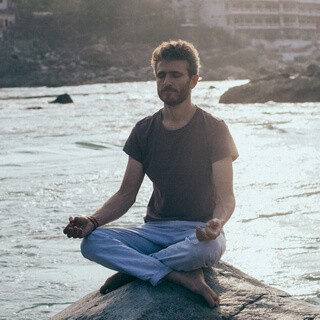
Sit with eyes closed and rest attention on the point between the eyebrows, the ajna point, simply watching it. Each time the mind drifts, bring it back to that single spot, with no mantra, image, or repeated word to lean on. Sessions are held over progressively longer periods, and in deeper practice the concentrated mind is said to lose its sense of location and settle into open awareness. The practice is transmitted teacher-to-student within the Shivabalayogi lineage.
Jangama Dhyana uses no sound, word, or image, only fixed attention on a single point, which sets it apart from mantra meditation and visualization practices. It differs from Trataka, where the gaze fixes on an external object with the eyes open, because here the eyes stay closed throughout. And it is a focused-attention practice rather than open-monitoring mindfulness, which observes whatever arises instead of resting on one anchor.
Not to be confused with
Mantra meditation and Transcendental Meditation
Both are seated concentration practices, but mantra meditation anchors attention on a silently repeated word or sound, while Jangama Dhyana deliberately uses no mantra or repetition, resting only on the point between the eyebrows.
Third-eye or ajna chakra visualization
Some brow-centre practices ask you to picture light, colour, or a symbol at the point between the eyebrows; Jangama Dhyana shares that location but uses no imagery at all, simply watching the point without constructing any mental picture.
Jangama Dhyana works by anchoring attention on a single fixed point, the spot between the eyebrows, so a scattered mind has one clear place to return to each time it wanders. This attentional anchoring, holding focus on one target rather than letting it chase every passing thought, is described in the practice's teaching lineage rather than measured in the technique itself. With repeated returning, practitioners are said to build sustained attention, the endurance to stay with one object for longer before the mind slips away. That account fits focused-attention meditation research broadly, which draws on other techniques and populations, rather than trials of Jangama Dhyana specifically (Ospina et al., 2007).
When the mind keeps scattering, fixing attention on a single point between the eyebrows gives it one clear place to rest and to return to each time it drifts. With no mantra or mental image to lean on, that point itself becomes the anchor, and practitioners often describe fewer thoughts pulling them away and a steadier sense of staying present.
[FLAGGED FOR DELETION - REDUNDANT CLONE]
What Jangama Dhyana does to the body has not been measured directly, so the physical picture here is borrowed from studies of related yoga and meditation. In one small controlled study, yoga practice was associated with higher levels of brain GABA, a signaling chemical that tends to accompany a calmer mood, alongside better mood scores (Streeter et al., 2010). Retreat research combining yoga and meditation over three months tracked a rise in BDNF, a protein that supports brain health, and a shift in the daily pattern of the stress hormone cortisol (Cahn et al., 2017). Practitioners often experience changes like these as feeling steadier through the day and less easily set on edge, though none of these markers were measured in Jangama Dhyana itself.
When stress won't ease as the day wears on, the body can feel wired and slow to come down. Cortisol, the body's main stress hormone, follows a daily rise-and-fall pattern that reflects how the nervous system meets demand and recovers. Jangama Dhyana itself hasn't been measured for this, so any change is inferred from related practices: in a 3-month yoga and meditation retreat, participants showed a shift in cortisol patterning alongside higher BDNF, a protein that supports brain health (Cahn et al., 2017), and yoga sessions have been linked to higher brain GABA and better mood (Streeter et al., 2010). Many practitioners describe feeling steadier through the day and less easily set on edge.

Limited–Indirect evidence supports Jangama Dhyana, because the technique itself has not been trialed and the findings are borrowed from related meditation and yoga practices. In a controlled trial of 66 medical students, mindfulness practice reduced perceived stress and anxiety (Warnecke et al., 2011); a single meditation session lowered state anxiety in a small trial of 32 patients with type 2 diabetes (Wen et al., 2023); and a broad review of meditation research also links regular practice to lower stress (Ospina et al., 2007). What is not yet supported: any study of Jangama Dhyana specifically, effects on diagnosed conditions, long-term benefits, or any claim that it replaces professional care.
No study has tested Jangama Dhyana on its own, so its likely effects are read across from related practices. Meditation and mindfulness training have been linked to lower stress and anxiety, and a randomized trial in 66 medical students found mindfulness practice reduced perceived stress by an average of about 3.4 points on a standard stress scale compared with usual care (95% CI -6.20 to -0.68) (Warnecke et al., 2011). Small studies also report biological shifts such as increased brain GABA (Streeter et al., 2010), and a single meditation session has lowered state anxiety (Wen et al., 2023). The limits deserve plain statement: none of this research tested Jangama Dhyana itself, a broad 2007 review judged meditation studies to be low in quality with mixed results for anxiety, and many findings rest on small samples and self-reported measures (Ospina et al., 2007).
0
Meta-analyses
1
RCTs
0
Systematic reviews
0
Observational
13
Pilot
Studied populations
Shri Babaji Mission, Shivarudra Balayogi lineage (2025). Learn Meditation: The Meditation Technique of Jangama Dhyana.
2025
Finding: This source is a teaching document from the Shivarudra Balayogi lineage that lays out how Jangama Dhyana is actually practised: resting attention on the point between the eyebrows, without any mantra, chanting, or mental imagery, learned through direct instruction from a teacher. It describes the method rather than measuring its effects, so it tells you what the practice involves and how it is traditionally passed on, not what results to expect. If you are considering this technique, treat it as a reliable guide to the form of the practice, and look to separate clinical research for evidence on outcomes like stress or focus.
See full citation in referencesAzadeh Nemati (2013). The effect of pranayama on test anxiety and test performance. https://doi.org/10.4103/0973-6131.105947
2013
Finding: In this trial, 107 graduate students were split into two groups, and the group that practised breathing exercises across a full semester ended up with measurably lower test anxiety than those who did not. If exam nerves or performance pressure are what draw you to a practice, this hints that a steady breathing routine, kept up over months rather than days, can take the edge off that anxiety. Keep in mind the study looked only at students in a testing situation, so it speaks more to nerves under pressure than to everyday stress.
reported significant; P<.05
Jangama Dhyana comes from the Lingayat, or Veerashaiva, tradition of India and is taught in the Shivabalayogi lineage, carried forward by Shivabalayogi Maharaj and his disciple Shivarudra Balayogi Maharaj (Mission & lineage, 2025). Within that worldview, sustained concentration on the point between the eyebrows is understood as a path from effortful focus toward Self-Realization, transmitted teacher-to-student rather than as a generic protocol. These roots help explain the practice's form, its fixed point of focus and its freedom from mantra or imagery, rather than proving any clinical effect.
For most healthy adults, Jangama Dhyana is a low-risk practice, a quiet form of concentration that tends to feel settling rather than stirring. Because the technique itself has not been directly studied, treat it as support for general wellbeing rather than a treatment for anxiety, depression, or any medical condition; the broader meditation evidence it draws on is limited in quality and mixed for outcomes like anxiety, so benefits are plausible rather than assured (Ospina et al., 2007). One caution comes from practice rather than research: long stretches of fixed focus between the eyebrows can sometimes surface restlessness or difficult emotions instead of only calm, so begin gently and stay attentive to how each session leaves you.
People living with a trauma history, a psychosis-spectrum condition, or a tendency to dissociate, that sense of feeling detached from the body or surroundings, should approach sustained inward focus carefully. Prolonged concentration can occasionally intensify rumination, the looping of distressing thoughts, or bring unprocessed material to the surface; this caution comes from practice rather than a safety study of the technique. Anyone who finds extended concentration distressing may want to keep sessions short and build slowly. If you are managing a diagnosed mental-health condition, keep your clinician informed and treat this practice as a complement to, not a replacement for, professional care.
Long stretches of fixed focus between the eyebrows can sometimes surface restlessness or difficult emotions instead of only calm. This caution comes from practice rather than a safety study of the technique, so begin gently, keep early sessions short, and check in with how each one leaves you. If uncomfortable feelings arise, pause and let attention settle on plain physical sensations, such as the feet on the floor, before continuing.
| Technique | Best for | Use with care | Evidence strength | Distinction |
|---|---|---|---|---|
| Trataka (yogic gazing) | People who find a concrete external object easier to hold attention on than an internal, imageless point. | Prolonged candle-gazing can strain sensitive eyes; adapt or shorten if you have an eye condition. | emerging EVIDENCE | Trataka anchors attention on an external visual object, most often a candle flame held with open eyes before the image is carried inward, whereas Jangama Dhyana keeps the eyes closed throughout and rests attention on the internal point between the eyebrows with no external object to look at. Both build single-point concentration, so the felt experience of a mind gathering onto one place is similar, but the anchor is outside in Trataka and purely internal in Jangama Dhyana. |
| Mindfulness (open-monitoring) meditation | Easing everyday stress and building broad present-moment awareness with a widely studied, well-taught format. |
On the ajna point, the spot between the eyebrows. You sit with eyes closed and rest attention there, simply watching, with no mantra, mental image, or repeated word to lean on. Each time the mind drifts, you gently return to that single point.
+
On the point between the eyebrows, known as the ajna point, which is the only anchor the practice uses. Jangama Dhyana keeps the eyes closed throughout and rests attention on that internal spot, watching it without any mantra, imagery, or verbal repetition. This imageless, single-point form is how the practice is taught within the Lingayat, or Veerashaiva, Shivabalayogi lineage; it describes the shape of the practice rather than any clinical effect.
No. Jangama Dhyana itself has not been directly studied; the evidence you will see is borrowed from broader meditation and yoga research, which is limited in quality and mixed for outcomes like anxiety (Ospina et al., 2007).
+
No. No trial has tested Jangama Dhyana on its own, so any claims about it rest on indirect research into related meditation and yoga practices rather than on the technique itself. That broader literature is limited in quality, with small samples and self-reported outcomes, and its findings for anxiety are mixed rather than settled (Ospina et al., 2007). Read those results as reasonable context for what the practice might offer, not as proof of what this specific technique does.
A concentration meditation from the Lingayat (Veerashaiva) tradition in which you sit with eyes closed and hold attention on the point between the eyebrows, without mantra, imagery, or verbal repetition.
A focused-attention meditation transmitted through the Shivabalayogi lineage, using fixed concentration on the ajna point without mantra, imagery, or verbal repetition.
The point between the eyebrows, sometimes called the brow centre, used in this practice as the single place where attention rests and to which it returns whenever the mind drifts.
A Sanskrit word for meditation or sustained contemplative absorption; in this tradition it names the deepening of concentration from effortful focus toward an effortless resting of the mind.
A style of meditation that trains the mind by holding it on one chosen object, such as a point, a sound, or the breath, and gently returning whenever attention wanders. Jangama Dhyana is one example.
A meditation family characterised by sustained voluntary attention to a selected object, with monitoring for distraction and disengagement-and-return of focus.
Steadying attention on one clear target so it stops repeatedly slipping off to worries or distractions. It tends to feel like fewer thoughts pulling you away and an easier time staying present.
Use of a fixed target to support focused attention and attentional selection, reducing mind-wandering through repeated re-engagement of the chosen object.
The capacity to keep focus on one thing over a stretch of time without drifting off. Building it feels like focus that holds a little longer before wandering, and less effort to notice you have drifted and come back.
The ability to maintain vigilant, top-down attentional control on a target over an extended period, strengthened through repeated resistance to mind-wandering.
Shri Babaji Mission, Shivarudra Balayogi lineage (2025). Learn Meditation: The Meditation Technique of Jangama Dhyana.
Cited in: Roots and tradition
Azadeh Nemati (2013). The effect of pranayama on test anxiety and test performance. https://doi.org/10.4103/0973-6131.105947
Cited in: Research
B. Rael Cahn, Matthew S. Goodman, Christine T. Peterson, Raj Maturi, Paul J. Mills (2017). Yoga, Meditation and Mind-Body Health: Increased BDNF, Cortisol Awakening Response, and Altered Inflammatory Marker Expression after a 3-Month Yoga and Meditation Retreat. https://doi.org/10.3389/fnhum.2017.00315
Explore guided sessions to deepen your Jangama Dhyana technique.
Outcomes measured
| Outcome | Effect size | 95% CI | N | Comparator | Source |
|---|---|---|---|---|---|
| state anxiety (STAI) | reported significant; p<0.001 | — | 32 | supine rest | Wen et al., 2023 |
| perceived stress (PSS) | mean change (PSS points) = -3.44 | 95% CI -6.20 to -0.68 | 66 | usual care | Warnecke et al., 2011 |
| anxiety | reported significant; P<.05 | — | — | — | Nemati, 2013 |
| depression | SMD = -0.24 | — | — | — | Hameed et al., 2020 |
| anxiety | SMD = -0.96 | — | — | — | Hameed et al., 2020 |
| stress | SMD = 0.04 | — | — | — | Hameed et al., 2020 |
| stress | SMD = -0.24 | — | — | — | Hameed et al., 2020 |
| stress | SMD = 0.03 | — | — | — | Hameed et al., 2020 |
| anxiety | SMD = -0.06 | — | 463 | — | Thabrew et al., 2018 |
| stress | reported significant; P<.001 | — | — | — | Karpakam et al., 2021 |
| stress | reported not significant; p=0.07 | — | — | — | et al., 2022 |
| stress | reported significant; p<0.05 | — | — | — | Warnecke et al., 2011 |
| anxiety | reported significant; p=0.026 | — | — | — | Gonçalves et al., 2018 |
| depression | SMD = -0.37 | — | — | — | Corry et al., 2019 |
| anxiety | SMD = 0.37 | — | — | — | Corry et al., 2019 |
| depression | SMD = 0.51 | — | 2,056 | — | Natale et al., 2019 |
| depression | SMD = -1.0 | — | 2,056 | — | Natale et al., 2019 |
No study has tested Jangama Dhyana directly, so all evidence is indirect and drawn from broader meditation and yoga research. That literature is limited by small samples, a high risk of bias in some trials, reliance on self-reported outcomes, and authors' own descriptions of it as preliminary, and it does not generalize cleanly to this specific technique (Ospina et al., 2007).
B. Rael Cahn, Matthew S. Goodman, Christine T. Peterson, Raj Maturi, Paul J. Mills (2017). Yoga, Meditation and Mind-Body Health: Increased BDNF, Cortisol Awakening Response, and Altered Inflammatory Marker Expression after a 3-Month Yoga and Meditation Retreat. https://doi.org/10.3389/fnhum.2017.00315
n = 38
Finding: Following 38 adults through a three-month yoga and meditation retreat, this study measured a rise in BDNF, a protein that supports the growth and resilience of brain cells, alongside shifts in the body's morning cortisol rhythm and inflammatory markers, and participants also reported less anxiety and depression by the end. For someone considering an intensive practice, this hints that sustained immersion may move some of the body's stress and brain-health signals in a healthier direction, not just change how you feel. Because everyone took part in the full retreat with no comparison group, these changes can't be pinned on meditation alone; diet, exercise, and other elements of retreat life may all have played a part.
reported narratively
Mohajer Hameed, Lorna O'Doherty, Gail Gilchrist, Judit Tirado-Muñoz, Angela Taft, Patty Chondros (2020). Psychological therapies for women who experience intimate partner violence. https://doi.org/10.1002/14651858.cd013017.pub2
2020
Finding: [FLAGGED FOR DELETION - MODALITY DRIFT]
SMD = -0.24
Hiran Thabrew, Karolina Stasiak, Sarah E Hetrick, Stephen Wong, Jessica H Huss, Sally N Merry (2018). E-Health interventions for anxiety and depression in children and adolescents with long-term physical conditions. https://doi.org/10.1002/14651858.cd012489.pub2
n = 463
Finding: [FLAGGED FOR DELETION - MODALITY DRIFT]
OR = 5.0
Ullas Karpakam, Maharana Satyapriya, Metri Kashinath G, Gupta Ashish, Nagendra H R (2021). Impact of Yoga on Mental Health and Sleep Quality Among Mothers of Children With Intellectual Disability..
2021
Finding: In a one-month programme for mothers caring for a child with an intellectual disability, a group with high everyday stress, daily yoga practice led to a clear drop in reported stress levels by the end of the month. For someone in a demanding caregiving role, that points to yoga as a realistic way to take the edge off chronic tension in a matter of weeks rather than months. Keep in mind this was a short trial focused on one specific and highly stressed group, so it tells us more about early relief than about long-term change or how the practice works for people in other circumstances.
reported significant; P<.001
Sunita ., Manju Lata, Himel Mondal, Manish Kumar, Raj Kapoor, Asha Gandhi (2022). Effect of Practicing Meditation, Pranayama, and Yoga on the Mental Health of Female Undergraduate Medical Students: An Interventional Study. https://doi.org/10.7759/cureus.28915
n = 105
Finding: In this 12-week study, 105 first-year female medical students were assigned to meditation, breathing practice (pranayama), yoga, or no practice, and all three active groups reported less anxiety, depression, and anger by the end. Meditation stood out for lifting participants' sense of well-being the most, more so than the breathing or yoga groups, which suggests a regular sitting practice may be especially helpful for feeling steadier under academic pressure. Worth noting, the drop in stress specifically did not reach statistical significance, so the stress-relief picture is less clear-cut. Keep in mind this trial used generic meditation rather than Jangama Dhyana specifically, and it looked only at young women in medical training.
reported narratively
Chris C. Streeter, Theodore H. Whitfield, Liz Owen, Tasha Rein, Surya K. Karri, Aleksandra Yakhkind (2010). Effects of Yoga Versus Walking on Mood, Anxiety, and Brain GABA Levels: A Randomized Controlled MRS Study. https://doi.org/10.1089/acm.2010.0007
2010
Finding: In this 12-week randomised trial, 34 healthy adults were assigned to either yoga postures or a walking routine matched for physical effort, and the yoga group came out ahead: they reported bigger gains in mood and larger drops in anxiety than the walkers. Brain scans showed that rises in a calming brain chemical called GABA tracked those improvements, hinting that the practice may support a steadier nervous system rather than simply burning energy. It is worth knowing this was a small study, and the practice tested was physical yoga postures, not Jangama Dhyana itself, so the findings speak to a possible mechanism rather than direct proof for this technique.
reported narratively
Emma Warnecke, Stephen Quinn, Kathryn Ogden, Nick Towle, Mark R Nelson (2011). A randomised controlled trial of the effects of mindfulness practice on medical student stress levels. https://doi.org/10.1111/j.1365-2923.2010.03877.x
n = 66
Finding: In this controlled trial, 66 medical students in their final two years were split into two groups, and those who took up a self-guided mindfulness practice reported meaningfully lower stress and anxiety than the students who carried on as usual, with the improvements still holding at a later check-in. For someone considering a regular attention practice, this points to real, lasting relief from day-to-day pressure rather than a short-lived boost. Worth keeping in mind: this was a modest study in a specific, high-stress group, and it tested mindfulness rather than Jangama Dhyana itself, so it offers indirect support for the wider idea that awareness practices help calm stress.
mean change (PSS points) = -3.44
Jurema Ribeiro Luiz Gonçalves, Arthur Pereira Jorge, Guilherme Cia Zanetti, Elisângela de Assis Amaro, Ricardo Tonim Tótoli, Giancarlo Lucchetti (2018). Religiousness is associated with lower levels of anxiety, but not depression, in medical and nursing students. https://doi.org/10.1590/1806-9282.64.06.537
2018
Finding: Among medical and nursing students at a Brazilian university, those with stronger religious and spiritual beliefs reported lower levels of anxiety, while their levels of depression showed no clear link either way. The connection to calmer, less anxious days points to how a regular spiritual or contemplative practice may fit into a demanding, high-pressure life. Keep in mind this was a one-time snapshot of a specific group of students rather than a study that followed people over time, so it shows a link, not proof that the practice itself lowers anxiety.
reported significant; p=0.026
Margarita Corry, Kathleen Neenan, Sally Brabyn, Greg Sheaf, Valerie Smith (2019). Telephone interventions, delivered by healthcare professionals, for providing education and psychosocial support for informal caregivers of adults with diagnosed illnesses. https://doi.org/10.1002/14651858.cd012533.pub2
2019
Finding: [FLAGGED FOR DELETION - MODALITY DRIFT]
SMD = -0.02
Ospina Maria B, Bond Kenneth, Karkhaneh Mohammad, Tjosvold Lisa, Vandermeer Ben, Liang Yuanyuan (2007). Meditation practices for health: state of the research..
2007
Finding: This wide-ranging 2007 review gathered research across many meditation and yoga practices and found that they were linked to lower stress in healthy people, though the authors cautioned that the underlying studies were too inconsistent and uneven in quality to support firm conclusions. Results for anxiety were mixed: in people with heart disease, yoga worked no better than a structured mindfulness programme, so no single style stood out. For someone drawn to Jangama Dhyana, the practical takeaway is modest encouragement rather than proof, since this practice was not studied directly and the findings speak to meditation broadly, not to this technique in particular.
See full citation in referencesXu Wen, Apar Avinash Saoji, Kashinath Metri, Sriloy Mohanty, Venugopal Vijayakumar (2023). Immediate effect of a meditation technique on blood glucose, state anxiety and relaxation in patients with type 2 diabetes: a pilot randomized crossover study. https://doi.org/10.1515/jcim-2020-0359
n = 32
Finding: In a small pilot trial, 32 adults with type 2 diabetes each tried a single session of a yoga-based meditation technique (Mind Sound Resonance Technique) on one day and simply rested lying down on another, so each person served as their own comparison. After the meditation session they reported clearly lower anxiety in the moment and greater relaxation than after plain rest, and their fasting blood-sugar readings dipped modestly as well. For someone curious about meditation, this hints that even one focused session may calm the mind and body more than rest alone, though it was a one-off, single-session study in a specific health group and it tested a different technique, so it offers only indirect support for Jangama Dhyana rather than direct proof.
reported significant; p<0.001
Patrizia Natale, Suetonia C Palmer, Marinella Ruospo, Valeria M Saglimbene, Kannaiyan S Rabindranath, Giovanni FM Strippoli (2019). Psychosocial interventions for preventing and treating depression in dialysis patients. https://doi.org/10.1002/14651858.cd004542.pub3
n = 2,056
Finding: [FLAGGED FOR DELETION - MODALITY DRIFT]
SMD = 0.51
People living with a trauma history, a psychosis-spectrum condition, or a tendency to dissociate, that sense of feeling detached from the body or surroundings, should approach sustained inward focus carefully. Prolonged concentration can occasionally intensify rumination, the looping of distressing thoughts, or bring unprocessed material to the surface; this caution comes from practice rather than a safety study of the technique. Keep sessions short, build slowly, and if you are managing a diagnosed mental-health condition keep your clinician informed and treat this practice as a complement to, not a replacement for, professional care.
Because Jangama Dhyana itself has not been directly studied, treat it as support for general wellbeing rather than a treatment for anxiety, depression, or any medical condition. The broader meditation evidence it draws on is limited in quality and mixed for outcomes like anxiety, so benefits are plausible rather than assured.
Jangama Dhyana is best approached as a gentle form of concentration in a comfortable seat, treating the numbers here as starting points rather than targets. A sensible beginning looks like a short session of light, unforced focus between the eyebrows, extended only as the state begins to feel settled rather than strained. Stay attentive to how each session leaves you, and if you are managing a mental-health condition or trauma history, keep it as support alongside professional care.
Begin with 5 to 10 minutes of fixed focus between the eyebrows, and extend the session only as concentration starts to feel steady rather than strained, letting your attention span grow at its own pace.
Sit upright but relaxed, with support if you need it, so the body can settle and stay still without numbness or aching pulling your attention back to discomfort.
Rest attention on the point between the eyebrows and return to it gently whenever the mind drifts, without gripping or straining, since effortful focus can create tension around the eyes or forehead instead of the ease the practice is meant to build.
Notice whether a session leaves you calmer or more agitated. If restlessness or difficult emotions surface, shorten or pause the practice and let your attention rest on ordinary sensations, such as the feet on the floor, before continuing.
If you live with a mental-health condition or a trauma history, treat this as support alongside treatment rather than instead of it, and let a health professional know you are practising so guidance can be tailored to you.
This information is educational and is not medical advice. This practice is not a substitute for professional care and should not replace prescribed medication or treatment for any medical or mental-health condition. If you are managing a health condition or taking medication, talk with a qualified health professional before changing your practice. If you are in distress or crisis, seek professional support.
| Mindfulness meditation usually invites you to openly notice whatever arises, breath, sensations, sounds, thoughts, without fixing on any one thing, while Jangama Dhyana narrows attention to a single fixed point and returns to it each time the mind drifts. The mindfulness style feels more like a wide, receptive watching; the Jangama style feels like a steady gathering onto one place, a tighter form of concentration. |
| Yoga (postural practice) | People who want a physically active, whole-body practice alongside mental calm. | Postures carry physical strain and injury risk; adapt for physical limitations or existing conditions. | moderate EVIDENCE | Yoga as commonly practised weaves physical postures and breathing together with meditation, so the body is actively engaged, whereas Jangama Dhyana is a still, seated concentration practice with no movement or breath technique, only sustained focus on the brow point. Most of the research often associated with Jangama Dhyana is in fact yoga research, which studies this broader, multi-part practice rather than fixed-point concentration on its own. |
Possibly, but only indirectly. Jangama Dhyana itself has not been studied, so it cannot be called a treatment for stress or anxiety; related meditation research links regular practice to lower stress and calmer states, so the reasonable expectation is support for a steadier mind (Warnecke et al., 2011), (Ospina et al., 2007).
+
Possibly, but only indirectly. No trial has tested Jangama Dhyana on its own, so its likely effects are inferred from broader research: a randomised trial in 66 medical students found mindfulness practice reduced perceived stress (Warnecke et al., 2011), and a single meditation session lowered state anxiety in a small trial of patients with type 2 diabetes (Wen et al., 2023). That evidence is limited in quality and mixed for anxiety, so the practice is best seen as support for a calmer mind rather than a substitute for professional care (Ospina et al., 2007).
By giving attention one fixed target, the point between the eyebrows, to return to each time the mind wanders. That repeated returning is thought to build attentional anchoring, which steadies focus on one spot, and over longer sittings sustained attention, the endurance to hold focus before drifting. This is drawn from lineage teaching and broader focused-attention research, not measured in Jangama Dhyana itself (Ospina et al., 2007).
+
By turning a single fixed point into an anchor the mind keeps returning to. Each time attention slips away, you notice and bring it back to the spot between the eyebrows, and this cycle of drifting and returning is what is thought to strengthen attentional anchoring, which steadies focus on one clear target so it stops chasing every passing thought. With repetition over progressively longer sessions, the same practice is said to build sustained attention, the endurance to stay with one object before the mind wanders. This account is a mechanism-level hypothesis from the practice's teaching lineage and the wider focused-attention meditation literature, not a measured outcome for Jangama Dhyana specifically (Ospina et al., 2007).
Not that anyone has measured directly. Jangama Dhyana itself has never been studied physiologically, so no brain or body changes are documented for this specific practice. Related meditation and yoga research hints at shifts like calmer brain chemistry, but those findings come from other practices, not this one (Streeter et al., 2010).
+
Not that anyone has measured directly, because Jangama Dhyana has never been tracked in a lab. The nearest evidence is borrowed: in one controlled study, yoga was linked to higher brain GABA, a calming chemical messenger, alongside better mood (Streeter et al., 2010), and a three-month yoga-and-meditation retreat tracked a rise in BDNF, a protein that supports brain-cell health, plus a shift in the daily pattern of the stress hormone cortisol (Cahn et al., 2017). These were measured in other practices and populations, so they are suggestive context rather than confirmed effects of Jangama Dhyana itself.
Use care. For most healthy adults Jangama Dhyana is low-risk, but long stretches of fixed focus between the eyebrows can occasionally surface restlessness or difficult emotions rather than calm. If that happens, shorten the session, open your eyes, and ground on ordinary sensations like your feet on the floor before continuing.
+
Use care. Jangama Dhyana has not been directly studied for safety, so this is a practice-informed caution rather than a finding from a trial. The practical approach is to begin gently, keep early sessions short, and check in with how each one leaves you; if restlessness or uncomfortable feelings arise, pause and let attention settle on plain physical sensations. If you live with a trauma history, a psychosis-spectrum condition, or a tendency to dissociate, approach sustained inward focus carefully and keep professional care in place, since this practice supports wellbeing rather than treating any condition.
Use care. If you have a trauma history or tend to dissociate, meaning you feel detached from your body or surroundings, approach sustained inward focus cautiously, since prolonged concentration can occasionally intensify rumination or surface unprocessed material. Keep sessions short, build slowly, and treat this as a complement to, not a replacement for, professional care.
+
Use care. This is a practice-informed caution, not a finding from a safety study of Jangama Dhyana itself: long stretches of fixed focus between the eyebrows can occasionally deepen rumination, the looping of distressing thoughts, or bring up difficult material for people with a trauma history or a tendency to dissociate. The practical guidance is to begin with short sessions and extend them only slowly, stop and ground your attention on ordinary sensations if distress rises, and keep any clinician you work with informed so this practice supports rather than substitutes for treatment.
Start with about 5 to 10 minutes of fixed focus between the eyebrows, and extend the session only as concentration begins to feel steady rather than strained. This is practice-informed guidance from the teaching tradition, not a study-tested dose.
+
Start with roughly 5 to 10 minutes. The practice-informed guidance from the Shivabalayogi teaching lineage is to keep early sessions short and let attentional endurance, the ability to hold focus before the mind drifts, grow at its own pace before lengthening the sitting. Jangama Dhyana itself has not been directly studied, so treat this as a teaching convention rather than a clinically validated dose, and simply extend the time once concentration feels steady instead of effortful.
The main difference is the anchor: Trataka fixes attention on an external object, usually a candle flame with eyes open before the image is carried inward, while Jangama Dhyana keeps the eyes closed and rests on the internal point between the eyebrows with no external object. Both build single-point concentration; the anchor is outside in Trataka and purely internal in Jangama Dhyana.
+
The core distinction is where attention is held. Trataka anchors on an external visual object, a candle flame or similar point held with open eyes, whereas Jangama Dhyana keeps the eyes closed throughout and rests on the ajna point, the spot between the eyebrows, with no image or object to look at. Both train the same underlying skill of gathering the mind onto one place, so the felt experience is similar, but no direct head-to-head study compares them, and Jangama Dhyana itself has not been directly researched. Choose Trataka if a concrete external object is easier to focus on, or Jangama Dhyana if you prefer an imageless internal anchor.
Resting in direct experience without labelling or interpreting it, so colours are just colours and sounds are just sounds. In this tradition it is described as a deep state reached as concentration ripens; it is a reported subjective experience, not a measured outcome.
A reported non-dual or non-representational state in which usual spatial and conceptual reference points recede; described subjectively and not measured for this technique.
The natural rise in cortisol, the body's main stress hormone, shortly after waking. Its pattern reflects how the nervous system meets the day's demands and recovers.
The characteristic increase in salivary cortisol within the first 30 to 45 minutes after awakening, used as an index of HPA-axis regulation.
A protein that supports the growth and maintenance of brain cells, often discussed as a marker of brain health in studies of meditation and yoga.
A neurotrophin that supports neuronal survival, growth, and synaptic plasticity, sometimes measured as a biomarker in mind-body intervention research.
A calming chemical messenger in the brain; higher levels are broadly associated with a quieter, less anxious state, which practitioners may notice as feeling more settled.
Gamma-aminobutyric acid, the primary inhibitory neurotransmitter in the central nervous system; reduced GABAergic activity is linked to mood and anxiety disorders.
Cited in: Faq, Research, What happens in the body
Mohajer Hameed, Lorna O'Doherty, Gail Gilchrist, Judit Tirado-Muñoz, Angela Taft, Patty Chondros (2020). Psychological therapies for women who experience intimate partner violence. https://doi.org/10.1002/14651858.cd013017.pub2
Cited in: Research
Hiran Thabrew, Karolina Stasiak, Sarah E Hetrick, Stephen Wong, Jessica H Huss, Sally N Merry (2018). E-Health interventions for anxiety and depression in children and adolescents with long-term physical conditions. https://doi.org/10.1002/14651858.cd012489.pub2
Cited in: Research
Ullas Karpakam, Maharana Satyapriya, Metri Kashinath G, Gupta Ashish, Nagendra H R (2021). Impact of Yoga on Mental Health and Sleep Quality Among Mothers of Children With Intellectual Disability..
Cited in: Research
Sunita ., Manju Lata, Himel Mondal, Manish Kumar, Raj Kapoor, Asha Gandhi (2022). Effect of Practicing Meditation, Pranayama, and Yoga on the Mental Health of Female Undergraduate Medical Students: An Interventional Study. https://doi.org/10.7759/cureus.28915
Cited in: Comparison, Research
Chris C. Streeter, Theodore H. Whitfield, Liz Owen, Tasha Rein, Surya K. Karri, Aleksandra Yakhkind (2010). Effects of Yoga Versus Walking on Mood, Anxiety, and Brain GABA Levels: A Randomized Controlled MRS Study. https://doi.org/10.1089/acm.2010.0007
Cited in: Faq, Research, What happens in the body
Emma Warnecke, Stephen Quinn, Kathryn Ogden, Nick Towle, Mark R Nelson (2011). A randomised controlled trial of the effects of mindfulness practice on medical student stress levels. https://doi.org/10.1111/j.1365-2923.2010.03877.x
Jurema Ribeiro Luiz Gonçalves, Arthur Pereira Jorge, Guilherme Cia Zanetti, Elisângela de Assis Amaro, Ricardo Tonim Tótoli, Giancarlo Lucchetti (2018). Religiousness is associated with lower levels of anxiety, but not depression, in medical and nursing students. https://doi.org/10.1590/1806-9282.64.06.537
Cited in: Research
Margarita Corry, Kathleen Neenan, Sally Brabyn, Greg Sheaf, Valerie Smith (2019). Telephone interventions, delivered by healthcare professionals, for providing education and psychosocial support for informal caregivers of adults with diagnosed illnesses. https://doi.org/10.1002/14651858.cd012533.pub2
Cited in: Research
Ospina Maria B, Bond Kenneth, Karkhaneh Mohammad, Tjosvold Lisa, Vandermeer Ben, Liang Yuanyuan (2007). Meditation practices for health: state of the research..
Cited in: Benefits, Faq, How it works, Research, Use with care
Xu Wen, Apar Avinash Saoji, Kashinath Metri, Sriloy Mohanty, Venugopal Vijayakumar (2023). Immediate effect of a meditation technique on blood glucose, state anxiety and relaxation in patients with type 2 diabetes: a pilot randomized crossover study. https://doi.org/10.1515/jcim-2020-0359
Patrizia Natale, Suetonia C Palmer, Marinella Ruospo, Valeria M Saglimbene, Kannaiyan S Rabindranath, Giovanni FM Strippoli (2019). Psychosocial interventions for preventing and treating depression in dialysis patients. https://doi.org/10.1002/14651858.cd004542.pub3
Cited in: Research
Editorially curated. Tracks are not themselves clinically studied; evidence on the page applies to Jangama Dhyana as a technique.
Beginner content for Jangama Dhyana

★ 4.8
·
Guided
·
28 min
Morgan O. Smith
How hard is Jangama Dhyana?
Jangama Dhyana keeps a structured floor because it relies on unadorned single-point concentration, and the reviewed Focused Attention defaults still fit.
2
Mental Effort
2 / 4
▾Emotional Depth
1 / 4
▾Physical Intensity
1 / 4
▾Prior Knowledge
2 / 4
▾