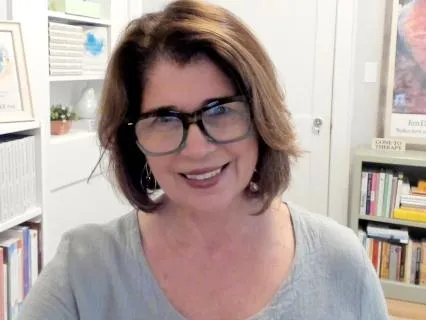
Hi,
I'm Dr.
Tara Cousineau.
A psychologist,
Mindfulness teacher,
And author.
I'm here to talk about one of my favorite subjects,
The inner critic.
Have you ever noticed a voice in your head that pipes up at the worst possible moments?
Right before a big meeting.
Who do you think you are?
After an awkward social moment.
Why did you say that?
Or looking in the mirror on a hard day.
You're a failure or worse.
That's your inner critic.
And pretty much everyone has one,
Or more.
You might recognize the inner critic as an internal voice.
Or sometimes a chorus of voices that tend to show up.
When you feel threatened.
Uncertain or exposed.
It shows up in relationships.
And it's why we often behave like insolent teenagers when we visit our family of origin.
Or we shut down when we feel vulnerable with another person.
You can also view the inner critic as a part.
A pattern or an algorithm.
Some like to think of it as a script.
It criticizes,
Compares,
Catastrophizes,
And often makes you feel like you're falling short.
I spent years working with perfectionists and high achievers and also people who consider themselves to be more chill and easygoing.
And I can tell you,
No one is immune.
The inner critic's greatest hits are very similar across very different people.
I'm not good enough.
You're gonna fail.
Everyone else has it together except me.
But the intensity of that voice can vary widely.
In my book,
The Perfectionist Dilemma,
I call the loudest of your inner critical voices your plus one.
The part that shows up at every event challenge every milestone.
You didn't really invite it,
But there it is.
Here's what I think is actually the most important thing to understand about the inner critic.
It developed for a reason.
Way back,
And I mean evolutionarily way back,
Humans survived in groups.
And tribes.
Being rejected by the group was a genuine threat to survival.
So our nervous systems learned to scan for signs of failure,
Inadequacy,
Of not fitting in,
Doing the wrong thing.
Your inner critic is,
In a strange way,
Trying to protect you.
It's a brain pattern trying to anticipate some kind of outcome.
It's like it's running a software designed to keep you safe.
The problem is that this pattern was learned earlier in life.
Often in response to things that were beyond your control.
Criticism from a parent,
A harsh teacher.
A humiliating moment in school or at work.
And the tricky brain kept running those programs even after you grew up and the original threat was no longer there.
The critical voice is usually trying to,
Well,
Keep you safe.
Help you succeed.
Prevent rejection.
In this way,
The inner critic is often motivated by fear,
Not wisdom.
The answer isn't to get rid of your inner critic.
And I know that might sound strange,
But trying to silence it or suppress it usually backfires.
It often gets louder.
Instead,
The first step is to just notice it.
To name it even.
Give it a little distance.
Oh,
There's that voice again.
Oh,
There's my plus one.
Sometimes I call this practice.
Notice,
Name.
And nurture.
When you can observe it instead of being hijacked by it,
Something shifts.
You're no longer fused with the criticism and you can get curious.
Is this actually true?
Or is this an old pattern running on repeat?
When your critic shows up,
Pause and ask.
What are you worried might happen?
What are you trying to protect me from?
How can I relieve it of its duties?
What is?
The next best step to nurture or take care of myself.
It might be something active.
Energizing or encouraging,
Or it might be something quiet and calm.
The thing is,
You get to decide.
Not your inner critic.
So the inner critic isn't your enemy,
But it's also not the boss of you.
The goal is to build a wiser relationship with this part.
Starting to recognize it and understand its role in your life.
Without judgment,
Without panic.
It's one of the most important things you can do for your well-being.
And that's where real change begins.