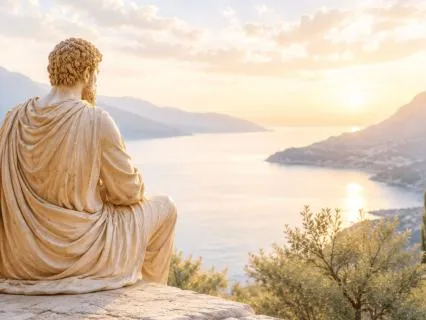
Welcome to this talk about the Stoic Path.
Wherever you are right now,
Whether you're lying in bed at the end of a long day,
Sitting quietly with a cup of tea,
Walking outside,
Or simply searching for something steady in a world that often feels overwhelming,
I'm glad you're here.
Today we're exploring a philosophy that has survived for over 2,
000 years because it speaks directly to one of the deepest human needs.
How do we remain grounded when life is unpredictable?
How do we face uncertainty,
Disappointment,
Fear,
Loss,
Pressure,
Conflict and change without losing ourselves?
The philosophy we'll explore is Stoicism.
Now,
When many people hear the word stoic,
They imagine someone emotionally cold or detached.
But true stoicism is not about suppressing feelings or pretending not to care.
Stoicism is about learning how to live wisely.
It's about becoming emotionally resilient without becoming emotionally numb.
It's about understanding what is within your control and releasing what is not.
At its heart,
Stoicism asks.
What kind of person do I want to be,
Regardless of what happens around me?
And perhaps that's why this philosophy feels so relevant today.
Because modern life often pulls us outward,
Toward comparison,
Toward distraction,
Toward anxiety about the future.
Toward frustration about things we cannot change.
Stoicism gently guides us back inward,
Back to clarity,
Back to responsibility.
Back to peace.
So during this talk,
We'll explore the foundational ideas of Stoicism,
The teachings of some of its greatest philosophers,
And most importantly,
How this philosophy can help us live calmer,
Stronger,
And more meaningful lives today.
So take a slow breath in.
And exhale gently.
Let's begin.
Stoicism began in ancient Greece around 300 BCE and later flourished in Rome.
It was practiced by emperors,
Teachers,
Athletes,
Writers and ordinary people trying to navigate ordinary struggles.
Three of the most well-known Stoic thinkers are Epictetus,
Who was born enslaved and later became a respected teacher,
Seneca,
A writer and advisor navigating politics and wealth,
Marcus Aurelius,
A Roman emperor who wrote private reflections to help himself stay calm and virtuous during immense pressure.
What's beautiful about Stoicism is that it was never meant to stay in books.
It was meant to be practiced.
It's a philosophy for real life.
For heartbreak,
For difficult conversations,
For illness,
For uncertainty,
For grief,
Ambition,
Parenting,
Failure and success.
The Stoics believed that peace does not come from controlling life.
Peace comes from learning how to meet life.
And one of their most important teachings can be summed up in a simple distinction.
There are things we can control and things we cannot.
This idea comes from Epictetus,
Who said,
The chief task in life is simply this,
To identify and separate matters so that I can say clearly to myself which are externals not under my control and which have to do with the choices I actually control.
This single idea can transform the way we experience life.
Because so much suffering comes from trying to control what was never ours to control.
Other people's opinions.
Other people's behaviour.
The past.
The future.
Unexpected events.
Ageing.
Loss.
Outcomes.
The Stoics remind us you cannot always control what happens,
But you can influence how you respond.
Your attitude and your choices,
Your character,
Your actions and your perspective.
This doesn't mean pretending painful things don't hurt.
It means remembering that your inner world still matters,
Even when outer circumstances are difficult.
And in many ways,
Stoicism is the practice of reclaiming that inner world.
Let's spend a little more time with this idea because it's truly the foundation of Stoicism.
The Stoics taught that clarity begins by asking,
What is actually mine to carry?
Imagine how much mental energy we spend each day worrying about things outside our control.
Will people approve of me?
Will this relationship work out?
Will I succeed?
Will things go according to plan?
Will I lose what I love?
What if something bad happens?
The mind constantly reaches outward,
Trying to secure certainty.
But life does not offer certainty.
And when we demand certainty from life,
Anxiety grows.
Stoicism teaches us to redirect our attention toward what is actually available to us in this moment.
Not perfect control,
But meaningful influence.
For example,
You cannot control whether everyone likes you,
But you can control whether you act with integrity.
You cannot control every outcome,
But you can control your effort.
You cannot control someone else's honesty,
But you can choose your own honesty.
You cannot control whether life changes,
But you can strengthen your ability to adapt.
This shift is deeply freeing because it moves us away from helplessness and toward personal responsibility.
The Stoics believed freedom comes from understanding the limits of control.
And strangely enough,
Accepting those limits often creates more peace than resisting them.
Think about how exhausting it is to fight reality,
To replay the past,
To argue internally with what already happened,
To wish people were different,
To cling tightly to expectations.
Stoicism invites us to stop wasting energy fighting reality and instead ask,
What is the wisest response now?
This doesn't mean passive acceptance.
Stoics still took action.
They still pursued goals and they still cared deeply.
But they understood that attachment to outcomes creates suffering.
They focused on effort over guarantee,
Action over obsession,
Presence over panic.
One practical Stoic exercise is this.
Whenever you feel overwhelmed,
Pause and ask,
What part of this situation is within my control?
Sometimes the answer is very small.
Maybe all you can control is taking the next step,
Regulating your breathing,
Speaking kindly,
Resting,
Asking for help,
Or choosing not to react impulsively.
But often that small space of control is enough to reconnect you to your strength.
A common misunderstanding is that Stoics tried to eliminate emotion.
That's not true.
The Stoics understood emotions deeply.
What they questioned was whether we should become ruled by every emotional impulse.
Modern life often encourages emotional reactivity.
Instant outrage,
Instant comparison,
Instant fear and instant judgment.
Stoicism invites a pause,
A breath between feeling and reaction.
Marcus Aurelius wrote,
You have power over your mind,
Not outside events.
Realize this and you will find strength.
Notice he doesn't say,
You control your emotions perfectly.
He says,
You have power over your mind.
Meaning,
You can observe your thoughts.
You can question your interpretations.
You can choose your actions carefully.
This is emotional maturity.
For example,
A difficult comment from someone may trigger hurt.
A stoic wouldn't deny the feeling,
But they may ask,
Is this criticism true?
If it is true,
Can I learn from it?
If it is false,
Why should I surrender my peace to it?
Stoicism helps create emotional steadiness,
Not because life becomes easier,
But because we become less easily destabilised.
And this matters profoundly in today's world.
We are constantly stimulated,
Constantly consuming information and comparing ourselves and reacting.
Stoicism offers an antidote,
Inner stability,
A quiet centre,
The ability to remain thoughtful in a reactive world.
And perhaps one of the most comforting Stoic truths is this,
You do not need to control every thought that appears in your mind,
But you do have influence over which thoughts you feed.
That's an empowering distinction.
For the Stoics,
Success was not measured primarily by wealth,
Appearance,
Popularity or status.
The highest good was virtue,
Meaning living with wisdom,
Courage,
Justice and self-discipline.
These were considered the four cardinal virtues of Stoicism.
Wisdom,
Meaning seeing clearly,
Making thoughtful choices.
Courage,
Facing discomfort and difficulty with honesty.
Justice,
Was about treating others fairly and compassionately.
And self-discipline was about not becoming controlled by impulses or excess.
The Stoics believed that if you cultivate these qualities,
You can live well regardless of external circumstances.
That's radical when you think about it.
Because modern culture often tells us,
I'll be okay when,
When I succeed,
When I earn more,
When I'm admired,
When life becomes easier,
When I finally feel secure.
Stoicism says your peace cannot depend entirely on unstable conditions.
External success can disappear.
Health changes.
Money changes.
Relationships change.
Public opinion changes.
But character travels with you everywhere,
And this perspective can be incredibly grounding.
At the end of the day,
Many Stoics would reflect on questions like,
Did I act with integrity today?
Was I patient?
Was I honest?
Did I contribute something good?
Where can I improve tomorrow?
Not perfection.
Practice.
Stoicism is not about becoming flawless.
It's about becoming intentional.
One of the most powerful Stoic ideas is a phrase later embraced by philosophers like Nietzsche.
Amor fati.
Love your fate.
Not merely tolerate life,
Not merely survive it,
But learn to embrace reality fully.
This doesn't mean enjoying suffering.
It means recognizing that resistance to reality often creates additional suffering.
The Stoics understood life will include pain,
Loss,
Unexpected endings,
Disappointment,
Uncertainty.
And yet they believed every experience could become material for growth.
Marcus Aurelius wrote,
The impediment to action advances action.
What stands in the way becomes the way.
Meaning,
The obstacle itself may become the teacher.
The heartbreak may deepen compassion.
The failure may create wisdom.
The uncertainty may strengthen resilience.
Stoicism asks us,
What if difficulty is not always punishment?
What if challenge is part of becoming?
This perspective can change the way we move through hardship.
Instead of,
Why is this happening to me?
We begin asking,
How can I meet this wisely?
Again,
This is not toxic positivity.
Stoicism does not deny grief or pain.
It simply refuses to let suffering be meaningless.
Another important Stoic practice was contemplating mortality,
Not in a dark or fearful way,
But as a way of awakening gratitude and perspective.
The Stoics regularly reminded themselves,
Life is temporary.
And surprisingly,
This awareness made life feel more precious.
Seneca wrote,
It is not that we have a short time to live,
But that we waste much of it.
When we remember time is limited,
We become more intentional.
We stop postponing what matters most.
We become more present.
We appreciate ordinary moments more deeply.
The warmth of sunlight.
A meaningful conversation.
A quiet morning.
A breath.
Stoicism teaches that death is not something to obsess over,
But something that clarifies life.
Because when we remember life is finite,
We often stop wasting energy on what doesn't truly matter.
We become more courageous about living authentically.
More willing to forgive,
More willing to love,
More willing to begin again.
So how do we actually practice Stoicism today?
Not as ancient philosophy,
But as a living practice?
Here are a few simple ways.
Number one,
Pause before reacting.
When emotions rise,
Create space.
Breathe,
Observe,
Respond thoughtfully rather than impulsively.
Number two,
Focus on what you can control.
Return your energy to your choices,
Actions and mindset.
Number three,
Practice gratitude.
Notice what is already here instead of constantly chasing more.
Number four,
Accept imperfection.
You will make mistakes.
Others will too.
Stoicism encourages growth,
Not perfectionism.
Number five,
Reflect daily.
Even a few minutes of self-reflection can build awareness and wisdom.
Ask,
What went well today?
Where did I lose my balance?
What can I improve tomorrow?
And number six,
Build in a strength quietly.
Not for applause,
Not for image,
But for your own peace.
The Stoics believed true strength is often invisible.
It's patience,
Integrity,
Self-restraint,
Compassion,
Resilience.
And perhaps most importantly,
Stoicism teaches us that peace is not found by controlling life perfectly.
Peace is cultivated internally.
As we come to the end of this talk,
Take a slow breath in and gently exhale.
Perhaps the reason stoicism still resonates after thousands of years is because human beings are still asking the same questions.
How do I handle uncertainty?
How do I live well?
How do I stay steady when life changes?
How do I find meaning?
Stoicism does not promise a painless life.
But it offers something maybe even more valuable,
A way to remain grounded within life's unpredictability,
A way to meet difficulty with dignity,
A way to cultivate wisdom instead of panic,
Presence instead of resistance,
Character instead of constant approval-seeking.
And maybe that's the invitation stoicism offers each of us,
Not to become emotionless,
Not to become perfect,
Not to control everything,
But to become more conscious,
More resilient,
More intentional,
More free.
Free from being controlled by every fear,
Every opinion,
Every outcome.
Free to choose who you become.
So tonight or today,
Wherever you are listening from,
Perhaps you carry this one simple question with you.
What is within my control right now?
And maybe that question alone begins to change something.
Thank you for spending this time with me.
Take one more deep breath in and slowly let it go.
May you move through life with clarity,
With courage,
And with peace.