Welcome to the Mindfulness Meditation Podcast presented by the Rubin Museum of Art.
We are a museum in Chelsea,
New York City that connects visitors to the art and ideas of the Himalayas and serves as a space for reflection and personal transformation.
I'm your host,
Tashi Chodron.
Every Thursday,
We present a meditation session inspired by a different artwork from the Rubin Museum's collection and led by a prominent meditation teacher from the New York area.
This podcast is a recording of our weekly in-person practice.
In the description for each episode,
You will find information about the theme for that week's session,
Including an image of the related artwork.
Our Mindfulness Meditation Podcast is presented in partnership with Sharon Salzberg and teachers from the New York Insight Meditation Center,
The Interdependence Project,
And Parabola Magazine,
And supported by the Frederick P.
Lenz Foundation for American Buddhism.
And now,
Please enjoy your practice.
Good afternoon,
Everyone.
Tashi Delek,
And welcome.
Welcome to the Return of Mindfulness Meditation with Rubin Museum of Art.
I'm Tashi Chodron.
I'm so happy to be your host today.
So those of you who are new,
We are a museum of Himalayan art and ideas in New York City,
And we are so glad to have all of you join us for this weekly program where we combine art and meditation.
Inspired from our collection,
We will first take a look at work of art from our collection.
We will hear a brief talk from our teacher,
And we are so happy to have Tracy Cochran back.
And then we will have a short sit,
15 to 20 minutes,
For the meditation guided by her.
And let's take a look at today's art,
And the theme is change.
Connecting to the most recent exhibit,
Death is Not the End,
So we are more of celebrating the life after and the changes.
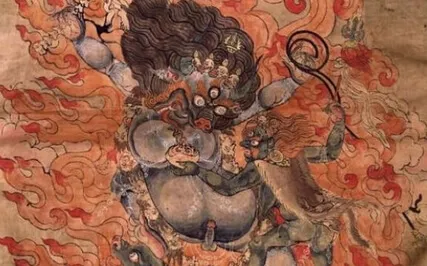
And the art connection for today is this beautiful painting of Yama Dharmaraja,
Origin from Tibet.
This is actually a woodblock print in mineral pigment on cloth,
And the dimension of this is 28 1⁄2 x 23 x 2 1⁄2 inches,
A beautiful Thangka painting.
And he's known as Yama Raja or Yama,
Which in Sanskrit means the Lord of Death.
In Tibetan,
He's known as Shinje Chojyal.
Yama Dharmaraja,
Also known as Kalarupa,
Is a wisdom deity protector of the father class of Anuttara Yoga Tantra,
Especially by those who are engaged in the practice of Yamantaka Tantras and found in all the Sarma schools.
The Gelugpa school holds Yama Raja in a special regard as he is one of the three main Dharma protectors of the school,
But in Pardo teaching,
Yama presides over the judgment of the dead.
He's a very fearsome and fierce,
Wrathful Dharma protector with the head of a buffalo and three round eyes,
Hair flowing upward,
A blue body in color,
Which is often the fierce,
Wrathful deity colors,
Because peaceful deities,
As we looked at in the last couple of sessions of Avalokiteshvara,
Are in white color,
Right?
So this is in a very dark blue in color,
Two hands upraised here,
And the left hand holding a lasso tipped with a gold ring and half wajra,
Right hand holding the stick with the skull head.
So this is the fierce,
Wrathful form of Manjushri,
The Bodhisattva.
He appears extremely animated,
Standing with the right leg bent and left extended on the back of a buffalo above a human body,
Sun disk and multi-colored lotus blossom seat.
To our right,
Which is to the Yama's left,
Is his consort Chamundi with one face and two hands clambering towards Dharmaraja.
Now at the bottom center is a skull cup filled with offerings of the five senses.
All right,
Now let's bring on our teacher for today.
Our teacher is Tracy Cochran.
Tracy has taught mindfulness,
Meditation,
And mindful writing at the Rubin Museum of Art and the New York Insight Meditation Center,
As well as in schools,
Corporations,
And other venues worldwide.
She's also a writer and editorial director of Parabola,
An acclaimed quarterly magazine that seeks to bring timeless spiritual wisdom to the burning questions of the day.
Her writings,
Podcasts,
And other details can be found on her website and on parabola.
Org.
Tracy,
Thank you so much for being here,
And please help me in welcoming Tracy.
Hi.
Hi.
It's good to be back in this space and to remember that one way of understanding is to track everything with your head,
But another way is to just be with,
Just let yourself be with these beautiful images,
These sounds.
And I got here early,
So I went and looked at an image,
A little sculpture of Yama,
The Lord of Death,
And I was holding the question,
How can this be a face of wisdom,
The Bodhisattva of Wisdom?
And I was struck by how it embodied an idea that we can try right now,
Which is just being with how you happen to feel.
And that exhibit in Yama is an embodiment of our fears,
Our fears of death.
And it doesn't just mean the final death,
But the end of any number of things,
The end of a job,
A relationship,
A home,
A time.
And what is it like to stop trying to escape,
To fix it,
To make something stay,
To have more?
We're wired,
We're conditioned always to want more,
To feel better.
That's why we come here,
It's perfectly natural.
But we're always offered an alternative.
This story of Siddhartha Gautama,
Who had everything,
Multiple palaces.
In today's terms,
You would have a private jet,
No question.
And if he was bored with one place,
He would go to another place and have perfect spa-like conditions to insulate him from fear,
From discomfort,
From sickness,
Aging,
Death,
Loss.
But we know how the story goes.
He had a hunch,
A yearning to know more.
And he snuck out of these perfect conditions and he saw them.
And seeing them in ourselves,
He did something really radical.
He stopped running.
He stopped trying to be more,
To have more,
To find solutions.
But I want to offer you a little twist that I find so interesting.
This story of this radical movement that he personally did of stopping,
Sitting down,
Being with,
Until he penetrated to another kind of loving awareness.
This story traveled.
And by the 13th century,
It traveled to the Byzantine Empire,
Where Christian monks began to tell the story.
The exhibit upstairs is Christian and Buddhist,
Because of course,
These fears aren't just one religion.
And these Christians called the Buddha Saint Joseph Batt,
After a king in the Old Testament,
This story.
And in their version of the story,
He found a teacher,
Barlam,
Which was their word for Bodhisattva.
Interesting,
Right?
And they did the same thing.
They broke away from wealth,
From wanting more,
From the perfect spa,
And they sat together.
And that's exactly what we're doing here.
Discovering that the movement is not out in a way,
But right here in yourself,
To just be saw with what's here.
Just that.
Turning the seeing attention to what's here.
In the Christian version of the story,
It was translated into Greek and Latin,
Old French,
Spanish.
It slowly became a story about love,
Where a pagan father was afraid to lose the love of his child,
As the Buddhist father was,
And came to see that this thing we call love isn't romantic attraction,
It's that seeing that accepts us just as we are.
And this king,
Like the Buddhist father,
Came to see that you can't lose,
You can't lose,
If you let something be in love,
In loving awareness.
We can sit together now,
In the midst of change,
In the midst of whatever you brought into this room,
And just invite yourself to be,
To be soft with it,
Knowing that we share something that cannot be destroyed,
That doesn't die,
This loving awareness.
So let's take our seats,
And just let yourself be comfortable,
Let your back be as straight as it can comfortably be,
And let your eyes close.
If that's not comfortable for you,
Lower your gaze,
And notice what it's like to bring a gentle,
Accepting attention to your own experience right now.
Noticing how it feels to sit with others who came here for the very same thing,
Something without words.
Notice that there's an awareness here that can take in an impression of how you are without commenting or criticizing.
Notice that it has vibration,
A vibrancy.
You don't have to seek it,
Just let yourself come back to the body,
To the sensation of feet on the floor,
The weight of the body,
The rhythm of the breathing,
Allowing everything to be exactly as it is.
Just rest in stillness,
Which is not silence inside,
But softening,
Not resisting,
Just allowing yourself to be here,
Met by an attention,
An awareness that sees without comment,
With compassion.
When you find yourself thinking,
Notice that this is completely natural,
And gently come back to the body,
Noticing that when you make this movement of return to yourself,
You open to a loving awareness that's vast,
Like this guy.
Noticing this awareness is also inside you,
That it's deep,
Warm.
Noticing that no matter what comes up inside you,
Sorrow,
Fear,
Anger,
Worry,
That it can be touched by this awareness,
And that everything you think can also be felt in the body.
Come down out of the head and just sense,
And allow yourself to be seen by an awareness that's kind,
Gentle,
Completely accepting.
Let yourself be exactly as you are,
And open to loving awareness,
Noticing how it feels to be completely accepted,
Nothing rejected.
When you feel lost in thought,
In feeling,
Picturing,
Just come home to the body,
To the present moment,
And notice that you're welcomed by an awareness that sees with compassion,
With caring.
Notice how it feels to rest in this stillness,
Knowing that it's not a void,
But vibrant,
Caring,
Alive.
Thank you so much for that beautiful session.
Thank you.
That concludes this week's practice.
To support the Rubin and this meditation series,
We invite you to become a member at rubinmuseum.
Org membership.
If you are looking for more inspiring content,
Please check out our other podcast,
Awaken,
Which uses art to explore the dynamic paths to enlightenment and what it means to wake up.
Season 2,
Hosted by Raveena Arora,
Is out now and explores the transformative power of emotions using a mandala as a guide,
Available wherever you listen to podcasts.
And to stay up to date with the Rubin Museum's virtual and in-person offerings,
Sign up for a monthly newsletter at rubinmuseum.
Org slash e-news.
I am Tashi Chodron.
Thank you so much for listening.
Have a mindful day.