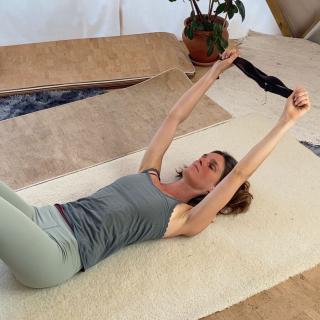
So in the second session,
We will work on the upper body.
In the upper body,
Our main focus will be the shoulder joint.
Which is this joint.
And it comprises the upper arm,
The humerus.
The shoulder socket,
Where the bone enters,
And the shoulder blade,
So the back of your body is part of your arm.
And we'll just see how these move in relation to the ribs,
How they are connected and how it functions.
Because your shoulder blades are connected to the ribs and they're part of your arms and they connect here in the front of the body around the sternum.
So just for you to be aware that your arm,
If you move your arm in several of the movements that you're going to make,
It will also involve the shoulder blade.
So your arm movement doesn't just stop here,
It'll go all the way to the shoulder blade.
So with all these little connections here around the sternum and here which is all muscularly,
The arm movement actually just has only a little joint here and the rest is muscular joints.
So it'll be very interesting to kind of explore how all these muscle constructions work and if movement is available to you.
So a lot of movement can be gained through pure movement around this area,
And a lot of pain and discomfort can be reduced through that.
So again,
The focus will be on how the bone moves in the joint and if you can feel that.
Exploring the different directions of movement of your arm and your shoulder blades,
Which I also shared in the Planes and Directions.
A video.
And.
You can have like a little,
If you want to understand better your shoulder blade,
Because that's a.
.
.
A shape that we're not too familiar with.
You can just kind of join me in a little exploration where you can place your hand.
On your shoulder blade which is.
.
.
The back of your body which I also showed in the in the video and just kind of feel if you can feel the border like the inner border of this triangular bone If you can feel the little tip.
If you can feel the outside border,
If you can maybe feel this bony rim.
Which is more here.
And just kind of see.
If you can feel that move,
If you feel the border,
The inside border,
If you can feel that move if you move the shoulder.
So to just kind of like create.
This little.
.
.
Exploration of what's my shoulder blade where is it where does it move how does it move can it actually move because maybe there is not so much movement which is also.
.
.
As it is right now.
And maybe through these practices,
The movement can get better and improve.
Also to move the bone there is a muscle that is here on the inside that connects to the inside of the shoulder blade that allows the shoulder blade to move forward.
So it's interesting to kind of.
.
.
See you.
If you place your hand here on the side,
There are muscles here on the ribs.
That can help.
Move your shoulder blade forward.
And it's an interesting muscle to have awareness of.
So yeah,
You can play a bit around with What can I do with my.
.
.
Shoulder blade,
Where does it move?
And can you feel muscles that there's actually muscles here?
That also move the shoulder blade because muscles can only shorten.
So to be aware that for the shoulder blade to move forward.
Something needs to shorten.
For that shoulder blade to come forward.
And those are structures that are inside.
Yeah between the ribs and the shoulder blade that allow the shoulder blade to move forwards.
So again,
The invitation,
Like before,
Is to move within a range that is available to you that does not cause pain or discomfort in any way.
That you don't force movements to happen.
And just paying attention also that there's not too much clicking and crunching happening.
That continuously happens as you move the shoulder because those are also already signs that you don't really have that range of motion available and that it's kind of inhibited and there's tension there.
So again,
To not over-activate the nervous system,
We want to respect those sounds,
Those signals.
And just do a little bit less.
So that you don't create any strain or any tension and that your body can just.
.
.
Move freely.
And again,
It is very helpful to either record your movement,
To look into a mirror as you make the movement so that you can watch yourself.
And see what you do,
Whether it really is.
Your arm that is moving,
Your shoulder blade that is moving,
Or if there's anything else happening,
If you're using your back or anything else.
Or that you're hiking up your shoulder.
Those are all little things that just kind of sneak in.
Um,
Because our natural way of movement can be.
.
.
Something that is actually already compensated that we're not aware of.
And you can't feel what you can't feel is what I always say.
So.
Seeing your movement,
Seeing your body is a really major help in creating awareness in your body and in your movement.
So let's explore in the second session.