So in this video we'll work with moving the arms overhead.
So grab a belt or something that resembles a belt,
Which we'll need.
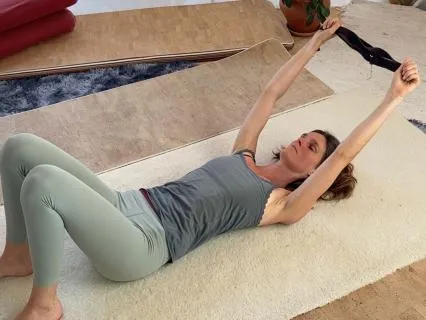
And come lie in the constructive rest position.
Feet on the floor,
Knees bent.
And take a moment to just check in how your body feels.
I was resting on the ground.
Where there is contact,
Where there isn't.
Tensions that you can notice.
How's your breath?
Then grab your belt.
Bring your arms up to the ceiling.
Holding the belt with your hands about shoulder width distance.
And gently hold the belt.
You don't have to squeeze it or pull on it.
With your arms up in the air,
Elbows straight.
Just find a place where your shoulder blades that are on the back of your body are resting on the ground.
So you can move your arms a bit up and down.
Where your chest feels open and relaxed.
And your upper back also feels open and relaxed.
Your neck feels relaxed.
And then it's kind of a neutral position that you're in.
So you don't have to lift your arms up to make the movement.
You also don't have to press them down.
We're going to work on moving that arm bone in the shoulder socket as I showed you with the skeleton in the introduction.
So you're going to gently move those arms overhead.
They're not going to reach all the way to the ground because there's a bone preventing that.
If you lift your arms up,
Then you'll be able to drop them all the way down,
But that's not what we're going for.
So we're going for relaxed shoulders.
Show their blades that are resting on the ground.
And just a movement of the arm bone in the shoulder socket.
And then you move gently back up again.
And this movement of up and down you will repeat several times.
Your arms down.
And back up again.
Just keep on breathing.
And as you're making this movement,
You're going to pay attention to what else is happening.
So maybe at some point you can feel that your back wants to arch.
That there's movement.
The connection of your back with the ground.
And then that's a deviation from the peer movement.
It's a compensation.
Or maybe you feel pain,
Discomfort,
Or you hear clicking noises in the joint.
And then keep the movement small.
Stay within a range where that doesn't happen,
Where you don't feel pain nor discomfort.
And where there aren't noises coming from the joint.
Notice how your belly feels?
Maybe at some point you feel that your belly is starting to grip.
Maybe as you move your arms overhead,
Your shoulders will want to move towards your ears.
Or maybe you notice that your arms are moving at a different pace,
That one is leading the movement.
Or it's just a bit wobbly as you move.
And if you notice that,
See if you can smooth it out a bit by going slower.
That you can start to tune in to that upper arm bone in the shoulder joint.
And just kind of allowing that movement to smooth out.
Keep on breathing.
Notice where you can let go of tension.
Can you breathe?
Can you feel your upper body supported by the ground?
So your whole torso can be heavy and relaxed.
It doesn't have to do anything.
It's just the arm bones that are moving in the sockets.
And it might be that your movement is small.
That you here already notice that your back is starting to arch or your shoulders are moving up or you're cleansing your jaw.
You stop breathing well.
And these are all signals that you're doing too much.
So just stay within a range where your movement is relaxed and easy.
And then keep exploring if you hit that limit.
Notice what signal.
Your body's giving you?
Signal of compensation of arching your back or of tension or whatever else is happening.
But keep kind of looking around that edge.
What's happening there?
Is there anything that you can soften,
That you can relax?
That you can not do.
So that activation of other areas don't happen.
And maybe you can't change it right now.
That's also okay.
We'll also do other movements that might support this plane of movement as I shared in the directions of movement video.
So sometimes we just need to work in different planes of movement that are supporting the plane of movement you are working in now.
To find balance.
So you go back and forth between the different movements.
To see.
Where there are compensations happening.
And where you can find support in the movement.
To help out with those compensatory patterns.
So bring your arms back down on the ground.
And just notice how you feel.
There's anywhere in your body that's letting go of tension,
The legs,
The feet,
The face.
Maybe your torso,
Your back.
Areas that you thought were relaxed.
But they are now sinking a little bit more towards the ground.
Maybe you are holding your breath a little bit.
And now all of a sudden you notice that you're breathing again.
So just notice the after effect of the movement.
Notice what has happened,
How your body now feels.
Notice the shoulder area,
How it feels.
Is there any difference?
Sensing around the neck,
The head.
Just feel the effect of this movement.