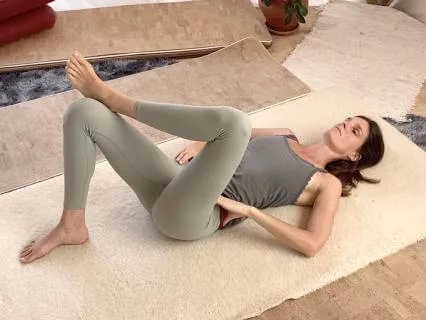
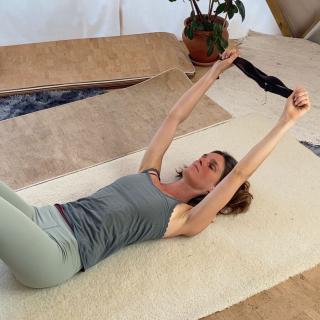
So here in this video we're going to practice figure 4.
Again,
You'll be lying in constructive rest on your back with your knees bent and your feet on the floor.
You can have your hands on your hip flexors.
Just take a moment to sense how you're lying here.
Notice the contact with the ground.
Your breathing.
And then bring your awareness to your right leg.
And lift it up towards your chest.
Straighten the leg a little bit.
And then try to rotate it.
And then after a few rotations to the left and to the right,
You place the ankle on your left leg.
And from here you open the knee out away from you.
And you allow it to go back.
So here you can have a few opening and closing movements.
And you lift up your right lower leg again.
And place your foot back on the ground.
So that's the movement.
To explore these different phases of the movement.
Where you lift your leg,
Which is like the marching movement that we've done.
Notice what happens there in your pelvis.
And then as you straighten your leg a little bit,
It doesn't have to be straight.
Then you do the rotation.
And notice how that feels.
If you're really rotating the leg.
Or if you're moving it sideways.
And this is a different plane of movement.
So see if you can feel that rotation of the leg bone in the pelvis if you can.
Otherwise,
You can always use your hands to help with rotating the legs.
Just to give some feedback and some guidance if that's helpful.
And notice what happens in your pelvis as you're rotating the leg.
Is your pelvis staying quiet or are you kind of hiking your hip up and down?
So it's not really a rotation of the leg bone in the pelvis.
But it's more movement of the pelvis and the spine.
And then if you cannot reach your ankle to your left leg,
Then maybe this is not yet a movement for you.
If you notice that you have to arch your lower back to get your ankle there.
And that's the thing to watch for.
You can play around with lifting the leg and rotating it.
And then that's the practice for now.
If you can place your ankle on your left leg without any compensation happening in your back or in your pelvis.
Then you can open the knee and bring it back.
And again notice how you're making this movement.
Is this a movement of the leg bone in the pelvis?
Or are you hiking your hip up and down?
And is there movement in the pelvis happening?
And also notice what's happening in your left leg.
Is your left leg staying quiet?
Or do you notice activation of the flexor below your left hand?
Which they don't have to do.
Also,
The flexor of your right leg doesn't have to activate as you move the knee away.
So notice.
If there's any flexor movement happening as you're opening your knee out to the side.
And then also see if you can.
Notice whether your left leg,
The one that's standing is moving from side to side.
Or if your foot is grounded in the earth and you're just moving the right leg bone in the pelvis.
And besides that,
Just notice your shoulders,
Your breath.
Feel what's happening and what you're doing and how you're doing it.
So just repeat and practice the movement a few times.
From lifting the leg to rotating it.
To bring the ankle to the leg.
And opening the knees a few times.
And if you cannot reach the ankle,
Up to the left leg.
And just stay with rotating the leg.
Bringing it up and down.
Noticing what's happening.
What's your left leg doing?
What's your pelvis doing?
Can your pelvis stay quiet as you make all these movements?
Is your belly gripping or can that stay soft?
Your shoulders,
Your jaw.
Are you breathing?
Just take your time to explore this movement.
Then bringing the right foot down and taking a moment to sense your body.
You feel a difference between the left side and the right side of the body.
Does the right side maybe feel heavier or bigger or softer or tighter?
Or what do you notice?
And do you feel that around your hip or your pelvis?
Or maybe you also feel something around your shoulders or your ribs.
Or your feet.
Just notice the effect of having done this movement on one side.
Noticing how it influences your whole body.
And then we'll switch sides.
So continuing with the left leg.
So lift the left leg up.
Straighten it a little bit so that you can do the rotation without your left leg touching the right leg.
Noticing if you can connect to this movement or if it's helpful to use your hand to kind of guide the movement.
You can look at your leg.
Seeing if it's rotating or if it's moving sideways.
See if you can make sure that it really is a rotation.
Then placing your left ankle on your right leg if that's possible.
And opening that left knee out and away from you and back.
Then just be curious.
Maybe this side is very different in its range of movement.
And in compensation patterns,
Then the other side.
So again,
Notice what's happening in your pelvis and in your back.
Your shoulders.
Notice if your right hip flexor as you're opening your knee is activating or not.
And also notice what the left hip flexor is doing.
If it is activating,
Make the movement smaller and do less.
And see if it then stays quiet.
So see if you can find that moment where it activates.
And then play in the range where it doesn't.
Then bring the foot back down.
Take a breath.
Just notice.
And then start again.
Lifting the leg up,
Rotating it.
And if you struggle with the rotation,
Just help out with your hands,
With your eyes.
Sometimes seeing the movement can help you to coordinate it.
And then as you've coordinated the movement.
You can start to feel it from the inside out.
Really feel what you're doing after that you've seen it.
Then you bring your ankle towards your right leg.
And move the left knee away from you.
And notice what's happening in the rest of your body.
Are you gripping with your belly?
Forward you're sideways.
And you allow your back to rest on the ground,
Your sacrum to rest on the ground.
And to just make the leg bone move in the pelvis.
And sense that movement.
Slow down if you notice that compensations are happening,
If the pelvis is moving,
If the back is moving.
Stay within a range where that doesn't happen.
Where you're not bracing to prevent it from happening.
And take your time to breathe.
Bring your foot down.
And start again.
And noticing that maybe after you've done it a few times,
It becomes easier.
The things are starting to shift.
And just notice a difference in the movement between the left and the right side.
And maybe the next time when you do the movement,
You start with the side that is easiest so that your brain is kind of familiar.
And doesn't have to work so hard.
Which then might help the side that is struggling more to do the movement better.
So play around with the sides,
With which side you start.
And which side is your easier side?
And which one is your more difficult side?
And allow the easier side to help the more difficult side.
You can always alternate between the left and the right leg.
To kind of tune in how the movement feels on the easy side.
And then trying to tune into that feeling on the more challenging side.
Help you to develop that awareness.
And then relax your leg.
Bring your foot back to the ground.
And take another moment to sense how your body feels.
Does it feel more balanced again?
What do you notice and what has this movement done for your body?