In this video we'll do the butterfly movement.
So again come to constructive rest.
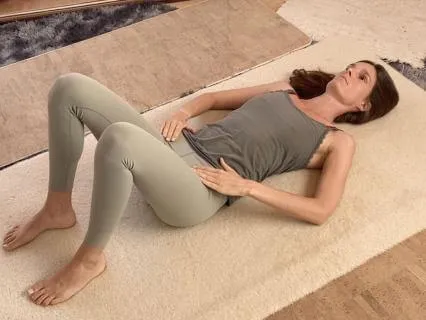
And this time do place your hands on the top of your legs and pelvic bones,
Like I have here.
And make sure that when you lift up your leg,
It's just an inch of the ground it's very little that you can feel and here you can also see.
That this muscle is becoming active.
So notice this in your own body and feel whether you can feel.
As you lift up that leg just a little bit.
That you notice that that muscle is activating.
So that you know where it is and that you can feel it.
And these muscles are called the hip flexors.
They flex they make sure that your upper leg goes towards your belly.
And now with your hands in this position,
Your feet hip width apart.
You're going to allow your legs,
Your knees to move out to the side.
As a butterfly movement.
And then move them back up.
So the movement is opening the legs and then bringing them back to neutral.
With the knees up in the air.
So just make this movement and notice what happens.
First notice if there's movement happening below your hands.
If you can feel that at some point during the movement,
These hip flexors are activating.
Or if there's maybe a little twitch or if it's a firm activation.
And when you feel that that happens,
Don't move any further because that's already a compensation that's happening.
Because these muscles don't have anything to do in this movement.
So for instance,
You notice that as you move your legs out,
When you're here,
It already starts to move or activate.
And that's the range that you're going to play with now.
Which might feel very small,
And you might have opinions about that,
And that's okay.
But stay within this range or play within this range and notice what you need to do to allow these muscles to not get involved.
So you can even have a little conversation with these muscles asking them to relax.
And it's not about bracing in another area because that's not helpful either.
That's also another compensation.
It's really about discovering What can you soften?
What can you let go of?
Because these hip flexors don't have to do anything.
And they can just not join in.
And then besides sensing that,
Notice if you're maybe arching your back at some point.
Your lower back and your mid back might be coming off the ground.
Your chin might be moving towards your chest.
So again,
Then don't make the movement any bigger.
Than where you feel this compensation happening.
Can you allow your shoulders to be soft?
Your jaw,
Your face,
Your tongue.
Again,
We're focusing on sensing the movement of the leg bone in the pelvis.
And the rest of the body.
Can just stay quiet.
So notice if you're trying to brace and prevent other movement from happening.
And allow whatever movement that wants to happen to happen and just become aware of it.
And don't move more than when you notice that other movement wants to happen.
And maybe you're not feeling anything because you tend to be very flexible.
And then see if you can tune into really sensing the movement of the leg bone in the pelvis.
And all other subtle movements that you can become aware of.
So if you tend to be very flexible,
The challenge here would be to really slow down.
Tune into the sensing.
And looking for stability in what you're doing.
And maybe as you're making this movement.
You notice that as the legs come up,
It might be a bit shaky or a bit trembly.
And that's also okay.
And then just take a rest and notice if there are any tensions that you're letting go of now after the movement.
Feel your body.
Keep breathing.
And then just start again.
Notice if you can allow your whole torso to be supported by the ground.
Your shoulders to soften and relax.
And also to feel what's happening in your feet.
Are your heels moving in towards each other like this and moving away?
Or can you just roll over the outside of your feet?
Also without activation of the hip flexors.
Without arching of the back.
And if your heels are turning in,
Then notice when that starts to happen.
And then when you do feel that sliding movement.
Or if you're using a mirror and you can see it.
And play within the range where the compensation doesn't happen.
See if you can stay in the range of the pure movement.
So that you're training your brain,
Your muscles and your nervous system that that's the safe place.
That's the pure movement.
And it doesn't have to recruit any other areas to support that movement or to compensate that movement.
Notice whether you're breathing.
If you stop to breathe.
And that's also a signal that you're doing too much.
So stop the movement now.
Take a moment to sense the body again.
Is there anything that's letting go?
That you hadn't noticed that was activated.
And notice what else has happened.
Notice how your legs feel now.
How your lower back feels now.
Your shoulders.
Your job.
Just notice what the effect is.
Of making this movement.
Was it useful?
Or was it not?
Or are you not sure?
You just need to practice it a few more times.
In different moments to really start to notice.
What this is doing for you.