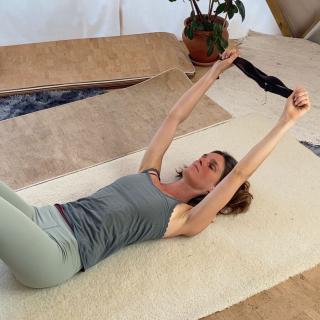
So today we're going to do a joint care practice.
Starting standing up.
So just stand,
Find a place where you can be comfortable to stand and just start with feeling your feet on the ground.
Just kind of noticing,
You can close your eyes if that feels comfortable.
Just kind of noticing where's the weight in your body.
Is it more in your toes?
Is it a bit more in your heels?
You can just gently rock forwards and backwards a little bit to just kind of figure out what's happening,
Where it's happening.
Maybe you feel like you're more on the outside of one foot and more on the inside of the other,
Or you tend to kind of collapse the arches of your foot inwards.
All good,
Just notice where you are.
Today.
Notice if you have this tendency of like pushing the knees backwards locking the knees or if you can just take them off the block not that you have to stand with bent knees But just feel your body weight kind of go into the ground.
So as we lie on the ground,
We always work with this idea of support from the ground,
Allow your body to be received by the ground or be held by the ground and in standing that is a thing that we can also use.
And I've worked with some people and.
.
.
Just this idea of.
.
.
Giving yourself to the ground as you're standing,
As you're walking,
As you're moving.
Is a very useful tool.
Uh,
Practice already to be like,
Okay,
I can actually not to walk on my tippy toes and be all anxious,
But can I sink in?
To the ground a bit.
Noticing where's your pelvis.
Can you kind of stack that?
On top of your feet or do you have this feeling of standing like I'm standing and I'm here and we're doing this.
Or is it like,
Oh my God,
I don't know what I'm doing here.
I'm not really happy about it.
And we're standing like this,
Or can we find a middle way?
I mean,
They're all good.
I'm making a bit of a joke of it.
But these are postures that our body can take.
Depending on what we go through in life.
And so I don't mean to mock that,
I've been.
.
.
I've been this person myself.
For a very long time.
That's okay.
And we just kind of discover what happens.
Can you feel your belly as you stand?
Can that kind of be let go i mean i don't have a huge belly I don't even have a big belly.
I'm getting a little bit of a.
.
.
Perimenopausal pouch.
Which I'm actually quite proud of because.
You know.
And so can this be like a little Buddha belly or a huge Buddha belly?
Whichever you have.
Can you allow that to be?
Can you embrace that a bit?
And be like,
Okay,
You can just.
Take the space you need.
Because,
You know,
It's there.
Can we?
Just allow that to be just for a while.
Can you breathe?
Can you feel the breath?
In the torso,
So it's not so much just breathing in the belly,
It's again you can place your hands if you want to.
Breathing in the side ribs.
And as you breathe into the side ribs,
Can you feel a bit of space also happening in the back?
So it is not just breathing forwards and backwards.
All the space here in front of you that you want to occupy.
But also space taking up in the back of the body.
And where are your shoulders?
If you have a mirror nearby,
Can you see that maybe one shoulder or both shoulders are kind of like.
.
.
My neck disappeared,
Or maybe.
Your neck can come back a bit.
Or maybe your shoulders are just here and this is as relaxed as they're going to get today,
For now.
Let's see what happens.
And notice where your head is.
Is it forwards?
Is it backwards?
Is it tilting to a side?
Back to the feet again.
And then from here.
You're going to step one foot back.
You can have your hands.
For me,
It always helps to have the hands in my sides because as the elbows go out,
You create more balance.
So once you step your foot back,
Oh,
Look at me.
I'll bounce.
Finding my grounding.
Amazing example.
You step your foot back.
And you turn your upper leg.
And that kind of allows you to Fold over your toes.
And your whole.
Foot kind of circles.
Loosening up your ankle.
And have the other foot as a strong standing base.
If you really feel wobbly and you're like,
This is not comfortable,
Have a chair in front of you or a wall nearby.
To hold yourself.
Steady so you don't fall over.
I don't want you to fall over.
Circle in one direction,
Circle in the other.
Opposite direction.
And if you've never done this before,
It might be a bit uncomfortable for your toes if you really like roll over them.
So be gentle.
And it gets better with practice.
So we're not here to torture ourselves,
Ever.
But sometimes when things are a bit stuck and haven't moved well for a while.
They can.
Feel a little bit rusty.
And come back,
Standing on both feet.
Notice if there's anything else in your body that has been tightened and now let's go,
Which is an interesting is interesting information to take along into changing legs.
So now stepping back the left leg.
And so really the movement is happening here.
From the upper leg bone.
In the pelvis and the rest of the leg.
Just kind of follows the movement.
So your knee moves out to the side and this just brings all this movement in through the ankle.
Through the toes.
In one direction and the standing leg.
Is a strong leg that really is being.
Yeah,
It's almost kind of pushing into the ground.
Circling in the opposite direction.
And also noticing,
Is one leg easier to move than the other?
All right,
And then back to standing.
On two feet and just notice for a second.
How that feels.
Is there a little bit more aliveness in your feet,
In your toes?
Them for.
I'm placing the feet a little bit wider almost well almost hip width apart maybe a bit wider bending the knees a tiny bit.
We're going to circle the pelvis.
And it's nice if you have a mirror nearby.
I have the screen so I can see myself move.
And the idea is to start with.
Moving the pelvis.
Circling it.
But keeping the shoulder steady.
So we're not doing this.
Which is something I see a lot,
But here my spine is moving through space,
But it's not moving by itself.
So this is more of a,
Actually more of an ankle movement.
You can see that my legs are moving.
Relative to my feet,
But there's no movement happening.
In my spine and now.
With this,
My pelvis is moving in relation to my spine.
So you can see.
Hip hiking up.
Pelvis tilting forwards,
Hip hiking up.
Pelvis tilting backwards.
And so.
That's what we're doing.
Again,
You can have the hips on your side and even help a bit with tilting and tucking.
If you're confused.
Allowed the legs to kind of have this forward motion.
And stillness.
In the upper body,
But you breathe.
You still feel the breath.
In the side ribs.
If there's areas that feel a little bit sticky,
Stuck,
Shaky,
Just slow the movement down.
Which is interesting because then you get all these kinds of points that are like,
Hmm.
What's happening here?
And so you can.
.
.
Move back and forth,
Forwards through that a bit.
Keep breathing.
And just noticing.
And circle in the opposite direction.
It's like doing a hula hoop.
And one direction is always easy.
And the other direction is like,
Hmm.
How does this work?
I've done this before.
Many,
Many times.
But still.
Circling for me.
Clockwise.
It's a little bit more strange than circling counterclockwise.
Notice also what you're doing with your jaw.
If you can,
I encourage you.
Sticking your head out,
Making your neck crunchy.
Or feeling again,
The weight.
Through your feet into the ground.
So really.
Allow your feet.
To receive the support of the ground as you do this.
The knees move.
And you're really using the center of your body.
To move and again if there's any areas that feel a bit painful Do less.
Don't move through the paint.
I just felt a little bit in my right SI,
So I'm making the movement a little bit more subtle.
So that I don't feel that.
So that I'm not moving through anything my body's saying,
Like,
It's not OK.
So if your body's saying,
No,
It's not okay,
Just back off a bit.
And then come back to the center.
Take a moment.
To notice.
Moving up.
The body.
Same thing.
Feet about hip width apart.
Tiny bends in the knees.
Now,
Instead of Doing the hips.
And the pelvis.
You're going to move kind of your sternum in circles,
Which might be a little bit more difficult.
So just kind of find Think of your sternum,
Of your breastbone.
And just kind of imagine that that is.
Swirling a big pot.
So now you're focusing more the movement.
Upper body.
Your shoulders can move now.
Your head can move also.
Just see if you can kind of figure out.
How to do this.
So there is a bit of pelvis movement happening,
It's not like.
.
.
Your pelvis is not doing anything.
You could even.
.
.
Make this a whole spine movement where you also allow pelvis to move,
But focus on the sternum.
So contracting the front of the body.
Opening the side.
Opening the front of the body.
Opening the other side or contracting.
Depends on how you look at it.
And then in opposite.
Direction.
Bringing some movement into the upper back.
Wow,
I feel this is a little bit more rusty for me.
All right and come back to center.
If you ever feel dizzy,
Feel free to take a break.
And again,
Take a moment to notice.
Then from here,
I'll step a little bit forward.
Well,
I have space.
We're going to continue with the arms.
One arm first.
For me,
My right arm,
Circling it backwards.
And also here.
You're gonna check.
Whether you're circling your arm backwards,
And rotating your whole body as you do it,
Or if you can just focus on moving your arm and your breastbone is staying closed.
Facing forward.
So you can have a half prayer position.
And noticing,
Again,
If you have a mirror.
It's nice to.
.
.
Being able to see what's happening.
But to kind of notice.
What am I doing with my upper body?
And can I just focus on moving the arms?
In the shoulder joint.
Again,
Feet are planted on the ground.
You can bend your knees ever so slightly to give that weight.
Into the ground.
Noticing what happens in your jaw,
Your neck.
Might be a bit tiring,
I know this from me.
This is tiring,
And as it's becoming tiring,
I'm more anxious.
Inclined to start cheating a bit.
Breathe.
Again,
Find your Buddha belly.
Allowing it to be soft,
And circle a few times forwards.
Don't overstretch it.
If you notice that your shoulder is clicking,
You can always put your hands on your shoulder and work from that.
It's like you're swimming.
And just Don't hurt yourself,
But see what range of motion you have available.
That is paint free.
Or doesn't increase the pain.
You already experience.
And create some movement into that arm.
Shake it a little bit and let it hang.
And maybe you notice that this arm is hanging a little bit lower than this arm.
So there was some stuff in my neck.
That is now.
Little bit less.
I also feel that my shoulder blade is resting differently on my upper back.
So just notice what you notice.
Even though I do this more often,
I'm still also very human.
And very much with tightness and stuff.
And so other arm.
Start circling it backwards,
Bring the weight into your feet.
And notice whether you want to turn your whole body.
Body backwards and there's nothing wrong with that.
I just want you to notice what you're doing.
And to choose what you're doing.
So if you're like,
No,
I really want to make this movement like this,
Then that's fine.
But still focus on the movement of the arm.
In the shoulder.
Notice if it's cracking,
If it's clicking.
If it is,
Make it movement smaller if you want to.
Make the movement like this or even Even just shoulder rolls.
If that's what is accessible today.
That is your practice.
And so just kind of play around.
Maybe you want to reach up a bit more,
Reach back a bit more.
Maybe that feels like too much and you just want to focus on,
Can I just lubricate my shoulder joint a little bit?
Which is also great.
And circle forwards a little bit.
Oh,
Sweat's starting to drip on my forehead.
This is very.
.
.
Very nice.
Hot yoga joint care practice.
And just notice how circling forwards is different from circling backwards.
And there we go.
Let it go.
Let your arms rock a bit and now.
I still think my right arm is hanging a little lower than the left.
But,
You know.
Stuff has changed.
In my shoulders.
Now we're going to do a little.
.
.
Um.
.
.
Exercise.
Coordination,
That's the word I was looking for.
Coordination exercise.
You're going to bring one arm forwards.
And one arm backwards.
And for some people,
This is going to be impossible.
Just try it.
You're going to circle them down,
Circle them both up.
Change your chest into the opposite direction.
Keep the arms going so they reach up.
Change your chest in the opposite direction.
And so both arms are turning.
In opposite direction.
One forwards,
One backwards.
The key in this movement is move your torso.
Make this twist.
If you don't make the twist,
You get into this and.
And then it's like,
How does this work?
Works bringing the arms out.
Bringing them down,
You can even bending your knees.
Reaching the arms up,
Making yourself tall,
Twist to the other side,
Making them go down.
And if you catch a little bit of a flow.
.
.
You can have the arms.
Swinging.
Key is rotate your torso.
Which you did before.
So you know you can do that.
Allow your shoulders to be relaxed.
Your arms to drop.
You need to catch the bounce.
Your feet grounded on the ground.
Coming back and going in opposite directions.
Same thing.
In opposite direction.
Again.
Rotate your torso.
If you don't.
You turn into this.
And now I forgot which way I was going.
This way.
Breathe.
And just notice how your whole body is involved.
In this movement.
Or not,
And you get just completely stuck.
And then let it go.
Little coordination,
Great to practice.
Key is to focus.
Doing this.
And keeping the arms moving.
As we do this,
We're continuing,
Placing the feet,
Again,
A little bit hip width apart.
Knees tiny bit bent.
Same movement.
But now your arms are just like ropes.
Hanging from your shoulders,
We're going to spin.
Keep your eyes gazing forward.
Or have your head.
Turn along.
Just make sure that this movement It's coming from your feet.
So you're kind of pushing off.
With your feet,
Your whole body from one side to the other.
It's the twisting motion.
Is happening in your spine.
So yes,
Your pelvis is moving a little bit from side to side.
Try to take care of your knees.
That you don't.
Over twist them.
That's why there's a little bend.
And a little break.
In the legs.
But more twist.
That can happen,
Like the final.
Twisty bit comes from the Leverage from your arms that are swinging.
From side to side and just keep focusing on it.
Letting go of those arms.
Letting them be like ropes.
You can also have them.
Hate you.
Gently.
Around the kidney area.
As you do this,
This is where one kidney is.
And this is where the other one is.
You can do that if you don't feel like it.
You can also not do that.
But have your body twist.
Can you have your gaze forward for a little bit?
And you get a little extra contrast.
Around the neck.
Which can be very interesting to do.
If you look along.
Over your shoulder.
And nuts also.
Just notice the differences between the two and really feel that your feet are receiving.
Or are creating the impulse.
And that an impact is happening there.
The break.
And the twist,
The impulse of the twist is coming from your feet.
And breathe.
And then slowly,
You don't stop abruptly.
But as if you're a boat coming into the harbor.
You very slowly.
Stop twisting.
And if you want,
You can close your eyes.
If not,
Then.
Of a soft gaze.
And just come to a standstill and just,
Again,
Notice the after effect.
Feel your feet.
In the ground.
Notice the movement,
The residual movement that might still be there even though you're standing still.
Hmm.
Notice your breath.
And then from here.
We move to extending a little bit wider.
Bending the knees.
And swinging the arms.
Having your knees bend.
As you do that.
And circling the arms up.
Interlacing the fingers.
In whichever way comes most natural to you.
Bringing the elbows shoulder height.
Notice if you're now just kind of like arching your back or if you can still Find it.
Steady.
Stance where you have a relaxed belly.
And you're going to move your elbows up and down.
And that will give this little Twisting.
Motion to your wrists.
Keep your elbows around shoulder height.
Keep breathing.
And just give your wrists.
A little bit.
Of the twisting.
And then again,
Let it go.
Swing your arms.
You can alternate which one crosses in front.
I didn't go.
Maybe some tension.
And circling them up again.
Interlacing them.
And then changing the interrelation.
Changing how you interlace them.
So that if before the left thumb was forward and the right pinky was backwards,
Now it's the opposite way.
Again,
Elbows shoulder height.
Feeling your body weight.
Given to the floor through your feet.
Space to breathe.
And just moving the wrist.
Noticing if you're hiking up your shoulders,
Up to your ears.
And you just.
.
.
Move your elbows up and down your shoulders are not really doing very much in theory.
Relaxing the wrists.
And letting that go.
Bit of a swing.
And coming back.
To standing.
Then the next one,
I will sit a little bit for that so that you can see a bit better.
There we go.
I'm a bit sweaty.
Sorry about that.
But,
You know,
It's hot.
We're now going to make a movement with the head.
And so you can stay standing.
At first you're just going to look over your shoulder.
And then slowly.
Look over the other shoulder.
Again,
Notice whether you want to twist your whole body.
Or whether you can just move your head.
Then,
As you Move from the left to the right and right to left.
Look down as you go.
From one side.
To the other.
And then back down.
So we're not looking up.
I don't want you to shorten the neck.
I want you to.
Of space.
And again,
Notice if you're rounding your whole spine forward.
Or if you can just move your head a little bit.
And your neck.
Close your eyes if that's comfortable.
Keep them open if that's comfortable.
Don't force anything.
Notice where there's space to move,
Where there's softness.
If you feel some resistance,
Just gently keep moving around that space,
Breathing,
Getting a space in the ribs.
Maybe even inviting some extra breath.
Into the upper back.
Notice if that helps.
And then looking down.
And slowly bringing the head back up.
And then To continue head movement,
Imagine you're Mexican.
Well,
That's maybe a bit racist,
But if you have like a big Mexican sombrero that has this big border.
You put a ping pong ball in it and you want to have that ping pong ball swirl around.
First,
Very small,
So we're gonna make like a little spiral.
Making the movement bigger.
So you start with kind of just moving the upper vertebrae of your first one and two.
So you just,
I'm going to do my eyes closed because then I can focus a little bit better.
So it's just kind of circling.
My skull on top of.
My spine.
That's kind of the.
.
.
Image.
Slowly.
See if you can make it circular or if it's like an egg or an oval.
And then very slowly.
You want to make that spiral.
A little bit bigger swirling that ping pong ball.
In your big head.
Hat,
Not head.
Hat.
Still,
It's just your head moving.
Your shoulders are not doing anything.
Breathe.
So the ground below your feet.
Or a few.
Decided to sit on a chair.
Yourself sitting on a chair.
And feel kind of the fluidity in your neck.
If it feels a bit rough or a bit shaky or a bit stiff.
Just imagine.
The fluidity,
The gel-like.
Idea.
And make the spiral smaller again.
Relax your jaw,
Relax your tongue.
Breathe.
Until you're just moving kind of like your skull on the top vertebrae.
Any movements.
Back to center.
Just taking a moment there to notice.
If you get dizzy while you do this,
Take a break.
That's fine.
And then we're going to turn the other direction.
So it's going counterclockwise.
And now slowly.
No,
I was going clockwise.
And now slowly.
In the opposite direction.
First starting small.
Make sure that you breathe.
See if you can turn it into.
Circular motion.
And an oval.
Very slowly.
Making the movement.
Come on,
Here I notice.
Some stiffness that was there this morning that I didn't feel all day.
And now around my right shoulder blade,
There's this.
So just You get slow.
If you feel anything.
Do a bit less,
Don't hurt,
Don't go into pain.
Breathe and see if you can Soften.
What feels tight.
Move with that.
And then again,
Slowly make the spiral.
Smaller again.
Without moving the shoulders,
It's just your head and your neck.
Relaxing the jaw,
Your tongue.
Breathing easily into the side ribs.
Belly soft.
And landing.
In the center.
And just taking a moment here.
To notice.
Now I'm going to get a backdrop.
Then one of my favorite movements,
Which I think is great for the back.
As you place your feet a little bit apart,
They can also be together.
Depends a bit on what's most comfortable for you.
And you stick your butt out,
So it's not about knees overtaking the foot.
It's really about sticking the butt out.
Placing the hands on the knees,
So if you have your knees together then they're together,
If you have them a bit apart they're a bit apart.
Sticking the butt out.
Having your back kind of carry itself so I'm not leaning into my hands.
My hands are just kind of there to keep my knees from moving.
Because the movement we're going to make is if you had a tail.
And an imaginary canvas behind you and a pencil on your tail.
It's getting really complicated.
You're going to draw a circle.
On that canvas with your tail.
So focus on moving forward.
The pelvis,
Without weight.
In your hand so you're spine or your back is strong.
Your feet are stable on the ground.
You're not.
Doing this.
You're really focusing.
On making circles with your butt.
I know this is challenging.
It's hard work.
Allow your whole spine to kind of follow the movement.
You can make it slightly bigger,
But really focus.
On.
Your tailbone.
And the circle,
The imaginary circle.
That you're drawing.
Behind you and if you are getting into it and you really want to have your shoulders Also getting involved.
In your head.
Feel free to do so.
Keep your hands light.
On your knees.
Your back strong,
Or as strong as you can.
If this is too much,
You can always go back to just circling the hips.
We're circling the breastbone,
What we did in the beginning.
Feeling the weight.
Through your feet.
And then opposite direction.
And this is a go slow,
Make it make it a slow movement.
And this is a really nice.
Waking up of the spine.
This is my one of my movements that I almost do every morning.
Your jaw,
Your tongue.
Notice the resistance where that is and move slowly.
Don't hurt yourself.
But invite.
Movement.
And when you're ready,
Oh,
Just come back to standing.
Take a moment.
And just Stand.
Notice.
What this movement did for you.
And we'll just do one final spinning.
To just let go of tension.
That might have.
Snuck into your body.
Or into your back.
Gentle spin,
Don't force anything,
Don't hurt yourself.
Make the movement from your feet.
Push.
Movement from your feet so it's not coming from your hips.
Your hips are just following.
The impulse.
That is happening in your feet.
And then slowly letting that go again.
And a final check-in as we stand.
Your feet on the ground.
Again,
Noticing where is your weight now.
Has anything shifted or changed?
How are your knees?
Are you tending to lock them or can they be soft?
And it's really that sensation of are you kind of lifting up your kneecaps,
Kind of like activating the quads?
Or can you allow that to drop?
And you find that.
That line of gravity that's kind of pulling you down.
And the more you are in line with gravity,
The more the pull of that gravity just goes straight through your bones and is not kind of like leaving you all kind of crooked.
But it's just going straight down and you can be tall in that.
Are being pushed down but you rise up.
From that.
That's why that connection with the floor.
Is so important that you feel your feet.
And you feel that solidness of that which is below you,
That which is holding you.
Or sustaining you or carrying you or however you want to.
See that.
Feeding your lower belly.
Notice if that can be soft.
Or if you're trying to tuck that in.
Can that be?
A home,
A safe,
Soft home for the organs that live there.
As well as the back.
And the back also.
Be asoft.
Safe home.
So without any tucking,
Without any pushing,
Without any pulling.
Just where is the spaciousness and can you be in that.
Same for the chest.
And the upper back.
Can you feel breath?
Around the chest,
Around the breastbone.
And can you also feel that breath around the shoulder blades in the upper back?
Noticing the shoulders.
The neck.
And the head.
And then just find a place to sit.
That is comfortable for you in a sitting posture that's comfortable for you to be in.
And just notice as you sit.
How does that feel now?
You can sit cross-legged,
You can sit on your lower legs,
You can sit on a chair.
All fine,
Just as long as you can sit with a relaxed mind.
Long spine so you're not kind of collapsing.
There is,
Again,
That space that you maybe have felt while you were standing.
That space you bring into your seated position as well.
So it's not forced,
It's not like.
.
.
Tall.
Finding that space and then softening and be like,
Okay,
How can I be tall without effort?
And then placing your hands wherever feels comfortable for you.
You can close your eyes if that feels appropriate for you.
I'd like to close this practice chanting the mantra once.
So you can exhale fully.
And then inhale deeply.
AHHHHHHHHHHHHHHHHHHHHHHHHH Thank yourself for showing up,
For being curious.
For breathing,
For moving,
For listening to your body.
And thank you for joining practice today.
Hope you enjoyed this.