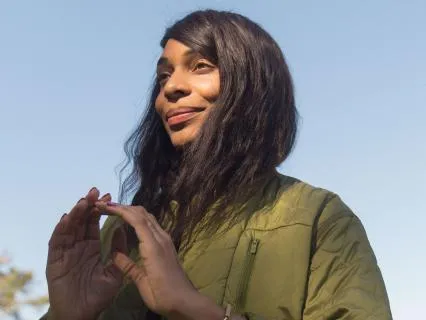
Welcome to Day 9 of the Dopamine Rebalance Challenge here on Insight Timer.
Each day,
You'll practice one simple skill to reset your relationship with distraction and reward,
Retraining your brain for focus.
Let's jump in to today's session.
Hello,
And welcome back to the Dopamine Rebalance Challenge here on Insight Timer.
My name is Nkechi,
And today we'll be exploring boredom,
Or what we might call intentional low stimulation.
I will be guiding us through a simple stillness mindfulness practice.
And in this practice,
There is no need to achieve anything,
Or fix anything,
Or create any type of particular experience.
The invitation here in this practice is simply to be present with what is,
With what is here,
With what is now,
And with what is arising when our stimulation drops.
This is incredibly important work for dopamine recalibration.
Low stimulation states allows the system to recover,
And when we reduce our input even briefly,
Our nervous system begins to settle.
Dopamine signaling stabilizes,
And the brain will gradually regain its capacity to find simple experience and reward again.
If restlessness shows up today in our practice,
It's not a sign that something's wrong.
It's often signaling that our system is adjusting,
And this practice is about being in better relationship with interruption,
With our boredom,
And with our impulse to fill in every gap.
I invite you to find a comfortable way to be in your space,
And we'll be here in this practice for about five minutes.
Being comfortable in your space might be sitting upright,
Finding a cushion,
Or a chair,
Having your feet firmly on the ground,
Your legs might be folded underneath you,
You might be laying down if that feels better for you,
But I really encourage you to find whatever feels right and correct in your body,
Allowing the spine to be supported,
The shoulders to be soft.
And if closing your eyes is a part of your practice,
I invite you to close your eyes.
You can bring the gaze in towards the heart,
Or towards the chest,
Or towards the earth if you want to keep the eyes open,
Whatever is best for you.
And so we'll open this practice by taking three breaths together,
Inhaling in through the nose,
And exhaling out through the mouth,
And again in through the nose,
And exhaling out through the mouth.
And one more time,
Inhaling in,
And breathing out.
And just noticing this breath of yours that is bringing air into the body and exhaling air out of the body,
In its simplicity,
Noticing that there is nothing to change about the breath.
Simply observing the rise and fall of the inhale arriving and the exhale leaving.
And in this observation,
Letting the breath be natural.
Noticing what you notice,
And allowing what you notice to simply be here,
To be present,
Following the breath.
You might find that as external stimulation decreases,
The mind might immediately want to search,
Or grab,
Or attach to something,
A thought,
A feeling,
A sensation,
An idea.
You might even notice the impulse to check something,
To go over something,
To reach for something,
To move,
To plan,
To be with a distraction.
So I invite you to simply notice that impulse when it happens,
And when it does,
Gently,
Lovingly return to your breath.
Notice and return.
Our restlessness is a very natural,
Very normal response when our stimulation decreases.
And so if and when it appears,
It might be helpful to simply name it restlessness.
Gently,
Lovingly return to the breath.
Returning to the inhale that's occurring in the body,
Or the exhale,
Wherever you are in your breath cycle.
Being with the body,
Being with the breath,
Noticing what you notice,
And noticing where the breath moves in the body,
The chest,
The diaphragm,
The ribs,
The belly.
A gentle rise,
A gentle fall.
Perhaps the belly expanding and softening.
Maybe noticing the subtlety or the labor of the breath.
The sensation of the breath and its impact on sensation felt in other parts of the body.
Small movements,
Tension,
Ease,
Spaciousness,
Expansion.
You may find the desire or impulse or just the wandering of your attention throughout the body with hopefully the lens of curiosity and loving kindness.
And so just being with your curiosity.
Or you might find that the mind may travel to a replaying of a conversation or a daydream or a memory or a to-do list or imagining a future possibility.
And there's no need to stop the thoughts.
Just notice that there's movement of the mind.
And when you notice,
Gently return to the body.
Return to the breath.
Being with the body,
Being with the breath,
Noticing what you notice,
Simply allowing it to be.
And maybe in these moments,
In this sort of practice,
In a quieting,
We begin to feel time again,
Not as something to escape,
But as something we live inside.
There's a simplicity of this quieting and of this being here,
Being now,
Being present.
We'll close our practice the same way we started with three breaths together.
Inhaling in through the nose.
Exhaling out through the mouth.
And again,
Inhaling in and exhaling out.
And one more time,
Inhaling in and exhaling.
And when you're ready,
We begin to slowly wiggle the fingers,
Wiggle the toes.
Gently bring back movement into the body.
Eventually flutter the eyes open if they were closed,
Coming back into your space.
As you return,
Take a moment to notice what you experienced.
Pausing for a few breaths before reaching for your phone,
Allowing slow transitions.
And maybe reflect on how you can bring this into your day in small ways.
The practice of staying in the quieting.
This can look like pausing for breath between transitional day moments.
Being slower to reach for your phone.
Standing quietly in a line or while you wait.
Allowing space for short walks or commute to unfold without adding additional input.
Creating small pockets of low and lower stimulation to give the brain some space to recalibrate.
Giving the brain some room for dopamine to stabilize.
And allowing for ordinary life to become more and more available again.
Beautiful work today and best of luck through the duration of this challenge.
Thank you so much.