Today,
You're going to learn about the pelvic and the thoracic diaphragms and how connection to this power center and this pressure center in our bodies really helps to nourish the voice.
Support the voice,
To express more easily,
And also supports your digestion,
Your nervous system regulation,
And your sexual health as well.
So in order to explain what's going on inside of our bodies,
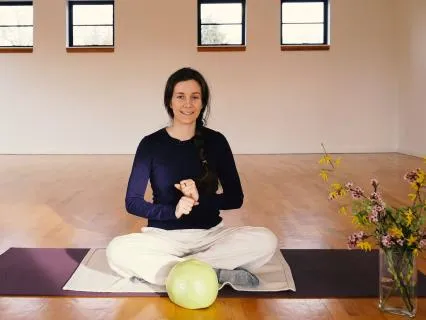
I've brought this ball as an example.
We're going to say that the top of this dome represents the thoracic diaphragm which is up here it connects just under the rib cage goes through the body and connects again to the spine and really separates this air chamber up here from the water chamber down here.
So this is the thoracic diaphragm.
And down here,
We have the pelvic floor diaphragm.
So this is everything holding your pelvis and all of this weight of your torso up.
And you can connect with it if you try to.
.
.
Do something known as a kegel or drawing in your pelvic floor as if you needed to urinate.
And so just try doing that a couple times here with me,
Feeling.
.
.
If you can connect in with this sense of opening and closing of the pelvic floor.
It doesn't need to have to be a lot And most people are either a little bit too tight and then they can really squeeze strongly and then they have trouble releasing or they don't have enough.
Control and so they actually struggle to connect with that closing of the muscle.
So when the ball is looking like this,
This is our exhale.
The thoracic diaphragm is relaxed up here and the pelvic floor diaphragm is actually working to draw in.
On the inhale,
The thoracic diaphragm drops down to make space for the lungs above.
And the pelvic floor diaphragm also drops down,
Opening and relaxing.
So both our thoracic and our pelvic floor diaphragms are relaxing at different times.
On our inhale.
The thoracic diaphragm engages and bows downward.
And our pelvic floor relaxes open.
And then on our exhale,
The pelvic floor starts to draw up and in,
And that's an engagement of the PC muscle,
The pelvic floor muscle,
And the thoracic diaphragm relaxes back up.
So without the ball,
You can actually take your hands and join me here.
So on the inhale,
Starting to do that with your hands.
And on the exhale.
I don't mean them back up.
Inhale.
And exhale.
Scene if you can.
Do this with me on the inhale.
Focusing on the pelvic floor,
Opening and expanding outwards.
And on the exhale drawing it up and in.
Inhale,
Dropping the pelvic floor down and out.
And exhale,
Drawing it up and in.
And just continuing that.
If you haven't focused on this area of your body before,
Just letting it do whatever it wants to do.
And we'll come back up to the thoracic diaphragm.
So on the inhale.
Feeling it expand and widen,
Feeling the rib cage actually open here.
Making it wider.
And then on the exhale,
Letting it surrender back down.
Inhale,
Widening,
Making space for the lungs and the heart.
And exhale,
Letting it contract back inwards.
One more time.
Inhale.
Expanding out and exhale,
Surrendering it down.
So we have this pressure system now that we've gotten to know where.
We're opening and widening and coming down on the inhale.
And then on the exhale,
We're drawing up and in.
And we're relaxing up here at our thoracic.
When we're singing,
It's really helpful if we can keep the integrity of that inhale here in our thoracic area.
So that would mean that on the inhale,
You let the pelvic floor release down,
The belly open,
The ribcage widen.
And then on the exhale,
You bring the breath up,
Starting from the pelvic floor,
From the belly.
And then eventually also from the rib cage.
But we want to keep the integrity of this ribcage at about 20 to 30% of what's possible.
We don't want to collapse completely in here and sing and lose all of that.
From all of our rib cage.
Because the integrity that we keep in our thoracic ribcage and in our thoracic diaphragm here actually supports relaxation in our throat.
And that's what we really want.
We want our throats to be open and just letting the tissues naturally do their dance up here and have all of the power and the support coming from down here.
So I'll bring the ball back again just so we can do a couple more of these breaths together with the ball.
So inhaling,
Feeling the pelvic floor reaching down.
And exhale,
Pelvic floor comes up.
Inhale,
Reaching the pelvic floor down.
And exhale letting the pelvic floor come back up One more time.
Inhale.
Thoracic widens.
Pelvic floor drops.
And exhale,
Pelvic floor comes back in.
And thoracic relaxes.
So one more thing I want to mention here while we have the ball is that If this is your whole stomach area in this tiny little example,
If you're unable to release your pelvic floor and fully surrender it down,
What ends up happening is as the inhale happens,
More and more and more pressure gets placed on those muscles of the PC,
Of the pelvic floor,
And they have to work way harder to hold all this pressure.
And all this extra pressure then gets placed on the organs in your intestines,
Your liver,
Your stomach,
Your spleen,
Your kidneys and all that pressure doesn't feel so good.
And so over time,
When that pressure gets too much on all the systems over and over all day long,
Our nervous system starts to go into a stressed out state.
It's harder for us to digest our food.
All of the natural functioning of the body just starts to become a little bit less easeful.
So if you can get to this place where you're letting yourself relax your pelvic floor,
That pressure gets to move naturally through the body and then the pelvic floor gets to hold it.
And then if you're able to bring that pressure back up through the body on the exhale,
Then the pelvic floor no longer has to hold and it's able to do its function of lifting that much easier.
So know that this practice takes a while.
If it's not how you're already functioning in your body,
Then that's okay.
You can do all of this with just the imagination of relaxation and often people use visualizations to help.
You can imagine a wave.
Rising.
And then releasing down onto the shore as you exhale.
I like to imagine a jellyfish moving through the water.
Inhale,
The head opening and exhale.
It's moving fluidly through the water.
Anything that gives you this sense of flow and ease will be very helpful here.
So let your imagination soar with your creative powers.