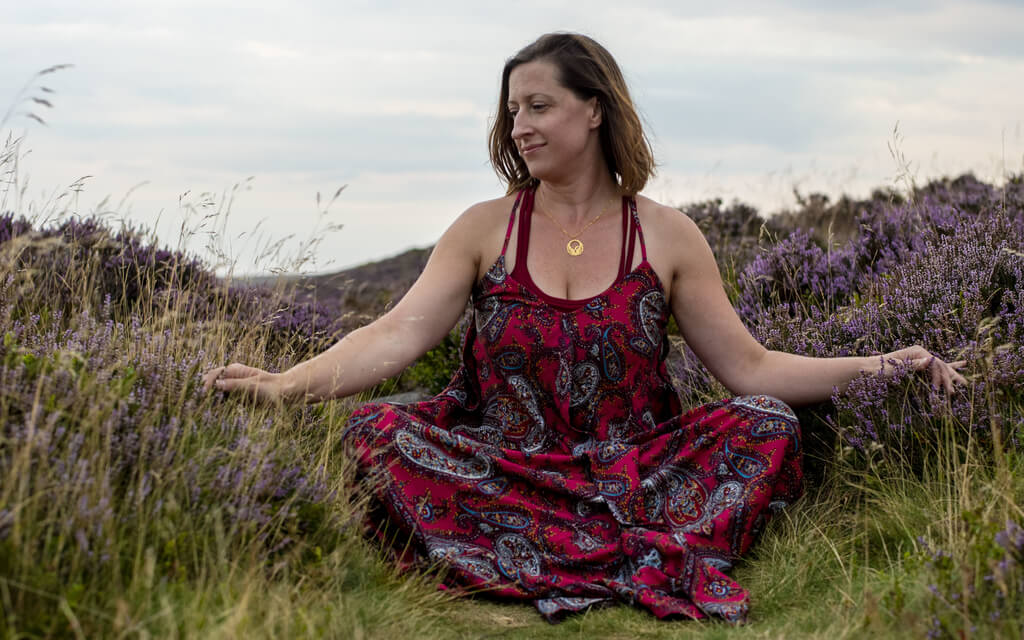
This practice today is focused on alternative anchors for your meditation to the breath.
I'm Sarah,
Long Haul Yogi.
I specialize in yoga and meditation for chronic conditions such as long COVID,
ME CFS,
Fibromyalgia,
Autoimmune diseases and more.
Often focusing on the breath can be challenging,
Particularly if you are recovering from COVID or if you have asthma,
COPD and other related breath issues.
It can also be that you've tried to meditate with the breath and it just hasn't worked for you,
It hasn't resonated.
Whatever that might be,
This meditation is a chance for you to experiment to see if it's using things around you,
Such as things that you can see,
Things you can hear or things that you can smell,
Can be an alternative to focusing on the breath,
The sensation of breathing.
This meditation you may find easier in an outdoors location because of the things that we're focusing upon.
However,
If you're indoors that's not a problem either.
To get into a comfortable position you can be seated or standing or even lying down,
As long as your back is in a straight neutral position.
Ground yourself in to the sensation of your body and its connection to the ground.
Or seat that you're sitting on.
Spend a little time focusing on the sensation of what is around you.
If you'd like you can take one deep breath and see on your out breath you can extend the breath out to relax the body.
Also let's take some time to ensure that your body is relaxed and at ease.
Please ensure that your forehead is unscrunched and relaxed,
The temples at the side of your head are relaxed,
Your jaw is loose and relaxed,
You may want to wiggle it from side to side to get into a neutral position.
Your tongue is gently relaxed at the roof of your mouth,
Your shoulders are down away from your ears and relaxed,
You might want to bring it to your ears and down and shrug a couple of times and then relax them down into their neutral position.
Ensure that your arm muscles and hands are at ease and relaxed,
Your belly is soft,
Breathing gently at your own pace and your legs and feet muscles are all at ease and relaxed.
So firstly we're going to explore what an anchor actually is.
Meditation anchor is simply a way to stay mindfully present to your experience as it is happening now.
With mindfulness meditation the key is to try and allow your mind to concentrate on the present.
It's likely your monkey mind can jump back and forth with different thoughts,
But the exercise is to try and bring it back to your anchor.
In Carlos Casaneda's books he actually discusses the use of an ally instead of anchor and I quite prefer that word as well.
So let's try and choose an ally that works best for you and your own mindful meditation practice.
Start with your sight.
So you can choose something around you,
But you can focus your sight on the other side.
It could be a candle flame or incense burning,
It could be the carpet or grass in front of you,
It could be a flower or plant,
It could even be the palm of your own hand.
Whatever it is,
Just decide what you're going to focus on for the next two or three minutes and we'll begin our practice there.
So just see if you can focus your sight on the object you have chosen.
This is your ally.
Try not to stare at it too intensely.
If you can relax your eyes and just gaze gently upon it.
It's okay if your eyes are moving around exploring the object.
It's also okay if you want to just focus in on a very particular point on the object and focus there.
See if you can hold your attention to your chosen object.
Keep moving naturally.
As we look at our object,
You might want to consider there are certain dimensions,
Textures and other qualities that it has.
See if you can mindfully focus upon the object but completely mutually,
Not analysing,
Judging,
Simply mutually observing.
So the mind may wander to thoughts.
That's completely normal and it's okay.
Just when you see your mind drifting somewhere else,
Just bring your focus back to your ally,
Your object of meditation.
You may also wish to label a thought if it arises,
Like past,
Present or judgement.
Whatever it is,
You can just stick a label on it in your mind and bring your attention back to your ally.
Okay next we're going to see if we can focus on a sound ally.
You can see if you can hear anything around you.
Could be the sound of rainfall or the sound of traffic outside your window.
Outside it might be the wind moving in the trees or bird sock.
If your environment is incredibly quiet,
You might want to switch on a nature sound or a meditation omm sound.
Just pick something and then we're going to begin to focus on this.
Because it's a sound and not an object of sight,
We'll gently close our eyes this time.
Your eyes closed,
Let's focus in on our chosen sound ally.
Just gently observe it.
Again with a neutral observation,
Not judgment,
Not a really analytical.
Seeing if we can focus in on that one sound or pattern of sounds.
You might want to consider the direction the sound is coming from.
See in front of you,
Behind you,
Or maybe it changes and bobs about.
You can also consider the volume.
Does it sound very very quiet?
Is it quite loud?
Or maybe it also changes.
It's possible with your sound ally that it's making you have a thought,
Maybe an attached memory to this sound.
That's only human.
Just again,
If you're having a thought bubble up to the surface,
Just acknowledge it and see if you can let it go and then focus back the sound ally only.
So as we mindfully focus on the sound,
Checking with your body again that it's nice and relaxed,
That you're not tensing any part of your body.
Again we're not trying to concentrate too intently,
It's more of a gentle,
Neutral observation.
Keeping the eyes closed,
We'll now move on to a smell ally.
If you're out in nature this might be quite straightforward.
You might be able to smell the dew in the grass or smell a plant,
A tree.
If you're indoors you might need to get some scents or essential oil or you might be able to pick up a smell that's just already in the air.
Let's just see if we can focus our attention on one scent or smell ally.
Of course if you've had COVID,
Smell might not actually be available to you right now.
That's fine.
You can either go back to a sight or sound ally or you could even try and conjure up what you remember a smell that you really love to be like.
This last task can be a bit more challenging.
Again gently without over-anonymizing or focusing too intently,
It's bringing our attention to the smell that we're focusing on.
Does it smell sweet?
Does it smell musty?
It does smell like if you could just give it one adjective.
Smells are greatly attached to memory in our mind,
In our brains.
So if your mind is drifting to a memory or a story around the smell,
That's fine,
That's normal.
Let's see if you can gently acknowledge that you're now thinking of something.
Let's see if you can just let it go and then come back to focusing on your smell ally.
Does the scent smell very,
Very faint or is it quite strong?
Is the scent all around or is it coming from a particular direction?
Just gently focus in on this scent.
We're coming to the end of this practice.
I hope this has been useful to you to explore different objects of mindfulness meditation.
I recommend that if you've found something that works for you,
Please see if you can cultivate it on a regular basis.
I find that meditating on an object is helpful five,
Ten minutes of every morning.
Let's do what is right for you.
Enjoy the calmness and consistency of focusing on present moment of present experience.
Namaste.