We are looking at the Bhagavad Gita.
Today we're looking at verse 38 of chapter 2.
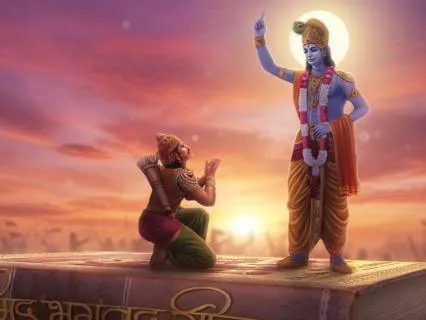
So we find ourselves on the battlefield.
Arjuna,
The hero.
Who is all of us.
And Krishna is charioteer,
His teacher,
His guru.
And Krishna is our highest guidance,
God the divine.
The whispers of wisdom,
However you understand it.
And Arjuna finds himself in the middle of a civil war.
With family.
On all sides.
And he is struggling to engage in the battle.
He doesn't want to hurt anyone.
He doesn't want to kill.
He doesn't want to,
He just doesn't want to do it.
Just like we find ourselves sometimes in situations where we feel kind of stuck between a rock and a hard place.
And we're just,
I don't want to,
So I'm just not going to.
And I'm going to bury myself in.
However I distract myself.
I'm just going to sit and scroll on Facebook or Instagram.
Tiktok or i'm gonna eat or i'm gonna drink or i'm gonna go shopping on Amazon or whatever,
But I'm going to do something to avoid this horrible thing.
But the battlefield in Sanskrit is called Kurukshetra and Kurukshetra is the is the place it's like the pilgrimage of the heart it's the place where we find ourself and it's like all the the warring parts of us you know all the challenged parts of us come together and They're at odds.
Like,
I don't know about you,
But.
.
.
There are parts of us that really help us on our journey.
Courage,
Faith,
Love,
Kindness.
And then there's all these other parts.
Maybe their epigenetic trauma,
Ancestral trauma,
Experiences we've had in the world that have caused us to give up hope.
Or wall off from people.
And these all live within us.
They're all part of the fabric that we are.
But the problem is.
When we give up.
The dark sides.
That's just the way it is.
Like if we put our courage in a box.
If we put our faith in a box,
If we put our intelligence in a box.
What wins.
And so Krishna's big journey here is to say,
You must engage,
You must fight.
And this is where we find ourself.
He has used many tactics so far.
In the beginning,
He's describing that you are an eternal being.
None of this affects you.
All the other beings are eternal beings.
Why are you getting so caught up in this?
In the same way that that inner battle says.
These are aspects of your past.
They aren't part of who you are,
And they're not part of your eternal self.
They're just part of your personality.
Know this.
Know that.
You are this eternal being watching.
Your human personality.
He went on to argue that you know even this is what we were just doing the last few weeks you know even if those voices inside of you say you're a loser and why are you doing that and are you afraid what's wrong with you how could like the taunting sometimes of those voices in our heads like they're They can be awfully cruel when you really look at them.
You know,
You would never want to speak to someone the way that your inner voices speak to you.
And that's what the last few weeks were about,
Was notice this.
Notice the taunting and don't let them win.
You know,
It's like the bully on the schoolyard trying to get under your skin so that they can feel stronger.
It's like,
Be careful,
Be careful.
Don't even react to it.
Because.
.
.
That's how they get you.
They get you caught up in the drama response inside,
And then all of a sudden you're exhausted.
So just to be really,
Really careful.
So last week we did.
36.
And he's talking about,
And your enemies will sneer and mock you.
And of course,
These are the voices in our head that want to win.
They want to keep us in our old patterns.
They will say,
The mighty Arjuna,
That brave man he slunk from the field like a dog.
What deeper shame could there be?
Nothing like the voices of shame inside of us to cut our feet out from under us.
Then he says,
If you are killed,
You gain heaven.
Triumph,
And you gain the earth.
Therefore,
Stand up,
Arjuna.
Ready your mind to fight.
Here is the verse we're going to look at today.
Indifferent to gain or loss,
To victory or defeat.
Prepare yourself for the battle and do not succumb to sin.
Indifferent to gain or loss,
To victory or defeat.
Prepare yourself.
For the battle,
And do not succumb to sin.
Paramahansa Yogananda says,
Equalizing by even-mindedness.
Happiness and sorrow.
Profit and loss.
Triumph and failure.
So encounter thou the battle.
Thus thou wilt not acquire sin.
Equalizing happiness and sorrow.
Profit and loss,
Triumph and failure.
So encounter thou the battle.
Thus thou wilt not acquire sin.
Let's hear what the Maharishi Mahesh Yogi says.
Having gained equanimity in pleasure and pain,
In gain and loss,
In victory and defeat.
Then come out to fight.
Thus you will not incur sin.
What comes to you when you hear that.
With thoughts or emotions.
Balanced attention to detail,
Equanimity.
What does sin mean?
Sin actually comes from,
I think it comes from an Aramaic word.
That's all about archery.
And it means to miss the mark.
How the Christian church used it.
Is something else.
But what it actually means is missing the mark.
Sort of like.
.
.
If you imagine You know when you're living and you're right on path?
You're making choices,
You're kind of in a whole space and you really feel like you're stepping forward.
And then there's other times that you feel just sideways.
And you're making choices that are actually taking you further off your path.
Mm-hmm,
Falling off the path,
Yeah.
And then it's like you're caught in the brambles in the forest.
And you're just,
Every step you take just seems to get you deeper and further away from your path.
So that's why it's really interesting.
The word is so loaded,
It's hard to use.
It's a pretty tough word.
It's been used to shame and guilt people for so long.
For thousands of years.
That's not really what it is.
That which takes away peace.
Yes.
Do not succumb to not experiencing life,
Maybe.
And so it's interesting,
Right?
You know,
This verse is all about finding,
So equanimity.
Is.
Finding the balance within.
That no matter what comes,
I am still centered.
That's equanimity.
That good or bad,
Rain or sunshine.
I am peaceful in my soul.
This is equanimity.
And this is essentially what Krishna is saying.
One person's sin may be another's joy.
Exactly.
Not only it might be another's joy,
It might be another's path.
It might be exactly what they need to do.
It's the danger of giving advice because just because it's something that I don't feel called to do.
100% does not mean you shouldn't do it.
Equalize gain and loss as though outcomes don't matter.
I struggle with this.
Some outcomes do matter.
Heartbreak,
Injury,
Injustice cost us as humans.
And that is exactly the conversation that we have to have.
So for example.
This is not about not engaging in life.
It's not about not feeling what's happening.
Because we have to feel things.
In order to take action.
And we're alive.
Like we're meant to feel things.
The Danger.
Is our brain.
The danger is what our brain wants to do with it.
If we were raised in a culture.
That taught equanimity.
When difficulty happened,
Heartbreak,
Injury.
Injustice.
If we were raised in equanimity.
We would interpret all these things differently.
We might interpret heartbreak.
As a deep dive into what it is to love.
And to understand that love,
Loss,
All these things are all part of it.
We may.
In a culture of equanimity.
If we have injury,
We may look at this and say,
Well,
Isn't that interesting?
I wonder why this is happening.
Am I being slowed down?
Is there something interesting on my path ahead because of this?
We would actually be,
Our brains would be wired differently.
To Encounter this.
But our life in the West.
And probably in most parts of the world now.
We've been raised in drama.
We've been raised in.
Movies about the good person and the bad person and the savior and the,
You know,
The victim and the victim triangles and all these things.
So our brains have been wired.
Into drama.
So now all of a sudden,
Any time something happens,
Our brains then,
There's a secondary experience.
There's the first feeling of loss.
So my friend just died.
Do I miss her?
Did I cry?
Yeah!
Of course!
The danger is,
If my mind wants to find drama in this.
.
.
It can.
It can twist this up and it can say I can't believe this and you know and blah blah blah and she should have been able to do more work and she needed to actually see her paintings hung in a center and she should have been able to and I could get myself so twisted to the point that I've actually forgotten my initial sadness of her passing.
Now I'm on a bandwagon and my mind is going at 100 miles an hour.
And I am getting nowhere.
I am accomplishing nothing.
And all I'm doing is getting tired and ingesting a pile of poison that my brain created.
And this is the challenge.
And this is what the teaching is here.
We're not meant to be automatons.
We're not meant to not desire certain outcomes.
We're not here to not feel pleasure and pain and love and loss and all that.
We're meant to do that.
What's our brain doing with it?
And it also,
If we look at it in a really practical way,
In life.
There's something very strange about having goals.
And of course,
Later in the Gita,
We will talk a lot about non-attachment to outcomes,
Right?
It's a huge,
Huge teaching.
But it's really interesting.
And it asks us to step back a little and ask ourselves,
Why are we here on Earth?
Yes,
The energy from side to side that we talked about last week.
Exactly,
Shira.
Why are we here?
Are we here to buy a big house?
Is that why this divine being incarnated on earth?
For 80 or 90 years?
Like we came here for a very limited time.
Why did we come here?
Did we really come here to get the big promotion?
To make all the money?
To lose the weight?
To win the competition?
Is that really why we're here?
Or is life really about the journey?
Is it about all the experiences we're having?
Regardless of outcome.
I mean,
After we've been alive for a certain number of decades,
We start to realize that In the end,
Things come and go.
Things go up,
Things go down.
One minute you've got lots of money next minute you have no money.
One minute you're skinny the next minute you're fat.
One minute you're you know young and vibrant and you know playing rugby and the next minute you're It just changes all the time.
And we watch other people change.
But life.
.
.
Is the whole thing.
Life is all the experiences.
It's the hard stuff.
It's the good stuff.
And it's interesting because.
.
.
You know,
In the tantric perspective.
The divine is all things.
It's the good,
It's the bad.
It's the painful,
It's the pleasurable.
It's everything.
And when we can really embrace that.
I don't know,
It's like life becomes more passionate.
You know,
There's a danger,
You know,
When we.
Only want life to turn out the way we want.
And I 100% get why we do.
It's what drives us.
It's the North Stars.
I'm writing a new book.
Obviously,
I want it to be successful.
Maybe it won't be.
Maybe,
You know.
Just you guys are gonna read it.
Or maybe just you guys will read it.
And half of you don't even like it.
And you're like.
.
.
Katrina,
I think this is kind of a stupid book.
Really?
It could happen.
It's the danger of being a writer or an artist or anyone who creates anything.
What's your definition of successful?
This is the question.
That's been posed here.
What is success?
Success the journey.
Let's say you are presenting a project to your boss.
You know it's a really big project and you've just been diving into it and you've done a million hours of research and you've put your heart and soul into this presentation and you're just so excited about it and you present it and to the board of directors or whoever.
And they say no.
They say,
Yeah.
Not this time.
Maybe we'll try again next quarter,
Or maybe make some changes.
What if success?
Wasn't getting.
The okay on the project.
And I really mean this.
What if success?
Was the thrill of doing the research.
The opportunity to do the project.
How much you learned and gained and expanded through the process.
And again,
To realize as soon as we have that perspective,
Like as soon as we have the perspective that success is the journey.
You're not gonna burn yourself out.
You're not going to alienate your friends and family while you're doing it.
Because this is my journey and maybe success is maintaining equanimity throughout the process.
Maybe success is maintaining my integrity throughout the process.
Maybe success is maintaining my work-life balance while I have this big project.
Maybe my success is diving into something I never would have studied before.
And I just want you to imagine living like that.
So then suddenly everything that we.
.
.
Take on.
Well,
If it works,
It works.
If it doesn't,
It doesn't.
And you really would look at that board and say,
Well,
Thank you for your time.
It was a pleasure putting this together,
I have to tell you.
If you have another project you'd love me to research,
I'm your person.
I would love to do this again.
This was really enjoyable.
We're only here for a short time.
Why wouldn't we come at it with that perspective?
It's a really,
Really interesting thing.
What are the sides of the energy?
The sides of the energy.
Oh,
The sides of the energy that Shira is talking about?
Last week we talked about when we hesitate.
And an idea comes and we go,
I don't know,
Maybe I should,
Maybe I shouldn't,
Maybe I should,
Maybe I shouldn't.
And within us,
From a yogic perspective,
We have these huge energy channels that run through us.
And the center is Sushumna.
And this is the center where the Kundalini rises,
Where we're clear.
And then we have Ida and Pingala on each side.
And it's like the energy is like ping-ponging back and forth.
This is the energy.
These are the two sides that we talked about last week.
So what do we do?
How do we find this equanimity?
The number one thing we do.
One of them.
Is we develop our witness mind,
Our witness consciousness.
And again,
This doesn't mean we aren't engaging.
It doesn't mean we aren't feeling.
We have it all.
We can feel.
And we can witness.
You can completely just.
Dissolve into a situation.
But still remember that you are an eternal being.
Incarnate here on earth having an experience.
The more we know that.
Not only can we pull out of difficult emotions,
We can also dive into them more.
And this is a real tantric perspective also.
That when we have a deep emotion,
The key is not to ignore it.
You don't want to get the brain in there making up stuff.
That's the thing.
You got to control the brain because the brain is very different from our feelings.
But when we have that witness consciousness,
We have like this divine tether.
And when we have a hard emotion,
We generally are pretty good at diving into good emotions.
Maybe not everybody,
Or maybe not all of us,
All the time.
What we can do then is we can dive into,
Say,
The pain.
And we dive right into the center of it and we feel the power of this pain.
This is actually the path of Tantra.
To dive into the.
Power of life.
The deeper we feel,
The more alive we are.
And there's something about you.
Diving right into the center of it.
Accepting it.
Loving it.
Feeling it.
That causes that energy to then dissipate.
Disperse throughout the body.
And it's actually really empowering.
Imagine not being afraid of emotions.
Again,
It's the mind we have to be careful of.
You could have injury.
And you could sit and you could twist on it mentally.
I can't believe this happened.
Why did this happen to me?
How come this bubble and the mind is just going,
But all that's doing is exhausting us.
And this is the Battle of Kurukshetra.
Because on Arjuna's side.
Are his brothers.
Courage.
Love.
Clarity.
Faith.
And I mean faith in life.
Faith in your path,
Faith in your dharma.
Faith that there's meaning in things.
And on the other side are all the voices.
All the voices that say you have to do this this is your obligation you can't back off you must do this and if you don't you're going to be doing this and then it shames you And this is where we have to stand tall.
And we have to say,
I don't actually.
Have to do that.
The other thing,
And again,
We're going to talk about this a lot more throughout the Gita.
But it's taking action in life.
Without attachment to the outcome.
Without ego attachment at all.
And like,
This seems weird.
Let's say I'm a massage therapist.
Someone comes in,
Lies on my table.
How could you not have a goal?
How could I not be attached to the outcome?
They come in with a problem.
Obviously,
I want to help them.
Right?
If they're in pain,
I want to alleviate the pain.
But it isn't up to you.
What happens as a result of the massage.
This person on your table.
Is a multi-dimensional.
Person who is dealing with layers upon layers.
Of tapestries of lives.
We have no control.
Like,
It's like we can't play God.
I can't fix you in a single massage therapy session.
I hope I can help.
But all I can do is the best job I can.
And how you feel in the end.
Is part of your journey.
I could teach a yoga class.
I teach kundalini yoga so I don't go around and adjust people.
I sit at the front of the class and I teach.
I lead people through sequences.
I cannot control the experiences that any single person in that room is having.
They may like it.
They may hate it.
They may find it rejuvenating.
They may injure themselves.
I can't do anything about it.
I'm not in control of their lives.
All I can do.
.
.
Is present the best way I know how.
And allow the world to turn,
Allow every person in the rooms experiences to happen.
I don't know whether.
.
.
This person doing Breath of Fire suddenly brought up anger that they've had against their brother for their whole life.
And now they're just sitting there mad,
Hating this yoga.
I can't do anything about that.
It has nothing to do with me.
Someone over there might be doing breath of fire and it might be cleansing their liver and suddenly they're releasing all this anger and by the time they're in shavasana they're just like Wow,
I've never felt such peace.
I cannot.
Control anything.
Let's say you work in a company or you work in a bank or something.
Imagine you walk in.
And all you know.
Is.
You're going to do the best job you can.
You're going to enjoy it.
You're going to interact with people.
You're going to be thankful that you're alive and happening and employed and who knows what.
But you're not gonna have any attachment to what happens today.
Because otherwise,
If we're actually out in the world,
The world is always changing.
Every single person is evolving and changing,
And you can't control it all.
But imagine instead you went into the bank that day and you're like,
Okay,
Today I'm going to meet this goal and I'm going to do this and I'm going to do this and I'm going to make sure that this happens and I'm going to,
And everything's going to run smoothly and everything's going to be great and everyone's going to be happy.
Think of the difference of your own.
Heart in your own experiences.
Like they're just radically different.
And the truth is,
We get to choose.
How we walk in to the bank that day.
We choose.
We can't choose what happens,
We can't choose who walks through the door,
We can't choose who gets the mortgage and who doesn't.
You can't choose all that.
But we can choose whether we're smiling.
We can choose whether we're rolling with it.
It can be hard for me to ignore all the what ifs.
It's such a good point because we were again trained in the what ifs.
Who was it?
Jodie Spencer,
I think?
I heard him talk once and he talked about how we.
.
.
I'm really super paraphrasing because I heard this literally on a podcast in a car once and I thought about it.
So I don't even know if this is what Joe said or if it's just what I think now.
But what I took away from it was very often we're living in a state of fight or flight.
We're not living in a state of equanimity.
And when we're in a state of fight or flight,
Fawn,
Freeze,
Flop,
Whatever state of nervous system dysregulation we're in.
We are living out of our animal brain,
Our survival brain.
And when we're in our survival brain,
We have to be aware of all the dangers.
And our brain,
Our frontal cortex.
Is an imagination station.
And we can go on forever.
We can think about every possible bad thing that can ever happen forever.
It's an infinite possibility.
Place of creation.
And this is where the what ifs are so dangerous.
Because none of them are real.
None of them.
I could finish this class and I could think,
Well,
What if I walk out of my bedroom and I fall down the stairs?
Then what?
Well,
Then I'm going to have to do this and I'm not going to be able to drive.
And then William's going to have to take me everywhere.
And then I don't even know if I'll even be able to teach on Insight Timer anymore because I'm going to be crippled.
And then I'm going to be spending all this time in the hospital.
And then what?
Why?
Why go down that road?
It's utterly irrelevant.
There's a man,
David Hawkins,
Who wrote the book Power Versus Force.
And I actually saw him teach in person.
And he was teaching all about reality.
And he said,
The most important thing you can do is stay in this reality.
Stay right here.
Do not go into the ifs.
Do not go into all of those things.
Stay here right now.
This is actually the only reality that exists.
There is nothing else.
It was a Q&A time.
And he was a hilarious person.
I'll never forget him.
And he said,
You guys can all come up here.
And ask a question.
But you are not allowed to ask an if question.
You have to ask a question about reality.
I will not answer.
A hypothetical,
Non-real situation that is no different than saying,
What if we get a flash blizzard tomorrow and it kills all of our plants?
Then what's going to happen?
All the Canadians are going to,
We're going to have to import all of our food from other countries and then this and that,
Because all of our crops will be ruined.
And then what's going to happen next?
It's such a waste of energy.
There's nowhere where it's valuable.
And the crazy thing is,
40 people lined up.
Add.
The diocese or whatever that stood up at the at the at the thing.
Every person asked an if question.
And as soon as they said,
Okay,
But what if he said,
Sit down?
And they went,
But I'm gonna just say,
Sit down.
And then the next person asked an if question.
And then the next person asked an if question.
And it was almost like we have been so trained.
That we don't even know how to ask questions about our actual life.
Like we're not actually even here.
You know,
You mentioned that it's particularly challenging as the parent of a teen.
So then we look at what is here.
What would I love to do with my teen right now?
I can't control their future.
I can't control what's going to happen this weekend.
I can't control who they hang out with.
What would be joyful?
And maybe it's like.
.
.
Do you want to go to the beach?
Do you want to go get ice cream?
I'd love to get ice cream.
Do you want to learn how to play?
Do you want to do something?
You want to go get manicures,
Pedicures?
Just do something in the present moment.
Just focus here.
What would you love to do right now with them while they're here?
Just stay here and dive into it.
You know,
Every situation is different and every situation calls for different things.
But all the what ifs?
They're just impossible.
And they just do no good.
And if we find ourselves.
In the what-if cycle.
The best thing we can do is sit down with a journal or a friend or a counselor or somebody and say,
All right,
What is my reality right now?
What is the truth right now?
It's all we need to know.
There's another aspect of tantric awareness that I love.
There's a few.
And so sometimes neutrality seems cold.
The word seems very cold.
But in Tantra they would say,
Shift the neutrality.
Divine awareness.
Or delightful awareness.
Like to just look at life and say.
Like what a rich experience.
For good or for bad.
What a world this is that we live in.
For me in one week.
I can become a grandmother for the first time.
And lose an extremely dear friend.
Kind of world is that?
And have all the feelings.
Like just every feeling from end to end in one week.
We can choose to be in awe of that.
The last thing I want to mention is.
.
.
Again,
Another tantric perspective.
I feel like a lot of our talks going forward are going to have a tantric perspective because I,
That's really my jam.
There's a word,
I talked about it last week,
Called Spanda.
S-P-A-N-D-A.
And Spanda is the vibration of life.
It's the vibration of the universe.
It's the sacred Aum that started it all,
That created everything.
And it's the vibration of Spanda that makes life happen.
Well,
The interesting thing about Sponda.
.
.
Is it's a contraction and an expansion.
It's the highs and the lows.
The victories and the defeat.
The pleasures and the pain.
That is the vibration of life.
Imagine deeply embracing that.
That all things.
Expand,
Contract.
And then after the contraction.
They expand again.
I was reading.
.
.
Women who run with wolves?
And when she talked about life and death.
She called it the life-death-life cycle.
Life death life I think is really cool.
Like to me,
That's.
Sort of the significance of spanda.
Everything that goes out comes in and then it goes out and that is the pulse of life.
Imagine deva and this is what krishna is trying to tell arjuna Find equanimity in the center of the pulse.
Have the wisdom to know that what goes out comes in.
And what is painful is eventually pleasurable.
You know what I mean?
Where there's pain,
There's also pleasure,
And there's also pain,
And there's also pleasure.
Imagine walking through life like that.
Expecting.
The ups and the downs and the expansions and the contractions.
Still feel it all.
Still dive into it.
But we don't.
We can still be surprised.
But we have a deeper knowing.
That things will continue.
This isn't the end.
I'm just gonna re-read.
Stephen Mitchell for a moment.
Oh,
And then the final thing is that integration of this idea of sin.
Because when we go too far one way,
And we don't believe that it's going to return backwards,
Back.
That's when our minds get in there.
How can we get lost?
And thus,
The sin happens.
We end up off our path because we no longer are in our center.
So here's how Stephen Mitchell says it.
Indifferent to gain or loss,
To victory or defeat.
Prepare yourself for the battle and do not succumb to sin.
I would love to know your thoughts or what you're taking away from this today.
Accept all of life as it comes,
Kind of like breath.
Expanding inhales,
Exhale emptying out.
It's the journey that matters,
Not the outcome.
Trust the past.
That life is blissful when actually lived.
Living in the moment is what this life is about.
Don't succumb to being without.
Oh,
Such a big deal.
Embrace it all,
Live now.
That the doing is what's important,
Not the outcome,
And especially not what others think.
Be more mindful to the feeling of peace in each phase of the day.
The goal is not to be moved by life's ups and downs and expect it.
So thank you,
Everybody.
We'll see you next week.
If not before.