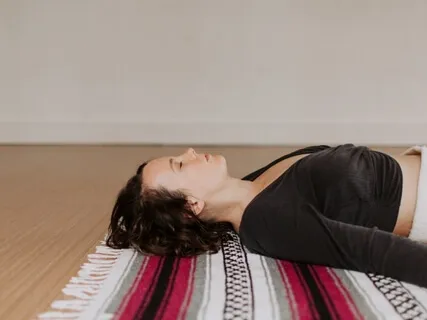
Making yourself comfortable on your back,
Supporting under your knees if you need to,
If you feel any pain in the low back,
And then also lifting the front hip bones a little bit and subtly taking the core actions and then releasing that effort so that just sort of organizing the pelvis and the rib cage and then relaxing.
And then bring your head into a ramping position,
The lowest point possible,
Touching on the head.
As you can,
If this starts to get comfortable enough to do without support behind the head,
You can do that,
But at first having a little bit of a lift so that your head's not in strain when you're lying down.
And then bring your palms to face up next to your side,
Plenty of space in the side bodies for breath,
And broaden through your back so that there's space between your shoulder blades.
Good,
And then soften all the effort and gently close the eyes.
And even with your eyes closed,
See if you can just take note of the movements of your eyes and try to hold the eyes still behind the sockets and connect to your sense of sight behind the eyes,
And then direct your breath and sight in and down so that the breath feels low and moves up into the side ribs and then into the upper back and shoulders,
A smooth transition to your exhale,
And at first,
Effort the exhale and lengthen out the exhale as much as you can until you're empty,
And then you inhale in and down again.
So different days,
This will take longer to sort of be able to put this breath pattern and rhythm in place,
Just knowing that it's your indicator about how your nervous system's doing.
And with the eyes contained and envisioning that movement of the diaphragm happening,
And seeing now if you can start to feel the initial part of the exhale be passive.
So inhale,
Diaphragm contracts,
Moves down and fills breath from low to high,
Smooth transition,
No pause,
Like a floating transition between inhale and passive exhale.
Add effort to the exhale as necessary so that it's empty at the end.
And see if you can notice breath moving up the back body as well,
So not just emphasizing movement up the front,
But feeling like breath is being poured into the whole torso.
From low to high.
And then we'll bring a mouth position into place.
Mouth position mimics nursing and taps you into the deep core,
Opening up your nostrils and allowing the diaphragm to move freely.
So bringing the tongue flat and broad on the roof of the mouth.
The teeth are slightly parted and the lips touch.
And then as if there were a hard candy between the tongue and the mouth,
Add a gentle,
Consistent sucking action,
Like you were vacuuming all the space out of the mouth or trying to taste the flavor of the candy.
And that sucking action is soft and consistent.
And notice any change that happens as you take that mouth containment in the nostrils or in the breath rhythm.
And notice the breath rhythm.
And so with containment at the eyes and the mouth,
Connect to your sense of hearing.
So hearing the sounds in the room,
As well as the sound of your breath.
And become aware of your sense of touch and feel your body weight heavy.
And feel all the textures on your skin.
And feel the air come in and touch the lungs and to fill,
Filling with vital energy from low to high.
On your next inhale,
Smell the inhale.
And smell the exhale.
And as you continue to smell the inhale,
Become aware of your feet and ankles as the breath continues to move low to high up the torso.
And scanning up to the knees,
Imagining you were sending that vital energy down to your foundation.
And then the pelvic floor and the hips and the hips and the pelvis.
Fill your pelvis up with your attention and your breath.
Anytime the mind wanders into thoughts,
Bring it back to coming in and down,
Smelling the inhale and smelling the exhale and envisioning the movement of the diaphragm,
Connecting deeply to the sound of your breath.
We'll keep breathing in this way for another couple of minutes.
I'll just offer this tone as a way of calling your attention back to presence.
So if the mind wanders simply gently and kindly,
Bring it back to this active rest,
Seeing if you can start to feel the passivity of the exhale.
.
If you're doing this practice in the evening before sleep,
Continue breathing in this way low to high,
Emphasis on the exhale.
If you're moving back into your day or into your posture practice,
We'll change the pattern of breath to be from high to low.
So after your next exhale,
Imagine you could feel breath come in and touch in the space between the shoulder blades first and then fill the rib cage completely and then move down into the belly.
Take a few minutes to let that new breath pattern sit in and notice if there's any changes in your breath rhythm,
How long your inhale and exhale are.
Still feeling the passive quality of the exhale.
Okay,
And as you are prepared to move towards sleep,
Just do so,
Let yourself drift off to sleep.
If you're moving into your posture practice,
Continue this high to low breath rhythm.
Also consider carrying this into your day.
Say you're at your office chair,
Thinking of breath coming in and touching that space between the shoulder blades and moving down.
This is a more energizing breath.
Just noticing the effect,
If any,
Of your practice.