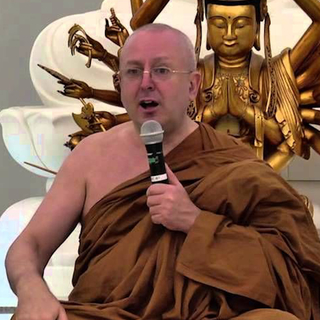
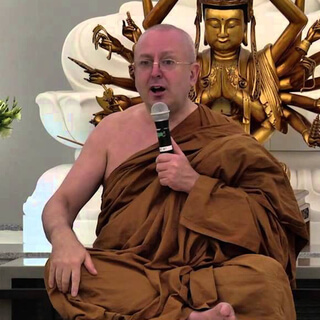
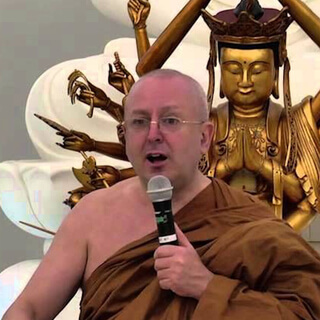
Obviously the first thing about meditation is your posture,
The way you sit,
And there is no magic posture.
I know that sometimes I've had great discussions with people who say that if you sit in one position,
You're likely to get better meditation in other positions,
And that's totally wrong,
Both from experience and from the ancient texts describing how to meditate,
Even through modern science.
I remember reading an article which somebody said to me that actually sitting with a straight back on the floor usually gives you back problems,
And the most comfortable position is about 10 degrees away from the vertical,
Which is as you are sitting on the seats.
That's why seats are so comfortable.
There's a certain evolutionary pressure on furniture,
Especially something as common as a seat,
That those seats became very popular and have survived and are hundreds of years of adaption,
Simply because that angle of your backrest has been found to be the most comfortable and also the healthiest position for your back,
Apparently.
So I just got used to sitting on the floor,
Sitting with my back reasonably straight,
But I just let my body alone.
I just check it to make sure it feels comfortable,
And my mindfulness and kindness is strong enough that I know where my body is comfortable.
So I check my posture.
I don't have some great plan and think that this is the way my body has to be when I start meditation.
I sit it down and I'm aware,
I watch,
And then I know where my body is comfortable when it's not comfortable.
So remember that this posture business,
You find the best posture using the combination of mindfulness and compassion.
That's important to remember.
And you'll find that even during the meditation,
As you meditate more and more,
You'll find that the mindfulness increases and even during your meditation,
You'll find that the body will adjust little by little during the meditation to become comfortable.
So it's really up to you to be aware of your body,
Aware of how it feels and to adjust your posture accordingly.
And sometimes that just happens naturally.
In other words,
You're sitting there and just something inside the body knows it needs to be adjusted this way,
It needs to be adjusted that way,
And you'll find your body becomes quite comfortable.
I certainly remember once when I was meditating a long time ago,
I just noticed my body just straightened up by itself.
And I was mindful,
Aware enough to notice.
I never told you to do that.
You just did it all by itself.
And that was one experience amongst many.
That was the first time I knew that as long as I put my body in a reasonably good position at the beginning of the meditation,
Any minor adjustments would be made automatically.
And that way I realized that I didn't need to worry too much about this body.
I didn't need to control it.
Just put it in a reasonably good position with kindness and mindfulness and then let it be.
And it will do the rest by itself.
And also about posture when you're meditating,
If it does happen that there's something wrong with the posture,
You've got your legs in the wrong spot and it starts to ache or it starts to have some pain,
Please move as soon as you possibly can.
Because by bearing with the ache or the pain,
You just make yourself more tense.
And meditation just gets more difficult for you.
You can't find any peace with a body which is in pain.
So what we do is if there is an ache or a pain in the body because you didn't get your posture right at the beginning,
Then adjust in the middle of the meditation.
30 seconds or maybe a minute of disturbance,
You make that up by being able to go deeper afterwards.
If you don't change the posture because you have a pain,
You will find that the disturbance will stop you getting peaceful.
It will waste 20 minutes or the whole meditation maybe.
So please,
If there is a problem there,
Do something about it.
Don't just be mindful,
Be compassionate.
I often emphasize that if you get your posture right at the beginning,
It's not so much the way you're sitting,
It's why you're sitting in that position is important.
Because you've applied mindfulness and compassion,
Because you haven't had any hard and fast rules that are adaptable,
Mindfulness and compassion at the very beginning on your body will not only set your body in a good position,
But it sets your mind up with these two qualities which will take you into deep meditation,
Awareness and kindness,
Mindfulness and compassion.
And you use those qualities throughout the rest of the meditation.
If you're mindful and kind,
Your mind doesn't wander so much.
I often told people that years and years ago,
My mind used to wander and you used to try and fight that mind,
It would wander away,
Bring it back,
Wander away,
Bring it back.
You know that didn't work.
And so I decided instead of using this force and using this sort of external discipline to use wisdom.
If your mind wanders off,
Why does it wander off?
What's the mechanism?
Your mind is still,
Why does it go off thinking about all these strange and weird things?
Why does it fall into dullness?
Why?
And of course the answer is very obvious.
When you ask the question why,
You get the right answer usually.
But you never ask the question,
Of course you never know the answer.
And the answer obviously is because your mind is not happy where it is.
It's a lack of happiness,
The lack of appreciation and value where you already are is what causes you to go somewhere else.
And so that very simple understanding was the answer to all restlessness.
So with mindfulness and especially with kindness,
I knew where I was and the kindness created the sense of happiness where I was.
Because I was kind to this moment,
Kind to the silence,
Kind to the breath,
Whatever my meditation object was,
Because I added this beautiful compassion,
Real kindness,
Not fake stuff,
Real kindness to this moment.
I was happy to be there.
In the same way that sometimes being in my position,
People ask me questions,
They want to sort of have some bit of counseling,
And sometimes I'm just a human being,
Sometimes I'm tired or busy doing something else.
But the only way to deal with such situations is just to be kind to the person in front of you.
It's amazing,
When you're kind to the person in front of you,
You're happy to be with them.
So when I'm kind to this moment,
Whatever I'm experiencing right now,
It might be a dog barking,
I'm just kind to that,
That sound of a dog.
I may have a sort of heat in the body because it's a hot day today,
I'm just kind to that feeling.
Whatever I'm kind to,
I create this beautiful sense of happiness in the moment.
And that is what really stops my mind wandering off.
I'm just happy to be here and that happiness is generated by some compassion.
Compassion,
Kindness,
Metta is one of the ways to generate this beautiful spiritual happiness,
Which fulfills and satisfies this moment.
So you don't need to wander off,
You don't need to be dull.
Dullness is another form of escape,
Escape from here because you're not happy to be here.
So by learning how to be happy to be here,
You find the mind doesn't wander off.
And of course one of the other reasons why you wander off,
Why you're not happy to be here,
Because you want to be in a better state,
You want to be in a deeper state of meditation,
You want to see the light,
The jhanas,
Enlightenment and all the rasmatas of meditation you may have heard about.
Yeah,
Those things do exist but when you want them,
You can never reach them.
But when you want things in meditation,
You want to be more peaceful,
You want to be deeper,
You want to be whatever,
It's that wanting which causes the mind to be restless.
So as long as you recognize that,
That is why my mind can't be still,
Because I want something else.
That is why my mind is restless,
Because I'm not happy to be where I am.
I'm not compassionate enough.
So please in this meditation,
Develop the mindfulness and compassion to your body first of all,
By getting into a good position.
And then mindfulness and compassionate to whatever you're experiencing in your mind.
And with that attitude,
You will find that the mind will be still.
It won't need to go off into darkness.
It won't need to find escape into thoughts and fantasies,
Plans and memories.
It won't need to do that.
Therefore it won't do that.
It will stay put.
And you learn the beautiful method of meditation.
You learn how letting go happens,
By being mindful and being kind.
Letting go happens.
And just all the restlessness and agitation of the mind and body gradually fade away.
Your mind and body become still.
And in that stillness you feel a deep sense of peace.
And even a more profound state of happiness,
Which will take you on into very beautiful states of mind.
So that's the way we meditate.
Mindful and kind all the way.
So if you're not already in a meditation position,
Please get into it,
Because now we're going to start meditation for about 45 minutes.
And you don't have to worry about the time,
Because when it gets to roughly 4 o'clock,
I will ring the gong.
So you don't have anything to worry about,
Think about.
Of course,
If I do die in the middle,
Then you might not hear the gong till 6 o'clock this evening.
But I have no plans to do that,
So you'll be totally safe.
But that will go at 4 o'clock.
So again,
Now you're sitting right now.
Be aware of the posture.
How to be aware of your posture is to be aware of the feelings,
The sensations in the body,
Which are associated with the posture you're currently in.
Geological sounds of kingdom.
.
.
.
.
.
Just being with your body and being kind and being aware of your body.
Don't let your mind wander yet.
Only when you are sure your body is reasonably comfortable,
Only then let it be.
Using the great simile of regarding your body like a vehicle,
Like a car.
You park your car in a good place,
Not in front of somebody's driveway.
You lock it,
The alarm system is on,
You can walk away knowing it will be there for you when you return perfectly safe.
If you know it's safe,
You don't worry about it.
If you know your body is safe,
You should put it in a good position.
You don't need to return to it until the end of the meditation.
Then we go to what we call the present moment awareness.
It's an important preliminary stage.
No past,
No future.
No fantasizing,
No dreaming.
Remember this is for meditation.
It's not just for goofing off.
Meditation,
Stillness,
Focus.
When you let the past go,
When you realize that now is the place your future is being made,
So you don't worry about the future,
Even the present making your future.
And you understand what we mean by the present moment.
Now you are mindful of the now.
Next,
Give compassion,
Give metta to this moment,
Opening the door of your heart to this moment no matter what it is.
Disturbing noise,
Heat on the body,
Whatever you're experiencing,
Opening the door of your heart to it is called letting it be with a smile of kindness.
.
.
.
.
.
.
.
.
.
.
.
.
.
.
.
.
.
.
.
.
.
.
.
.
.
.
.
.
.
.
.
.
.
.
.
.
.
.
.
.
.
.
.
.
.
.
.
.
.
.
.
.
.
.
.
.
.
.
.
.
.
.
.
.
.
.
.
.
.
.
.
.
.
.
.
.
.
.
.
.
.
.
.
.
.
.
.
.
.
.
.
.
.
.
.
.
.
.
.
.
.
.
.
.
.
.
.
.
.
.
.
.
.
.
.
.
.
.
.
.
.
.
.
.
.
.
.
.
.
.
.
.
.
.
.
.
.
.
.
.
.
.
.
.
.
.
.
.
.
.
.
.
.
.
.
.
.
.
.
.
.
.
.
.
.
.
.
.
.
.
.
.
.
.
.
.
.
.
.
.
.
.
.
.
.
.
.
.
.
.
.
.
.
.
.
.
.
.
.
.
.
.
.
.
.
.
.
.
.
.
.
.
.
.
.
.
.
.
.
.
.
.
.
.
.
.
.
.
.
.
.
.
.
.
.
.
.
.
.
.
.
.
.
.
.
.
.
Understand,
Through direct experience,
How 45 minutes of meditation feel.
And why it feels this way?
What did we do?
What did we not do in order to come to this state of peace?
Buddhism is all about cause and effect.
This is the effect,
What you feel right now.
What were its causes?
This is where one gains insight into the factors which give rise to peace.
State of freedom.
State of inner happiness.
It doesn't matter how deep you are or not so deep.
You still should be able to make that connection.
Letting go,
Being still,
Is a cause of peace.
I am now going to ring the gong three times.
When the gong finishes turning for the third time,
You may come out for your meditation.
So as well as giving your instructions at the beginning of the meditation,
It's always also very important if you wish to develop your meditation to get into the habit when you are by yourself of spending the last three minutes asking yourself how you feel.
What's it like at the end of the meditation?
That serves two purposes.
First purpose is to know how meditation works.
What you need to do or rather what you don't do to develop beautiful,
Peaceful states of mind.
Even if you don't know what meditation truly means,
You get some sort of experiential idea of what peace is,
What stillness is.
This beautiful clarity of the mind,
You're not dull,
You're not sleepy but you're fully aware that the mind isn't moving so much.
It's the mind which has an inner contentment,
What I often call a mind which shows qualities of freedom from desire.
This doesn't want anything,
It's just happy just to be peaceful still,
Content within itself.
To know that feeling is the cause of that feeling and to know what the feeling is like are the two reasons why I encourage this at the end of the meditation.
You find the more that you experience a feeling of peace at the end of a meditation,
The more that the mind knows that feeling of peace,
The more that you will incline towards it.
It's a saying of the Buddha about meditation in the ancient texts.
He said once you recognize that state,
He said the mind leaps to it and it finds stability there,
It finds joy there and finds relief from the world in that state.
It's a phrase which is used so often by the Buddha,
A long time ago,
Alatnapali,
Pakadati,
Santitati,
Pasidati,
Vimucati.
It appears maybe a hundred times in the suttas.
It's as if the mind recognizes that's a beautiful place to go because you've stopped at the very end of every meditation,
You've recognized it.
You've tasted it and you've lingered on that taste until the mind wants to go back there.
So when it comes close,
The mind just leaps into meditation.
Best simile I can get for you,
It's just like when you have a dog and it's time to go for a walk.
As soon as the dog realizes it's going for a walk,
It just grabs the lead and brings it to you.
It's just so happy.
It's going to do something it likes.
But it's leaps to the opportunity of going for a walk.
So say when your mind recognizes just how peaceful,
Valuable,
Beautiful meditation is,
It's as if as soon as you sit down,
The mind leaps towards that stillness.
It settles in it because it recognizes from experience that this is a wonderful place to stay.
Because it stays there,
It finds joy there and finds this beautiful sense of release.
This is a freedom,
Which is why we meditate.
It's a certain sense of release from all of the problems of your world,
All of the stuff you have to do,
All the busyness,
A release from the problems of the past,
A release from the fears of the future and a release from this fighting and running away from the present called desire or craving.
You find release from all of that.
It's as if the mind has always been pushed and pulled just by these demons.
And these demons now disappear,
You find release.
You don't have to do things.
You don't have to fight your peace at last.
And it is a state of release,
A release from suffering,
Which is why meditation is just so pleasant.
So when you really get into this meditation,
That peace and joy you felt at the very end,
You can amplify that ten times,
Hundred times,
A thousand times,
A million times and more.
Incredible peace,
Incredible stillness,
These amazing states of freedom.
That's why they even call the deep meditation as the rimokha,
The eight freedoms,
The eight liberations they call the jhanas.
It's a beautiful phrase which the Buddha used.
You're absolutely free.
And that's what you feel.
A state of deep freedom,
Peace and inner happiness.
So that's what this meditation is all about.
That's what it leads to.
And this is how it's achieved.
Simply by being compassionate and being mindful and putting those two together.
You don't need to fight the mind.
When you're happy to be here,
You're here and the mind becomes still.
These things just develop and develop and develop.
So that's a bit of training in meditation.
So any questions or comments about what I just said?
A question about the relationship between stillness and peace.
Exactly.
Exactly.
So these are two things which feed upon each other.
The more still you are,
The more peace you feel.
The more peace you feel.
Of course peace is a state of happiness.
It's one of the joys.
Sometimes people think that peace is just boring and dull.
As you would know,
Peace is delightful.
So peace is a joy.
Because it's a joy,
You're even more happy to be here than you,
More still.
So if you've got this,
The trick is to add value to recognizing something worthwhile.
It's more the case that peace is incredible number of levels.
You think you know peace and then you get to a stage which is more peaceful,
Infinitely more peaceful than peace.
You think that's the limit and then you get to another state,
Infinitely more peaceful than infinite peace.
So we don't really know peace.
The same with stillness.
You can always be more still.
You can always be more peace.
You can always be more still.
You can always be more peace.
So the feedback loop is just the best simile there.
So however peaceful you feel you are,
There's almost always more.
Same with stillness.
If you think you're still,
Know there's more stuff to come here.
Some of the great joys of meditation is a personal experience.
Sometimes you think you can't get more peaceful than this.
And then something happens and this is more peaceful.
These things blow your mind.
You always thought you knew what peace was,
What stillness was.
You find deeper levels.
So they just work off each other.
But the main,
The most important piece of advice is,
You're all agitated.
There's no stillness there at all.
It's hard to make stillness.
It's much easier to make peace.
So work on the peace.
Out of meditation when the senses are on fire,
You just learn to just,
First of all once you know that,
It's just irritating.
And then after a while you just have a little bit of sense restraint.
So you don't put them in places.
In other words you don't like to match in the bush.
So in other words you don't take your mind to places where they really start a huge conflagration.
That's what we call restraint.
You hang out around peaceful places,
Calm places,
Places of nature rather than North Bridge on a Saturday night.
So that way you're calming down a bit.
You don't go to shopping centres.
Because you were with the monks for I don't know how long.
And sometimes we have to go to these places for something or other.
And it's one of the worst places.
I must admit there's one place I get aversion to shopping centres.
Usually you've got something to do there.
It's head down.
And I know the place I've got to go and just straight there.
No looking to the left,
No looking to the right,
Head down,
Whoosh.
And get out as soon as you possibly can.
Sense restraint,
Yeah.
So you don't allow the burning senses to create a big fire which burns you up.
It's interesting that most people don't realise how they think the sense is good fun.
Go out and enjoy yourself.
Go shopping.
I just can't understand that why people go shopping for fun.
So I went up recently to give some talks in Malacca.
And my group over in Singapore,
They heard I was going up there.
So they hired a bus,
Went from Singapore to Malacca.
It's only about 3 or 4 hours.
And then after teaching them this beautiful meditation and great talks.
And then they were leaving early.
What are you leaving early for?
How are we going?
Shopping.
Now these are Singaporeans okay.
They go to Malaysia to shop.
And the Malaysians or Australians,
You go to Singapore to shop.
So you go to the best shops and Australia goes to Singapore to shop.
Why didn't you shop at home?
And you realise it's not because you get cheaper goods or more range of goods.
It's just shopping because it's fun.
So it's just all that sensory import.
Bang,
Bang,
Bang,
Bang.
People get addicted to it.
I couldn't believe that.
What are you going shopping for?
I couldn't tell them not to.
Shopping and eating.
And after eating,
More shopping and more eating.
Those of you who are Asians or you've been to Asia,
It's just amazing just how many meals they have a day.
Teaching a bit of meditation and talks,
We finished at 10 o'clock.
And I had a nice place to stay.
But most people were staying in the temple.
They all had big rooms,
Their own dormitories.
But they made an announcement the next day that a few people were late,
Coming back.
They actually had to climb over the wall of the temple at 1 o'clock in the morning.
Where have you been?
Eating.
So as soon as everything was finished at 10 o'clock,
I was wiped out.
I wanted to go to bed and have a sleep.
These guys,
They just go out to eat.
It's not as if I had just a breakfast and just a very,
Very small lunch.
I just saw what they ate.
It's really unfair that I put on weight so easy,
But I don't eat that much.
What these guys eat,
They eat what I eat in one meal a day about six or seven times.
So I don't know how they do it,
How they just manage to not put on weight.
But that's what they did.
And we finished at 10 o'clock,
So they must have been there for two hours eating in these shops.
And of course,
You know in Asia there's always a restaurant opened all hours of the night.
So anyway,
Shopping and eating and eating and shopping and crikey.
So that's called burning the senses and also burning your money as well.
It costs a lot of money.
So it's great in Australia.
Actually the restaurants actually close.
It's just weird.
Anyway,
Any other questions?
Going,
Going.
Okay,
Let's finish off.
It's 4.
15.
So thank you for coming and another session this same place,
Same time next week.