In the dark room there is no teacher but darkness itself.
No book?
No screen.
No faith,
No horizon.
There is only what arises in the mind.
And the awareness that witnesses it.
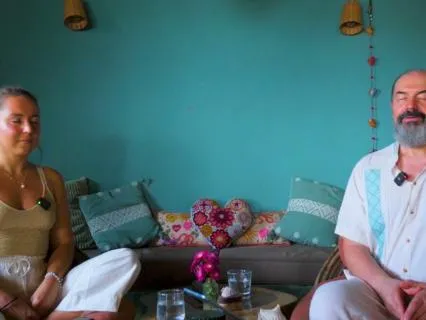
Sahaja Nanda has just completed a three-month dark retreat.
Sealed in a room without a single photon of light.
This episode explores what that means.
Experientially and spiritually.
Bringing the experience back.
To you.
Please close your eyes.
Keep your back straight.
The verticality of the spine.
Gives a sense of.
.
.
Inner verticality We are fully present,
Fully aware.
Relaxation.
.
.
Bring the awareness.
In the middle of the chest.
A little to the right.
The openness of the heart.
A reconnection with the depth of our being.
From the depth of our soul.
I consecrate to God the very essence of all beings.
The fruits of this recording.
Challo.
Awareness of that.
We gently open the eyes.
Sahaja,
Welcome and thank you for sharing yourself with us today.
I guess the first and most obvious question is,
Well,
Why a dark retreat?
What is a dark retreat and why that choice?
In a way,
You just explained this.
It's an invitation to explore a very profound intimacy with yourself since the external world appears as non-existent or the disturbance of objects is less and less there.
And yes,
In that solitude and that sensorial deprivation.
Many inspirations may appear,
You face deeper aspects of your being,
And then you let the heart unfold more and more.
So essentially,
That's why.
Um.
.
.
Was it your first one?
Was that one different than some other ones?
You had shared with us previously that you had lived many years in a cave also.
How was that different than totally in the dark?
Yes,
I did many retreats in caves,
Mostly.
I did also some retreats in darkness.
Um.
.
.
The first one,
It was long,
Long time ago,
Around 18 days.
And then I also did much smaller,
Three,
Five days,
A long time.
The difference between cave retreat and.
.
.
Dark retreat.
I wouldn't say that dark retreat is more necessarily more radical because a cave retreat has it's also its own charm and the beauty it's a deeper sense of solitude,
I would say,
Because.
.
.
Somehow when you know that around you there is absolutely no other human being.
That in itself is giving us a sense of surrender and freedom.
And then also these conditions in Kiev,
I remember the first retreats in Kiev.
There was no tent or something like this.
I was just sleeping on leaves.
And That connection with nature is very,
Very,
Very unique.
And then also not having as in a dark retreat you have still a hot shower or things like this there it's not so yes on the one hand cave retreat is more or less of a bourgeois sort of environment.
But of course,
Dark retreat.
Is.
.
.
Stage in which there is no escape for the mind.
In that sense that,
Oh,
I just enjoy the sunset or look at some birds or.
.
.
Just It's beautiful in itself,
All these are so beautiful,
But the Dal Retreat brings a different level of maturity.
And looking at yourself in a more simplified way,
I would say.
How was that for you?
What is it that you felt,
That you experienced when you mentioned looking at oneself in a more simplified way?
What is removed?
What thoughts,
What identities,
What is removed?
And what do you touch to?
Yes,
So.
.
.
Yeah,
In order to speak about this,
I'm going to start unfolding what happened during this Retreat.
Yes,
I know there was a question how this unfolds after one month or after a few days,
Where the first days were and so on.
But for me because there was such experience with it.
Meditation and retreat.
I approached in a quite direct,
Abrupt way,
So there was not a transition period or time to adjust,
I knew,
I knew what to do.
Darkness means.
So it was a total surrender to that.
Um.
.
.
I feel that it's relevant to mention that I didn't see this as a challenge or as a provocation,
Of course.
I didn't know what.
.
.
Physiologically may happen in three months of darkness for this body.
I was quite confident that with the mind and everything can be witnessed.
It's like,
You know,
You think now let's say we are in the.
.
.
Middle of March and then three months.
Like mid-December,
So being since mid-December till now in darkness,
How would it be?
And I would contemplate,
Oh,
It's still okay.
It's possible,
It's possible.
So this was a kind of contemplation before.
And then.
.
.
You enter there.
Not with the idea of I am going to challenge myself or I want to show something.
But with a deep sense of humbleness.
And Actually,
This was,
I would say,
The first What surprised me was this.
Invitation to go in a total sense of repentance and humbleness,
But somehow like an archetypal.
Humbleness and repentance,
Like nothing,
Nothing.
You are nothing.
There is nothing of personality that matters.
So there was not,
And it's not wise to start such a retreat thinking that you need or you have to manage this.
Is about a surrender,
It's about a trust with this sense.
I am not alone,
To put it in a dualistic way.
No,
I am not alone.
I am with God.
Or better said,
There is this divine dimension of my being,
And I surrender to that.
Whatever will happen,
Whatever will be,
It will be.
And that gave a sense of flow,
Like a sense that it's not my responsibility here,
It's just what is going to unfold.
It will happen.
And then.
.
.
Um.
.
.
The retreat.
Start it And.
Some surprising Things happen.
As I said,
For me was not a need to do this retreat.
It was just that was offered to have this three months period.
Not teaching in the school and then I thought It doesn't make sense to just go on a trip.
I can go in beautiful places in India or see beautiful nature.
But I didn't feel that this is.
.
.
Really.
How to honor this time.
So I was longing for an intimacy with the heart.
And also I felt that this can be also.
A model and an inspiration for students and for people in Trinidad and in general.
That yes,
It is possible to stay in solitude for so long.
When you learn to witness,
When you learn to witness.
But I didn't.
Expect more than this.
So I was surprised.
When It came to me that.
.
.
In this retreat,
I should.
Look at the mind and try to stop completely the mind.
That is not something absolute and is not something that.
.
.
Needs to happen.
Even in meditation,
There can be thoughts and that background of awareness.
So in itself,
That quietness,
The absolute quietness of the mind,
Is not a request in itself.
Spiritual tradition and of course when we are in daily life functional thinking is there.
But being there,
I saw that there is no reason to have thoughts.
And I was looking at the thoughts I had.
And.
.
.
I cannot speak about,
You know,
Traumas or big problems that are needed to be resolved.
Nevertheless,
I could feel or I could see thoughts about what I should say in a certain circumstance or maybe it's better I should have done better like this and thoughts like this would come.
And Then also very interesting was like I would try to report what is happening.
Explain,
It's like my dharma of being a teacher,
To explain to people,
To students what is happening and how is it,
So it's like I would give a teachings there,
And they realized that this is not needed.
And it happened while sitting in this,
Like we may say,
Child pose,
Keeping the head on the ground.
That.
There was no thinking,
And then for more than one day,
There was absolutely no thought.
So I realized that it's possible,
And then the thoughts came.
I realized that it's possible,
So it was very much about this journey into this.
Well,
There were many different streams in the same,
You know,
In this how the memory was functioning or how this pure I.
So I'm going to speak up about each of them.
Um,
So what was the radical shift which brought the calmness of the mind?
Was.
.
.
An understanding that you don't need to make peace with each and every event of your life.
But to drop.
Everything at once.
Because otherwise,
You know,
You reiterate things,
But then it comes again and again and again.
Somehow endless.
You say that you think that,
Yes,
That was solved,
But then it appears again.
So acknowledging an aspect doesn't mean to resolve it,
Especially with the unconscious.
So.
.
.
I came to this sense of pure being,
To this nakedness of being,
To this I am.
And starting staying in that state.
And in that I am.
Which didn't have a reference to past,
To future,
To time or space.
It appears that these.
.
.
Thoughts?
Are not really relevant.
It was like.
.
.
You don't need to take.
Page after page from the book of your for your past you can throw all the book away at once or rather it's like you realize that you are not the book,
But you are the one in which that happens,
You are the reader of that,
You are not that.
So for example Buddha didn't need to make peace with all that happened.
He left the palace.
Disappointed his father who hoped that he will become a great emperor and he abandoned his wife and he went in all that process and that realization came before he had clarified all these things.
And there are countless examples like this.
So this idea that you don't need to make peace with each and every part of your life,
Maybe an inspiration for many who.
.
.
Try to consider that we first need to clarify or make peace with different pieces of our life or keeping a sense of guilt or keeping a sense of spiritual perfectionism.
Spirituality is not about.
Making peace with all this.
It's about learning how to drop.
And when that.
.
.
Was understood,
It was like.
.
.
Conscious,
Decision.
Well this happened in the spiritual journey also,
But not in such a radical way.
It was just a conscious decision.
A way of dropping,
A dropping not as a rejection,
But a dropping in clarity.
That I am not that old person.
Yes,
There is a memory,
There is a continuity in terms of a body.
But I don't need to resonate emotionally anymore with that.
And then it was like I was looking at my past,
Like.
.
.
Reading a book or studying something,
History.
And it was just like this.
This is the way in which Mind.
Calm down.
So it's possible.
And then with this,
A lot of things.
A lot,
A lot of things.
But before speaking about that,
Still I feel the need to speak about what happened with memory.
There was also a whole journey.
Because initially a sense of transcendence was there.
And I realized that I forgot many things.
For example,
The name of some Fridaya teachers who I'm interacting very often with.
And it was one day I was trying to remember,
What's the name of that person?
What's the name?
This was not.
.
.
The first time when this happened.
I know in retreats.
Such things may happen.
It's a sense of.
.
.
Transcendence.
I still felt that,
No,
This is not the way.
That memory should still somehow remain there.
And there,
Then,
There was a time.
.
.
In which a lot,
A lot of memories came.
So a flash a lot a lot of memories with so much accuracy,
With so many details.
I never experienced before.
So I would remember.
The name of the dog in my adolescence and then in a blog.
Plates with the name of the families of the neighbors.
I never met,
But I would remember the name of every person who was the neighbor or whatever.
So a lot of of clarity,
But with this I could see also how this sense of me starts being activated and how this memory tends to crystallize again a sense of me.
And that was a good lesson.
And then I realized,
Yes,
Memory can be there,
But without this this crystallization of a me of individuality.
So all these helped.
To.
.
.
Honor more this sense of a pure I,
Staying in this stillness.
And It was a time also in the beginning.
When just saying,
I am.
Brought so much fire.
So much fire,
Fire,
Fire.
Quiet.
And I couldn't sleep because of fire.
It was so hot,
So hot.
Like a burning of everything.
In just this presence,
In just this I am.
Then.
.
.
I realized that this I am It's not personal.
The true I am.
Is cosmic.
In the sense that It opens us.
Too.
Majestic dimensions of our being.
So being in the heart.
In this pure I am.
It was like.
.
.
The most powerful was the sense of eternity.
It was like.
.
.
A fascination for eternity.
But eternity was there,
And eternity was there.
In in everything,
Everything was pointing to that.
So in that.
Stillness,
Of course the darkness,
I would say the veil of darkness that unveils.
So the veil of darkness that unveils.
Darkness as tremendously alive,
Sacred,
Self-aware,
But darkness not as just the absence of light or a physical condition,
But this very This very presence,
This very freedom.
And then it's like.
.
.
You know at night when.
.
.
When The whole nature is covered by darkness,
Plants.
Trees.
Human beings are covered,
Protected by this silence.
This embrace which is Ultimately with sleep it's an embrace of bliss.
In this case was so conscious,
Just a connection with that eternity?
And bliss.
So it's like a discovering of these divine qualities of our heart.
And I would say that this was the most.
.
.
Powerful.
Revelation that came in this retreat that our heart is cosmic.
That in our heart there are these divine qualities.
Infinity,
There is eternity,
There is perfect love.
There is compassion,
There is bliss.
We do experience this,
We have moments,
We have glimpses,
But then we say this is just a glimpse.
It's not a glimpse,
It's the dimension of our being,
It's not just a state that comes and goes,
It's who we are.
Is only that we put these.
Of personality and ignorance upon that.
So there was.
.
.
It's like we sabotage ourselves with personal thinking,
Our worries,
Our way of relating.
All these social conveniences,
Limitations.
Take us.
From this potential to honor the Divine.
And there,
In that silence,
It was so obvious,
So obvious,
So obvious.
I remember.
Even after such meditations,
I even had a dream.
And now.
It may sound very naive,
But there was so relevant.
I was teaching,
Again,
I was with a group of students,
With many people,
And I would say to them,
I'm going to show you now God.
Do you want to feel God and to know God?
Let me show you God.
And that's just simply say,
Go into your heart.
Go into that depth.
You feel that.
You feel that tremor,
You feel that.
.
.
Infinity.
Open,
You feel that Eternity there.
That love.
In its essence,
That is God.
And that seemed so obvious there.
So that was like for me like a demonstration I would show to say to everybody which of course when you filter with the mind doesn't make sense but there What's so obvious?
So this sense that.
.
.
Real duty as human beings.
Is to honor.
This essence is to honor these divine qualities.
This appears,
Of course,
In many traditions.
For example,
In Sufis,
Ibn Arabi,
A great philosopher,
Speaks about the divine qualities,
These divine names,
Which are basically this pure love,
Pure compassion.
Absolute beauty.
Perfect light.
Spiritual light,
The witness all.
As seals.
In our heart.
So the heart has all these qualities.
And it's just our duty to reveal them,
To discover and to.
.
.
Make them alive,
So make that vibrant aliveness there,
To acknowledge that.
It's just like this.
And then I don't know if you saw this Avatar movie,
But it's that moment in which,
You know,
Those beings are used to travel on their birds,
Each of them flying with their own bird,
Which is somehow like a symbol of this mind and individual vehicle,
But then it was that essential step of the avatar who just jumped on that huge bird,
That toru.
So it was that feeling when I am is not taking an individual Um.
.
.
Vehicle and identifies with a personal mind and tools.
But jumps on this.
Huge bird of consciousness.
And then this freedom that is there.
And then also it appears very much this.
.
.
Image of Jesus Christ.
As one who took this toruk,
To put it like this,
This huge bird of universal consciousness.
So.
.
.
It was not a connection in a religious way,
And of course with all the reverence,
But Jesus appeared,
Jesus Christ appeared at this moment.
Archetypal I am.
He actually speaks like this.
I am that I am before Abraham was I am.
So that archetypal I am.
Then it was also that sense of connection when he would say me and my father and me are one.
And all that sort of.
Communication is like entering a realm of divine mysteries.
How that,
You know,
My father brought me here or told me to come,
What kind of connection is there?
How that happens.
In the dark retreat that became so alive,
So vivid.
This.
No,
I am.
As radiant and revealing this.
And then with time.
When there is no mind.
.
.
Also where time can be.
It was a very beautiful circumstance that that retreat,
Usually,
I also did other dark retreats,
And usually I would be aware of daytime and night,
You know,
Some sounds.
But in that particular period of the year,
In that retreat,
I couldn't realized I couldn't hear.
Too many sounds from outside.
So I couldn't have a reference.
The only reference points from outside where the moments when milled.
Would come.
But then there was on Fridays for example,
I would fast.
And then,
Yeah,
The day would go and then I would think.
Now is the time to end the day.
But then I would.
Still,
I would hear,
Oh,
The doves.
This means it's morning.
Let's meditate.
A little bit And then the food would come,
The next day was there.
And.
Slowly,
I didn't sleep at night.
I didn't,
I started to.
.
.
To do.
Keep the sleeping at night they were mostly naps so naps during the day.
And the night was mostly for.
.
.
Meditation and I remember there was a poem of Rumi on this question what time What time is it?
And then in that poem said.
.
.
It is time for prayer.
So it's time for what time is it?
It is time for meditation.
It is time for meditation.
So going again and again.
And then it was also a sense that,
Well,
But I should be.
Adjust with the,
You know,
Rhythms,
Biological rhythms of the sun and things like that.
So on.
Then I realized,
No,
The sun,
The real sun is the sun of consciousness,
So let everything Go.
Guided by this sun of consciousness,
The sun of the heart.
And let everything flow.
In this way so they were mostly naps and then with a feeling that I'm eating time.
Even this came as an idea.
I'm eating time.
It was the heart eating time.
It was this darkness eating time.
It was this stillness.
Presence.
And then time.
Becomes stillness.
The space.
Becomes illness and love.
And about space as well.
Um.
.
.
In the beginning,
Of course,
Because I have.
.
.
Some experience in such dark retreats.
I know that You know,
Entering there,
It's like entering in the womb,
Or entering is not about fighting darkness,
It's just about the joy of entering.
Diving into that.
But.
.
.
It came to me.
In the first days.
That I should honor.
This space as a space of Shambhala as a space of a sacred realm.
Shambhala is in the Tibetan Buddhist tradition,
A realm of bodhisattvas,
Is also corresponding with a dimension of our being,
This realm of thought.
Purity and compassion.
Authentic spiritual aspiration.
And I felt that.
.
.
This is like a projection of Shambhala.
And I even asked,
I wrote,
I asked for.
.
.
A yantra of Shambhala to be there,
I couldn't see it.
But I could feel it.
And yeah,
This was,
I mean,
In the first day,
The first night,
I had a dream about Shambhala,
And that was the inspiration for that.
And then in the next day was a dream about living in the cave of It sells like an old mug.
It was mostly the.
.
.
A Christian monk,
It was mostly the sacredness that I could perceive in that.
So that was also like adding something.
To that quality of that space.
And that space was not.
.
.
Was not seen as a space,
It was like.
.
.
Accessing the core of it.
Of existence,
Like living exactly as you would go deep in meditation,
Deep in your heart.
And then you feel that there is at the very core of your being.
The very core of everything.
Are in that space and it's like an actualization of that.
So i would feel How?
I would see the world from inside out.
So like everything shifted.
So I would see from the very essence.
.
.
Coming to that core of being to that very essence of being and then seeing the world.
Yeah,
That space and everything.
From that.
Being grounded.
In that stillness and oneness and love.
And then everything was just an expression like I would feel like a transcendent language of God in all that.
Would be there,
Everything touched by that.
Conscious light and benevolence and beauty and love.
Sacredness.
And joy.
There were moments when I would.
.
.
Go to.
.
.
In the end of whatever day would come.
I would consider,
I would go.
.
.
And then just tears of gratitude.
And bliss,
So much bliss.
I would say,
Oh,
It's still the middle of the retreat,
Or what will happen?
It will be like I would explode.
But literally,
There were moments in which I felt that any miracle is possible.
When I feel that I would physically disappear,
And then reappear,
And.
.
.
So not with that sense of,
You know.
.
.
Attachment to a miraculous or this kind of person's stories,
But with a sense of.
.
.
Of an intimacy in which.
.
.
Everything flows.
And the mystery is the key.
Of everything is the law of God.
Of how everything unfolds.
And this gratitude and this.
.
.
Please.
Yes.
That's beautiful.
Thank you.
You had mentioned earlier in our conversations that you really felt a big difference between solitude and aloneness and somehow that that was something that distinguished also your experience in a cave or in the darkness.
Would you like to share a bit more about that?
Yes.
Yes,
It is an essential difference between.
.
.
Aloneness and solitude.
Well,
They are just concepts,
But we can associate different significances.
So there is a sort of feeling,
We'll name it aloneness,
In which this aloneness feels as a sort of separation from the world,
A sense of alienation,
It feels like it is imposed.
It can feel even when you are with people,
You feel somehow distant but in a painful way and in an alienating way.
And aloneness even with yourself or from yourself.
Um.
.
.
Which feels like a punishment and that's why people tend to avoid being punished.
Alone.
There is another dimension,
This dimension of solitude.
Which is an accepted and embraced and conscious.
Aloneness,
Which turns,
Which is sublimated in a joy of being with yourself.
Then what you look is not emptiness it appears for the mind it appears an emptiness there is no stimulation,
There is not so much to do.
And the mind tends to interpret this as a nothingness or painful.
The ego is threatened in that.
And is afraid.
And doesn't have a reference point.
But in solitude.
Find yourself.
In solitude you are,
We may say,
Never alone because you are with yourself.
We may say we are with God.
It is a chance to discover what I just mentioned.
Freedom,
That dimension of eternity or infinity and all these beautiful qualities or cosmic qualities of our being.
And that makes Solitude.
An openness.
You may be in a cave but then there is so much love for any human being or for animals and so much connection because somehow we enter to this core of existence,
There where everything connects,
And everything is in that beauty and freedom,
And it's in the very nature of life.
The Spirit.
So then solitude is,
Yes,
Is regenerating and empowering.
Solitude,
Yes,
Was embraced not only by yogis and it's,
We know,
A whole tradition of people went in solitude in different religions and mystical lineages but also artists may feel this because it's a Profound regeneration is a way of healing.
Dropping what is superficial or starting to understand what is really relevant and what not,
And then it's more spaciousness there.
Because Our soul is not.
.
.
Caught in I need to do this or that or.
.
.
Adjust.
Follow some social media.
Habits are,
But I am free.
So,
Of course,
This requires a sort of education we learn,
To move from aloneness to solitude,
To discover.
It's an art to open to that.
At ease.
It's a beautiful,
It's worth for us as human beings.
It's such a beautiful distinction that you're making.
Thank you.
Yeah.
It's interesting that even Reine Maria Rilke said that two lovers should be the guardians of their solitude.
And then also Khalil Gibran speaks about being as a couple like two pillars of the temple,
Not so close.
So space is also emphasizing this.
It's relevant and sometimes we tend to forget this.
Beauty of solitude.
Sahaja,
What is a last thing that you would invite our audience to contemplate on concerning this topic?
Well,
Maybe this topic is a little bit abstract considering Now the.
.
.
Challenging.
Sort of approach.
Now three.
Three months in complete darkness.
That I just invited.
To.
.
.
Try Solitude.
To open to that and even.
.
.
Dark retreat.
Two days it's something that Anyone can try.
And remember,
Always the door is open.
You can leave anytime,
So it's no pressure.
But it's a beautiful exploration.
And apart from this.
.
.
Um.
.
.
Something intimate.
It came in this retreat.
A prayer,
A prayer to share with you.
Students or with whoever wants.
A prayer that can be done.
In the morning or.
.
.
Anytime.
You simply come in the heart.
And it's like an invocation.
On my heart.
Awake.
Be vibrant.
Be open.
To the infinite divine love.
Be open to eternity.
On my heart.
You Thank you,
Sahaja.
Thank you for sharing yourself with us today and sharing your wisdom.
Thank you.