We are moving towards our death in every present moment.
This can sound a little morbid as an observation,
But stay with us.
It's actually a very true key for freedom.
Death is the most liberating truth available to a human being.
The person that shared that is our guest today.
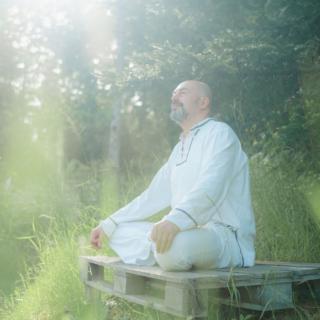
I'm sitting here today with Claude Vaduva,
Who wrote that the present moment itself constantly dies in our awareness and constantly gets reborn in our awareness.
In this episode,
We want to share with you what happens when we stop running from that truth.
We will talk about death in the present moment.
The fear of death.
And practical tools to contemplate in your daily life.
We will talk about what it means to be dying.
And at the same time being more alive than you have ever been.
Before we begin.
Please note that this episode includes reflections on death,
Mortality,
And the impermanence of life.
These topics may feel emotionally sensitive for some listeners.
Please listen with care and honor your own needs.
Thank you.
Claude,
Welcome again.
I'm so happy to have this conversation with you today.
Thank you.
Welcome.
Why is it so important to talk about that?
Because it brings a clarity of direction.
Because we live in a delusion.
That somehow we will live forever.
And our actions.
Somehow have a continuity in the future,
Which we are not 100% sure that they do.
It is such a.
.
.
Uncertain.
Thing in our lives,
The continuity of our lives,
We can be dead in half an hour,
In 15 minutes from now,
For any number of events.
In 24 hours.
And.
This is so unsettling.
That within.
Our mind.
Within our being.
We have to create an illusion.
When we impose that illusion upon ourselves,
We can call that delusion,
If we want.
That we have a future.
And in a way it makes sense,
You wouldn't want to invest effort.
Into something that doesn't have a future.
So because of this,
Our ego,
Ourselves as a persona,
Lives with this veil.
This taboo,
This veil.
With this imagination.
That we will be around tomorrow,
The day after tomorrow,
And so on.
And we are hiding ourselves from this possibility,
From this reality,
That this may not be so.
We are living for our future self.
We are living into a future that doesn't yet exist.
Exist.
And contemplating about this can bring an awakening,
Can bring a clarity.
Can also bring.
A deeper sense of life and beauty and recognition of.
The miracle that is here now.
So.
Is not about not.
It's not about entering into a morbidity.
And it's not about.
Living life with the fear.
It's not about nothing.
Investing to the future or doing things for the future.
But naturally a detachment.
Starts to arise there,
A different vision of life starts to arise,
Almost like a spontaneous karma yoga.
Beyond success or failure.
Beyond expectations,
I will start building this house.
Whether you get completed or not.
I don't know.
But between.
Now.
And the next now,
Or between now and tomorrow,
How do I live my life to its fullest,
Not knowing what life can bring?
It's not about death.
Life can bring anything.
It can bring poverty.
It can bring richness.
It can bring a moment of joy and peace.
It can bring suffering.
So things are always fluctuating,
But there is a particular thing that has to do.
With death that is different than the other ones.
Which has to do with the.
.
.
A deep spiritual question,
Is there something more after death?
Is there something more to lie?
A cartel a very wisely said.
Um.
.
.
Life.
Is not the opposite of death,
But birth is the opposite of death.
And life is,
Life is,
You see.
From a spiritual perspective,
We are facing the ego.
With its deepest fear.
We are facing the ego with,
We can say,
With one of the very single.
.
.
Or one of the most important impetus that makes the ego alive,
Which is the need for survival,
The fear of death,
You see.
So.
We are living as if we don't have death,
As we are not dying.
Because it's horrible to face.
The actuality.
That actually this ego comes.
Completion,
This body will come to a completion.
And this life cycle come to completion.
So then there is a.
.
.
Contemplation that starts to arise.
Everything I invest myself.
Into right now.
Everything that I consider most important.
Supremely important.
What happens to this investment when I die?
So.
When you get angry right now and you feel so.
.
.
Or upset and you feel so justified.
So justified in maintaining this upsetness for a day or two or a week or a month.
Maintaining that separation against that person,
Maintaining that thing that they did wrong to you and that you can never forgive,
And how dare they?
Or you are afraid of getting hurt.
You got hurt in a relationship,
You give it a try and someone betrayed you.
And then you go into another one,
And guess what?
That one didn't work out either.
I'm disappointed,
Double disappointed.
Betrayed again.
By love,
By society,
By the one that I owe for myself,
And again.
And then.
We start to develop a kind of protection.
You know,
It's like.
.
.
I'm about to enter into a relationship and I come with my list of checkboxes,
This person shouldn't do this,
This is a red flag,
And so on and so forth.
So instead of approaching life with a heart,
This availability with that authentic.
Authentic Connection.
With their vulnerability.
Mind measure ourselves from the mind and protect ourselves.
I'm not saying to To not be wise,
A fool wouldn't.
Take precautions where it's clear you should take precautions.
But sometimes we protect ourselves and we.
.
.
Go onto the path of protection of the ego,
Survival of the image.
Of the reputation,
Of the status and so on.
And then.
There will come a moment when death will come.
And what are you going to say?
On your deathbed.
You're going to say.
In this lifetime,
I manage.
To not enter in any relationship.
That could hurt me.
I avoided so many ways of being hurt.
And then.
Like,
Ha!
And then you die.
I avoid it.
Not entering in any vulnerable situation.
I protected myself.
You died.
Did you win?
Is that what life is for?
Is this what this life is for?
What would you say to yourself?
How are you going to feel about your life?
At the time of your death.
Was there a good life?
Did you have regrets?
Did you feel happy,
Joyous?
Which way did you live?
Again.
You'd be foolish and you'd be kind of going to the other extreme to say,
Ah,
Because of this,
Let me live my life.
Where I don't take care of protecting the body.
You love the body,
You want to protect the life,
The physical body,
You want to take care of everything that gives statistical probabilities that you may incur death.
Or increase that unnecessarily.
You don't need to do that.
You don't need to climb crumbly rock.
Cliffs and things like this you could if you want to but you take the responsibility of death day so i'm not saying it to live life in that way where you unnecessarily expose yourself.
But psychologically,
Emotionally,
We can develop a kind of resilience.
We can develop the capacity to be more vulnerable.
We can develop the capacity to.
.
.
Because we don't know.
And.
.
.
We can start to live more alive,
More immediate,
More authentic.
So let me ask you a question.
Which I know you've heard before,
But maybe.
How would you live your life if you had three more days to live?
What would be your main considerations?
If you only have three days,
Is right now 6 p.
M in this Mazunte time here in Mexico.
And in three days from now,
6 p.
M.
You will expire.
Today is Saturday.
Sunday,
Monday,
Tuesday.
How are you going to live the next three days?
How are you going to live the rest of Saturday,
Sunday,
Monday,
Tuesday?
What are you going to do?
Are you going to live life exactly the same way?
The answer that comes to me is love.
To love more.
What does practically mean?
What will you do as a human being for the next three days?
Love?
Okay,
It's conceptual.
It's a very nice thing.
I agree with you,
But practically?
To tell people that I love them,
For real,
To maybe have funny conversations.
The first people that I think about are my mom and my dad.
My mom and my dad.
Anybody else?
My friends yes i mean you can say to anyone but you're going to have a list of priorities because you don't have the entire time and then i guess a priority would also come with the things that i tend to postpone more and now you know when we have the illusion or when in this case when i have the illusion of time i can always tell myself I can have that conversation with my dad or with my mom in that case.
In a week time,
In a month time.
But when the imminence of death is right now,
It's do it now.
And why?
The question would be why?
Because I believe it matters and I believe in.
.
.
Speaking the truth.
So healing them or healing you?
No healing me,
I have no control on them.
They can just receive me fully,
Authentically.
So at the time of death,
You feel more at peace?
So you want to die at peace.
And also.
We also become clear that we are postponing certain things,
And that we are not loving enough.
Yes?
So,
Why not after this very podcast and interview that we are having,
Not call up your parents and tell them,
Or tomorrow morning when they wake up,
To have that conversation with them.
Why postpone?
I mean,
In this case,
I kind of know it's on the list,
You know.
Postponing would have no sound reason or wise reason.
I feel in those reflections,
Kind of force me to look at the truth and to be then do it.
And postponing it one day,
One more day,
A second more days,
If that is a priority,
The day that I die.
Then it is a priority tomorrow morning too.
The veil of or the illusion of time.
Just goes away.
And the priority and the importance of life and the things that you're going to spend time on.
So you spend countless time on doing things that have very little importance.
You're just looping around thoughts that come to you.
And what if you live your life where you say,
Not in an impatient,
But in a loving,
Compassionate way,
But with a great clarity.
I'm sorry,
I don't have time to think.
Distorts.
I don't have time to care.
About who got the bigger apple.
I don't have time to judge you.
I don't have time or interest to spend my lifetime,
To invest my life force.
Into this.
Dead-end things that lead to nowhere.
I don't have time to play other people's programs.
I don't have time to pick other people's flags.
When I haven't yet called my parents or said the peace or made my love,
Said my loving words to myself or others.
So,
It immediately is like something starts to arise there.
So living in death starts to bring things that are very important.
Of course,
Spiritually,
One of the Big question is what am I doing on this planet?
What direction do I have as a soul?
What is happening?
Is there something am I needing to accomplish in this lifetime here?
Of course,
As soon as I ask this question,
The answer is,
Is there something physically accompanied?
A book,
Art,
Whatever,
Family.
But also the question is.
.
.
Is there something my soul?
Is to learn,
To touch,
To unfold.
So death really looks and brings this kind of contemplation.
Brings the reality.
Of the present moment,
The reality of the ego.
And faces that very fear of the ego.
When you face that fear.
It becomes easier to surrender the ego.
So when you ask the question,
Who am I in that practice of self-inquiry?
Or Vatmavichara.
You are more inclined.
To say.
To surrender.
Than to hold on.
To this when an action needs to be done.
You are more likely to stand up.
And do it.
You are more likely to not.
Be concerned with the fear of missing out.
It's like,
Imagine living your life saying,
Well,
I'm already dead.
I'm already dead,
So let's see.
Since I'm already dead.
What an amazing thing can I do now?
I still have.
This present moment,
Time I have.
One more minute,
Five more minutes,
What can I do?
Well,
I don't know how much,
But.
Let's see,
What can I do?
Something that arises for me is radical honesty in those questions and those reflections also.
Because let's take the example that I'm asking myself.
What really matters,
Or as you were saying before,
I have no time for this,
I have no time for that,
I have no time,
Like setting the priorities.
Maybe we can easily tend to fall into that tendency to also avoid or to bypass some things that actually are important for our path,
For evolution,
For healing.
Um.
.
.
Yeah,
Is there any distinction or something that arises for you when I speak that up?
Yes.
One thing arises for me,
All I agree with you,
Definitely radical honesty and priority becomes quite relevant.
What is for you important now in this lifetime,
In this honesty?
But an interesting thing that arose as you said this is,
Would you be healing a patient that is dying?
Patient that is dead already or near death and then maybe 80 years is near enough death and the question is why am I healing?
Why am I doing these things?
I'm not saying to not heal,
But we start to put things in perspective.
What does healing mean?
Healing my ego or healing anything that I'm doing in the name of God?
Want,
You see.
So again,
That clarity of perspective starts to arise.
There,
Maybe certain things can be spontaneously released.
So death can bring healing without needing to go through a healing journey,
When the significance of who you are,
What's happening,
Or where these things are.
You don't need to hold on.
To that pain,
To that suffering.
To that anger,
To the hate they have towards another one.
Maybe the path of forgiveness.
I forgive you.
And gives you the space to love.
And to enjoy life,
To let go,
No matter what horrible thing has happened to you.
Still,
The ego wants to make that right in a particular way.
Through the mind,
Through changing the world,
Through changing the conditions to make sure this is never going to happen again because I need to survive and that was hurting.
That's painful.
And also a very powerful process that can appear there.
You can say,
Let me first be free.
Let me first die to it.
Let me,
If I'm dead,
None of this matters.
But now that I'm alive,
I'm carrying this burden.
I am carrying this burden.
The trauma that I'm carrying.
It's a,
Or that pain,
It's a repetition of something that happened in the past in my mind that I'm re-imposing upon my body.
Of course the body has the triggers and remembers the patterns,
But it remembers the patterns because the mind recollects or something gets triggered there.
It's a complex issue.
Yes,
Still.
It is.
Of freedom that can start to arise.
When we are already ready.
To forgive,
To let go.
To die to it.
And 10.
From that place,
We can start a different healing arises there.
It's not the healing of retribution.
So,
For example,
Someone did something that is not good to you.
It's about healing the world,
Or maybe that person deserves to be put there.
In jail or incarcerated or something like this.
You take care of that.
But you're not taking care of that.
Out of that.
Impulse of the ego to fix the situation.
So that you can feel safe,
Because you are not safe.
You are dying and you are dead.
You're just like a fish on the side.
Calls.
On the earth when it comes out of water just flapping.
You just have another 80,
40 years of flapping.
Yes,
Well,
Maybe I'm being a little bit too extreme,
But this vision about death is extreme because eventually it comes to the death of the ego.
So at some point.
The spiritual path,
The spiritual process.
The comms.
Question that arises spontaneously and without words.
It's a question of surrender,
But a surrender that is so.
.
.
Profound and complete.
In thorough.
Which becomes a question of existence or nonexistence,
A question of.
.
.
Death as existence itself,
As a separate existence itself.
So contemplation about the death or taking to this extreme prepares one for that moment of release.
A way to prepare for that is to come near to that,
And anxiety or fear appears.
So you keep going back and forth,
But you keep going back and forth in presence and in awareness,
And you start to get used to the territory.
So even entering your meditation near that domain and then retracting,
And starts to bring significance,
Starts to make you live with that contemplation,
With that secret,
Maybe unconscious contemplation on nonexistence,
Of dying,
Of the transcendence.
But in time.
You keep repeating the meditation.
You don't shy away.
You approach it.
That you don't want to cross yet,
That's fine.
Yuki Eneso Point.
At some point that contemplation can become.
Clear,
Can become conscious.
You can face that death.
You might still not be ready.
And yet at some point on the spiritual path.
That time comes when you are willing to let go.
To die.
Now you are willing to die with her.
Divine grace comes.
Brings a union and a solution or not.
It is beyond you but you As a being,
As a soul,
You start to clarify your availability for this solution.
Your availability for that death,
For that.
From the non-dual perspective,
It's not about another lifetime,
Or another reincarnation,
Or about people remember me as being the enlightened being,
Or so on and so forth.
It's like non-dual.
None of these conceptual realities or images or perspectives are there to hold anything,
You see?
It just becomes.
Yes.
It becomes a complete.
Availability.
To dissolve.
Completely.
Into non-existence.
To make it somehow practical.
How would you invite any person listening to us today?
Too.
Not only contemplate,
But invite that a little more into their lives.
They can go rock climbing,
Yes and no,
But really like to How can you integrate it into your life in form of contemplation,
But active contemplation in that sense,
Not risking your life out of an unconscious choice and from adrenaline,
But really to just invite death on the practical daily life.
It's a bit of a tricky question because.
.
.
Maybe you're not yet supposed to do that,
But maybe those who are listening to this podcast,
Today's sharing,
Might be ready to do so.
But yes,
Practically,
This exercise that we tried a little bit can be very powerful.
You have 24 hours to live,
And then three days,
And then seven days,
And three months.
So what would you do about this?
Another contemplation about this has to do with what if I didn't know Oh.
That someone I love.
Passed away,
But I didn't know for some time.
That they passed.
Away.
Maybe I was in a retreat in the mountains or they were on a trip.
But during that time which I didn't know they passed away,
But they were still in my life somehow.
I was still connected to them in my heart.
And very alive,
And they were alive to me.
And I connected in my love and everything that was there.
In the contemplation arises is when someone passes away or they have a terminal.
You'll miss her.
How do I remain with that alive,
Loving connection towards the soul,
Towards that being?
Understanding that the physical body is not true.
Yes,
There's the pain that I might not meet them in the physical body,
But what if they took a trip to a country and we never saw each other again and we're never able to communicate again?
How would I hold them in my heart?
And you hold them the same way,
Whether they're alive or dead.
With this body.
Expires.
You see,
So that could be also wonderful contemplation as well,
How to connect.
To other beings directly from the heart and the aspect of death.
Brings this.
This capacity of that.
Intimate,
Alive experience of connection through love.
The heart because ultimately in the realm of the heart or in the realm of the spirit or this depth of our being We are transcending the physical.
The connection is no longer necessarily happening in the physical realm.
The physical realm is just a.
.
.
Translated.
Physical.
Position that.
We identify with this physical body.
You are here,
I am here.
But in our hearts,
We don't have.
To be.
Separated or in different locations,
We can relate to each other in a more intimate and direct way.
And that becomes a beautiful way.
To prepare oneself for.
.
.
For your own death or when someone dies or to support when someone dies.
Connection with that soul and in the Eastern tradition to pray for a better reincarnation or for marriage and even in the Tibetan Buddhist tradition they speak about the first three days after death.
To that.
Awakening to the recognition of the Self.
To enlightenment.
Can you share more about that?
Um.
.
.
Yeah,
I can share a little bit.
So.
Immediately after the death,
The separation.
Of the soul.
I'm trying to use some common words.
So let's say the soul leaves the body.
And in that moment there's a shock.
So let's put it in a very common words like this.
And then there's a shock because everything that you took yourself to be,
And you identify yourself,
Which is the physical body,
And the emotions that you have about the physical body,
And the energies that you have about the physical body,
And the concepts that you have about me and the physical body,
And suddenly,
Get separated.
And in that moment,
What happens is like a fainting.
You enter into.
An unknown,
It's like a faint,
You know,
You enter into unconsciousness.
If you prepare yourself to have this kind of separation but remain present,
Then.
When the physical body dies there's the potential for the self that is no longer identified and has the karma and some scars of everything of everything else to remain self effulgent into the recognition of the self and that would be the awakening the recognition of the self as the self awakening to the primordial self or there's many ways of speaking like this now an interesting contemplation about this happens that when we go to deep Deep sleep often disappears quite a bit.
So you are now into an awakened state.
But awakened state,
It doesn't mean that enlightened state.
It's just like this logical state that exists here.
In the Indian tradition,
They call it the Jagrat state.
But then from here you can go into a Sleep that has dreams.
And the sleep that has dreams.
Is no longer connected to the physical body and the energetic body.
And you can go into a sleep that has no dreams.
In the sleep.
In the awakened state,
You are awake,
Or some consciousness is awake,
And we're dealing with objects.
The object somehow reflects this sense of lucidity.
When we are in a dream,
We can remember our dreams,
We can remember that we slept,
That we are sleeping,
That we sleep,
We can even awaken to have a lucid dream.
But also it's a kind of like subject,
Object.
Kind of.
Connection that exists with consciousness there.
So there is some lucidity.
It's not the same as when you are here,
Where objects are solid.
It's like things are fluid and it's a different,
We can call it the astral dimension of our being,
Astral objects.
But when you go to deep sleep.
.
.
And even the mind turns off.
Then that reflection through the objective world to the form.
Disappears or is cut off.
So we become unconscious.
Yet,
If you pay attention when you wake up after a deep sleep.
Remains there a little signature.
A little intuition.
That something did happen,
That actually the awareness never really turned off,
Because it cannot.
The consciousness never turns off.
But you.
Can.
You can have an intuition of that.
So you can start to explore this liminal,
This in-between times when you sleep.
And awakening to the recognition of the clear light of consciousness,
Of awareness.
And in this way,
You can start to train yourself,
Or when you go in meditation of self-inquiry.
As you go through releasing the awareness of the physical body,
Chronic body,
Maybe emotional body,
You start to remain present.
You go deeper and deeper,
But you remain vividly present,
Vividly present,
Vividly present.
And you start to dissolve through the layers,
Through the koshas.
In the.
.
.
You.
Can start to train yourself to not faint in that moment.
Death.
Another interesting contemplation is that let's say that the karma is not True.
Awaken.
Exactly in those two and a half,
Three days.
After.
You die after.
You leave the body,
The physical body.
Or you can still consider a journey of the soul.
It's like in this lifetime.
I could work.
On.
Building muscles,
There's nothing wrong with building muscles.
Building like houses,
Like Jesus was saying in the Bible,
You build houses on the sand,
You should build houses.
Hauser Chambers.
In what is stable,
In the stability of the depth of the being.
I'm paraphrasing,
Yes.
So you start to,
Maybe let's say you have an aliveness to work out,
You work out or you start to establish also working on your emotional body.
Why am I saying this?
Mental body and a purification that can arise there through that,
On your discipline,
On your clarity.
I'm saying this because after the time of death,
It is said that the physical body dissolves into the physical plane.
The pranic body,
Which is very strongly attached to the physical body,
Dissolves in the pranic plane together with the physical body.
But the emotional astral body,
Mental body,
Karmic body,
Bliss body.
And everything else,
The soul and the expression,
They continue until the next reincarnation.
So now you can start to make use of this physicality which is very stable and the pranic quality which is not yet stable.
The prana,
The energy that we feel is not yet conquered by mental.
Concepts and labels.
So it's quite free of the mind.
To the almost silent kind of.
Aspects of our being that we have access to,
That we can feel through our being.
So we start to make use of these gifts,
Of these blessings.
These miracles to start to restructure our emotional qualities,
Our mental qualities,
To become loving,
Compassionate,
Transparent,
Devotional,
To yes to to like don't no you you're dead already why do you need to carry anger and upsetness so just I know it sounds simple,
Just let go.
But if you continue to live and survive and you feel attacked and you don't feel safe,
Of course you're not going to let go.
A healing needs to happen.
But there's also another perspective.
It's not available for all beings.
For some beings,
Karmically,
It's available to simply let go.
And release through this contemplation,
Through the shift of perspective.
I'm saying not all beings because.
.
.
For some people,
The aspects of the physical body and mental body,
Emotional body.
They require processes.
To become transparent,
To let go,
To bring that sense of safety,
Healing wounds and so on and so forth.
But that's like a spiritual preparation.
Also a spiritual clarity,
Yes.
Of course,
There's more to speak about.
This topic but to come to that quote that you expressed in the beginning.
An interesting recognition that we can bring is that death is actually quite necessary.
In order for life and beauty to exist.
If you look at this very present moment.
Every vibrating form,
This voice,
These words,
Our movements,
Our being,
Every vibrating form.
It's vibrating.
This expression of this panda,
Of this sacred panda.
Sacred tremor,
This sacred.
.
.
And.
.
.
Is shifting but any shifting of form It's a death of the previous form.
So we are living in an alive river of form that constantly changes.
And if it didn't,
Maybe we can take a snapshot,
Or this is the most beautiful moment.
And the mind wants to do that.
The mind.
.
.
You can learn a lot about the mind when you consider that once very much.
To take a snapshot of this and conquer it.
This is beautiful.
And then other situations that are terrible and not good,
And this is the one,
This is the one,
Let's hold on,
Let's grasp.
But in that moment,
Actually.
.
.
You.
To take that means to kill beauty,
To kill this fluidity.
You would mean that in that way.
You'd be clinging to something that is not real.
Because the reality is that things constantly die.
And constantly rebirth,
Constantly dies.
And then the dynamism is the beauty.
The beauty,
The sacredness.
That the bliss of living,
The aliveness of living,
It's exactly this shift,
This constant depth shift.
And awakening in the present moment.
And I would say all of the present moment.
Many.
The very reality of the spirit.
Awareness,
Consciousness.
And the manifested reality pervaded by the spirit and consciousness,
The manifested forms that are constantly dancing,
Constantly dancing,
Dying and rebirthing.
Dying and rebirthing.
From.
A wider perspective,
We can say,
Well,
Maybe there isn't a death and a rebirth,
It's just a dance.
But at a particular level we could interpret it.
As this recognition.
Of this ongoing death and rebirth,
Which is life,
Which is beauty,
Which is sacredness.
Which is a very sacred dance.
The mother of the Shakti,
We say,
Of the source also,
The great,
The Parashakti,
The great source.
It's not a feminine or masculine principle that we are speaking right here.
We're speaking about this.
Unified.
An experience of.
Of union.
Between that pure awareness consciousness that can exist without form.
Existing and pervading.
Reflecting,
Radiating spontaneously from all forms,
In all places,
At all times.
And our very fear of death.
That exists as the very source.
The very source program of the ego of identification.
It's dancing away.
So we die before we die.
We embrace that death.
We love death not in a morbid way,
But in an awakened way,
In a wise way.
And there,
That program starts to become free and loose,
And that transparency allows for the spiritual path to perhaps touch deeper within.
Thank you for that beautiful share.
Let's round it up with the usual question,
The beautiful question,
The contemplation.
What is a question or an element that you would like to invite our audience to contemplate on?
I know we covered many of them in this episode,
But if there was one with which they could start,
What would it be?
There are so many rushing in the same time.
And I'm contemplating what would be something appropriate for someone who is a serious spiritual.
.
.
Student who is deep,
Deep into it and also for the beginner,
Is there something that can be available or can support?
Bulls.
And the one thing that I can feel for both.
Always is this clinging.
Clinging to this vision.
Separation,
Clinging to this vision of separation,
Even for the advanced spiritual practitioner it is that secret clinging to existence unknowingly being reiterated.
And.
.
.
Maybe an invitation is.
.
.
Maybe just a spontaneous inspiration.
What if you could live your life as if you wasn't your own?
Are you something that you were caring for?
Temporarily caring for this body,
For these emotions,
For this.
.
.
So,
Live your life as if it's not there.
Your own as you are a deep,
Compassionate,
Loving caretaker.
Combo.
Yes,
Of this body,
Of others around you,
Of this life,
Of this miracle.
Yes,
In this constant duration of the sacred.
Miracle that this life is.
To honor it,
To honor it in this way,
But not in the sense of.
Personal,
Clinging personal ownership.
So already in that,
There is an implied.
Movement of death and desolation.
From some very basic primordial um programs that appear through our evolution,
Natural,
Nothing wrong with any of them.
Or we are just transcending.
Beyond just the evolution or the next part of evolution.
Into the nobility of our human beings,
Into this possibility.
Thank you so much for that last compliment and for being with us today and sharing your beautiful wisdom and openness.
Thank you.
Thank you.
It was a joy.