So welcome to your yin practice.
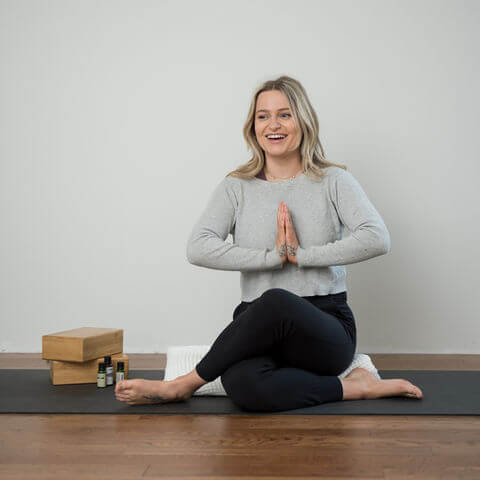
Let's start in any comfortable seated position.
Whatever that means for you.
You can be sitting on a chair.
Cross-leg kneeling,
Maybe with one leg out,
Doesn't matter.
Take a second to find your comfortable seated position.
And once you do find it,
Just settle into it.
A comfortable tall spine,
Nothing rigid.
Let your shoulders melt down.
And then just feel your breath.
Notice where you feel it.
And just watch that place.
Notice where your mind is at,
If it's all over the place or if it's settled right in.
Just drop your left ear towards your left shoulder.
Your right shoulder might try to join in and lift up.
Try to keep it down.
Just setting our timer here.
Just breathe.
Let gravity and time and patience do the work.
You might find the tiniest little tuck in of your chin helps to get into that sweet spot.
Might start to radiate up or down.
Come on up real slow.
And then try this out on the other side.
Again that shoulder might try to lift.
Guide it down.
And the joy of yin is that all you have to do is show up.
Being here is enough.
Being patient.
Waiting for the stretch.
Waiting for your breath.
Less is more.
Come on up.
And take a couple breaths just in center.
Then drop your chin down to your chest.
Keep your back pretty straight-ish.
You can stay here or you can bring your hands behind your head.
Think of a gentle weight,
Not a yang.
Come on up.
Release.
Maybe move your head a bit.
Notice if you already feel a little bit different.
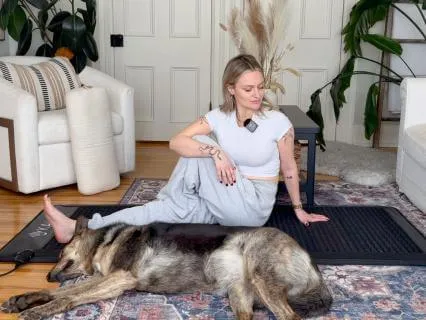
And then I bumped my coffee table so Chili's awake.
Straighten out your right leg,
Bend your left.
You can stay here.
If you want a little bit more you could cross your foot over.
And just take a couple breaths here.
One option is to twist towards your leg.
If that feels too tight,
Like too much compression through your abdomen,
Then you can twist the other way.
Wherever you are,
Bring your neck into this.
So instead of just keeping your head center with your chest,
Take a peek over whatever shoulder you're turning towards.
You don't need to be cranking yourself into this.
You don't need to be.
.
.
Perfect posture.
Just find a twist that you can hold for a bit.
Less is more Indian.
The magic isn't doing the deepest posture ever.
It's being here.
Being present and like slow but steady.
You might find your body starts to open up.
And your body wants more of a twist or more of a deepening of the posture,
Whatever that means for you.
It's really you being in conversation with your body.
Not a wrestling match with tension.
A conversation.
Do I want to go deeper?
Is that what my body wants?
Come on out.
Now if you're used to yin,
It might feel like we're racing through this practice.
Only we've been holding for a minute or two each posture.
Um we're working our way up to longer held poses so it's a nice way to ease into the slowness So we'll go into the other side.
Straighten out your left leg,
Bend your right.
You can cross your foot over if you feel called.
And then just twist either towards your leg or away from it.
And remember,
As these postures go on,
Do what you want.
You can always do what Chili's doing,
Which is Shavasana.
All this dog has ever done is like some downward dogs and shavasana and she's totally content.
And so if you're giving yourself a hard time for taking some rest,
Remember,
That's what she does,
And she's pretty dang happy.
Give yourself grace.
And patience.
And it's not just for this practice,
Right?
It's every practice.
Culmination of all your practices.
Some days we're going to be more gentle,
Some days you're going to.
.
.
Do crazy stuff.
Maybe.
But just because you're not doing the most intense thing today,
Perhaps,
Doesn't mean you never will.
Come on out of this.
Move around.
And then we'll start to bring in a bit more lower body.
So let's start.
With the right leg out.
Bend your left knee again.
And then this time,
Cross your.
.
.
Leg over keep wiggling your toes over and over until you've got your knees as stacked as they can be.
Now you can stay right here,
This is plenty.
If you choose to fold later on in the posture,
You'll feel it through the outer left hip and the back of your right leg.
If you're feeling real hippie,
You can gracefully bring that bottom leg under.
You can't see because the dog's in the way,
But my foot's just under.
I'm not gonna do that one,
I don't feel like I need that today.
But I'm not you.
You choose.
And then we'll layer in the upper body.
So you can give yourself a hug here,
Right arm underneath.
If you've got the space,
You can bring the back of your hands or your palms to touch.
You can lift your elbows up a little.
And potential.
To fold.
You might find that you need some support here,
Blocks under your torso,
Under your legs somewhere,
Prop up as you see fit.
So you're getting into the back of your body.
Between the shoulder blades,
Maybe the back of your neck a bit.
Hips,
Legs.
It's a bit of a doozy,
A bit of a pretzely one.
Keep breathing.
Keep finding your breath.
As time goes on,
You might fold deeper.
One more breath.
Unravel your arms.
Woo-hoo.
Come on up.
Unravel your leg.
Move around as you like.
Then we'll try out the second side.
So left leg is straight,
Right leg is bent.
You heel toe,
Heel toe it over.
Maybe you bring the other leg in underneath.
Like for those of you that love pigeon and stuff,
That might be your jam.
Or you can do no legs,
Or you can do no arms.
You can go hands-free.
Otherwise,
Bring your left arm under the right.
Choose hug,
Back of the hands or palms together and try.
Fold them.
Does anyone else immediately forget which arm is supposed to be on top?
I might be doing it backwards.
Don't tell me if I am.
I don't wanna know.
Keep coming back to your breath.
Soften your jaw or anywhere else that tends to hold.
Or brace.
Come on up.
Unravel big stretch.
And then let some come to hands and knees when you're ready.
You can keep wiggling around as I yap here.
Um,
This next one is melting heart.
So it's a big heart opener.
Traditionally it's done hands and knees,
But that's irrelevant.
If you'd like,
You can come to stand next to a wall or.
.
.
Yeah,
Standing is the most like knee friendly one and shoulder friendly.
You would put your hands against a wall.
I just don't have one close enough.
Put your hands against a wall and let your heart melt down.
Same,
Like if you're standing.
You know what I'm saying?
That.
You could do it with your hands on a couch,
Something like this.
More of like a child's posy option.
Or hands and knees Keep your hips over your knees-ish.
And then walk your hands wide,
About as wide as your mat,
And start to let your head and your heart melt down.
You can rest your forehead You can rest the side of your head.
You can rest your chin if you're feeling really stretchy.
You can also bend one elbow.
And rest your forehead on your forearm.
I'll let you know when we're halfway through so you can switch sides depending on what you're doing.
So find your favorite and hang out there.
We're at the halfway point.
You can switch sides if you were doing one side at a time.
You made it.
Come on out of there.
That might mean a child's pose,
Maybe with your arms back alongside your body.
Maybe you want to give your legs a break and move them around.
Just breathe.
Let your shoulders chill.
This next one.
There are some different ways you can do this.
So one option is to do this from child's pose.
Knees can be together or wide.
You would lower down.
I'll show you the seated version in a second.
Keep your left arm extended.
Bring your right arm back.
Then bend your right elbow.
So the back of your hand lands somewhere on your back.
Then bend your left elbow So the palm of your left hand lands somewhere on your back.
So your hands might touch here,
They might not.
That's one option.
You could also do this seated.
Same thing,
Left arm up,
Right arm back.
And then you can bend your elbows.
Sometimes you're going to be able to reach opposite hand behind your back and you can grab hold.
Sometimes you're going to feel miles away,
In which case you just stay here.
If child's pose just isn't your jam,
Then you can do this seated anyway.
You can tip forward a bit if you want.
And then we'll hang out there.
You can also take one or both arms out of the equation.
Go ahead and switch sides.
You might be able to catch hold of Your hands on this side and not the other,
That's fine.
Part of being human is being asymmetrical.
Come on out of this.
Unravel.
Whew.
When you've had enough to lie down on your back.
Now this next one requires.
.
.
Your pillows or rolled up blanket.
I'll show you a few different options here.
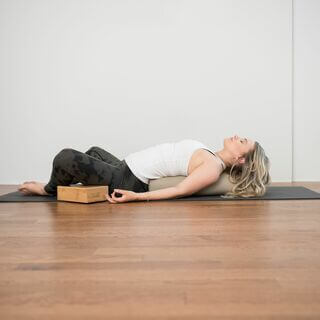
One is to bring your pillow.
Lengthwise,
Behind your back,
Bum on the floor.
Reclimb down onto your prop.
So big heart opener here.
The wider your arms are,
The more you'll feel it through your chest.
In front of your shoulders.
So this is such a great one,
We do it all the time.
Um,
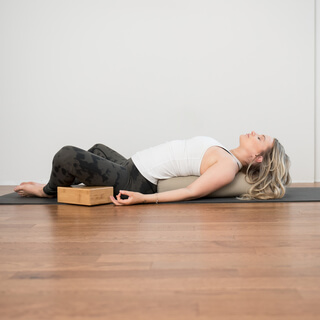
If you want a slightly deeper one then you bring the bolster or whatever you're using.
You flip it around so it's kind of width-wise.
You can bring the back of your head down onto either some blocks the ground or maybe another pillow.
In all of these,
You can do whatever you want with your leg.
Now,
Sometimes in rest or something,
I'll tell you not to do this one because your head's like hanging off the edge.
Indian since we're not holding it for as long as we would be in rest It's cool.
It's just in rest.
We hold this for like 15 minutes,
So it would get Uncomfy?
But find what you want to do.
This one is a bit more of a back bend.
The other one is more of a heart opener.
You know,
Try them on,
See what fits today.
Try to soften around the support a little bit more.
And just two more breaths.
Bend your knees.
You can roll onto one side or you can push yourself up if you have the energy.
And then we'll come into a twist.
So you choose.
How deep of a twist you do.
One option is to drop both knees to your right side.
Maybe you add a cushion underneath or between your knees.
Reach your arms wide.
Look away from your legs.
You could always cross one leg over or straighten out one leg.
Find what feels delicious.
And just breathe.
Continue to come back to your breath.
Unravel,
You can roll onto your back,
Onto your side.
Whatever feels good.
Hmm.
Here we go.
Second side.
Choose whatever variation you like.
Be patient with yourself with the posture with the practice You're almost there.
And then unravel and you can roll onto your side,
Your back,
Whatever.
Mm-hmm And eventually.
.
.
You can settle into some stillness.
For final rest.
You've done enough.
There's nothing you need to do or accomplish or change.
Just let yourself rest.
Being here is enough.
Feel that steady rise and fall of your breath.
Place a hand or two over your heart.
Or someplace else meaningful for you.
Feel your heartbeat.
And send a heartfelt thank you to your body.
To our yoga practices.
And to you for carving out this time in your day to practice and do something really sweet for yourself.
Thank you so much for being here with me and Chili.
Peace,
Everyone.