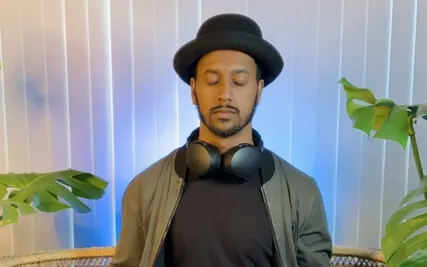
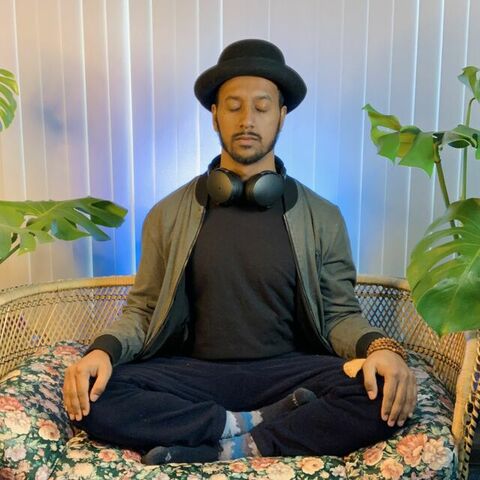
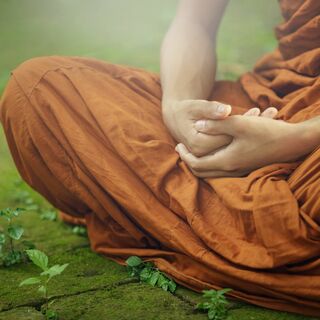
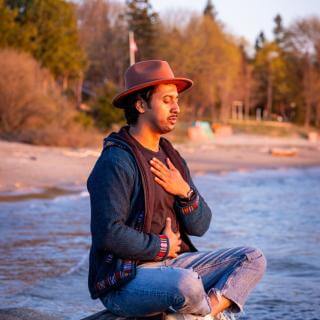
Begin by finding your most comfortable position,
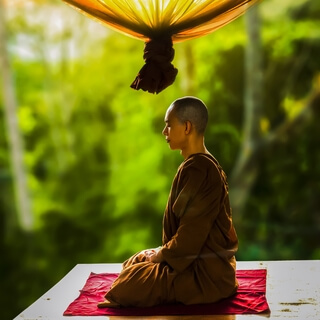
Preferably sitting down on the floor or a chair,
In a quiet and peaceful space.
Keeping your back upright,
But not uptight,
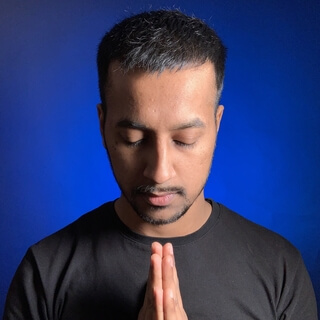
Tilt your head down as you're looking at the floor 3-4 feet in front of you.
You can gently close your eyes or keep them slightly open,
Taking a few breaths in through your nose as you locate your breath and exhale slowly through your mouth,
Following your body and mind.
Begin to bring your attention to the present moment.
Let go of any thoughts or distractions that arise and focus on your breath.
Begin to contemplate the concept of emptiness.
Allow yourself to explore the idea of all phenomena like inherent existence and are ultimately empty of any permanent,
Independent self-nature.
Visualize yourself standing in an open field surrounded by a vast and limitless space.
Allow this space to represent the nature of emptiness.
As you contemplate on emptiness,
Notice any thoughts or feelings that arise.
Allow yourself to simply observe them without judgment or attachment.
As you continue to meditate on emptiness,
Begin to let go of your habitual ways of perceiving and understanding the world.
Recognize that concepts of self and others are ultimately empty and the true nature of reality is interconnected and interdependent.
Allow yourself to experience the spaciousness and openness of emptiness.
Notice how it feels to let go of your usual patterns of thinking and to simply be present,
Just witnessing the raw experience without any labels.
Seeing the open field,
Grass,
The plants without labeling them the grass or the plants.
Keep contemplating on emptiness while I expand my take on this topic.
Emptiness doesn't mean that everything is empty.
Emptiness or shunyata in Buddhism is a mode of perception that involves looking at experiences without any preconceived notions or stories that we use to make sense of the world.
There is no doubt that it is helpful on surface level but these stories and views can distract us from understanding the cause of suffering.
For example,
When meditating and feeling angry,
Mind immediately labels the emotion as my anger and may elaborate on it with stories and views.
However,
This only leads to more suffering.
The cause of suffering is the labels of I and my that set the process in motion.
Emptiness involves recognizing the lack of inherent existence of these labels and concepts and by letting go of these presumptions,
We can directly experience how events influence each other and we can find a way to end suffering.
As you come to the end of your practice,
Take a few deep breaths and allow yourself to fully integrate the experience of emptiness into your body.
Remember,
Meditating on emptiness is a process that takes time and practice.
So be patient with yourself and allow yourself to explore this concept in your own way and at your own pace.
With consistent practice,
You can deepen your understanding of emptiness and experience the profound freedom and liberation that comes with it.
When you are ready,
Gently open your eyes and take a moment to reflect on your experience.
You may want to journal about any insights or realizations that arose during your practice.
If you enjoyed this practice,
Please leave a review and feel free to check out my course,
Meditate Like a Monk,
Sending you peace and love.