Higher Mind.
The master key of personal development.
In my decades of study of personal and spiritual growth,
Through the lenses of meditation,
Wisdom,
Philosophy and psychology,
I've been exposed to hundreds of different ideas,
Systems and techniques.
In my effort to simplify things,
I've spent a lot of time reflecting on what is the essence of it all.
I knew that the essence had to be simple,
Otherwise it would not be very practical.
If we need to keep in mind a hundred different teachings,
Cultivate fifty different virtues,
Remember many different mindsets,
And follow twenty different methods,
We'll not get anywhere.
What we'll experience is overwhelm,
Accompanied by a sense of being behind and not being good enough.
Yes,
Human psychology is complex.
There are many different elements needed for us to live well,
Relate well,
Achieve our goals and transcend it all.
But without a focal point.
Without a master key to understand it all,
We are left in a state of confusion,
And that's not helpful.
For motivation and growth,
Clarity is king.
After years of self-reflection,
I've come to understand that in personal and spiritual growth,
The master key is to cultivate the higher mind.
This is the practice underlying all practices.
Rightly understood,
This is the summary of everything.
Meet your higher mind.
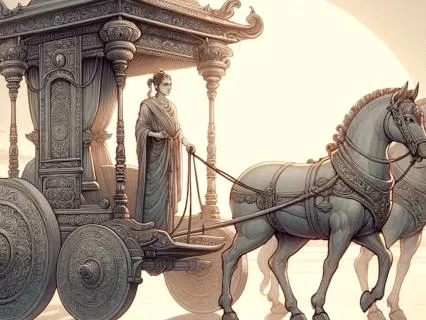
The best way to understand the higher mind is through the metaphor of the charioteer,
Which I adapted from the Upanishads.
The chariot is the body.
The passenger inside it is the soul.
The charioteer is the higher mind.
The horses are the lower mind and the reins are self-discipline.
For a more visual take on this metaphor,
Check the illustration in the article.
A healthy and well-integrated individual is one in which all of these elements are working together harmoniously,
Each knowing their place and cooperating with the others.
You move fast in life when the horses are healthy,
The chariot is strong,
And the charioteer is wise and in full command of the reins.
Then the passenger will be happy.
The charioteer.
Higher Mind.
The charioteer who is driving it all is on a mission.
He has values and aspirations and thinks long-term.
It's the part of us that has wisdom,
Self-awareness and willpower.
It's the only one who can come into direct contact with the soul.
The charioteer is on a journey to fulfill a particular purpose for the passenger.
And for that he will keep the horse's lower mind under control via the reins.
Self-discipline.
If the higher mind doesn't hold on to the reins,
The horses will run haphazardly.
They will not go where the higher mind wants to go.
Aspirations.
It would be a bumpy and frustrating journey.
And the purpose of the passenger may not be fulfilled.
The horses may even end up breaking the chariot.
The charioteer is the driver of life,
The architect of our destiny.
It is an extension of the passenger and is there to fulfill his vision.
From time to time,
The charioteer needs to turn inside and hear what the passenger has to say.
We call this intuition.
The horses lower mind.
The horses have their desires,
Fears,
And impulses,
And they are often not aligned with the charioteer's goals.
They represent our lower mind,
Which is considered the least developed part of us.
The lower mind values comfort over purpose,
Distraction over focus,
And instant gratification over long-term goals.
Left to their own devices,
The horses will often move sideways,
Distractions,
Try to avoid the road,
Procrastination,
Stall because they think they cannot get to the destination,
Self-doubt,
Not feel like moving forward.
Lack of motivation.
Actively move backward to avoid perceived danger.
Turn against each other.
Inner conflict of parts.
Turn against the charioteer.
Self-sabotage.
And give you plenty of good reasons for their behavior,
Rationalization and excuses.
Without the reins of self-discipline,
The horses won't take you where you want to go.
Rather,
They will run after green fields whenever they see them.
Instant gratification.
The charioteer will feel powerless.
And the chariot itself might break down.
The passenger will not arrive at its destination.
The charioteer has a purpose in mind and the capacity to lead the horses to the destination.
The horses by themselves will just live by the conditions of their existing environment,
Reacting to what arises in front of them at any given time.
This is what I call the conditioned life in mindful self-discipline and the conditioned identity in wise confidence.
It is living outside in.
Your outside determines your inside.
Therefore it is better for the horses,
And for all elements of our being,
That they be skillfully guided by a higher principle.
That is,
The higher mind.
Share your tear.
The Chariot Body.
It is said that the body is the temple of the soul,
And this fits perfectly with this metaphor.
If the body is healthy and strong,
The journey will be smoother.
On the other hand,
If we have not taken care of our chariot,
We'll be moving slowly,
And needing to stop often for repairs.
The horses may need to work extra hard and start rebelling against the charioteer.
The reins.
Self-discipline.
The reins are how the higher mind controls the lower mind.
If they are too tight,
The lower mind will rebel.
If they are too loose,
The lower mind will run wild and get you into trouble.
In a constant balancing act,
The charioteer needs to keep the reins in hand,
Carefully managing the horses.
And this is done in a spirit of love,
Not punishment.
You need to love your horses and treat them well.
Give them rest,
Give them good food,
Give them space to play.
But don't forget that you are the leader.
Know who you are and act accordingly.
This is one of the things that is different about mindful self-discipline.
It's not forceful.
As I always say,
Awareness first,
Then willpower.
If you try to control the horses by acts of self-violence,
Such as repression,
It will backfire.
You might make some progress right now,
But in the long term the horses will either rebel against you,
Eventually overpowering you,
Or will be too tired to do any further work.
Burn out.
The passenger soul.
The soul is pure consciousness,
The witness of everything.
It is inside the chariot because it has a journey to fulfill.
But in essence,
It transcends it all.
Here's where the more spiritual aspects of this metaphor comes into play,
To be potentially explored in future iterations of my work.
The higher mind in philosophy,
Psychology,
And spirituality.
I've adapted the charioteer metaphor from the Upanishads,
Who are perhaps the oldest reference to this concept.
I say adapted because in the original,
The horses are the five senses,
The reins are the lower mind and self-discipline is part of the higher mind,
The charioteer.
The original metaphor would require a lengthy explanation of yoga psychology for it to make sense for the modern reader,
Which defeats the purpose of simplicity.
So I've bundled together the senses in the lower mind as the horses,
While the reins are self-discipline,
An extension of the charioteer.
This concept is not exclusive to Hindu thought though.
We find a similar view in other philosophies as well as in religion and science.
Thinkers throughout the ages have acknowledged that at the core of the human journey,
There is distension between the higher mind and the lower mind.
However they might have called it.
Plato divided the human spirit into two parts,
The rational soul,
Responsible for reason and virtue,
And the appetitive soul,
Associated with desires,
Emotions,
And impulses.
The Stoics advocated for living in accordance with virtue.
Keeping disruptive emotions and desires under control,
Thus achieving a state of inner tranquility.
Many mystical traditions focused on attaining union with the Source by cultivating the higher aspects of our being and transcending the limitations of the lower self.
The father of modern psychology,
William James,
Distinguished between the stream of consciousness,
Lower mind,
And the self,
Higher mind.
The latter being responsible for attention and intention.
Or what I call awareness and willpower.
In neuroscience,
The triune brain model maps the functioning of our mind across three main layers.
The reptilian brain,
The mammalian brain,
And the evolved brain.
The evolved brain or neocortex,
Higher mind,
Is responsible for long-term thinking,
Meta-awareness and willpower.
In all these schools of thought,
The idea is the same.
The lower mind is more impulsive,
Conditioned and focused on the short term.
The higher mind is the nobler aspect of our nature.
The lower mind reacts to the environment based on the loudest impulse in the moment.
The higher mind responds to life based on values and aspirations.
The journey simplified.
The end goal of my work is to help you live your aspirations,
However you define them.
In that journey,
The lower mind will be your challenge.
It lacks focus,
Discipline and confidence.
It procrastinates,
Gets distracted and goes into unhelpful thought patterns.
It gets stuck with negative emotions and at times lacks clarity and motivation.
It's your conditioning.
The solution is to cultivate the higher mind.
Develop your awareness and willpower.
The two reigns.
Have a vision for who you want to be and live inside out from it.
Know your values and aspirations,
And shape your life around them.
Integral personal growth requires us to harmoniously develop all aspects of ourselves.
But for that,
We need to operate more from the higher mind and cultivate its powers.
One goal,
One challenge,
One method.
That's the essence.
Now back to you.
How strong is your higher mind?
Is it holding on to the reins?
What will your life be like if you live more from the higher mind?