Welcome to the Happiness Podcast.
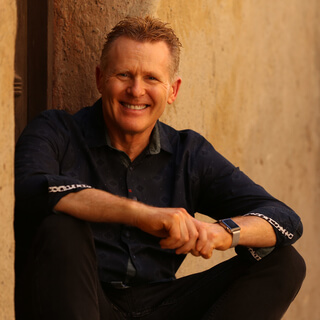
I'm Dr.
Robert Puff.
This will differ in different places around the world,
But here in the USA,
When we get our first job or a regular job,
Once we start working,
We have to work 50 weeks out of 52 weeks before we finally get a vacation.
So when those two precious weeks finally arrive,
You know what often happens?
We get in our car,
We get in our plane,
We go to our destination.
We're perhaps lying on the beach or a beautiful mountain setting overlooking a waterfall and we think about I wonder if I'll get a raise when I get back home or will we ever be able to save enough to get a down payment to buy a home or how am I going to pay off the debt for this vacation it's more than I expected so though we may be in one of the most beautiful places after working 50 weeks Half the time,
We're missing out on the vacation.
How does this happen?
Our human brain is an incredibly predictive engine.
It loves to anticipate the future,
Whether it's planning for an international trip or just worrying about tomorrow's schedule.
Sadly,
When we place all our emotional value on extraordinary future events,
We become blind to the extraordinary beauty of the ordinary days.
So even when we're on a beautiful vacation,
After perhaps slaving for 50 weeks,
Right in front of us could be someone something gorgeous and beautiful,
And we completely don't see it because we're in our heads.
And during those 50 weeks,
We start treating a normal Tuesday as an annoying obstacle just to get through.
This chronic anticipation is literally making us miserable.
There was a landmark research study done at Harvard University by Kensingworth and Gilbert that revealed human minds wander 47% of the time.
And their conclusion was striking.
A wandering mind is an unhappy mind.
When we aren't anchored in the present,
Our baseline state defaults to anxiety.
Have you ever noticed that when you're on a vacation after working for so many weeks,
That your mind sometimes wanders to the anxious thoughts about the future and what's going to happen,
Even though you may be in one of the most beautiful places in the world?
For many of us,
These anxious thoughts often boil down to someday.
It's like we're climbing a staircase and we just can't wait to get to the top of the staircase because then we think all our troubles,
All our worries will be well.
Unless you just don't talk to people very much or aren't surrounded by people that retire,
You probably all know of cases where someone worked for years,
Decades,
And they may have hated their work and they just couldn't wait to retire.
And when they get there,
They're dead within three months.
There's a very famous book by Leo Tolstoy called The Death of Ivan Ilyich.
Ivan spends his entire life climbing the social ladder,
Always looking forward to the next promotion and the next societal benchmark.
Only on his deathbed does he realize the horrifying truth.
In his constant pursuit of someday,
His actual life slipped completely through his fingers.
He was never truly present for any of it.
Ivan represents the default mode of our modern society,
Sacrificing the reality of the day for the illusion of tomorrow.
Last week I finished reading one of the most beautiful books I've ever read before.
It's called The Samurai's Garden by Gail Tsukiyama.
We can use this story as our master class in what it looks like to be forced out of a waiting room and into the present.
Sachi,
A beautiful young female girl,
Is diagnosed with leprosy and exiled from her family,
Losing her honor,
Her home,
And her future.
Her cruel fiancé,
Kenzo,
Abandons her because of societal expectations and future plans that he cannot accept as a flawed present reality.
His inability to adapt ultimately destroys him,
And he ends his life prematurely.
Called Stefan who's from China but is staying at their family estate in Japan because he's so ill and he needs to recover.
As the story unfolds,
Stefan visits Sashi's village expecting to find despair because this village is an outcast from society where people have leprosy and have been rejected by society.
But instead.
.
.
Stefan finds Sashi,
A woman who built a sanctuary of peace.
Because Sashi's future was stripped away,
She had nowhere left to live but the present moment.
She finds exquisite,
Untouchable joy in the careful placement of garden stones and the quiet ritual of tea.
Sashi's survival illustrates that a beautiful life is entirely dependent upon deliberate attention.
But we don't need a tragedy to strip away our distractions to start paying attention to the profound beauty right in front of us.
Perhaps you're thinking,
Yeah,
But Dr.
Puff,
These are just stories that people write.
They're not based on reality.
If I had leprosy or if I was dying prematurely,
My life would be horrible.
When I was in graduate school at Princeton,
I spent the summer of 1983 in the Middle East.
During this time there was a heavy war going on in Lebanon and I was there during the war.
Young people from around the world went there because there was a blind school where children lived and we went there to paint it and help make it better.
The funny thing was,
I had the most experience painting because I,
Back in Iowa,
Used to paint in the summer propane tanks to get me through school.
So they put me in charge of the project,
Which I definitely wasn't trained for,
But I did my best.
But during that time,
I ended up meeting some of the children who lived in the blind school.
And there was a young boy,
He was probably about 13,
And he had been blind since birth.
But because of the war in the Middle East,
Both his parents were dead.
So you would think someone who's blind,
Both his parents are dead,
And he's in a war,
That his life would be pretty horrible,
Correct?
But he wasn't.
He was such a beautiful soul.
I can't even tell you.
His heart was made of gold.
He really loved life.
And he was so grateful because what we would do every day is we walk to a library,
Not too far from the blind school.
And we would go in there and I would read some of my favorite books to him.
And there was just so much joy in his heart.
And he loved the books.
And he was one of my teachers of life.
He taught me that no matter what we're going through,
There's just always something beautiful to be attentive to.
So how do we rewire our brain to start living in the present moment and not let so much of life just pass us by?
Mindfulness is not just a poetic concept,
It's a biological necessity.
Decades of clinical research on mindfulness-based stress reduction demonstrate that regular,
Present-moment awareness physically shrinks the amygdala,
The brain's fear center,
And thickens the prefrontal cortex,
Which evaluates,
Regulates,
And sustains positive emotional states and long-term well-being.
When we pull our attention out of the imagined future and drop it entirely into the physical present,
Our nervous system registers that we are safe.
If we give it some thought,
It really makes sense.
If we're not worried,
Anxious,
Concerned about the future and in the present moment,
Then in that present moment,
All is well because the threats and anxieties,
They're not there.
We're not giving that anxiety energy and instead,
We're relaxed in the here and now.
And we really get to see all the beauty around us.
So how do we practice and develop our present moment awareness?
We don't necessarily need a zen garden to practice Sashi's level of presence,
But what we can do is select one deeply mundane daily task,
Whether it be blending a green smoothie,
Feeling our legs as we stretch them during a wall sit,
Or washing our face and commit to executing it with absolute focus.
We can do the I am here pivot.
Throughout the day,
When we catch our brain attempting to rush forward to the next appointment,
We anchor back into our physical senses.
We feel the feet on the floor,
We take a breath,
And we silently declare,
I am arriving here right now.
Throughout the day,
We can challenge ourselves to find moments of exquisite beauty that we would normally have ignored while rushing.
One of my favorite things to do,
Because I live in Southern California and I drive a lot.
Is as I'm driving.
See.
Be present,
Don't just drive,
Don't just sit.
Be on the phone,
Don't just listen to something,
But physically be present and see the flowers that I drive by,
The sky that I'm driving under,
And the beautiful trees all around me.
And it always surprises me when I do this,
And I do this often,
How much there's to see.
Life is beautiful,
But when I'm rushing,
I miss so much of it.
So I love to use my time when I drive.
To look.
And see.
And it makes driving a lot more enjoyable too.
But not only driving,
It makes life so much more beautiful.
Our lives aren't a dress rehearsal.
It's not a waiting room for a better tomorrow.
The good life.
Our Good Life is available to us right now.
But we have to be present to claim it.
And I'm suggesting,
No matter what,
We may be going through right now,
No matter how difficult it is.
There's just always.
When we pause.
And we look.
And we see something beautiful to be with.
And when we start cultivating those eyes of being present,
We'll find that we'll create a life.
Like Sashi.
That is absolutely gorgeous no matter what life throws at us.
Thank you for joining me on the Happiness Podcast.
Until next time,
Accept what is,
Love what is.