The best thing you can do is help the body return to its natural instinctive expression of calm.
That's what you want to bring back.
That's what you want to assist the body to do because it is always striving.
For homeostatic balance.
Enjoy this practice here with me.
Thank you.
The nervous system acts as the body's master command center and communication network.
The nervous system is made up of the brain,
The spinal cord.
And a vast network of nerves.
Coordinating regulating and communicating with all of the organ systems of the body,
Cardiovascular,
Respiratory,
Digestive,
And skeletal systems.
The nervous system translates what you see,
Hear,
Taste,
And feel.
Interactions,
While also controlling automatic behind-the-scene functions like heart rate,
Digestion,
And breathing.
When we speak about regulating the nervous system.
We're talking about the ways in which you can intervene when you feel anxious.
Sad,
Or any other uncomfortable emotion.
To create relief,
Comfort.
Safety and presence.
One of the true mechanisms of regulating the nervous system is to bring the mind's attention to the present moment.
I'm going to show you how to create your own unique way of self-regulating using breath coupled with another sensory organ.
Remember,
The nervous system translates all of what you take in through your senses.
Into.
What better way to help you than to use an aspect of what you take in through your senses.
Same way in which the nervous system does.
As it translates what you take in.
The experience that you have.
As we couple breath with another sensory organ,
This will help to keep the mind focused in the present and it has the additional benefit of actively creating calm for the nervous system.
When I'm working with a client who is struggling to calm their nervous system.
There can be a learned pattern of thinking that continues to cause nervous system dysregulation.
As much as you may struggle to feel better,
Know that the practice is about living in calm.
Cultivating more moments.
Experiences,
Thoughts.
And an environment in which you can live calmly,
Regulated.
And of course,
Practicing this way of being often is key.
It can be so helpful to design a technique unique to what you need as it allows you to utilize inner reassurance and the touchstones that for you are most helpful.
Remember,
Any helpful strategy will work for as long as you give it your full attention.
If you find a ruminating thought has returned,
Or if you're feeling anxious.
Simply return to your regulation practice.
It doesn't mean that the strategy isn't effective.
It does mean that you need to use it again in that moment,
That's all.
No need for self-doubt or worry,
Feeling discouraged.
Rather,
Return to the practice.
Of feeling calm.
It's most effective when you can incorporate conscious breathing into your regulation practice for It works quickly and breath is always accessible.
In regulating using your breath,
You also.
.
.
Directly and simultaneously regulate your nervous system.
This is because when you take slow,
Deep breaths,
You stimulate the vagus nerve,
Which activates your parasympathetic nervous system.
A function of which creates relaxation and rest responses.
This signals your brain to lower your heart rate,
Reduce cortisol levels,
And decrease blood pressure.
Physically,
Calming the body.
Your body's stress response.
Breath is undoubtedly the most powerful tool that you possess.
For nervous system regulation.
To build your own sacred pause of relief and regulation,
Begin with your breath.
You want to take deep.
Inhalations because when we are dysregulated our breath is typically short and rapid.
And longer exhalations,
Releasing the breath with an easeful,
Longer pace.
You want to give attention to the natural pause at the top of the breath cycle and then at the end of the breath cycle.
It's not to hold breath.
Rather,
Just notice the natural pause.
Within each breath cycle.
Also gives you a moment to pause and be present.
We're going to choose one of your five senses to pair with your breathing.
Choose your auditory system if you feel a kinship with listening for what sounds.
In your environment are soothing?
Will work well if you have,
Let's say,
A fan on.
And can listen for its gentle motion,
Or perhaps to ground yourself with the calming ambient music that you have playing.
Listening for the sounds of nature beyond your open window.
If you prefer to use your sense of smell.
Pairing this with your breath.
To smell the air entering through your nose.
This proprioception or body awareness allows you to feel.
The breath expanding.
In your chest.
And sometimes,
We use our sense of touch,
Our tactile sense by placing one hand onto our chest.
Feeling each wave of breath.
As it enters the body,
Filling your lungs.
This is our interoceptive or internal feeling.
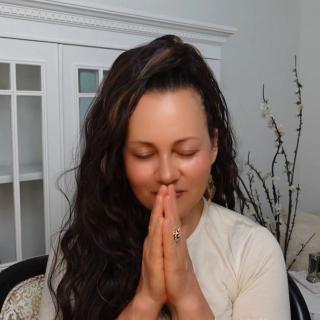
You may also want to try the chin mudra.
Your thumb,
And fingers touching and your palms touching.
Facing down towards the earth or near your knees if you are seated.
And you feel the gentle connection with your fingers.
As you experience the gentle oneness.
Of the present moment.
Use what sensorial practice will instinctively make this more meaningful as you attend to your breath.
Let's practice together.
With gentle noticing of your experience.
For about three minutes.
It's likely here that your mind may move away from your breath,
And that's okay.
The practice is to return each time.
And to do so.
Until you feel calm.
That's your endpoint.
Most times we don't allow ourselves enough practice time to feel calm.
We abandon or we become distracted.
And so the nervous system doesn't fully experience calm.
So let's together practice for three minutes now.
You you.
Well done.
The practice needs to be rehearsed,
And as you do,
You'll notice glimpses of feeling regulation.
Calm,
Relaxation even for a few moments.
And then to build on this feeling as well.
You continue to experience calm felt in your body and of your nervous system.
And in your minds.
Let's take a few more minutes together here and return to the practice.
Of self-regulation and calm.
Notice.
Of feeling.
Of regulation of your nervous system.
Thank you.
Thank you so very much.
Namaste.