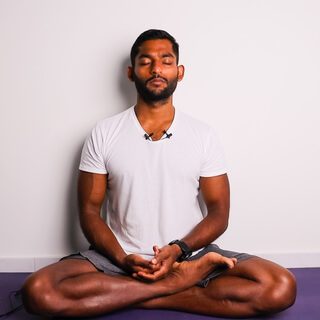
This meditation session was given on 25th of March 2019 in Basel,
Switzerland.
In Yogic traditions,
There's a concept of five Jnan Indriyas and five Karmindriyas,
Meaning ten sensations.
I talk in more detail about it during this session.
A very warm welcome to all of you in this Monday evening meditation session with me,
Dhyan Se.
For today's session,
I would like you to,
First of all,
Sit here for a few minutes and absolutely do nothing.
All the meditation techniques that you know,
Focusing on the breath,
Focusing on somewhere else,
Anything that you know,
That you have learned from the past,
Just put that aside and give yourself next minutes to sit and absolutely do nothing,
Not even trying to do nothing.
You can keep your eyes closed,
You can keep your eyes open.
I would suggest you to keep your eyes closed.
It's easier.
Just for the next minutes,
Until I ask you to open your eyes,
Sit and do nothing.
No doing absolutely whatsoever.
Now very gently and slowly open your eyes.
What happens when you sit and do nothing?
I would like you to share what goes on in you when you attempt this,
When you sit down and do nothing.
What happens?
Anyone?
Mind goes on and on and on.
And what do you do?
Let it carry on.
Thanks.
I've learned honestly,
During the last year,
To just,
Of course,
Fractions,
I can call it fractions,
Bits of thoughts tend to,
I just don't pay attention and they dissolve.
They dissolve into nothing.
I can't even tell you now what came to my mind.
It's actually bits and pieces of thought perhaps,
But I did not follow them and don't even let them take shape.
When you say,
I don't let them take shape,
You're doing something,
Right?
I don't pay attention.
When you say,
I don't pay attention,
Or something in me doesn't pay attention.
I don't know how to put it,
You know,
It's a linguistic issue.
I know that it's somewhat of a play of words,
But at the same time,
There is something behind that play of words,
Which needs to happen.
When all action stops,
What happens?
When you are absolutely in non-doing,
Still the mind goes on and there is some sensation,
Even that sensation of that,
I am not doing anything or I have learned to let my thoughts go.
Absolutely fine.
What you're doing is absolutely right.
All I'm trying to say is that there is something more,
There's something where you can even go further,
Which is happening on its own.
You don't do it.
Meditation is a state where you don't do anything.
It happens on its own.
That quality is what I'm trying to convey to you.
Yes,
You can meditate and you can also allow meditation to happen.
The second,
The latter,
When you allow meditation to happen,
The quality of that is different than the quality of when you do meditation.
And I'm with you,
It's made of linguistics.
That's the difficulty,
But that's where also there is an opportunity to somehow get to that.
In today's session,
What I want you to identify is that all this mind,
All what is going on is nothing but a sensation.
There is this constant sensation,
Sensation in your mind,
Sensation in your body.
And we are so used to only recognizing us,
Our existence,
That I exist,
That I am with this sensation.
And without the sensation,
We think we do not exist.
Without this sensation,
We have fear.
Without the sensation,
We don't know what that is.
When you allow meditation to happen,
When you are in non-doing,
Then you also recognize yourself as not just the sensation.
And that you,
Experiencing yourself not as sensation,
Is where all the magic happens,
Or all the peace happens,
All the resting happens.
That resting space belongs to you all the time.
No matter what you're doing in this world,
Where you are,
Whatever is going on in your mind,
That resting space belongs to you.
And I would like you to take back that resting space by identifying,
First of all,
What are these sensations that are taking your awareness and keeping you engaged,
Giving you a sense of that,
Yes,
You are there,
Yes,
You exist.
In yogic traditions,
These sensations,
There is a framework to understand that.
There are many,
Many,
Many,
Many ways to do that.
In this simple framework,
These sensations are divided into two parts.
The first part is the five sense perceptions.
When you hear something,
That sensation,
You immediately try to catch to that sensation,
You're immediately going there,
You're so used to that sensation.
That's the hearing,
Then seeing,
Smelling,
Tasting and feeling.
We all know these five sensations.
These five sensations are constantly keeping our awareness involved and to learn,
Yes,
The process of learning to withdraw ourselves from these five sensations is something one can learn,
One can practice and is a prerequisite,
Is a requirement for the meditation to happen on its own.
That process is known as pratyahara.
Pratyah is perception,
Hara is to withdraw yourself from it.
Pratyahara is this yogic process,
Which is a structured process of you withdrawing your attention,
Your awareness,
Learning not to fall for these five sensations that are created out of the five senses,
Sense perceptions.
That's half the story.
The rest half,
The other five sensations are sensations of action.
The first sensation of action is of speech,
Of articulation,
Of expression.
That sensation that you get from when you speak,
When you articulate,
When you express,
There is a compulsive aspect to that as well because we are so used to it.
When it's needed,
It's good,
But when it's not needed,
We are still expressing ourselves.
We are still talking,
We are still articulating in the head,
In our own thoughts,
In our own inner world,
When we close our eyes,
Still that articulation,
That thing is going on.
Second sensation is the sensation of movement.
Movement is in physical terms you can understand as the movement of the body.
Very simple to understand.
Constantly we are identified with the movement of the body.
We always want to move,
Somehow in a validation that yes I'm there,
Yes I'm there.
When we have to move the body,
Move the body.
When we don't have to move the body,
We should be able to just be at rest and let the body be on its own without us having this compulsion of this sensation to move the body.
Third sensation is grasping,
Is wanting to hold on to something.
In physical terms,
We have the hands for that.
In psychological terms,
We are constantly wanting to grab hold on to something.
We are so compulsive,
So insecure that we want to hold on to a thought.
We want to hold on to anything that comes across in our mind screen and want to grab on to it.
This happens consciously or unconsciously and we need to attend to it and see that we are constantly doing that.
Somehow we need to learn to take our grip off that as well and not grasp everything that comes our way and just rest without trying to grasp.
The last two actions in yoga are described as reproduction and elimination.
These are more physical processes,
But what you can for this meditation,
Interpret them and understand them as for example,
The process of inhalation and exhalation.
Reproduction represents when you want to have something,
You want to create something,
You want to grow more,
You want to grow bigger.
That psychology is expressed in your actions where you are constantly striving for growth.
You are constantly striving to be more,
To be somebody bigger than who you are,
To have more of things.
If it's expressed in possession,
You start collecting more and more things.
If it's expressed in achievement,
You start to achieve more and more.
So that sense of wanting to be more that is coming out of this sense of reproduction,
Which also needs to be addressed when it's not needed.
And the last is elimination,
Which in physical sense is whatever comes into the system,
Goes out of the system and as a part of the breathing process,
Which is easier to relate to,
To see it as that when you are breathing out,
This constant sense of you throwing something out of your system and whatever you have gathered in,
There is a constant exhalation,
Constant exit of that happening out of your system.
These are two very subtle sensations.
We won't focus on these two sensations that much,
As much as we will focus on the first three,
Which is to the sense of articulation,
The sense of movement and the sense of grasping in today's meditation.
In total,
These are the ten major gross sensations that are constantly taking our attention,
That are not allowing us to be in a state of non-doing,
That are not allowing us to be in a state where meditation happens on its own.
As beautiful as other techniques are where you do meditation,
I invite you to allow meditation to happen,
To first of all identify these ten sensations in it,
In your own being and then try to dissociate yourself from each of these ten sensations and see when you dissociate yourself from each of these ten sensations,
What is left?
Is that not a restful space on its own?
Is that not a space out of which silence arises naturally on its own?
Is that not meditation in itself?
See it for yourself,
Experience it for yourself.
As a process,
The first pratyahara that we will do,
That we will practice today,
Is we will go to each of these senses.
This is the structured process that allows us to become aware and conscious of each of these sensations.
We will recognize ourselves in that process,
In that sensation,
And then we will withdraw our energy from there and let it be.
90% of that will automatically fall.
If 10% of the sensation is still there,
If there is a noise from outside,
You can't stop that noise.
If you don't try to stop that noise,
90% of that,
You won't be bothered by that.
The rest,
10%,
Would also gradually go down as you become more and more silent,
As you dissociate yourself from each of these senses and sensations.
Very simple process.
Before we start that meditation,
If you have any questions about what we discussed,
Is it clear?
I see Ilze has some questions about that.
Maybe we can discuss this after the meditation.
Thanks.
With that,
For this meditation,
We will start with seeing as the first sense.
So we will,
First of all,
Leave our eyes open,
And then after a few minutes,
We will close our eyes.
I will guide you through the entire sequence.
Please sit straight.
With your hands,
Either in your lap or on your thighs,
Whatever is comfortable to you.
And look in front of you,
Straight in front of your vision.
And as you look,
Become aware of this sense of seeing.
See how you see shapes,
How you see colors,
Light.
And slowly withdraw yourself from the sensations that this vision is creating.
And look in front of you.
And look in front of you.
And gently close your eyes.
Withdraw all the energy away from the eyes.
Let the eyes be at rest.
And take your awareness to what you hear.
When you hear,
Notice the sensations that are created in you.
And withdraw yourself from these sensations.
Let the noises be.
You withdraw your energy away from the sensation of hearing.
And let the sounds be.
Let the sounds be.
Don't touch them.
Don't touch them.
Don't touch them.
Don't touch them.
Completely withdraw yourself from the sensations of what you hear.
And bring your awareness to your nose.
As you breathe in,
Notice the sensation of smell.
And let this sensation come to rest.
And let this sensation come to rest.
Move your awareness to your tongue.
To the sense of taste.
Let this sensation rest.
Withdraw all your energy.
And become aware of your skin.
The sensations on your skin.
And let go of these sensations.
Let them be.
You withdraw all your energy and remain silent.
Bring your awareness to this sense of speech.
This inner mumbling,
Wanting to express.
Let that be at rest for the next minutes.
Nothing to say.
Nothing to express.
Completely let go of your speech.
As your speech becomes silent,
Your mind becomes silent.
Now notice all the movements in your body.
With this sense of movement,
Let that rest.
Let's let it go.
Let your body become still.
No more movement.
Notice that your mind is trying to grasp,
Hold on to something.
Release that grip.
Let that go.
Don't hold on to anything.
Let everything go.
Now move your awareness to your breath.
Gently observe your breath.
Breathing in and out.
Simply observe your breath.
Now leave your breath.
Do absolutely nothing.
No more doing.
No sensation.
No movement.
No doing.
No sensation.
No breathing.
No sensation.
No sensation.
No breathing.
No sensation.
No breathing.
No breathing.
Gently bring your awareness back to your breath.
Remain still.
Remain silent.
Keeping your awareness on your breath.
Bringing it back to your body.
Feeling the sensations in the body.
Sensation in the mind.
And very slowly and gently you may open your eyes or keep them closed for the next few minutes.
Take the next couple of minutes to absorb,
Contemplate and let this experience settle in your being.
If you want you can move your body.
Better stay still.
Maintain this silent awareness that you are experiencing right now.
Do absolutely nothing.
If you practice this pratyahara,
The withdrawal from sensations,
Will happen on its own.
This practice of pratyahara doesn't have to be done in only sitting silently.
You can do it while you are in action.
This practice of pratyahara,
Withdrawal from sensations,
Will take away all these compulsions that are there in us,
That make us go here and there,
Do this or that.
It will immensely change the experience,
The decision-making that we have in our life,
Which has practical implications on our life,
As much as they have on the spiritual journey that you are in.
And yes,
When that is reaching to a natural happening,
Meditation becomes natural,
It becomes easy,
It becomes spontaneous.
In whichever situation you are,
In whichever action you are,
You have always the opportunity to go back in yourself into this inaction and rest there,
Into this resting space,
Which we all have.
With that,
I would like to thank all of you to participate in this meditation session,
Being patient,
Being silent,
At least trying.
If you have any questions,
We have a couple of minutes to still take them.
If you would like to share your experience,
Any doubts,
Anything that was coming up in your experience of meditation,
Which you would like to clarify,
This is the time.