Namaste and a very warm welcome to all of you in this daily live meditation session with me,
Dehansi.
Today we begin the third pillar of yoga.
From the yoga sutras of Patanjali,
There are four pillars of this journey of yoga.
The Samadhi Padha,
The Sadhana Padha,
The Vibhuti Padha and the Kevalya Padha.
Today we begin the third pillar which is the Vibhuti Padha.
After all the Sadhana,
After all the effort that you have done,
You move on to this third pillar.
This third chapter,
The Vibhuti Padha,
Which means the path of accomplishment.
You see,
Yoga and meditation are not just to calm down or to relax or to fall asleep before after a tough day and before you want to sleep,
You do some meditation,
Some yoga to relax and be fit.
Yoga is a science of accomplishment.
Yoga is a science which allows this human being to accomplish something,
To have the Vibhuti.
Vibhuti means accomplishment.
So it is a very important path if you follow this path diligently,
If you follow this path sincerely.
There is a lot to gain,
Much more than just some moments of relaxation,
Some moments of peace,
Some moments of centeredness.
What Vibhuti,
What achievement are we going to get from yoga?
The first thing we have to understand here is that life that is given to us is in itself an accomplishment.
It is not just a given,
It is not just thrown at us and now suddenly we are in this world and somehow we have to live.
This is an accomplishment after a lot of sadhana,
After a lot of devotion,
This is a chance to experience this beautiful world.
This is a chance to know this world.
If you see a child,
When a child is born,
The brightness the child has in its eyes,
He is discovering everything,
He is looking at everything,
He is gaining all the knowledge of this world,
He takes this life as an accomplishment.
But slowly as we teach the child labels,
We teach the child A for apple,
B for bat,
We teach the child labels to everything that the child experiences.
We say this is what the name of this thing is,
This is the shape of this thing,
This is the color of this thing.
We quickly teach the child labels and all the knowledge that the child was discovering,
All the dimensions of the child that was discovering are shrunk.
And then the child remembers only labels and forms memories that we call as our mundane knowledge.
You see the brightness in the eyes of the child slowing down and becoming mundane,
Then he becomes educated and then he becomes a person who is just using these labels and calling them knowledge and get caught up in this.
And the whole meaning of life,
The whole sense of life as an accomplishment is somewhere lost and then we keep on adding substitutes.
So the first accomplishment that yoga can give you which is not supernatural,
Which is very natural,
Is your life back in your life.
Is the recognition that life is an accomplishment,
Is that once again that access to life as pure knowledge,
As pure knowing,
When you look around,
When you look at a tree,
When you look at a mountain,
At a river,
Another person,
Sky,
When you look at everything,
You are once again fresh.
You once again see with fresh eyes and there is knowledge and there is knowing.
And not just the labels of shapes,
Color,
Name,
Size and functionality and characteristics and so on,
The real knowing.
That's the first accomplishment and there is many more on this path of vibhuti padha where there are supernatural powers if the yogi is diligent,
If the yogi is continually doing this practice,
Then there is no limit to what this manifestation,
This body,
This mind,
This entire organism is capable of.
We use this organism for a very few small scope of things.
Not all this organism,
This human body,
Mind and this consciousness is capable of is beyond limits and a glimpse of that can be seen in this vibhuti padha.
I will not go through this vibhuti padha to offer you some supernatural powers and the practices to supernatural powers but only for you to remember,
To recognize what all is possible.
You don't have to chase supernatural powers but you just have to see what all you are capable of.
That will give you fresh energies,
That will give you motivation in the life,
The way you are living,
In whatever you want to achieve in life,
The way you want to live in life from inner peace to something that you have been wishing for a long time and would like to realize that all that is possible in recognition of how powerful and limitless we are and that is what is all described,
All signalled,
All made aware of in this vibhuti padha.
So let us begin this vibhuti padha with the sutras of Patanjali.
The first sutra of vibhuti padha,
Patanjali says,
Desha bandha chittasya dharana Dharana is the binding of mind to one place,
Object or idea.
Let me remind you in this path,
In this journey,
Patanjali set a framework called Ashtanga Yoga.
He gave us 8 pillars or 8 points where the first 5 points were yama,
Niyama,
Dhan,
Pratyahara,
Pranayama and asana.
And now the last 3 pillars of Ashtanga Yoga,
Dharana,
Dhyana and samadhi.
These 3 pillars,
Dharana,
Dhyana,
Samadhi are what allows all these powers on this vibhuti padha.
When you practice the first 5 which are rules and virtues and values and all these practices which allow you to purify yourself,
Allow your body,
Mind,
Consciousness to be in a state to become eligible for something.
But then this dharana,
Dhyana,
Samadhi,
These 3 points of Ashtanga Yoga,
The last 3 points of Ashtanga Yoga of this framework,
This is the practice.
This is what you need to do in order to move towards the powers,
Move towards the accomplishments.
The first of them is dharana.
I will speak of dharana,
Dhyana,
Samadhi all together to explain them all together because the differences are significant,
Are important to understand.
When we say meditation,
We actually don't mean anything because it is a very generic word.
When we in English say meditation,
There is no real meaning to what we are pointing at.
If you want to be more precise,
If you want to be more correct,
If you want to really communicate what actually are you doing when you say I am meditating or this is meditation,
Then you need to follow the yogic definition,
The yogic path because in yoga everything is classified.
Patanjali is such a scientist,
Such a technologist,
Such an engineer of the consciousness that he puts everything in its place to the very detail.
These 3 dharana,
Dhyana,
Samadhi,
They all can be called as meditation,
They all can be also called as stages of meditation,
They all can be different types of meditation but they have their own place,
They have their own significance.
When Patanjali brings out these 3 dharana,
Dhyana,
Samadhi,
He wants you to understand the differences between these 3 and once you put them together,
Once you learn how to do these 3,
What all you can accomplish through this practice of yoga,
Patanjali wants you to understand and learn in this vibhuti pada.
The first one of that is dharana.
I had spoken about this previously as well,
So let me repeat what I had earlier explained,
The difference between attention,
Concentration,
Meditation and samadhi is exactly derived from these 3 points of dharana,
Dhyana and samadhi.
The way to understand this is,
Imagine you have a light source in you,
A torch,
That source of light if you point out at an object in a dark room,
You see that object.
So there is a source of light which allows you to see an object that is there in the dark room.
Now imagine that this light source that is there in your hand is constantly flickering,
Is going up and down,
Right,
Left and this beam of light,
This source of light is never at one position.
Can you know anything with that?
Can you see anything with that?
No.
The object in front of you in the dark room will remain in darkness,
Will remain unknown to you,
Incomprehensible to you if the light source that you have keeps on moving,
If it is never still.
And the same is with our awareness.
If our awareness is not still,
If the awareness is constantly moving,
And you see we have 1001 reasons to remain distracted,
For the mind to get caught up with the thoughts,
For the mind to get caught up with ideas,
Plans,
Fears and all the other contents of the mind that there is no chance for the awareness to be still and to point that beam of light at an object to really know that object.
So once you learn how to make this beam of light point at a particular object,
This is known as attention.
When you say I attend to an object,
It means you have learned to bring this beam of light,
This beam of awareness towards a particular object.
When you learn to stabilize it and it's not moving anywhere and you learn to point your awareness at one particular object,
You narrow your awareness,
You narrow your focus down to one particular object,
That is known as concentration.
And in yoga,
That is known as dharana.
When there is one pointedness,
When there is flow of awareness on one particular object,
That is known as dharana,
That is concentration.
That is the basis.
See that we have lost the basis of our powers and that is why we feel so powerless.
That is why we feel so unaccomplished because we are unable to even regulate the awareness that belongs to us.
That is the closest to our nature.
That is the only thing that we have to know this world.
So when we learn to point our awareness and hold it at one particular object,
That is known as concentration.
And when that concentration is established,
What happens is that the flow of light,
The flow of awareness,
It starts to shine upon the object and then you see the object.
What also happens is that the source of light,
This starts to move closer to the object.
It somewhat you can call travels,
Not in space,
Not in time,
But in awareness,
In consciousness it moves towards the object.
So the object that is witnessed,
That is seen and the source of light that is throwing the awareness that is releasing the awareness is moving closer.
This process is known as dhyana.
This process is the essence of all meditations.
Concentration is just a preparation.
Concentration is not the essence of meditation.
With concentration you cannot know anything,
But with dhyana you can start to know things when the light of awareness is shining on one particular object,
Then you see the facets of the object,
Then you start to see all the multidimensionality of the object and the source,
The awareness is slowly moving closer and closer.
As it moves closer to the object,
The object is shining even brighter and the knowledge is becoming even more multidimensional.
And you see everything with so much clarity.
And this is how everything can be known.
In dhyana everything can be known.
And if you see before the times of telescope,
Microscope and all the technology that we have in place,
How did the yogis,
How did the seers,
How did the ancient people knew all about the existence,
Knew all about minute details of the inner and minute details of the outer.
From the inner to the outer,
From the micro to the macro,
Everything was mapped out before we had the instruments what we have in science today,
Everything was still mapped out.
How was this done?
It was done through all these practices of learning how to modulate,
How to utilize the power of your awareness.
So the first is learning to attend,
Then learning to concentrate and then learning to have dhyana,
The meditation where the awareness is uninterruptedly flowing at one object and the source is also slowly moving closer to the object.
And then the next stage happens which is samadhi where this source and the object merge and there is no difference between the object and the source.
And then in this merger,
In this samadhi,
This form that you have in front of you,
It reveals its truest nature.
It reveals its nature which is in its formless,
Its unmanifest.
I will talk more about that tomorrow.
Let us practice this attention,
Concentration,
Meditation,
Moving towards samadhi and spending the next few minutes practicing these three on our breath.
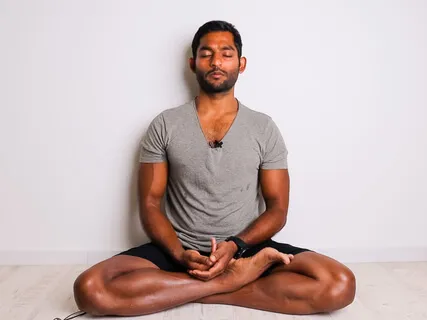
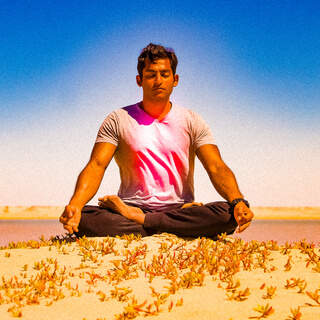
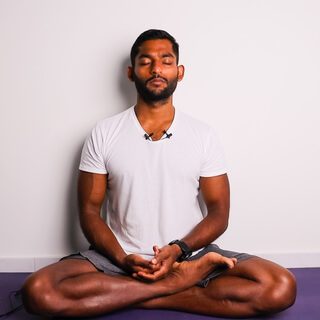
Let us close our eyes and take a posture that is comfortable with your spine erect,
Body relaxed,
Shoulders down,
Head relaxed,
Allowing yourself to arrive in this moment,
Your body resting at its own weight,
And your breath flowing in and out.
Naturally.
Begin by attending your breath,
Acknowledging your breath.
The flow of your breath flowing in and out.
And as your awareness settles on your breath,
You move from attention to concentration,
To dharana,
Where your awareness settles,
Focuses on the breath.
Pause.
With every breath,
Allow your awareness to focus on your breath,
Your mind to rest.
Freeing your awareness,
Freeing your awareness to focus on your breath.
If you are distracted,
Gently bring it back.
And bring your awareness back to your breath.
Don't try to change anything about your body,
Not trying to stop the thoughts.
Only your awareness focuses on your breath.
And the breath flowing in and out,
Naturally,
Gently,
Slowly.
And as your energies rest,
The awareness on your breath settles.
Slowly you are more closer to your breath.
The focus becomes natural,
Easier.
And you are close to your breath,
Simply watching your breath flowing in and out.
Moving from concentration to meditation.
Natural,
Uninterrupted flow of awareness to your breath.
Move closer to your breath.
So close that there is only breath.
You become the breath.
You become the breath flowing in,
Breath flowing out.
You become the breath flowing in.
And leave all effort.
Visit in this silence an awareness that you experience in your inner space.
You become the breath.
Stay in this uninterrupted flow.
You become the breath.
And you become the breath.
And very gently and slowly you may open your eyes.
And notice the awareness and silence in this moment and carry it into your daily life.
Namaste.