Hi there,
It's Deb Blum,
And I'm a teacher here on Insight Timer,
And today we're going to talk about anxiety and what to do when anxiety hits.
So when we experience anxiety,
I like to think of it as a part of us that arises.
We don't necessarily expect it,
Or sometimes we do.
And it comes up in our body.
It oftentimes feels like a set of sensations in our body.
It's very familiar for many of us.
We know what it's like.
We know what anxiety looks like.
We know the texture of it.
We know the sensations and the experience that we have of it.
And for the most part,
It's something that's uncomfortable and we want to push it away or we want to use some type of coping mechanism to deal with it,
To feel it less.
It's almost a way that we want to fix the anxiety,
Or 2.
Yeah,
To push it away.
The The paradox is that what we really need and what anxiety is asking from us is to stay with it.
The very thing that feels like an antidote to anxiety which is usually some form of doing something about it,
Is often what keeps us circling.
The way out is the same way that you would survive quicksand,
Which is to stop struggling,
To get still,
And let yourself be there.
There's a line from chapter 15 of the Tao Te Ching,
In Stephen Mitchell's translation,
That I come back to over and over again in my own life.
And here's how it goes.
Do you have the patience to wait till your mud settles and the water is clear?
Can you remain unmoving till the right action arises by itself?
It's a real question.
Lao Tzu doesn't say go clear the water.
He asks you if you have the patience to wait.
To be present with whatever it is that's coming up.
Maybe the water has been swirled around and the mud is there and eventually it settles and you can see clearly,
But you want to make the mud go away.
So the question is,
Do we have the patience to wait,
To let it clear itself simply by not stirring it any further?
That's almost the opposite of how most of us learned to handle anxiety.
A very possible reason why.
Is because anxiety may have made itself known when we were very young.
It may have shown up.
When we were experiencing things that were scary or terrifying and that nobody was there to help us through it.
We felt powerless.
And our body felt fear and anxiety and maybe panic.
And we learned how to navigate the world and not have to be owned by our anxiety.
And yet,
Oftentimes we still were owned by our anxiety and the feelings were big and it was hard for us to navigate,
But we might have learned other strategies for living with and tolerating anxiety.
But let's talk about what that usually looks like.
And this comes back to the metaphor of quicksand.
The instinct,
The moment that someone puts their foot on quicksand and it starts to sink,
Is to thrash,
To pull and to fight and to try to get out of there.
But quicksand is strange stuff.
It behaves differently depending on how you move through it.
So when you struggle against it quickly,
It actually tightens around you.
So that means that every panicked moment drives you deeper.
Despite your best efforts for it not to,
It does.
But if you have the presence of mind to slow down,
To spread your weight,
And to stop fighting,
That same substance that was pulling you under will hold you up.
I know,
It's crazy,
But stillness is what creates buoyancy.
Struggle is what creates suction.
Open water does a similar thing to a frightened swimmer.
When you feel afraid in the water,
Maybe you've experienced this before,
Oftentimes what happens is Your brain is saying to you,
Swim harder,
Get to the shore,
Don't stop moving,
Tread water.
Stop a panic.
Burns oxygen fast,
And it makes the breath more shallow and more ragged,
So that very breath that we need actually gets taken from us when we're working so hard.
In contrast,
Floating.
Just going still,
Letting the water hold you,
Costs almost no energy at all.
And this isn't just a metaphorical truth.
It actually is a physical one.
Stillness is the more efficient state.
And often it's the safer one.
When we're talking about anxiety,
It works in a similar way.
The moment that we feel that rising of the sensations,
Maybe it's a tightness in the chest or a racing thought or a sense of panic,
The body bracing.
Almost all of us reach for doing something.
We problem-solve and fix.
We soothe.
We smooth things over.
We control.
We plan three steps ahead.
We seek reassurance from someone else.
We distract ourselves.
We scroll.
We research the worst-case scenario until we feel like we've handled it.
We seek certainty and answers.
We apologize preemptively.
We over-prepare.
Every one of these things is a form of thrashing.
It's totally understandable.
It's very human.
The attempt to try to get out of this situation,
To stop feeling so much anxiety,
To get out of that quicksand fast.
And every one of them ends up tightening the mud instead of letting it settle.
What anxiety is asking for underneath all that thrashing?
Isn't a solution.
That's what the young knew.
Thought you needed because you didn't have the ability to navigate that situation.
You were probably alone as a child in these moments.
And so there was a way that you had to figure out a way to cope with it.
But here's the thing.
What anxiety needs now from you?
Is company,
Your company.
It's you.
Turning toward it and saying,
I see you.
I see you,
Anxiety.
I cannot tell you how many people say things like,
I just want it to go away,
Or I just ignore it,
Or I tell it to shut up.
All right,
Tell the.
.
.
To stop.
And all of those things are a form of resistance,
Right?
There's a form of resistance and there's a form of saying,
You're not welcome here.
But what if your anxiety is a young part of you?
And it just wants to be felt.
Not fixed.
It wants you to come back into the body that's holding it.
Rather than escape into the mind that's trying to outrun it.
So what does floating look like in practice?
It really does start with the acknowledgement,
I see you.
I see you,
Anxiety,
You're here.
I feel you.
I feel it right now.
I feel the sensations.
I feel my tight chest.
I feel that sick feeling in my stomach.
I feel the urge to escape or to act right now.
And instead of analyzing it or trying to make it go away or solve it,
We just notice it.
It's just observation.
I see you.
And then a second invitation could be,
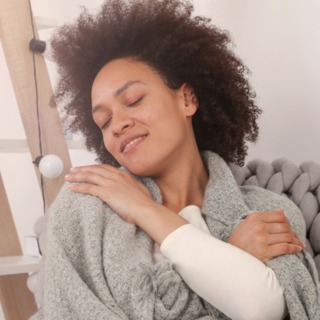
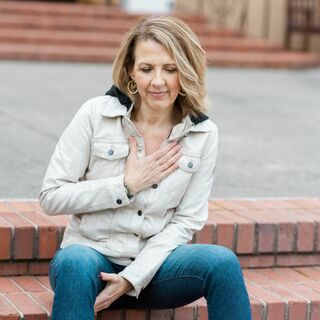
Perhaps something like putting your hand on your heart.
A small,
Simple gesture that says to the young,
Anxious,
And scared part of you,
I'm here.
You are not alone with this.
Possible in that moment,
You might be able to acknowledge that we're safe in this moment.
And this is not to negate the worry.
It's more like,
In that moment,
Your body needs to hear that it doesn't have to fight for its life.
Because that's what your body thinks.
That's what your nervous system thinks.
That's what the young part of you that never got heard.
That's what that part is feeling.
There might be a moment in there where you can take a long,
Slow exhale.
Longer than the inhale.
Because the breath is a tool that we can use to directly reach in and turn the volume down on your nervous system that thinks it's drowning.
So we start by just acknowledging and saying,
I see you.
And then it's putting our hands on our heart and saying,
I'm here,
You're not alone.
And maybe Even if you don't believe it right now,
I'm here to tell you that we actually are safe and we are not drowning.
And perhaps a nice long exhale to engage the parasympathetic nervous system.
Sometimes it might even look like movement,
But not that anxious movement of getting something done or doing something or trying to distract ourselves.
More like shaking out your hands or going for a walk.
Maybe it's splashing cold water on your face or swaying or wiggling or dancing.
It turns out that doing things like splashing cold water on your face triggers something that's called the mammalian dive reflex.
Kind of interesting that we're talking about.
Drowning,
Or being in the water.
This is an old automatic response that slows the heart down.
The moment that the cold water touches your face,
It slows the heart down.
So moving your body and using your body can really help you.
To move the anxious energy,
Especially when we're not trying to make it go away.
We're just saying,
I see you.
I'm here with you.
We're going to try to move the energy through our body.
We're not trying to make it go away,
We're just trying to move it.
Because again,
The question is,
Can we be patient enough?
And still enough.
To let the mud settle.
Or do we need to go in there and try to actively clear it?
Because it takes a little more time for the mud to settle.
We do have to use things like breath.
And attention to ourselves in presence.
It does ask us to be patient and to not just act on something that we have been patterned to do over the years.
A way that we learn to cope that very much is not working for most of us.
The mud doesn't settle because we demand it to.
It settles because we stop stirring it up.
And I know that sounds crazy that you're stirring it up every time that you try to fix it or change it or make it go away,
But we are.
So this is our chance to settle ourselves,
To come into stillness,
To stop stirring,
To become present with and turn toward the anxiety,
Even though that just seems so crazy.
But to turn toward it,
To be with it,
To take some breaths,
To acknowledge it.
To recognize it to be a young child part?
To acknowledge that it's a dysregulated nervous system that needs breath to regulate it,
That might need us to move our bodies to regulate it.
To help the energy move through our bodies.
And to clear the water.
So we see that Lao Tzu's question was never really about water.
It's always been about whether you can trust that stillness can do something that effort just cannot.
Can we recognize that we are an adult now?
And that we can choose a different way.
The way of stillness.
The way of presence.
The way of patience.
The way of self-care and self-love,
The way of compassion,
And tending to our anxiety,
Our anxious parts,
Those young anxious parts.
Now we get to ask ourselves the question,
Can we let our body float in that very feeling that we feel so sure will pull us under?
Trust me when I say,
You won't sink.
But you will finally get to rest.
And you will finally give that part,
That anxious part,
The attention,
The care,
The witnessing,
The holding,
The loving,
And the healing that it's been asking for,
And that it needs.
A quick recap,
When you feel the sensations in your body,
The first step is noticing.
Awareness is always the first step.
And noticing your impulse to do something about it,
To make it go away,
To fix it,
To not have to feel it anymore.
That's step number one.
And once you've noticed it,
Maybe there's a moment that you can turn toward it.
I know your impulse is going to be to do something about it.
But just pausing,
And for one micro-moment saying,
I see you,
Anxiety.
I know you're here.
Now you might still take the action.
You might go do the thing.
But look at what a huge thing you did,
Just in that one moment.
You shifted a pattern,
Even if just for one micro-moment.
And then the better that you get at this,
The more time you have and the more possibility you have to be able to use your breath.
To move your body.
To put your hand on your heart,
To say,
I'm here with you,
To reassure yourself.
To step in as the adult that you are now.
To be with the young,
Anxious,
Fearful,
Scared,
Panicking,
Young self,
And to say,
I've got you,
And I've got this.
And this is the way.
That we let the mud settle.
Through a level of stillness and presence,
Rather than action and effort.
You've got this.
Give it a try.
And keep moving toward wholeness,
And I'll see you there.
Namaste.