From the Talmud,
Through Kabbalah,
And into Hasidism,
Jewish spiritual thought recognizes the profound duality in being human.
Classically described as the Yetzir HaRav versus the Yetzir Tov,
The evil impulse versus the good impulse,
Or sometimes called the Nefesh Behamit versus the Nefesh Elokit,
The animal soul versus the divine soul.
Today we might call it the ego versus our divine essence.
So how do we overcome ego and choose our divine essence?
To do that you first have to become aware of your divine essence.
But if you look for it,
You won't be able to find it.
The trick is to look for the ego instead,
Because that which is aware of the ego,
Otherwise known as awareness,
That awareness is the divine essence.
That's why meditation works.
How do you do it?
Find out in this teaching on the Torah portion,
Parsha Toldot,
And a guided meditation on the Hebrew letter Yud.
I'm your host,
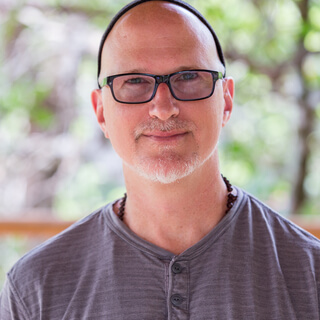
Rabbi Brian Yosef Schachter-Brooks.
Enjoy.
Vayit ro tzitzu ha-banim be-kirba,
The children struggled within her,
Va-to-mer,
And she said,
In-kein,
La-ma-zeh anochi,
Why am I like this?
Va-telech,
And she went li-droshet Adonai,
To inquire of the Divine,
Va-yomer Adonai,
Hashem said to her,
Two nations are in your womb,
Shnei goyim bevit nech.
So what is the metaphor here of these two beings struggling inside her womb?
Well,
We see a lot of struggle today in the world.
Our political climate is passionately polarized,
But there's another contest for power going on right now as well.
The question is,
Can you engage in it with the same enthusiasm?
It is the contest between two different versions of yourself.
On one side is the ego.
For most of us,
This ego usually wins in landslide victories over and over again,
And rightly so.
The ego has the most experience,
With the advantage of being constructed over a lifetime,
Not to mention having the constant support of the thinking mind.
On the other side is awareness.
Awareness has a more difficult time because people don't even notice her.
They can't see her,
Because she is the seeing itself.
Furthermore,
Even though awareness is far more ancient than the thinking mind,
She never really ages.
She is always seeing this moment anew,
So she seems young and naive.
She must,
We tend to think,
Need the ego and his thinking mind to run the show.
How does it do that?
The basic approach of the ego is struggle.
Bayit wrote,
Tzitzu ha-ba-nim be-kir-ba.
The children struggled within her.
Va-to-mer.
And so she said,
Im-kein la-ma-zeh ano-chi.
If it's gonna be like this,
Why?
Why am I like this?
There comes a time when a person is ready to give up the struggle.
The question to each of us is,
Have you reached this point?
Are you ready to go beyond ego,
Finally?
Do you want to inquire of reality and find another way?
Va-telech li-drosh et Adonai.
She went to inquire of the divine.
And so,
Let this be your prayer.
How do I give up the struggle?
Ha-shem.
Show me.
Show me the path.
But then,
Shema,
Listen.
A message vibrates from the silence.
Sh'nei goyim be-vit-nech,
U-sh'nei la-umim mi-mey-ayich yip-ha-re-du.
Two nations are in your womb.
In other words,
There are two of you.
Two peoples will separate from within you.
In other words,
Be aware of the distinction between the ordinary me,
The ego,
And the awareness that is behind and beyond the ego.
And one kingdom will become mightier than the other kingdom,
And the older will serve the younger.
The ego,
The conditioned me,
Is old,
Not in the sense of actual age,
But in the sense that it is based on experience from the past.
But there is a deeper I that never grows old.
It is always fresh,
Alive,
And new.
The ego likes to be in charge,
But it is destined to serve awareness.
Then there will be a great silence far more profound than any thought.
That silence is your nachalah,
Your birthright,
If you would but awaken to it.
How do we awaken to it?
Va-yehi eisav ish yodea tza'id,
Ish sadeh.
Esau was a man who knew hunting.
Be-ya'akov ish tam.
But Jacob was simple.
Yoshev be-ohalim,
Dwelling in tents.
In other words,
Give up your hunting.
Give up your seeking for control,
Or more precisely,
Be the awareness of your impulse to seek control.
I'll say that again.
Be the awareness of your impulse to seek control.
The impulse might still be there.
Giving up on it doesn't mean that you necessarily get rid of it.
It means you're not worrying about it.
You're not seduced by it.
And instead,
Come into the tent of your heart,
Into this moment as it is,
And dwell here in simplicity.
This portal of simplicity is represented by the letter yod.
The letter yod is the smallest of the letters,
Almost dimensionless like a point.
It is also the shape that begins the inscribing of all the other letters.
So in this sense,
It hints that all of our experience on all levels begins with this formless,
Dimensionless,
Unassuming,
Yet most profound miracle,
The divine gift of consciousness.
It is simple because it is prior to preference,
Prior to analysis,
Prior to opinion,
Prior to personality.
It is simply aware.
And so we can invoke the letter yod.
We can use this as a starting point for our practice.
The nature of the simplicity is the opposite of thinking and obsessing about what's going to happen.
It's just a basic trust.
A trust not because we think something specific will happen,
But because we're not identifying with that need for things to be a certain way.
We're just letting things unfold.
And so the Kavanaugh for yod,
I am trusting,
I am relaxed,
I am simplicity,
Chanting on long out-breath.
And our chant from Psalm 15,
Holech tamim.
Holech means to walk,
To move through life.
Tamim means with simplicity.
And it also has an implication of purity,
Of sincerity,
Of not having ulterior motives,
But the motive simply of being present,
Of being a loving presence together here in this moment.
Mi yagor ba'o halecha?
Who can sojourn in your tent that is the tent of the heart?
Mi yagor ba'o halecha?
Mi yishkon bahar kod shecha?
Who may dwell on your holy mountain?
Meaning,
Who can have that sense of transcendence from the drama of all that's happening around us?
Holech tamim,
A person who walks in simplicity.
Ho yagor ba'ar kod shecha?
Mi yagor ba'ar kod shecha?
And preparing to come into meditation,
Letting your body be relaxed but also alert.
Bringing forth an attitude of generous,
Loving,
Offering of your attention to all that is present right now on all levels.
Noticing your mood,
Noticing the thoughts arising in the mind,
Noticing your environment,
Your sensory perception,
Feeling of your body and your breath.
Bringing your right hand to your heart and offering awareness,
Attention from the heart.
Lecha,
Deep breath in.
And bringing your left hand to your belly,
Awareness,
Feeling down,
Coming to dwell in the inner space of your belly.
Awareness like light permeating your organs,
Bringing life and healing to all of your cells.
Flowing downward through your legs,
Down to your feet.
And flowing down from there,
Down into the floor beneath you,
Down into the earth.
Filling the lower part of your body with consciousness.
And awareness rising up as well.
Chest,
Upper back,
Shoulders and neck.
You can bring up your shoulders for a moment,
Tensing on purpose in order to allow it to relax.
Letting your shoulders drop.
And awareness flowing down through your arms,
Hands and fingers,
Connecting back with your heart and your belly.
Bringing attention more deeply into the flow of your breathing.
Letting your breathing become a bit more slow,
A bit more deep.
Awareness rising into your face,
Facial muscles,
Brain and nervous system.
Bringing little smile to your lips.
Being the loving,
Benevolent,
Indwelling presence in the temple of the body.
Naa say,
Deep breath in.
Bringing right hand up from your heart to lightly touch your forehead.
As awareness radiates outward from the body into the space around you,
Coming to rest on all the elements of your environment,
The objects,
The room,
The walls,
The light,
The sounds vibrating in the air.
And recognizing that all of this outer world as it appears to you right now is appearing in consciousness.
This consciousness is like a field,
A vast open space without boundary or border.
Limitless openness in the inner world of thoughts and feelings as well as the outer world are all arising in this space.
And beyond the body,
Beyond thoughts,
Beyond feelings,
Beyond personality,
You are this space.
You are this space of awareness.
Vinishma.
Deep breath in.
Kissing your fingers,
Relaxing your hands.
Ravonosha Lulam.
Bless us to meditate deeply and powerfully today.
Help us to rest our minds in the simple prayer,
Atiyahu.
You who are not separate from anything or anyone we encounter.
You who are not separate from this awareness that we are.
Atiyahu.
You are what we call the sacred,
The divine,
The holy.
Atiyahu.
Atiyahu.
Resting the mind in the silent repetition.
Atiyahu.
Atiyahu.
Being conscious,
Noticing thoughts that arise.
Not trying to suppress them or get rid of them.
Just gently but firmly bringing yourself back again and again.
Atiyahu.
Atiyahu.
As we come into silent meditation.
Bringing some movement back into your body.
Taking a nice stretch.
Ravonosha Lulam.
As we prepare to come back into our activities,
May we be grounded in the knowledge of ourselves as that simple open space.
Oseh shalom bim ramav,
Hu ya'aseh shalom aleinu.
Ve'al ko Yisrael,
Ve'al ko Yoshvei Tevel,
V'imru.
Amen.
Shalom.
I hope you've enjoyed this Torah of Awakening.
I'm Rabbi Brian Yosef Schachter-Brooks.
Until next time,
All blessings.