The Zen Master,
Shunryu Suzuki,
Gave us the only instruction we need for today.
He said,
In the beginner's mind,
There are many possibilities,
But in the expert's,
There are few possibilities.
In the villages of Braj,
The childhood home of Lord Krishna,
Just before the festival of Holi,
Something strange happens.
The silks,
The heavy brocades,
And the embroidered shawls,
All the fabrics that announce status and lineage,
Are locked away in chests.
Rich and poor,
King and farmer,
Everyone puts on white,
Simple,
Unbleached white.
This isn't a uniform,
It's a declaration.
They are saying to the universe,
I have no defenses today.
I have no status.
I have no past.
I am a blank canvas.
There's a story from the lanes of Vrindavan,
A village in India.
A scholar travelled for months to reach this village.
He'd spend 40 years with his nose in the scriptures.
He memorized everything,
Debated in the courts of kings.
When he arrived,
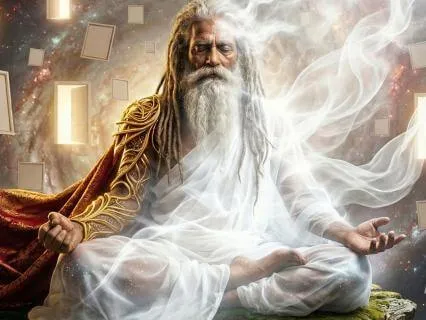
He was draped in this heavy brocade robe,
Deep red with gold thread.
You could spot his status from a mile away.
The villagers were kind.
They offered him food,
A place to rest,
But they didn't bow.
They didn't treat him like a master,
And that confused him.
So he walks up to an old woman sitting on her porch,
And asks,
Do you know who I am?
The old woman doesn't even look up.
No,
She says quietly.
I know what you're wearing.
I don't know who you are.
Heat rises in his chest.
He starts listing his resume.
I've studied the Vedas for four decades.
I've debated in king's courts.
I've memorized.
That's what you've done,
She interrupts,
Finally looking at him.
That's what you've done,
Not who you are.
She holds up this simple,
Unstitched white cloth.
In this village,
We don't wear our past.
We wear our readiness.
If you want to be known,
Keep your brocade,
But if you want to see,
Put this on.
He stands there,
And he realizes his robe isn't just red silk.
It's 40 years of,
I know.
He took the white cloth,
Folded his brocade,
Left it on her porch,
And didn't touch it for three days.
And in those three days,
He saw Vrindavan for the first time,
Not through the lens of a text,
Through his own eyes,
Unarmored.
He didn't become less of a scholar.
He became more of one,
Because he finally understood knowledge isn't a possession you guard inside a fortress.
It's a river you enter.
So that's the invitation today.
Not to become stupid.
Not to forget everything.
Just to practice,
For a few minutes,
What it feels like to not grip what you know.
Let's start simple.
Feel your body in the chair.
That's it.
Back may be supported against the cushion or not.
Feel the feet on the floor.
Notice how you're being held.
Notice that you don't have to hold yourself.
Drop your shoulders and clench your jaw.
Take one deep,
Conscious breath.
Just to notice that you're here.
Not at work.
Not in the future.
Here.
Now,
Before we get into the deep practice,
Just for a moment,
Look at your hands.
Just simply look at them,
Resting on your thighs.
Slowly,
If they aren't already,
Turn your palms facing up and open your hands.
Finger loose.
Not grabbing anything.
Feel that.
That's openness.
That's all we are practicing today.
And now you can allow your eyes to softly come to a close.
And as you sit there,
I want you to bring to your mind a domain or an area where you are considered an expert.
It could be your profession.
It could be a skill.
It could be a role.
A parent.
An athlete.
A partner.
A leader.
Somewhere where people look to you for answers.
Just bring it to the forefront of your consciousness.
Notice what happens in your body when you think about that.
Do your shoulders tighten?
Does your jaw clench?
And here's the interesting part.
Look at your hands.
Without you realizing,
Did they start to curl into fists?
Just noticing.
No judgement.
Those fists,
That clenching of the jaw,
That's expertise.
That's all the years of learning.
All the times you had to be right.
All the credentials.
All the proof you've had to carry.
It's not bad.
It's kept you safe.
It's gotten you where you are.
But now,
For a moment,
Feel what it costs.
Feel that tension in your palms.
That grip.
Feel that tightness in your jaw.
Perhaps even on your face.
That contraction.
Here's the thing about your brain.
And I'll just say this like we're just talking.
Your brain has these pathways.
Neural superhighways.
Every time you act like the expert.
Every time you correct someone.
Every time you prove you're right.
Every time you defend what you know.
Those highways get wider.
Faster.
More automatic.
It's efficient.
But it comes with a cost.
The more those highways widen,
The harder it is to see a different route.
The harder it is to be surprised.
That's what Master Suzuki meant when he said,
In the expert's mind,
There are few possibilities.
The expert's brain has optimized.
It knows the fastest way.
It's not looking around anymore.
But here's the cool part.
And neuroscience backs this up.
Those pathways can also weaken when you don't use them.
When you sit here,
Right now,
With your hands open.
Not defending.
Not proving.
Not correcting.
Those expert highways are just sitting idle.
And when neurons stop firing together,
They start wiring apart.
This is called neuroplasticity.
The brain's ability to rewire itself in response to a new experience.
But neuroplasticity has a precondition.
It requires cognitive flexibility.
And cognitive flexibility requires something most high performers find terrifying.
The willingness to be wrong.
To admit that what you knew yesterday may not serve you today.
The expert is frozen.
They cannot learn without losing face.
The student is fluid.
They can receive anything.
This is the logic of the white kurta.
The blank slate.
You're literally,
Physically,
Neurologically,
Loosening the grip of your expertise right now.
Just by sitting here with open hands.
So let's dive deeper into this practice.
Just sit.
Just sit.
That's the only instruction.
A thought comes.
I should be doing something productive.
Your hands are open.
You don't have to grab it.
Another thought comes.
I'm not enough.
Your hands are open.
Let it pass.
Another thought comes.
This is pointless.
Your hands are open.
That's fine too.
If a thought sticks,
If it hooks you,
If it won't leave,
That's not failure.
That's just information.
Your hands are still open.
The thought can stay.
You just don't have to fight it.
Maybe there's some tension on your face.
Or your jaw.
See if you can release that and let it pass.
Like every thought does anyway.
That's the heart of the practice.
Just letting it go.
Again and again.
Slowly and gently,
Bring your awareness back.
Feel your feet,
Your hands,
Still open on your thighs.
When you're ready,
Close your hands.
Make gentle fists.
Feel that.
That's your expertise.
That's knowing.
You will definitely need it later.
Now,
Open them again.
Feel the difference.
That movement,
Close,
Open,
Close,
Open,
That's the whole skill.
Knowing when to hold and when to release.
When to be the expert and when to be the beginner.
Most of us just forget we can open.
Before we end this meditation,
Set this intention.
Speak it silently or aloud.
I can hold what I know.
I can also let it go.
I know nothing.
I am ready forever.
Everything.
This is not a confession of ignorance.
It is a declaration of freedom.
You are not your resume.
You are not the roles you play.
You are the awareness that holds the expertise,
Releases it,
And picks it up again when the moment requires.
Take a deep breath into your lightness.
Feel the potential in your cells.
You are fresh.
You are new.
When you open your eyes,
Try to see the room as if for the first time.
See your problems as if you've never seen them before.
See the people in your life as if you've just met them.
Walk into your day with the curiosity of a child.
Be well.