Hey everyone,
Welcome to day 17 of our 30 day yoga challenge.
My name is Candice and today's practice is a fascia flow.
So our fascia is this body wide network of connective tissue that is responsible for so many things in our body.
We have fascia that actually surrounds our organs,
Our muscles,
Our muscle fibers,
But we also have this thick spongy layer that lies just underneath of our skin.
It is connected all through the body.
Our superficial back line,
For example,
Is connected from the bottom of our feet,
Lined all the way up the back and actually connects to the frontal bone in the forehead.
So it's this giant netting that is responsible for so many things.
How we move,
How we breathe is responsible for force transmission when we're jumping and throwing.
So caring for this network is so important.
And sometimes the body pain that we feel is due to muscles.
It might be due to joints,
But a lot of the time it's due to our fascia.
And if you think about the fact that this netting is connected all through our body,
It can be due to,
Disruption in the fascia in a different area of the body.
If you think about like an adhesion that you would have or a disruption in the fascia,
Say behind your knee,
It's going to be pulling down on the rest of the fascia all the way up the line.
So you could be feeling pain in your lower back or anywhere else along that line.
So this practice is just caring for and getting connected to and moving it in different ways with the fascia in mind and the different fascia lines that we have underneath of our skin.
So you will need a ball.
I have a cork ball here,
But you can use a tennis ball or lacrosse ball,
Sort of ball that works,
I mean the firmer the better,
But whatever you have,
You can just set that beside you and we're going to get started standing at the top of our mat.
So getting started,
Just standing with your feet about hips distance apart,
Spreading through the toes.
Let's lift all 10 toes,
Okay?
Let's ground down through the big toe,
Pinky toe,
Heel of the foot,
The knuckles there.
Even though all 10 toes are lifted,
You can feel the grounding down through those three points.
And then slowly,
One by one,
Lowering down the pinky toe,
Second toe.
Can you drop one toe at a time?
Big toe comes down last.
Feel a nice spread through the toes.
Grounding down through the feet.
As you feel that pressing down through the feet,
You can feel the energy pressing up all the way to the top and the crown of the head.
Rolling the shoulders up,
Down,
And back.
So we're going to start with what I like to call a check-in.
So standing tall,
Feeling even through all corners of the feet.
Keeping the spine tall,
Keeping the crown of the head lifted.
Can you lean your body forward but keep the heels down on the mat?
Right before you're about to fall,
Can you lean back,
Press through the toes,
Lean back all the way,
But keep the toes down.
Try not to fall back.
I mean,
If you do lose your balance for a minute,
Just come back into it,
But just finding that edge of where you're about to fall and know that as you lean forward,
What catches you and brings you back.
That's your back line of your fascia.
So we're going to lean back.
And what catches you before you fall,
That's your front line.
So leaning forward,
Finding your edge,
Keeping the heels down.
Leaning back.
Keeping the toes down.
And then we'll come back to center.
Same idea,
But we're going to move side to side.
So leaning all of your weight over to the left,
Keeping all sides of the feet on the mat.
These are your lateral lines pulling you back to center and all the way over to the right.
And then your left lateral line will pull you back to center all the way over to the left.
So just kind of leaning.
Side to side.
And then can we take it in a circle?
So leaning over to the left.
Swing forward,
Keep the heels down,
All the way over to the right.
Bring it back,
Keep the toes down.
All the way to the left.
So just finding that edge.
On all sides.
Take it back,
We'll take those circles the opposite way,
Leaning over to the right.
Swing forward.
Over to the left.
Let's get back one more,
One more circle.
All right,
And then back to center.
From there,
Grabbing your ball,
Whatever ball you have,
I'm going to turn and face you.
So what we're going to do is roll the bottoms of our feet.
This is a great practice to have.
Most of us have really tight,
Tense fascia on the bottoms of our feet.
This is our plantar fascia.
So this is a great thing to do,
Especially if you're a runner or someone who just experiences a lot of pain in the bottoms of the feet and the plantar fascia.
Rolling your feet is a great practice.
So let's start with the right foot.
We're just gonna take the ball,
Bring it to the knuckle of the big toe,
And even steady pressure,
We're gonna take it and roll it back to the heel.
And as you get back,
Tap,
Roll it forward,
Lift off the pressure and roll back forward.
So we're just applying pressure when we're rolling to the heel.
And then tap it back.
Steady pressure,
And there's going to be certain spots.
That feel,
Oh,
That feel very intense.
So just rolling through it,
Breathing through it.
Steady pressure.
All the way.
To the heel.
And as you do that,
Kind of moving all the way down the toe line,
So you started at the big toe,
Moving to the second toe joint and rolling back,
Trying to get all sides,
All parts of the bottom of the foot,
All the way to the pinky.
And if you're finding it too intense,
Just don't apply as much pressure.
We're just going to take a couple more passes through there.
And then as you're passing through,
You're finding those areas that feel very,
Very intense.
So those very sticky spots.
For me,
It's always kind of towards my heel.
So find that.
And we're gonna lean into it and we're gonna breathe into it.
Unclench your jaw,
Soften your shoulders.
Steady pressure on that one spot that feels very intense and just breathe through it.
Feeling it really.
A few more breaths here.
All right,
And then back off out of it.
Take your foot off of the ball.
And plant your foot beside the left and just stand there for a moment.
Notice the difference from right side to left.
I'm sure you will feel it.
For me,
After I roll one foot,
And I like to do this little check-in here,
I feel like the foot I just rolled is almost in the ground,
And the foot that I haven't rolled is on top of the ground.
So I feel very much more integrated into the ground after I roll the bottom of my foot.
I don't know if you feel the same way,
I'd be interested to know,
So let me know in the comments how you feel right here after the video,
How you feel after rolling only one foot.
Full breath in,
Full breath out.
And then we can move to the other side.
So taking the ball,
Same idea.
On your left foot.
Starting at the big toe knuckle.
Steady pressure.
From the knuckle all the way to the heel.
And then tap it back.
Steady pressure all the way along,
Moving down.
Each knuckle of the toes.
Trying to get all.
.
.
Of the bottom of the foot.
This is a great practice to do in the morning.
If you have a ball nearby,
Just kind of wake up and do this a few times.
Let's do a couple more passes.
I'm sure you have found those spots that feel very icky or intense.
So you know where we're headed.
So from there,
Find the spot that you don't want to apply pressure to,
But you will.
One foot might be worse than the other.
So as you find that spot,
Steady pressure holding the foot there.
Soften everything else.
When something's uncomfortable,
We tend to clench and hold our breath.
I really want you to breathe deep here.
Breathe into it if you can.
And if it's very,
Very intense,
Just back off,
Back off the pressure a little bit.
You don't want to be so intense that you're like in pain,
But it is going to be uncomfortable.
So just breathing through it,
Breathing through the discomfort.
Soften the shoulders.
Soften the jaw,
The forehead.
Just a couple more breaths.
Back off out of it.
You can take your ball and roll it off to the side.
We won't use it again.
And then from there,
Come back to the top of your mat,
Ground down through the feet,
Feel how deeply connected you are with the ground now.
And then from there,
We're gonna do that little check-in that we did at the beginning once again,
And see if your balance improves a little bit.
So standing tall,
We'll just do a couple passes each way.
So leaning forward,
Keeping the heels down.
Leaning back,
Keep the toes down.
Forward,
Keep the heels down.
Leaning back,
Keep the toes down.
Come back to center,
Lean over to the left.
Keep the piggy toe edge of the right foot grounded.
Lean over to the right,
All sides of the feet grounded on the floor.
To the left.
To the right.
Next time you come over to the left,
Find that full circle.
So lean forward,
Keep the heels down,
Take the circle over to the right.
Lean back,
Keep the toes down.
If you lose your balance,
Just come back into it.
Pause when you come forward,
Take the circles opposite way.
So lean to the left.
Lean back,
Lean to the right,
Come forward.
And then come back to center.
So from here,
In our yoga practice,
A lot of the time we cue it coming into a forward fold,
Keeping a flat spine,
Which is fine.
And that,
You know,
Brings the stretch into the hamstrings.
And that does kind of keep you safe if you do have any sort of spinal injury.
So I will say if you have like slipped disc or any sort of spinal injury that,
You know,
Rounding the spine isn't a very safe thing for you to do.
When we come down into our forward fold,
Do so with a flat spine.
But if that's not your case,
We can try bringing the forward fold action into the entire back line of the body.
So sometimes when we're in our forward fold,
We do roll all the way up to stand,
Right?
I'm sure you've done that in a yoga class.
We're going to do the opposite.
We're going to roll all the way down,
Starting from tucking the chin.
So grounding down through the feet,
Standing tall.
From there,
Tuck the chin.
After that,
You can round the shoulders forward,
Rounding the upper back.
Keep rounding through the spine,
Keeping the knees soft.
All the way down,
Keeping the chin tucked.
You might feel a stretch through the back of the neck,
Through the back.
That's normal.
As you come down,
You can start to hinge at the hips,
Keeping the knees soft.
Rolling all the way down.
From there,
Shift the weight into the left foot.
Step the right foot back,
Drop the knee.
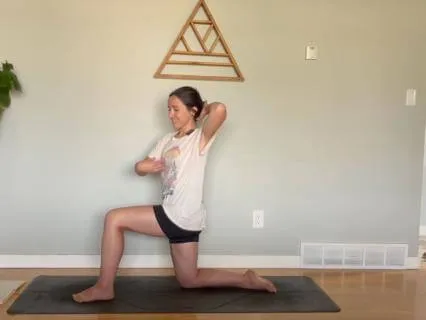
So we're going to come into a low lunge here,
Stacking right knee underneath of the hip.
As you do,
You want to squeeze that right glute to keep your pelvis stable,
Stacking knee underneath of the hip.
And sitting up tall with the spine.
You can take your hands to your knee or take one hand to the hip,
Left hand to the knee.
From here,
As you breathe in,
Shift the hips forward,
Squeeze the right glute.
Feel the breath moving into the belly.
As you lift the heart,
Feel the breath moving into the ribcage.
Breath moving into the chest,
Chin lifts last.
Feel yourself full.
As you exhale,
Opposite way,
Tuck the chin.
Round the shoulders forward,
Press the heart back,
Press the navel back.
Press the hips back,
Lean back slightly.
Inhale,
Press the hips forward,
Squeeze the right glute.
Lift into the belly,
Lift into the ribcage,
Chest,
Chin.
Exhale,
Chin tucks,
Shoulders round forward,
Heart pulls back,
Spine rounds,
Press the hips back.
Inhale,
Come back up to center.
Tall through the spine.
From here,
Take your right hand to the outer left knee,
Pressing your hand into your knee and your knee into your hand.
Take the left hand to the back of the head,
Elbows straight out from the shoulder.
Take a breath in.
And as you exhale,
Using your core to twist.
These are your spiral lines of your fascia that's responsible for this twisting action.
And we're going to pulse back to center.
Using the core to pulse and twist.
Back to center.
Inhales back to center,
Exhale to twist.
For two.
And one.
Come back to center.
Take the hands down,
Tuck the back toes under.
Step up into your forward fold.
Full breath in.
Full breath out.
Shift the weight into the right foot,
Left foot steps back.
Drop the left knee.
Knee stacked underneath of the hip.
Slowly rising up.
You can rest your right hand on your knee,
Left hand can come to your hip.
From there,
As you inhale,
Squeeze the left glute to press the hips forward,
Then lift the navel.
Chin comes up last.
Exhale,
Chin tucks first.
Shoulders round forward,
Heart pulls back,
Navel pulls back,
Hips press back.
Inhale,
Squeeze left glute to press the hips forward.
Navel,
Ribs,
Chest,
Chin.
Exhale,
Chin,
Shoulders pull forward,
Heart pulls back,
Navel,
Hips.
Last one.
Hips press forward.
Moving all the way up,
Chin comes up last.
Exhale,
Chin tucks,
Heart pulls back,
Ribs,
Navel,
Hips.
Inhale,
Come back to center.
Tall through the spine.
Left hand comes to outer right knee.
Right hand,
Bend the elbow,
Takes behind the head.
Inhale,
Lifting up through the crown.
Exhale,
Twisting from your torso,
Your trunk.
Over to the right.
Might just be a little twist.
Inhale,
Back to center.
Exhale.
Inhale,
Back to center.
Exhale,
Twist.
Inhale,
Back to center.
Exhale.
Last one.
And back to center.
From there,
Release the hands down.
Take the right foot back.
We're going to find a comfortable seat.
I'm going to sit on my heels,
But find any comfortable seat that works.
From there,
Take the arms out to the sides.
Turn your head to face the left arm first.
From there,
From the shoulder,
We're going to externally rotate the left arm so the palm faces up,
But moving from the shoulder.
Take a look back at your right hand.
We're going to internally rotate from the shoulder so the palm faces back.
Okay,
So the arms are moving in opposite directions.
Lean your weight slightly over towards the left hand.
Take a look over to the palm that's facing up to your left.
As you come back to center,
Turn your head towards the right.
When you do that,
Flip both arms.
So now the left arm is going to be internally rotating from the shoulder.
Right arm is externally rotating from the shoulder.
Back to center and switch.
So find some fluidity here.
Let's take one more pass each way.
And then come back to center.
Take the left hand down beside you,
Reach the right arm up.
Crunching through the left side waist,
Opening through the right side waist,
That side bend here.
Inhale,
Come back up.
Exhale,
Side bend to the right.
Again,
Find some fluidity.
Inhale to take you up.
Exhale,
Come over.
Inhale out.
Exhale.
And feel how the opposing actions work in the body.
So the left side closing off creates the opening through the right side.
Same thing on the other side.
Right side closing off creates the opening through the left.
And then we'll come back to center.
Take the hands to heart center,
Close the eyes,
Feel connected in your body.
You can blink the eyes open.
We will end here.
And thank you so very much once again for joining me.
I hope you enjoyed today's practice and we will see you again tomorrow.