And breath of fire is one of those foundational breathwork practices in the yoga tradition.
It's a really nice entry point and what I like about it is you can use it in the morning when you are needing a little bit of a boost of energy.
But you can also use it in the evening to kind of regulate some of those,
All of those wildness that you might have accumulated through the day.
So it does a good job of kind of regulating the nervous system.
And so lots of times when we think that we need energy,
Sometimes we just need to balance our energy.
And that's what Breath of Fire does.
The breath of fire is also known as Kapalabhati,
And it's also known as skull shining breath.
Call this one breath practice called Bhastrika,
They will call that breath of fire.
But traditional breath of fire is just mostly just an exhale,
A very quick exhale,
Like you're just,
Like you're just huffing.
And so you can place your hands on your belly and just try that.
And just notice how the belly snaps.
Alright,
So what you're doing is you're kind of using the diaphragm forcefully and that's also toning those muscles and the core.
And you might even notice through practice,
You can find that subtle lift in the mudabandha But you don't need to focus on that too much.
If you're just learning it for the first time.
The key is that by focusing on the exhale,
You notice that the inhale is kind of automatic.
All right,
So if you go.
It's like this automatic inhale,
All right?
So we don't focus on the inhale.
Another breath practice called Bastrika goes.
.
.
So that's an energetic breath practice.
And we'll do that for another time.
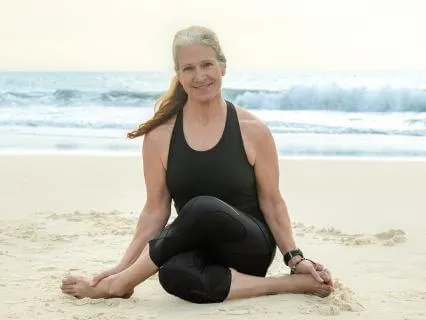
You want to make sure that you are sitting up tall.
And so I like to keep my hips a little bit higher than my knees,
And your shoulders are kind of grounded.
So in other words,
Just be aware of sometimes we shrug our shoulders up.
And some people like to keep their hands on their belly during this practice.
You can place your hands,
Just whatever feels comfortable for you.
And just,
Again,
If you want to keep your hands on your belly and just feeling that snap,
Go ahead and do that.
But also just remember that it's just a snap in the belly.
You don't need to be doing this.
Just the torso should be engaged and just the.
.
.
All right,
So let's try five.
All right,
So let's do it.
One,
So,
I'm sorry,
You do.
So inhale halfway.
And exhale.
All right,
So you feel that snapping in the belly.
And so it just kind of becomes this rhythm.
And I always liked that because it's just something that you can focus on and kind of use it not only as a meditation,
But as a precursor to meditation.
So let's try 10 this time.
So just a little inhale halfway.
Next cell.
All right,
So.
Just 10 and then.
So different traditions will have you exhaling through the mouth.
And so I know when you take a hot yoga class,
You end with Kabbalah Bhatti,
And it's a.
.
.
Some people do that.
Or you could just do it through the nose.
But just be mindful,
If you do it through the nose,
Make sure that if you have any allergies,
You blow your nose ahead of time.
So I'm going to do just a little,
Just so you can hear it.
But we're going to do 30 for now.
We're going to do two rounds of 30 with three deep breaths between.
Need to stop,
Then go ahead and stop and then pick up.
Um with the rest of us.
If you want to go faster or slower,
Just feel,
That's fine too.
All right,
So we're gonna do 30,
And then we're gonna do three deep breaths between.
And then we'll do another 30,
OK?
So just take a little half inhale.
Let's begin.
Inhale.
Inhale fully.
And exhale,
Side down.
Inhale again.
And exhale,
Side out.
Inhale.
Exhale.
And let's do our half inhale.
We'll do 30 again.
Inhale.
Exhale.
Inhale.
Exhale.
Inhale.
Exhale.
And then just kind of take notice of your energy.
You can breathe on your own.
So maybe you feel a little bit more balanced,
Maybe you feel a little bit more energy.
Maybe you feel just kind of like,
Oh wow,
Some of my anxiety is kind of.
.
.
So as I said,
You can practice this breath of fire.
Just before you start to meditate.
Or you can just use it as a just a quick little pause throughout your day to kind of reset,
Reset your energy,
Reset your nervous system.
So you can remain balanced throughout the day and so you can just kind of allow your life to just be guided by your intentions rather than just maintaining this idea of reactivity just constantly darting around.
So again,
I just love it because it's very,
Very basic,
Very easy to do.
You can do it anytime.
Don't really need.
A set time,
You can just count 30 at a time.
Two rounds of 30,
That's fine.
I do.
.
.
I want to mention that you really don't want to practice pranayama while you're driving are very aware of the road because you really want to focus on driving.
But it really is just a good way of just,
If you want to just be seated in your chair at work or at home and you just need a little quick,
Little bit of a break,
This is a perfect breath practice for you.
Take care.