Okie dokie,
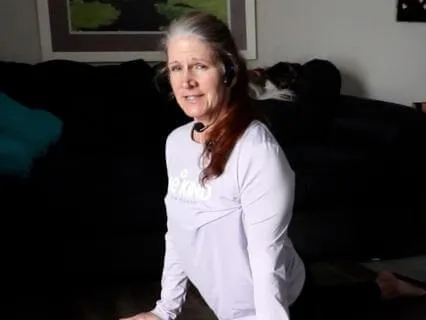
So let's start in sitting.
Lots of times I start a yoga class in child's pose,
But.
.
.
This is gonna be more of a.
.
.
A moving,
Talking sort of thing.
Very different from how I normally teach the yoga classes in the studio.
So close your eyes if that's comfortable for you.
Be sure that your spine is straight and your knees are.
.
.
A little bit below your hips.
Just allow yourself to breathe.
What facilitates the breath is opening shoulders,
So lots of times we're hunched over for too long.
And we.
.
.
Don't give ourselves.
The space to breathe.
I mean I know that sounds esoteric but we don't give ourselves this physical space to breathe.
Sorry,
This is like pinching against my chin and driving me crazy.
And so with each breath,
Just open your shoulders and see if you can expand.
Your collarbones.
Make sure each breath just draws down really,
Really deep.
So that your diaphragm pushes out your belly.
And then exhale we just So the diaphragm pushes up.
Belly comes in.
So keep continuing that.
And so.
.
.
If you're anything like me,
You will have a long to-do list.
We have.
.
.
All these things that we want to do from day to day and for me I actually have a list that I write rather than having little digital one.
And.
.
.
Some of those things I get done,
Sometimes I don't.
But when it comes to the bigger things in our lives,
It's harder to scratch off.
We might have things like getting married or buying a home.
Making a certain salary.
And these are maybe some more superficial things.
But it comes a time in our life when you know we might say well Someday I'll do this someday.
I'll do this someday But as calamity might strike or you might.
.
.
Encounter something a great conflict that brings about suffering or pain.
And.
.
.
You suddenly have this freedom because something might have been taken away from you and you said well when is that someday And the very first word in the Yoga Sutras is Atta.
Which means now.
And it signifies like attention.
It's now.
You've arrived.
You are ready.
So you ask yourself,
When does that someday begin?
And yoga says,
Atta,
Now.
So without thinking about those long to-do lists right now,
Let's see if we can shake off and just kind of remove.
Some of the tensions that keep us anchored in the past and release some of that and open ourselves to now.
So inhale,
Expand,
Open your chest And exhale,
Let's twist a little bit to the right.
Using your right hand to maybe help you open the chest,
But don't force it breathing through the right shoulder.
I mean,
You're really not breathing through the right shoulder.
But you're allowing that shoulder to open.
Expand.
To the new possibilities The shifting.
That's necessary for now.
To happen.
Inhale extend the spine straight and exhale let's come to the other side twist over to the left Open the left shoulder.
Use your fingertips to help guide you a little bit deeper.
And don't feel that you need to force the neck too early.
Just recognize where you are now.
And don't concern yourself too much with what you have to do.
This evening,
This afternoon,
This morning.
This week.
Just see if we can allow our bodies to open to now.
Inhale extend the spine,
Exhale release.
Now let's come on to our backs.
If you have the block you can remove it.
And let's see if we can maybe open the core a little bit.
So usually I do this on.
.
.
My my back i mean i'm sorry on my hands and knees But what you should do is Bring.
Your elbows to the block.
And squeeze it between your knees.
Okay so you're really compact here now extend the left leg and France.
The left arm.
So feel the core engage here.
And then bring them back together.
Let's do the other side.
Excuse me,
Charlie.
So this is very slow.
Deliberate movement.
So often in life,
We move too fast without really knowing what we're doing.
In a physical practice,
When we move to fast,
We can invite injury.
Make sure your lower back is pinned to the ground.
As you keep the solid,
Steady core.
One more time each side.
So this is where we stabilize the core.
Because without a stable core,
Remove the block.
And roll it up without a stable core.
Without a stable foundation,
You can't find stability in life.
So let's roll around,
Let's do some cat and cows.
So inhale,
Draw.
The collarbones away from your chin,
Open the chest.
Tip the tailbone high and exhale,
Press into the hands belly button to the sky.
Curl the tailbone under.
Inhale,
You can do this on your own at your pace.
Linking breath with movement,
Pressing in through the knuckles to kind of activate your sheer forearms.
Because as we know in yoga practice anytime you're on your hands the forearms should be active.
And that takes a lot of pressure off the wrists,
Which also can get a little congested.
And see if you can maybe open the shoulder blades away from you.
And then on the inhale With cow,
See if you can pull the shoulder blades towards you.
And then just kind of make smiley faces with your hips.
Because all this is just really playing.
With movement.
Especially if you're not very active during the day.
Okie dokie.
Let's tuck the toes,
Come into a quick downward facing dog.
And just.
.
.
Just kind of pedal the feet back and forth.
Again,
Pressing in with the knuckles of your hand,
With the fingers of your hands.
All the little of my toes.
Now step the right leg through.
Drop the back knee.
Untuck the back toes.
And of course,
My knee is always kind of cranky.
On this side.
And let's just kind of hang out here for a moment.
And I actually like this pose a lot.
For various reasons.
And so you've heard whenever you do like lunch and stuff,
Never put your knees over your toes.
But as you know,
So many of our movements in life.
Will do that.
So my knee is really,
Really far from my far over my toes and let's just kind of hang out here.
Maybe use the hands to press away and just notice if this back hip just gets a look like a little beautiful A little bit of a stretch.
But you're also getting some dorsal flexion and the foot.
By bringing it far in your toes.
Lots of times some of our problem in our backs and our knees and everything have to do with What's going on with your feet?
So let's press the legs straight.
You can maybe pull the heel forward a little bit.
We're not staying here for too long.
We're just kind of just opening and closing.
The hinge of our knee and then plant the hands step.
The right foot back.
And come into downward facing dog and switch.
So the left knee comes forward.
Untuck the back toes and then just find this again so My Shih Tzu is giving me the stare.
Which means she wants something.
Usually attention or food.
She just went outside.
I'm just slowly just needling the Knee a little bit further.
Word.
And pressing my torso away.
Because this is really active.
There's a time for it to be a little bit more passive and yin,
But this is active.
So a typical flow class will have you moving very,
Very quickly.
Remember that yoga isn't necessarily like calisthenics.
It is a lot more than that.
It's about self-inquiry.
Figuring out what's going on in the body and mind.
So let's press the leg forward straight So in other words,
If your mind and body are operating on two different channels,
That's where yoga needs to be a little bit more.
About integrating the two.
So.
That means slowing it down.
And having that inquiry.
Now,
Granted,
There's a time where.
.
.
A good beautiful creative flow is very,
Very lovely and it can really get into some places that You never thought you would go.
But.
.
.
Sometimes when the mind checks out that's when we can get into trouble.
So let's step in the foot.
Forward,
Plant the hands,
Come back into downward facing dog.
Let's petal the feet.
And then walk the feet to the hands and let's just do a quick flow.
Just to get the legs,
The body moving a little bit,
Hopefully.
My camera won't lose me.
So to sweep the arms up overhead,
Flip the palms.
And then let's just kind of lean over to the right.
And let's lean over to the left.
And just kind of giving the shoulders a little bit of stretch.
Hmm.
Just be very present to what your body is feeling just noticing if one side seems to be a little bit more than another so inhale sweep the arms up overhead exhale swan dive the hands Fall forward.
Forward fold.
Inhale halfway lift.
Exhale step back into your plank and let's lower all the way down to the mat.
So in COBRA,
We often just kind of come up and grit our teeth like this or we do an upward dog like Like basically like a part of a burpee.
Let's see if we can really figure out what our bodies are doing in COBRA.
Now,
If you.
.
.
Want to go a little bit more into cobra i have a video on it but let's place the hands way outside this is called king cobra And so the hands may be.
.
.
The forearms will be about,
You know,
90 degrees from your upper arms,
Okay?
So that way we're just kind of like,
You know,
Tenting the fingers.
And just feel what it's like just right here.
Just feel what it's like.
To just open the chest just a little bit.
So,
You know,
You're coming down,
Just this little baby cobra right here,
Roll the shoulders away from your.
.
.
The front of your mat.
So you're pulling the shoulder blades.
Behind you,
Behind the back of your mat.
So that's just step one.
And let's inhale.
And exhale,
Let's see if we can come up a little bit higher.
Planting.
The pubic bone into the mass.
And breathe here.
So you feel your core engaged.
This is your lower back.
This is.
.
.
The front.
This is your core muscles really moving.
And then exhale,
Come on down.
Now let's just do regular Cobra.
Just hands just below your shoulders.
Roll the chest open.
Inhale.
To cobra.
And exhale,
Tuck the toes,
Come through plank,
And then go through downward facing dog.
Inhale,
Hips,
Hike high.
Exhale,
Step the feet to the hands forward fold.
Inhale,
Halfway lift.
Exhale forward fold.
Inhale flat back comes up reach up reach high and exhale forward fold.
Inhale extend the spine long Exhale,
Step blank.
Step back to plank.
Let's lower and let's do our cobra one more time.
Inhale,
Roll the chest open,
Cobra.
Exhale tuck the toes.
Press back downward facing dog.
Inhale,
Hike the hips high,
Bend the knees.
And let's step forward place place your hands on your calves on the floor on your hips let's come up with a flat back And exhale forward fold.
Next inhale roll your chest arms up open reach up reach back and exhale.
Let's do one more.
Inhale halfway lift.
Exhale step back plank Let's lower all the way down one more Cobra.
I mean,
You can do a chaturanga if you want.
But let's see if we can really activate the core.
And our cobra.
Find out where we are.
Because if you're not doing it now,
When are you going to do it?
When are you going to really seek the deeper places within you.
Hmm.
Alright,
So not much going on here,
So let's come back onto our knees just like we were before.
Subscribe your blocks,
And.
.
.
Step the right foot.
In front,
Just like we were doing before in lunge.
Let's just kind of heel-toe.
The foot over towards the left.
It's not really that important for you to have the shin parallel with the front of your mat.
As you can see,
Mine is more like a I don't know,
I like it.
45 degree angle or something.
And the back leg is straight and try to get it behind you so in other words just avoid kind of kicking it closer towards you,
But try to keep the back leg straight.
So avoid just kind of like rolling one side or the next.
Now,
Lots of times we,
This is very very delicious,
We roll forward and that really is the best part about Pigeon but we're gonna do a little bit more active.
Okay.
And so this is where we want to really hike up the hips high.
Using our block.
So just.
Press in with the right shin.
Press in with the left thigh,
So press down with both.
Really make this active try to use your legs to prop you upright.
And maybe.
.
.
You can float the hands.
Because eventually there are yoga postures that have you do that.
But feel how active this is when your chest is open and straight in pigeon.
So really pressing the shin of the right leg down.
Pressing down.
You can use the blocks to float your torso over.
But see if you can.
Maybe not so much use your hands.
So just like we were doing in King Cobra,
Just use the hands as guides.
So there's a little bit of a backbend here.
And then using the core.
To roll forward.
And keep you steady.
So you're folding.
But keeping the course steady.
And strong.
Now one more reach up and now we let go.
And now we just kind of fold forward and let it go.
So we go from a more active pigeon pose to a more passive pose,
And you hang out here.
And breathe.
So again,
When we.
.
.
Think about the word ata.
We are always.
Holding the attention.
We're always thinking attention now.
Now is the moment.
Now is the moment.
To either respond not necessarily with activity.
But a response.
Sometimes means to let go.
Whether it's just let going of a feeling.
Or let go of something that doesn't serve Those deeper.
Some days that you're working toward.
Just crawl ourselves up.
And I don't get out of this posture.
We can come through plank.
We can come through all fours.
Or you can come into a three-legged dog and just kind of kick out the thigh.
Oh,
Yippee.
Let's try the other side.
Lots of popping so this one is this knee is a little bit more icky always want to make sure that's your front foot in pigeon.
So in this case,
It's our left side.
You want to make sure it's flexed,
Especially if you have knee problems.
Like I do.
And sometimes it also helps to just keep the hips high by using the block or a bolster.
But since we already have blocks to prop us up this takes a little bit more pressure.
Of the thighs while we're keeping the back leg really really active So press in with the thigh.
The right thigh.
And just notice what the hip is saying to you on this side,
Because again,
It was in one position a few minutes ago.
Now it's in something very,
Very different.
And the same with this leg.
So this leg is getting a little bit off.
External rotation,
This hip.
Thank you.
So.
And place your blocks,
Whatever is gonna be comfortable.
I might need to move this one a little bit forward.
So let's make this active.
So pressing in.
The left shin.
Using the core.
Sucking that core in.
Pressing up,
Moving up high.
Let's see if we can fall forward.
Like the forward fold.
So extending the spine straight.
Involving the core.
And using the core and the back,
Well,
The back extensors are part of the core.
But let's see if we can just make this moving.
Active.
Mmm.
And maybe you can hold.
And do the same.
There.
That can get a little hot.
Keep pressing,
Keep activating.
And now let's fall.
So again,
If you want to prop your lock up a little bit,
Or you can just kind of let it fall to the side,
A little sloppy version of pigeon.
Or swan pose as we have in.
Yin Yoga.
And just notice how your hips are reacting.
So oftentimes what happens is we get stuck in certain patterns.
And yoga if you are willing to get out of your patterns You know,
You,
I mean,
It's one thing when you go to like,
Certain type of yoga class and you do the same postures,
That's great.
But see if you can.
Unlock the patterns of your mind.
And sometimes if you do the same postures in yoga,
You can let it truly be the mind-body experience by unlocking the patterns.
Of saying,
I have to do this or just saying,
Why isn't my hip doing this this way this time?
But also those same postures will help steady your mind.
So that when the time is right,
You have that stability of saying,
You know what?
It's time for me to.
Change.
It's time to transform.
Now is that time.
So we use the movements.
So let's just very,
Very slowly move.
Out of this posture.
So it's the movements.
That can help change us.
And kick the leg back up and around.
It's the movements that can change us.
Let's come on to our seat.
But also it's just that true integration of body.
And minds.
And that's really what we're doing.
As we're using the body to maybe kind of unlock some of those patterns but also not be so fixed in those postures.
To the point that the mind just kind of says,
All right,
I'm going to think about other things or I'm going to be stuck in my attachments.
Okay,
So let's roll onto our backs.
And let's do just a very gentle back bend before we close off.
So let's take our block and just,
You can roll it.
This is the apartment.
This is townhouse and penthouse level.
Whatever feels good for you.
I'm going to put it at the townhouse level.
And just let your feet fall.
And in this little bit more of a relaxed version of Bridge pose.
This can also unlock the hips.
Which hold a lot of our attention.
Tension.
And a lot of our stuck patterns.
It also holds trauma.
It was all of.
.
.
Our muscles are surrounded by tissues.
That are connected to our nerves all of it's connected And so when you experience conflicts or trauma,
My stomach's rumbling.
It sends a signal to your body to react tighten up So yoga sometimes will teach us to.
.
.
Allow ourselves to unwind from these stuck patterns these little places stuckness maybe a hip i know for a fact this my left hip tends to tighten and it makes this leg shorter and then it makes my knee hurt,
And then I don't wanna run,
And then I lose shape.
There's my fitness my vo2 max as uh which his face is obsessed about that's all good just notice the the hips Mmm.
And just notice that my legs just extended a little bit straighter.
As I became a little bit more relaxed.
And then we bend the knees if they're not bent and then just slowly raise your hips remove the block and extend your legs into Shavasana.
And this can be a short shavasana or a long one,
But.
.
.
So we just have that subtle sense of okay,
A little bit of tension to get the body moving.
And then we relax into a posture.
Help us steady the mind so we make it a mind-body connection And.
.
.
And if you go to a yoga studio,
You'll be longer in Shavasana.
But just always.
.
.
Take note of how much your mind wanders in stillness.
And that's where your yoga practice can come into play Because the faster the yoga practice,
The less your mind needs to work to keep still.
But the slower the yoga practice and the more stillness you have,
The more the mind has to work.
To keep.
From running off and swinging from branch to branch.
And the second sutra is yogas jita riti naroda which essentially is translated to yoga.
Achieved by stilling those fluctuations of the mind.
That's part of it,
But.
.
.
Slowly roll on up.
You can just take a moment in a fetal position.
Or you can roll directly up into sitting,
Sitting comfortably.
And so a consistent yoga practice doesn't necessarily have to mean movement.
It can be just as simple as just sitting in a posture or just sitting in some sort of stillness.
And just recognizing those fluctuations of the mind.
So anytime life brings you anxiety.
That's a part of you that's saying there is something.
That you aren't paying attention to.
That should be addressed.
Your body and your mind are reacting to something deep down inside of you.
Atta Now Pay attention.
Because that liberation from that anxiety,
From that stress.
That connection to something greater.
Is available.
With just a little bit of practice.