Welcome,
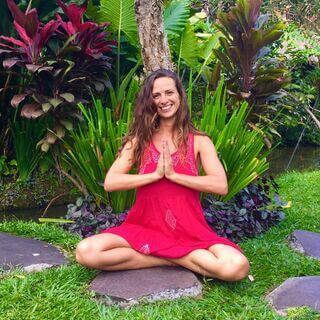
My name is Nola Bloom,
And today I want to share a practice that comes directly from the heart of yoga philosophy.
It is a practice that supports us every time we step onto the yoga mat.
And just as importantly,
Every time we step into our lives.
Today's practice is Drishti.
Drishti is an ancient yogic technique described in the Yoga Sutras,
One of the earliest texts outlining yoga as an eightfold path.
And in these teachings,
Yoga is not presented as a physical system,
But as a path of training the mind.
One of the very first teachings we receive in the Yoga Sutras is simple,
Yet profound.
It says yoga chitti ritti nirodaha,
Which means yoga is the cessation of the fluctuations of the mind.
And if we break that down a little further and a little more simply,
It essentially says yoga stops the fluctuations of the mind.
And then we may ask a very important question,
But how?
The rest of the Yoga Sutras are essentially an exploration of that question,
Not how to force the mind into silence,
But how to work skillfully with attention so the mind naturally settles on its own.
In yoga,
We're not actively trying to stop the thoughts.
We're not trying to control the mind or make it behave.
Instead,
We learn to take our attention off the constant stream of thinking.
And when attention is no longer feeding the mind,
The fluctuations begin to soften.
And that is the aim of the practice.
The mind still will fluctuate and thoughts will still arise.
But through yoga,
We train ourselves not to be pulled into every movement of the mind.
And this is where drishti comes in.
Within the eight limbs of yoga,
Drishti is most closely connected to the sixth limb,
Dharana.
This is the practice of single-pointed concentration.
Dharana is the act of focusing the mind.
And drishti is the point of which we place our attention on.
It's where we focus.
But before dharana,
We also begin to cultivate pratyahara.
This is the fifth limb of yoga.
This means withdrawal of the senses.
And drishti supports this by simplifying the field of attention.
And instead of the senses constantly reaching outward,
We offer the mind one clear place to rest.
And this is why drishti is so essential in our yoga practice.
In asana,
The physical practice,
Drishti is often taught as a technique for balance.
So if you ever tried to stand in tree pose or any balancing poses on one leg while looking around the room and glancing at other students or watching yourself in the mirror,
Then we know what happens.
We start to wobble,
Maybe even fall over.
And usually after falling a few times,
Clicks,
We realize that these techniques exist for a reason.
Because when the gaze rests on one steady point,
The body begins to organize itself around that focus.
Our balance improves.
Not because the body suddenly becomes stronger,
But because the mind becomes steadier.
And over time,
We absorb the qualities of what we focus on.
When the focal point is stable,
We cultivate stability.
When attention is scattered,
The energy also becomes scattered.
Where attention goes,
Energy flows.
Drishti also teaches us about non reactivity.
It trains us to remain steady,
Even when there is movement,
Sound or distraction around us.
And this is how yoga supports us not only on the mat,
But also in daily life.
And so the aim is not to block out the world around us,
But to gently remain present within the world.
And eventually through long term practice,
These techniques lead towards a state of reduced fluctuation.
And what yoga describes as Samadhi,
The eighth limb of yoga,
Not as a goal to achieve,
Or a badge to earn,
But as a natural state of sustained practice.
And so today's session is both a teaching and a practice.
We're going to start with an open eyed Drishti,
Grounding attention externally,
And then we'll transition to a closed eye Drishti,
Focusing on the third eye,
Allowing attention to turn inward.
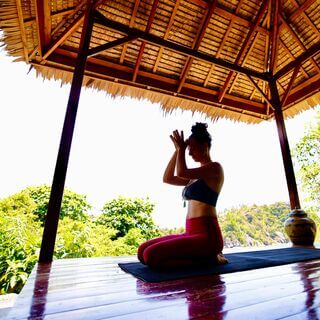
So go ahead and find yourself a comfortable seated position.
Being in a seated position naturally allows us to cultivate,
Focus a little more deeply,
Whereas when we lay back,
We can drift out more easily.
And so I would encourage a straight spine,
Allowing the body to feel supported and at ease.
First,
Close your eyes for a moment,
And turn your attention inward.
And this is pratyahara,
Withdraw the senses,
And focus on the breath.
Slow the breathing down.
Allow the shoulders to relax.
And now allow the eyes to gently open and fixate on one point in front of you.
Something that's not moving,
So avoid leaves of a tree or anything like that.
We want something that is stable,
Unwavering,
And unmoving.
Just allow your gaze to gently rest there.
So the eyes are open,
But soft.
The faces relax.
The breath is natural.
Notice how the mind responds when the gaze settles.
And if attention wanders,
Gently bring it back to your chosen point.
The intention to keep the gaze steady on one point to learn about this ancient technique.
This is drishti.
Now keeping your gaze steady on that one point,
Begin to notice your peripheral vision.
Without moving your physical eyes from your focal point,
Become aware of how much you can still see around you.
Notice light and shadow.
Notice any movement.
Notice any shapes or colors at the edge of your vision.
Just allow everything to exist around you without pulling your attention away from your focal point.
And just notice how your attention wants to react to anything that's going on around you.
So the practice is to remain steady.
You're focused,
Yet aware.
And let's just remain here for a few moments,
Sensing how this affects both the body and the mind.
Just keep the eyes on one point.
And now without losing the sense of focus,
Gently close down the eyes and allow any external images to fade away.
Bring awareness now to the space between the eyebrows.
This is the center of our intuition,
Our insight,
And our knowing,
Also known as the ajna chakra.
And just hold your attention here at one point as all of the muscles of the brow begins to soften.
And so as we use our third eye drishti,
Just keep in mind that we are not physically crossing our eyes.
We're gently bringing our attention to one point and holding the attention there.
So the eyes remain unstrained.
And it's just your awareness resting on one single point.
And this is your inner drishti.
Now imagine a soft,
Luminous presence at this point.
This presence is not sharp or bright.
It's just clear and steady.
Holding the attention of the space between the eyebrows.
Now imagine yourself standing at the edge of a vast yet still lake.
This lake represents your mind.
At first you may notice small ripples across the water.
And these ripples represent thoughts,
Sensations,
And subtle movements of awareness.
Without trying to change anything,
Continue resting your attention on your drishti.
And as attention steadies,
The ripples begin to soften.
And the surface of the lake becomes calmer,
Clearer,
And more reflective.
And sense the stillness within you.
Not something you create,
But something that naturally emerges when attention is gathered.
And thoughts may still arise.
And just acknowledge them gently and guide awareness back to your focal point.
Again and again.
And this is the practice of dharana in lived experience.
And so now we'll hold this together in silence,
As even my words can be distracting in cultivating focus.
And so as we just move into a few moments of silence,
Keeping your attention on one point.
And just notice how the attention wants to fluctuate.
Continue guiding your attention back to your focal point.
Bring awareness back into your physical body.
And feel the breath moving naturally.
And take a nice big inhale,
Fill the lungs.
And exhale all the air out.
And gently opening the eyes.
Notice the quality of your attention.
And this simple practice,
Rooted in ancient wisdom,
Supporting clarity of the mind,
Steadiness of attention,
And presence in everyday life.
So I encourage you the next time that you step onto your yoga mat,
To really use drishti when you're in the poses,
To fixate your gaze on one point,
And watch what happens with your balance.
Yeah,
Watch what happens with your practice when you start to incorporate these ancient techniques.
They are there for a reason.
This is also a practice if I'm working on the computer,
Doing a lot of stuff and just can't focus,
Close down the eyes and just take a few moments focused on your third eye.
And then when you open your eyes again,
It's like,
Okay,
Back to work.
So you can use this practice anytime.
Once you really start to cultivate this relationship with drishti,
You'll see it's so useful in so many different ways beyond the mat.
Thank you for joining me today.
May this practice support you both on your yoga mat and beyond,
Helping you to move through life with greater focus,
Ease,
And awareness.
Namaste