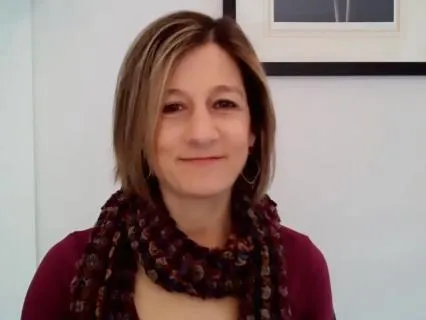
Hi,
I'm Beth Carland,
And I wanted to share some thoughts today about working with the worrying mind.
So a number of years ago,
We had a very rainy season.
And it rained day after day,
Week after week.
Quite a number of weeks.
We had a car that we parked on the side of our driveway in the dirt and the grass.
And you can imagine with all of this torrential rain that it turned into a bit of a mud pit.
So one day my daughter went to back up the car as she typically did.
And the tires started to spin in the mud.
And the harder that she tried to back the car up,
The more effort she exerted,
The more those tires spun and spun in the mud.
Digging deeper grooves until she literally got stuck in a rut.
It took my husband who had more experience with this sort of thing to be able to come out and show her that she actually had to do something counterintuitive.
She had to pull forward.
She had to move in a completely different direction to carve out a new pathway,
New tracks in order to eventually get unstuck.
And I've been reflecting on this a bit as I've been thinking about the nature of my own worrying mind.
I've certainly had a chance to do a lot of reflection this past year during the pandemic.
A lot of the middle of the night wakings and really observing my own worrying mind and trying to use my own strategies or strategies that I've learned over the years.
What I found,
Certainly with my own worries,
And I think this is true for many people,
Is that the harder I try to think my way out of the worries.
It's like if I can just keep thinking about this long enough and hard enough that somehow I'm going to dig my way out,
I'm going to find my way out,
I'm going to feel a resolution.
But what I find is the opposite usually happens,
That I just get stuck in these mental ruminations that keep spinning round and round.
And in some way,
It can even feel like an addictive loop that just gets harder and harder to extract myself from.
So what do we do about these kinds of worries?
One thing I think is to just make a distinction and to really.
Observe where our thinking mind is really beneficial and helpful for us and where it's not so helpful.
So our thinking mind is particularly good at being able to solve problems when we have all of the pieces in place and we just need to assemble them or when we're trying to plan and we can make concrete actions for some future event.
A lot of times we're faced with uncertainty,
We're faced with things in the future we can't control,
Things that may or may not even ever happen.
And there was a really interesting article I came across by James Clear,
Who's the author of Atomic Habits.
And he writes about how for our giraffe ancestors,
You know,
They lived in this immediate return environment where their everyday actions had immediate outcomes.
If you see a lion,
You run away and that solved the problem.
Whereas we humans in our modern lives live in a delayed return environment.
Where many of the problems we worry about are future-based and they can't be solved right away.
So we have this brain that wasn't dissolved to solve the problems of the delayed return environment.
What do we do about this?
And one piece is that I think if we can identify within any given worry.
Is there some small piece of this?
And sometimes it might just be really small.
Where I have some personal agency,
Where there's something here that's in my sphere of influence.
So,
For example,
If I have financial worries,
Sometimes there's a lot I can't control,
But it might be really helpful to sit down and make a list over the next two weeks or over the next month.
This is what the budget is going to look like.
If I have worries about a health issue,
I might take some time to do some research to find,
You know,
Who the doctor is that I would feel most comfortable seeing to help me with this issue.
I might also choose to spend five or 10 minutes a day doing some meditation specifically just to help me cope with the stress of that.
If I lose a job,
Then I could sit down and I could spend some time writing out,
You know,
20 contacts of people I can reach out to.
And go ahead and spend the next three days doing that.
So when we can take small concrete actions,
Really small things.
To help us,
To give us a sense of personal agency that can sometimes bring a little bit of ease.
But what I really want to focus on is what about the things that we can't control?
What about the things that don't fall into that category?
And that's where it's really helpful to move in a different direction,
To carve out a new pathway,
New tracks.
And what I'm really talking about here is not a pathway on the grass,
But to really carve out a new pathway in our brain.
To engage a different part of our brain separate from the one that's keeping us stuck in that mental rumination.
And so.
.
.
One of the ways that I think that is helpful to do this is not thinking so much about how I need to get rid of my worries.
But what else can I invite in instead?
What else can I turn on or turn the volume up on that can help bring some ease?
And I think about a little bit like turning on a light in a dark room.
We don't chase the darkness away.
We don't push the darkness out the door.
But what we do is we turn on a new circuit.
And in the light that diffuses into the room,
The darkness.
Gradually dissipates.
And this is,
You know,
This metaphor for bringing ease to our worries.
So I want to share three strategies that I found helpful in working with these kinds of worries,
Especially some of those middle of the night worries where you really can't get up and do too much.
So the first one is this idea of coming to our senses.
And Alicia Goldstein,
Who's a meditation teacher.
Spoke about in one of his workshops how when we're in the present moment when we're engaged in the present It's incompatible with worry.
And one of the best ways that we already have built into our biology to come right into the present moment is through our senses,
Through what we see.
What we hear.
What we can touch.
What we can feel.
Even just feeling the movement of breath coming in and going out,
Feeling our feet on the ground,
Those kinds of things.
Can bring us right into the present moment,
Feeling just this breath right in this moment.
And again,
When we can come into the present moment,
It steps us out of that part of the brain that keeps us stuck in those mental ruminations.
So coming to our senses,
Engaging our senses.
A second thing that can be really helpful in terms of trying to step out of this worry loop.
Is something that i called widening the container And there's a Buddhist teaching that's commonly shared that if you take a tablespoon of salt and you put it into a cup of water,
Try to drink that water and that water would be really difficult to drink.
But you take that same teaspoon,
Tablespoon of salt and put it into a pond or a lake or an ocean.
And it would be hardly noticeable.
And our worries can be like this too,
That when we get caught in our worries,
When we're.
.
.
You know,
Caught in that contraction when we are swallowed up almost by our own thinking.
It can feel like that tablespoon of salt right in that small cup.
But if we can widen our container,
If we can step back and observe what's happening from a place of spacious awareness.
Really bringing a quality of mindfulness to whatever is arising.
This can really help to bring a little bit of ease to take the intensity out of what's there.
And mindfulness meditation really helps us do this because we become the observer of our own mind.
And there's a couple of images that I find really helpful during meditation to use.
One is imagining a vast,
Expansive ocean.
And instead of my worries,
Like that I am that wave that's just being swallowed up by the worry.
That just picturing my mind like that vast ocean and the worries are the waves that rise and fall.
And really stepping into that sense of something more vast and expansive that holds it all.
Another image that I find really helpful is an image of.
The vast expanse,
Blue sky.
And really imagining our worries or thoughts like clouds that come and that go.
And again,
Being able to be held in something more vast,
Expansive,
And even bringing in this quality of benevolence.
Can be really helpful.
So the third thing that I want to share with you is a strategy that really helps to.
Step us out of that survival part of our brain and turn on a more newly evolved part of our brain.
What I call engaging the caring circuits.
So there's a part of our brain that's constantly scanning our environment for cues of safety or threat or cues of,
I'm sorry,
For cues of safety or for cues of threat and danger.
When we can turn on that part of our brain.
That can really take in cues of safety.
It can really help to bring ease to the word in mind.
And so there are lots of ways of doing this,
But one way is really just connecting in with a sense of what we deeply care about.
And connecting in with a sense of being cared about,
Being held,
Being protected in some way.
And so we might think about a mentor.
Or a coach,
Or a loving friend.
Or a compassionate being,
Real or imagined.
Or a spiritual guide or a spiritual teacher,
Whatever works for you to imagine being.
In the presence of a compassionate being of some kind.
Or you might also imagine if that doesn't work for you,
More about being in a beautiful space in nature.
Being in the safety and surroundings of the natural world and being held in this space,
Feeling safe,
Feeling grounded in this space.
And so when we can connect in with some of these images,
It really helps to bring in that feeling of safety to our nervous system.
And when we're inviting that sensation in,
When we're connecting with our caring circuits,
It can help to bring ease to the worrying mind.
So I hope that some of those strategies were helpful.
And.
.
.
And I'm glad I was able to share that with you.
And I do have a meditation that goes along with this,
That meditation to ease the worrying mind that works with some of these strategies.
Thank you so much.
Take care.