Hi,
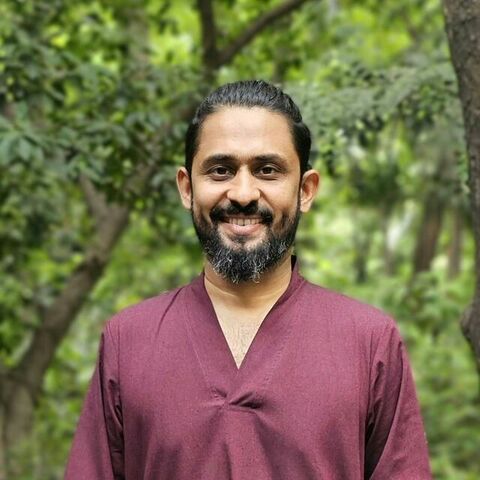
I'm Jerry.
I'm a meditation and mindfulness teacher based in Fort Kochi,
India,
And I run Nishrayasa,
A holistic wellness studio where I share meditation,
Mindfulness,
And sound-based practices.
Thank you for being here.
I'd like to explore a simple idea that has changed the way I think about meditation.
Last year,
I came across this sentence in Dr.
Amishi Jha's book,
Peak Mind.
You are missing 50% of your life.
I actually read that sentence twice.
It felt almost impossible to believe.
But the more I thought about it,
The more I recognized something in it.
We do not deliberately choose to miss our lives.
But our attention has a habit of wandering somewhere else.
Think about how often this happens.
You are sitting with your family,
But you are mentally preparing for tomorrow's meeting.
You are walking through a beautiful place,
But you are thinking about something that happened yesterday.
You're talking to someone you genuinely care about.
But instead of really listening,
You are already preparing about what you are going to say next.
Your body is here but your attention is somewhere else.
And wherever our attention goes,
Our experience follows.
This is one of the things I find most fascinating about the human mind.
At any given moment,
There is an enormous amount of information competing for our attention.
Sounds,
Colors,
Smells,
Sensations in the body,
Thoughts,
Memories,
Emotions,
And everything happening around us.
We couldn't possibly give equal attention to all of it.
So the brain filters and selects.
It decides what comes into the foreground of our experience and what remains in the background.
And that ability to direct and sustain our awareness is what we call attention.
Attention sounds like a very ordinary thing,
But it shapes almost every moment of our lives.
When people first come to meditation,
They often tell me,
I want to stop thinking or I want to make my mind quiet.
Sometimes they hope meditation will make them permanently calm or help them get rid of stress.
And while meditation can certainly support those things,
What the practice is really about.
At its heart.
Meditation is training attention.
Think about what happens when you sit down to meditate.
You bring your attention to the breath,
And then sooner or later,
The mind wanders.
You start thinking about something else,
Maybe a conversation,
A problem,
Your plans for tomorrow,
And then you notice,
I am thinking,
So you bring your attention back to the breath.
A few moments later it wanders again and you bring it back and again and again.
That moment when the mind wanders isn't a failure.
In fact,
The wandering is part of the practice.
Because every time you notice that your attention has drifted and you gently bring it back,
You are training the ability to choose where your attention rests.
The returning is the practice.
And this is why I find Dr.
Jha's work so interesting.
Attention is incredibly powerful.
But it's also surprisingly fragile.
Think about what happens when your attention is repeatedly drawn towards worry.
Even if nothing particularly threatening is happening,
The world can begin to feel uncertain.
If your attention keeps returning to resentment,
Your relationships can begin to feel colored by that resentment.
And the same thing can happen in a more positive direction.
When we intentionally bring attention towards gratitude,
Kindness,
Or simply the experience of the present moment,
Our experience begins to change.
We often think that reality shapes our attention.
But in many ways,
Our attention also shapes the reality we experience.
And modern life makes this particularly difficult.
Notifications interrupt us.
Emails compete with conversations.
Social media encourages us to move rapidly from one thing to another.
And even when nothing external is demanding our attention,
Produce its own endless stream of thoughts,
Memories,
Plans and worries.
It's no wonder so many of us feel distracted or mentally exhausted.
Our attention is constantly being asked to move,
From one screen to another,
One conversation to another,
One thought to another,
Without much opportunity to settle.
But here is the encouraging part.
Attention is trainable.
Just as the body becomes stronger through exercise,
Our capacity to sustain attention can become steadier through practice.
And we don't train attention by forcing the mind to become quiet.
We train it by noticing distraction and returning,
Again and again.
At first,
This might happen dozens of times in a single meditation,
And that's okay.
You're not doing meditation badly.
You're actually doing the exercise.
Over time,
Those moments of returning start appearing in everyday life.
You notice that you have stopped listening during a conversation.
You notice the first signs of frustration before you react.
You catch yourself worrying about something that hasn't happened yet.
And instead of immediately following the thought,
You recognize it and come back.
Back to the conversation,
To the person in front of you,
To the breath,
To this moment.
And I think this is where the real value of meditation begins to reveal itself in how we experience the rest of our lives,
Not just while sitting with our eyes closed.
We start to listen more deeply because our attention is actually with the person speaking.
We taste our food instead of rushing through a meal while thinking about what's next.
We notice the warmth of the morning sun,
The sound of birds outside the window,
The expression on someone's face,
The feeling of walking,
The simple experience of being alive.
None of these things suddenly appeared because we started meditating.
They were already there.
What changed was our ability to be present for them.
And when I think back to that sentence from Dr.
Amishi Jha,
You are missing 50% of your life,
It no longer feels like a shocking statement to me.
It feels more like an invitation to notice how much of life can quietly pass us by when our minds are constantly somewhere else.
You to have a perfectly peaceful mind.
It offers something more practical,
The ability to notice where your attention has gone and gently bringing it back.
And perhaps by learning to do that,
We don't just become better at meditating,
We also become a little more available for our own lives.
Because life is happening here,
Right now,
And attention is how we meet it.
Thank you for listening.