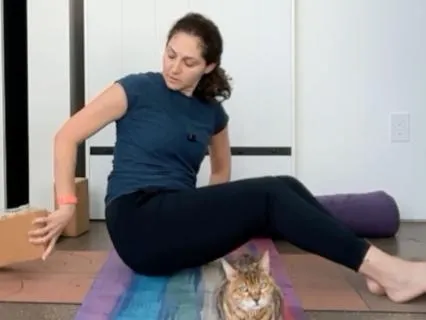
Find a comfortable reclined position.
You can have your legs extended long or maybe it feels better to have your knees bent or have a bolster underneath.
And just maybe start by rolling your shoulders under.
Arms by your side,
Palms facing up Slight tuck of the chin so the back of your neck is long.
And just begin to arrive here,
Catch your breath.
Notice how your breath feels.
Thank you.
Fast or slow,
Deep or shallow.
Let's see if we can start to.
.
.
Deepen your inhale and lengthen your exhale.
Just be mindful of your breath,
See if you can make your next inhale a little bit longer.
And your next exhale.
Really slowing down your breath.
As much as it feels comfortable.
You can breathe in.
And out of the nose,
Or in the nose,
Out the mouth.
Whatever feels comfortable for you.
Just lengthen.
And then starting to bring your awareness to your body.
Notice how your body feels today scanning from the crown of your head all the way down to your fingers and your toes.
Just notice if there's any part of your body that's maybe a little tight or sore.
A little bit more love during practice.
And just being mindful of that.
If something I say during practice doesn't feel right for you,
Please don't do it.
Just come out of the pose.
And take a resting pause where that works for you.
We're going to be holding poses for longer duration of time,
So three to five minutes on each pose.
Hmm.
I want you to make sure that you're not holding.
Any sharp pain or discomfort.
We want to be comfortable in all of our yin poses.
You want to feel something.
But not go to your.
.
.
Pee piss.
Level of the pose.
So find your edge where you want it.
You feel the pose and then back out of it like 10%.
And hold there.
And with time,
Your body will start to open up and you'll notice that you may be able to go a little bit deeper.
And that's the practice.
Not working the muscles.
Which might go deeper than that.
Letting go of the muscles around your body.
To work the deeper tissues of Asha.
Joints and the ligaments supporting the joints.
And slowly start to bring some movement to your body.
So bring your big toes together,
Point your toes,
And then reach your arms overhead.
Come to a full body stretch like you're waking up for the first time this morning.
Inhale,
Reach,
Get long.
And exhale to soften.
Now we're going to come into a reclined crescent pose or banana asana as it's called in yoga.
So start to,
Keeping your hips where they are,
Start to walk your feet towards the right side of the mat.
And then lift your shoulders up and start to walk your arms and shoulders towards the right side.
So we're coming into this crescent shape.
With our hips in the middle of the mat and our feet and arms reaching towards the right side.
And then if it feels good,
You can cross the left ankle over the right.
And you can grab the left wrist with your right hand.
So depending on how you feel,
How your shoulders feel,
Make sure that you're making adjustments.
So maybe you need to bring a pillow or blanket under your left shoulder.
To support shoulder,
Making sure your shoulders are still grounded.
So if you need to bring.
.
.
The ground up to your shoulder,
You can do that.
So bringing something under your shoulder.
To help support it.
You can turn your head to the left side if that feels good in your neck or allow your head to turn to the right.
And just feeling the stretch on the left side of your body.
From your toes all the way up to your fingers.
So this isn't a really deep stretch.
You may not be feeling a lot here.
Just allow your body to settle.
Come to stillness.
And come to your breath.
Soften your gaze or close your eyes.
And just hold this pose.
We're gonna be here for.
.
.
About three minutes or so.
So we're going to be here for quite a while.
It may not sound like three minutes is a lot,
But holding a pose for that long does start to show us the duration of the time.
Think about holding and staying still and if your body.
.
.
Tells you to move.
Listen but see if you can Be really mindful.
Alright.
Not act right away.
Notice if you really need to lower.
Where it's just a reaction.
As you hold stillness You may notice that your mind starts to wander.
You may get distracted by thoughts or emotions.
And when that happens.
Just kindly bring your awareness back to your breath.
Now you may notice that this pose is starting to feel really easy.
And you're thinking that this isn't really yoga,
I'm not really doing anything.
So if you want,
You can maybe try to go a little bit deeper.
So maybe try walking your feet a little bit more towards the right side.
Maybe turning,
Bringing your shoulders and arms a little bit more to the right.
And just notice.
Deepening the stretch.
How that feels in your body.
If it's too much,
You can back out.
And if it feels okay,
Come to stillness and hold here.
Breathing deeply.
Feeling your body expand.
And the stretch deepen as you inhale.
And feel your body soften.
Let go.
As you exhale.
Take a deep breath in.
And a long breath out.
You One deep inhale.
You full and complete exhale.
Let it go.
Now really slowly start to relax.
Start to first walk your feet to center.
And then walk your arms and shoulders back to center.
Coming to again lying down on your back you can allow your hands to rest gently on your back.
Valley.
And allow your feet to fall to either side.
Soften your gaze,
Close your eyes.
And notice if you feel a difference.
In the left side of your body compared to the right.
Just noticing,
Maybe the answer is no.
Then bring your big toes together,
Point your toes,
Reach your arms overhead,
Come to a full body stretch,
Deep inhale.
And exhale,
Soften.
Starting to walk your feet towards the left side.
Move any props aside so your feet aren't touching anything.
You can cross the right ankle over the left and then start to walk your shoulders and your arms to the left side.
Coming to a crescent shape.
To the opposite side.
So you can grab the right wrist with the left hand if that feels good.
You can turn your head to either side depending on how it feels in your neck.
Make sure your shoulders are grounded.
So if you need to bring a folded up blanket or a pillow under your right shoulder to bring your mats up to you,
You can do that.
And then when you find your pose,
Just come to stillness.
Soften your gaze or close your eyes,
Soften your jaw.
Allow your tongue to fall away from your mouth.
And just breathe into this pause.
Feeling your body expand as you breathe in.
And soften into the pose as you breathe out.
You as your mind wanders.
Just kindly bring your awareness back to your breath.
Now if you want to go a little bit deeper into the pose,
You can walk your feet maybe a little bit more towards the left side.
Maybe walk your shoulders towards the left side a little bit more.
Just find a place where you feel comfortable.
And come back to stillness.
Deep breath in.
And a long breath out.
One more like that,
Deep inhale.
Full and complete exhale.
Let it go.
And then slowly start to walk your feet back to center.
Your shoulders back to center and allow your arms to rest somewhere on your body or by your side.
Just pause here.
For a few breaths,
Noticing how you feel.
Noticing your breath.
And then when you're ready,
We're going to come to supported bridge.
So bend one knee and then the other,
Bringing your feet on the mat,
Feet hip distance apart.
And you want to lift your hips up to a level where it feels comfortable and safe.
Where you can.
Hold stillness.
So if you have a yoga block you can bring your yoga block under your hips just to the lowest level.
Or to the medium height.
So try avoiding the highest height on your block.
If you don't have a yoga block.
You can fold up a blanket or two or have a firm pillow or cushion under your hips just to tilt your hips up or lift your hips up just a little bit.
If you're using a block,
Make sure the block isn't pressing against your spine.
So yoga blocks are usually a little bit harder.
If you're using a blanket or a pillow,
It may not be that important,
But with a block,
Make sure it's not pressing against your spine.
It's under your hips.
And just.
.
.
Find a height that feels right.
So it can be lower or higher depending on how you feel today.
And then see if you can roll your shoulders under just a little bit.
Allow your arms to rest by your side.
And your neck and your head is comfortable so you can have a slight tuck of the chin so your neck is long on the ground.
Making sure there's no sharp pain or discomfort anywhere.
Especially in your shoulders and your legs.
So when you find.
.
.
Your supported bridge.
And you've made your final adjustments and movements.
Is find stillness.
Come to stillness,
Soften your gaze,
Soften your jaw.
Often the muscles of the face.
Let go of anything you're holding on to in your body that you can soften and let go of.
Your fingers,
Your toes.
Your thighs.
And just allow gravity to Pull your shoulders down.
Open up your heart.
Allowing your body to settle into this heart opener and backbend.
Is your in a place where it doesn't feel.
Comfortable.
When you come to film it.
You can always back out a little bit.
I'm going to lower my block to the lower height.
Year.
And then find stillness.
So any movements or adjustments,
Just make sure you're making them mindfully.
Because of habits or a reaction to the thought or.
.
.
Feeling that comes up.
Just really be mindful.
Any movement that you make.
Staying in stillness,
Breathe.
Allow your body to settle.
You when your mind wandered.
Is come back to your breath.
Take a deep breath in.
Open your mouth and slowly and quietly sigh it out.
Let it go.
Okay,
One more like that,
Deep inhale.
Exhale slowly through the mouth.
Now from here,
We're going to move into an inversion.
So if you have a block and you're on a medium height,
You can lower it down to the lowest height.
If you're on a pillow or blanket,
The height may be okay.
We're just going to start to lift our legs up.
So again,
Your prop is under your hips,
Not your spine.
We want to make sure we're not pressing against the spine.
And if lifting your hips doesn't feel good,
You can just remove your prop and bring your hips down and start to lift your legs up.
So you can have a generous bend in your knees.
You don't have to straighten your legs.
We just want to lift the feet.
Above.
The hearts here.
Your arms can be by your side,
You can bring your hands on your belly.
And we won't be here for a long time but just notice how this feels your body to deep,
Long breaths.
Notice if you're clenching your jaw.
Notice if your shoulders are moving up towards your ears.
So if you're flexing or pointing.
Your feet.
See if you can let that go inside.
Being really mindful of how this feels in your lower back,
Making sure.
There's no sharp pain discovered.
I'm sure there's no tingling or numbness in your toes.
If there is,
Just lower back down.
Deep Breathing.
Long breath out.
Good,
Slowly start to bring your feet back down.
Gently lift your hips up,
Move your prop aside and lower your spine all the way down.
You're the man.
And then walk your feet mat distance apart.
Slowly windshield wiper your knees,
Side to side,
Letting that go.
If you want,
You can hug your knees into your chest or come to half baby pose if that's in your practice.
You can say it's wellness or Again,
Just rock gently from side to side.
Yet.
And then when you're ready,
We're moving into our final relaxation pose,
Shavasana.
So for this one,
We're going to use props and move into supported fish.
If.
.
.
Supported fish doesn't feel good or you've had enough of a back bend for back bends today,
You can just come to Shavasana with your spine flat on the mat.
If you want to move into supported fish,
If you have a bolster,
You can put your bolster on the mat.
Just sit right up to the edge of your bolster and come down so the bolster is aligned under your spine.
If you don't have a bolster,
You can roll up kit so it looks like a bolster.
You can also use blocks for supported fish.
More involved to set up so you want to have two blocks on different heights so your first block is on the lowest height and second block where your head goes is a little bit higher so we want to set up so the first block lines up with the middle of the mat so where your bra line would be and and just between your shoulder blades.
So this may look like it feels uncomfortable,
But it's very comfortable when you get saddled into it.
You want to make sure your head is supported.
For this pose,
Lift it.
Above.
Your shoulders.
And.
.
.
Um.
.
.
You can make adjustments to the height if you need.
The first block can be on the middle height and the one for your head,
The highest.
Again,
When you first move into it,
It may feel like.
.
.
It won't be comfortable,
But after you get settled.
It is very supportive.
Feels really good.
So wherever you are,
Either on your back,
Reclined,
And supported fish with a bolster or a blanket.
Under your spine.
And supported this with vlogs.
Just make any final movements or adjustments that you need.
And find wherever you feel comfortable.
So finding your version of Shabbos Anah.
That feels good for you.
And come to stillness.
Starting to relax your body.
Allowing your legs.
To soften your hips heavy.
Letting go of your shoulders,
Allowing your arms to rest gently by your side,
Palms face up.
Fingers curled in.
Slight tuck of the chin so the back of your neck is long.
Soften your jaw,
Allow your tongue to fall away from the roof of the mouth.
Soften the muscles of the face and your eyelids,
Allowing your eyes to gently close.
And then scanning from.
The very top of your head,
The crown of your head.
All the way down to your fingers and your toes.
Just notice if there's any part of your body.
That you're holding on to that you can soften and let go.
Allow your body to rest.
And breathe naturally.
And take in the effects of your practice.
Take a deep breath in.
In the long run.
One more like that,
Deep inhale.
Full and complete exhale,
Let it go.
Slowly start to bring some movement back to your body.
And your fingers,
Your toes.
And it's very calm.
Really slowly being mindful of your props make your way to a seat so making sure that you're moving mindfully Have a beautiful day.
Find the seeds.
With your spine tall,
Your neck straight,
Your chin parallel to the mat.
Soften your shoulders,
Down your back.
Soften your gaze or close your eyes if that feels good.
Bring your hands by your side,
Inhale to reach your arms all the way up,
Palms touch overhead.
And exhale,
Bring your hands to your heart center,
Bow your head to your head.
Thank yourself for coming to your MAC today,
For spending this time for yourself and for your practice.
Bring your thumbs to your third eye,
The space between your eyebrows.
And your thoughts be kind.
To your lips.
May your words be caring.
And your thumbs to your heart center.
May your heart be filled with love and gratitude.
Thank you so much for practicing with me today.
Namaste.