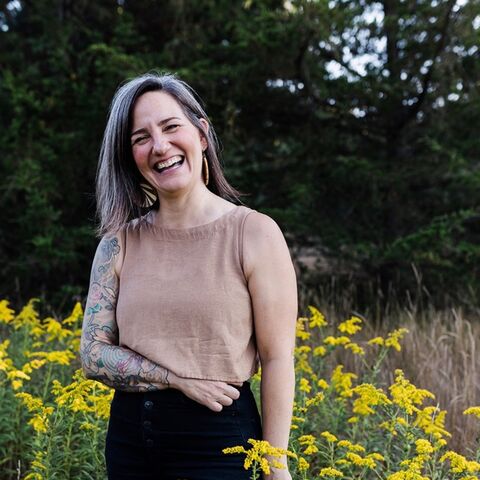
My name is Larissa,
And I know I probably missed a couple of folks in there as I was saying good morning,
But welcome to everyone.
We're going to practice together for about 15 minutes.
It's taking a little bit of time to slow down,
Spend a little time with yourself.
And reminder to take good care of yourself as you stay.
Our meditation practices in a few parts.
And it's a very simple practice.
We choose a focal point,
Step one.
We return to it again and again,
That's step two.
And we practice being as kind to ourselves as possible in the process,
That's step three.
And the reason we choose a focal point is because our mind will choose one for us.
We've all accidentally been caught in a worry loop or.
Stuck in some future thought,
Some planning thought.
And so the idea is that we choose and then we return to ourselves.
And to the best of your ability,
Be kind to yourself in the process.
You're welcome to close your eyes or set your gaze downward.
Starting to slow down.
Your mental processing a bit just by softening your gaze.
And then start to notice your breath.
And then noticing of your breath.
There's a subtlety to it.
There's a consistency to it.
There's rhythm in your breath.
For all of these reasons.
It's soothing to us.
And on occasion,
Let's see if there's stuff he knows,
Some allergies upcoming.
Or perhaps even you've experienced something where You couldn't take a breath,
So paying attention to your breath brings you just a touch of anxiety.
You can start to pay attention instead just to the groundedness of your feet beneath you.
Notice your legs touching the chair beneath you.
We choose our body because our body is always present.
And we almost always begin here,
Somewhere in the body.
That way our mind has a place to land back into again and again.
And that practice of being kind to yourself is incredibly important.
So that we're not inviting our mind to land back into judgment.
Or we're not just following our mind in its judgments.
Take a moment to notice you might even give your torso a little wiggle just Softening your body into the cushion you're sitting on.
Soften your shoulders.
Notice your jaw,
Can you soften there?
Just notice for a few moments here the foundation beneath you,
How much stability and support your body has.
We rest in that for a moment.
And then from the steadiness beneath you,
Just noticing the movement of your breath again.
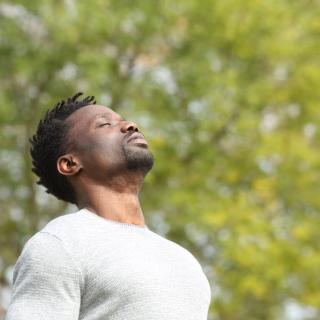
The expansive quality of your inhale.
And notice how your body naturally softens as you exhale.
We don't always experience that,
Especially in the busyness of the day.
Right here you can invite it in.
Spacious inhale.
Softness on your exhale.
And there's quite naturally a receiving quality on your inhale.
And a returning quality of the exhale,
Giving back.
Our breath itself is reciprocal.
The trees and the greenery around us.
Creates this oxygen that we take in.
It's a gift.
And then we give that gift back through this exchange of guesses.
The greenery and the trees around us can draw from that.
There's a natural abundance and reciprocation in our breath,
A natural giving and receiving that occurs.
Notice again that firm foundation beneath you,
The steadiness that's holding your body.
And then that subtle movement of your breath,
Expansive.
And relaxes.
Spacious and soft.
Receiving,
And giving.
And you can come back to this often.
Throughout the day,
Throughout this meditation,
Just the movement of your breath.
Or the steadiness beneath you.
And then I'll invite in an added layer here.
It's a meditation practice.
It's called Thanglen.
It's a traditional Tibetan Buddhist meditation practice.
In Tonglen,
The word itself means sending and taking.
Or receiving and giving.
So it's a natural working with our breath.
But we also start to work with our minds.
So we begin with just being with our body.
And you can come back to this at any time.
The steady rhythmic movement of your breath taking care of you.
We'll also utilize our breath.
To work with this Tonglen practice.
And the invitation.
Can almost feel counterintuitive.
You've probably all read the Pinterest phrase that says something like,
Breathe in the positive,
Breathe out the negative.
Breathe in the good,
Breathe out the bad,
Something to that effect.
But instead what we do here.
As we receive.
What's challenging,
We breathe it in.
We transform it within our hearts.
And then we breathe out.
Goodness.
Compassion.
Gentleness into the world.
Let's take a moment,
You might bring to mind just a loved one.
Might be experiencing some challenge in their life.
Or perhaps it's you.
Some event,
Some challenge.
And instead of following the story around it,
And just take a moment.
Notice again the spaciousness of your breath in.
You might even imagine your heart in the center of your chest expanding as you breathe in.
Notice the softening quality of your exhale.
I'll invite you this next exhale to sigh it out.
We breathe in together,
Spacious.
You might even sigh out your exhale.
And then bringing together your mind and your breath.
Perhaps you.
Came up with some challenge.
Rather than the story,
Just imagine your loved one or yourself.
And this next breath in.
You're drawing in that challenge and holding it gently in your heart.
And when you exhale,
You're offering back your compassion to the world.
Breathing in whatever this challenge is,
Holding this person or yourself in your heart.
When you breathe out.
Intention of offering back your compassion.
Breathing in,
Trusting the spaciousness of your heart,
Feeling that spaciousness on the inhale.
When you exhale.
You're giving back.
Your gentleness.
You're well-wishing.
Just practicing on your own for a few rounds.
Receiving.
Your loved one or yourself,
Receiving this challenge,
Holding it in your heart.
And breathing out your own goodness,
Your own compassion.
The idea here is to also recognize that it's consistent reciprocation.
You're not trying to breathe in the challenge and hold it.
I'm not trying to bear the burden.
You're transforming it with your breath,
With your naturally radiant heart.
This intentionality,
Not only working with your body and your breath.
But your mental states.
Sometimes we don't know what to do with the challenges of the world.
And here it's this opportunity to stay with the difficulty.
Not to tell ourselves the story of it.
Just to recognize.
Suffering is a part of being human.
Can I hold it in my heart just for this moment of my inhale?
And give it back to the world with my deep compassion,
My gentleness,
My well-wishing.
In these last moments,
I'll invite you to just work with an image of the world.
It might be the globe.
Be your favorite animals.
That might be your favorite person.
These last few moments as we breathe in and out together.
You might work with this phrase I offer.
I breathe in the heartbreak of the world.
I breathe out my compassion.
I breathe in the heartbreak.
I hold it in my naturally radiant heart.
I breathe out.
My gentleness and goodwill.
I breathe in and hold just for this moment.
A heartbreak.
And my open heart gives back.
My goodness.
I'll invite you to bring your hands into any of your closing habits or practices,
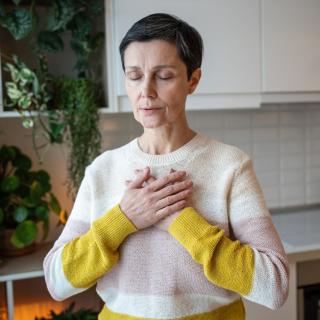
Maybe hands over your heart,
Maybe palms together,
Like gratitude.
And it's so important that we remember to release.
We're not trying to carry the burden of the world in this Tom Glenn practice.
It's a giving and receiving.
It's abundant and it's reciprocal.
I'll end with a few loving kindness phrases,
Just repeating them back as they make sense for you.
May I remember.
The abundance of my heart.
May I remember the innate goodness of my breath.
When action is needed.
May I choose to move with ease and peace.
And may the merits of our practice ripple out to benefit all beings.
And just whenever you feel complete and there's no rush ever.
Take a moment to thank yourself for showing up today.
Thank you each for being here,
Supporting this sangha,
This community.