Many practitioners reach a point where practice feels flat and the instinct is to push harder.
Today we're going to do the opposite.
We're going to be using smaller and slower movements to develop precision so effort becomes more effective,
Not just larger.
So when you feel ready,
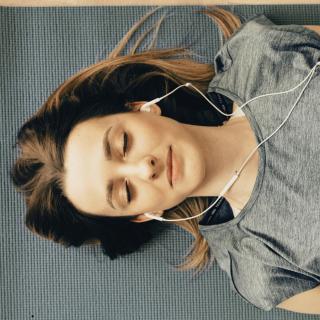
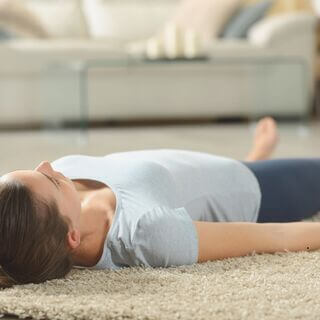
Lie on your back with your knees bent and your feet on the floor.
Notice the immediate impulse to adjust something.
Many people feel the need to make a practice stronger or more interesting but for now we want to try to do less.
So we'll start by bringing the attention to the breath.
Allow the inhale to arrive normally,
The exhale to finish completely.
As you work with the breath,
Encourage it to settle and to become smooth.
In a moment we're going to add some movement to work alongside the breath.
We'll start with a small pelvic tilt.
So on an inhale,
Just tip the pelvis slightly forwards.
As you exhale,
Return to your start position.
The movement can be small enough that somebody who was watching might not even notice it.
Continue slowly working with this movement,
Tilting the pelvis on the inhale,
Settling back to your start position on the exhale.
As you work with the tilt,
Notice how easy it is to make the movement larger than necessary.
Keep your focus on the scale and try and reduce the size of the movement.
Keep the breath smooth,
Remembering always that precision requires attention.
Continue working with this movement in time with your own breath.
As you complete your exhale,
Come back to stillness and just pause here.
Take a moment to notice whether the attention has sharpened,
Not because effort increased,
But because we removed the excess movement.
Then,
When you feel ready,
On an inhale,
Slide one heel away from you along the floor.
Let the inhale last the length of the movement.
As you exhale,
Return to your start position just as slowly.
Work from side to side.
Inhale,
Foot slides away.
Exhale,
It returns.
If you find yourself losing control of the speed,
Reduce the size of the movement.
Remember,
Slower does not mean heavier.
It just means crisper.
Continue working with this movement in time with your own breath.
Notice how quickly the mind starts to want to hurry.
That impulse to push is often familiar.
So,
Instead of increasing effort,
See if you can simply refine coordination of breath and movement.
When you've completed your next exhale,
Just resting in your start position,
Pausing here.
In classical yoga language,
Stability and process begin by working with the apana and the agni.
But maintaining practice requires something different.
It requires reducing unnecessary activity,
So vitality is not continually spent.
Precision conserves energy.
Intensity spends it.
With this in mind,
We're going to work this time with a small bridge posture or two-foot support.
So,
When you feel ready,
On an inhale,
Push through the feet and just allow the hips to lift a little.
Lower so slowly that the exhale determines the speed completely.
Inhaling,
Hips floating up just as much as is comfortable.
Exhaling as the hips return slowly to the ground.
If you reach the floor early,
You're moving too fast.
So,
Just keep repeating this process,
Floating the hips up on the inhale,
Controlling their return downwards on the exhale.
As you work,
Notice the difference between effort and control.
And then,
Lowering on your next exhale and coming back to a place of rest.
Resisting the temptation to move or adjust,
Remaining still.
Just observing the internal state.
You might find that the system feels a little clearer,
Even though we used less effort in the practice.
This is the place where practice begins to feel sustainable.
Not because it's necessarily easier,
But because less energy is wasted.
Take a few more breaths here.
And then,
When you feel ready,
Just roll on to one side of the body and come up slowly to a seated position.
If you practice again soon,
Notice whether you need less effort to feel the same amount of work.
Precision often reveals itself only when you return to a practice regularly.
Thank you for practicing with me today.