Before we begin,
It's important to remember that this breathing exercise is not a replacement for medical or psychological care.
If you are working with a doctor,
Psychologist or therapist,
Please continue following their guidance.
Think of this exercise as a small tool you can use in the moment when things feel overwhelming.
You are always in control.
You can stop at any time.
There is nothing you need to force.
Just allow your breathing to become a little softer and a little slower.
If possible,
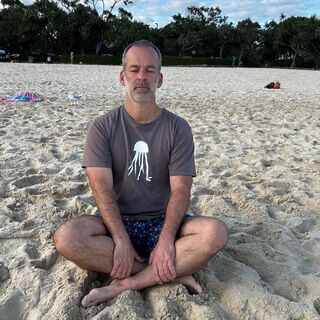
Sit comfortably.
Let your shoulders relax,
Allow your hands to rest somewhere comfortable.
Close your mouth,
Place the tongue on the roof of your mouth and just notice the air moving in and out of your nose.
There's no need to take big breaths.
In fact,
Smaller,
Softer breaths are what we are aiming for.
Just allow the breath to begin to quietly settle.
Continue to breathe only through the nose.
Let the breath be quiet.
Imagine you are breathing softly enough that someone sitting beside you would not hear it.
As you breathe in through the nose,
Allow the belly to gently expand.
As you breathe out through the nose,
Let the belly soften.
We'll begin a gentle rhythm.
Breathe in your nose for four seconds and breathe out for six seconds.
Again,
In through the nose for four seconds and out through the nose for six seconds.
Let the exhale be soft and slow.
Longer exhales help reduce the heart rate and signal safety to the nervous system.
Continue breathing like this.
Slow,
Quiet,
Gentle.
Now,
We will make the breath slightly smaller.
Not by forcing it,
Just imagine you are breathing 10-20% less air.
The breath becomes softer,
Almost like you are lightly fogging a mirror inside your nose.
Small breath in,
Small breath out.
If you want,
Place your hand on your tummy.
When you breathe in,
Your tummy expands.
When you breathe out,
Your tummy contracts.
Make the movement smaller.
You might begin to feel a slight air hunger.
This is normal.
You may feel warmth in your hands.
And you may feel a build-up of saliva in your mouth,
Meaning that you are going in to rest and digest.
This is normal.
It simply means your breathing is becoming more efficient.
Keep the breath soft.
In through the nose,
Out through the nose.
Slow,
Quiet,
Gentle.
Allow your body to begin to settle.
Now,
We will add a small pause after the exhale.
Nothing forced.
Breathing in gently through the nose.
Breathe out slowly through the nose.
At the end of the exhale,
Simply pause the breath for 2 seconds.
So,
Breathe in.
Breathe out.
And pause.
One,
Two.
Then breathe in again.
Let's try this together.
Breathe in.
Breathe out.
And hold.
And breathe in again.
And keep going in that pattern.
In for 4.
Out for 6.
And a pause.
Remember,
Soft inhale.
Longer exhale.
Small pause.
This pause allows the nervous system to reset and settle.
Remember,
This should always feel comfortable and controlled.
If the pause feels uncomfortable,
Simply return to gentle breathing.
Before we finish,
Take a moment to acknowledge something important.
If you are living with PTSD,
Your nervous system has been through a lot.
The reactions you may experience,
Feeling on edge,
Overwhelmed or suddenly triggered,
Are not signs of weakness.
They are signs of a nervous system that has been working very hard to protect you.
Right now,
By slowing your breathing and giving your body a moment of calm,
You are helping your nervous system remember that it can settle down.
You don't need to force anything.
Even a small moment of slower,
Quieter breathing is a step towards helping your body feel a little safer.
And remember,
You are not alone in this process.
Many people are learning that simple tools like the breath can support their healing alongside the care and support they are already receiving.
For now,
Just allow yourself to stay with this gentle breathing for a few more moments.
Return to your normal breathing,
But only through the nose.
Notice if anything in your body feels different.
Perhaps the shoulders feel softer.
Perhaps the mind feels a little calmer.
Even a small shift is helpful.
Remember,
You can return to this breathing any time things begin to feel overwhelming.
Just slow the breath,
Breathe through the nose,
Make the breath smaller and softer,
And allow your nervous system the chance to settle.
Take one last gentle breath in through the nose,
And a slow breath out.
You've got this.
You're doing well.