Many people suffer from some degree of back pain or ache.
And.
The majority of it is not because they're lifting things too heavy with poor technique or they've done some physical activity.
It really comes from this sedentary living.
So a lot of it comes from people are sitting too long and when they sit,
They sit improperly.
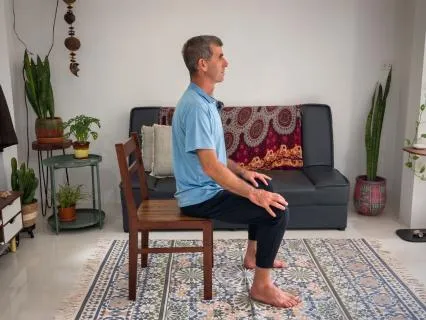
So I want to demonstrate is proper sitting technique in a chair.
So not only will this affect the feeling and the health of your back,
It's also you're going to notice will have a big influence on your ability to focus and concentrate as well as your mood.
So proper sitting position.
We want to feel the feet planted on the floor.
Generally,
That's not that hard for people,
But there are some people that are really short that tend to sit in a chair that's too high.
Then you want to put some books or something down that your feet are planted.
You want to have your body on the outside of the chair.
So as I say,
Only the sit bones.
So if you notice,
And I'm going to turn sideways at the end of this demonstration so you see me from the side.
So you're only on your sit bones and your upper legs are off the chair.
If you notice,
The lower legs,
The shin bones,
Are perpendicular to the floor.
Okay,
So feet are planted.
Feel your sit bones on the chair.
That's the start.
The next thing you want is you want to relax the chest and you want to,
As they say,
Drop the pelvic bone.
So what I mean by that is you don't want to stick your butt out where you arch the lower back and your chest is out.
We also don't want to try to force a flat back and tuck in the tailbone aggressively.
You just put your awareness on the tailbone,
The bottom of the spine,
And it's like a feeling of it just drops.
It relaxes.
And that precipitates a relaxation of the chest.
Now,
It's very important that the arms are comfortable.
A lot of times people sit in chairs with these armrests and it squeezes in.
And not only does that bring the body tense,
It also cuts off the breathing.
And you could try that.
If your arms are out wide and your armpits are open,
You can notice the diaphragm can engage.
It's easy to breathe deep,
Slow,
And smooth.
If you're like this or you're on an armrest,
You'll notice you're locked off.
So you want to just have the armpits open.
Palms down,
Palms up above the knee,
Whatever you're comfortable with.
Open,
Loose.
Point four.
The spine.
You want to feel the spine elongate,
As they say,
Like a string of pearls.
Or in a Western sense,
Put your awareness into each vertebra.
You want to feel separated.
If you're slouched up and someone says,
Oh,
Pay attention to the lumbar region,
The lower back,
It all feels compressed,
Like it's like one vertebra.
What we want to do is we want to extend.
Elongate the spine that you feel vertebra discs vertebra that they're not Touching and they just rise rise rise as if the head floats up.
So you're feeling very tall.
Now the shoulders are down.
Away from the ears,
Hence the opposite of uptight.
The shoulders are back.
The opposite if you're on the computer or on the phone.
And you want to spread out the shoulder blade so the upper back just spreads out.
You don't want to be tight.
We're squeezing.
The ears stay over the shoulders.
But the eyes,
Interestingly enough,
Are not straight.
You want to look down about 10 degrees.
Make sure you don't drop the head so the eyes drop down about 10 degrees,
Slight tuck of the chin,
Ears stay over the shoulders.
The eyes soften and relax.
The face softens and relaxes.
Make sure your jaw There's a few spots in the body people tend to hold tension.
One is here.
Especially even if people are trying to do something serious or something that brings in stress or tension,
Relax the throat,
Relax the jaw and chin.
Once again,
Make sure the shoulders are softened down.
Bring some awareness to the lower back.
Once again,
We're not trying to force it up,
Just soften it in the back.
So to go rather,
This is the seven points of posture.
Feel your root,
Be on your sit bones,
Feet planted.
Drop the tailbone.
And the chest relaxes.
Number three.
Armpits open,
Arms relaxed,
Almost like an eagle or some big birds,
Arms out nice and loose.
Step four,
Point four,
Spine rising like a string of pearls,
Head floating up.
Point five.
Shoulders down,
Back and away.
0.
6 Ears stay over the shoulders.
Eyes look down 10 degrees.
And 0.
7.
Just sink and relax.
Relax through the eyes.
The jaw.
Throat and neck,
Shoulders.
Upper chest,
Lower back.
If you want to just do a quick two points of posture.
This feeling of the spine rising.
And the body feels like cotton.
Or in a Western sense,
You want to feel as tall as you can possibly feel while the body is relaxed as it can possibly be at the same time.
This is a really interesting dynamic that goes on with posture.
And for some people,
It seems almost impossible.
But the more you connect to that feeling of feeling very tall,
As if the spine just rises,
Rises,
And rises,
At the same time,
All your muscles and tissues just almost just melt and drop off.
The healthier you're gonna feel.
So just to give you a quick look on what this looks like sideways.
As you can see,
My whole upper legs are off.
Just on the sit bones Nice and tall.
My body's relaxed.
A lot of times we look at people and it looks like they're in really good posture,
But they tend to be pretty stiff.
The chest is out.
Your chest is out.
You've locked the diaphragm.
We want to do diaphragmatic breathing.
Just relax,
Relax to the chest,
Rise to the spine.
So really playing with that dynamic in your posture.
Of tall as you can possibly be,
Yet being as relaxed at the same time.
The better your back is going to feel.
The better your focus and concentration is going to be.
And the truth is it actually improves your mood as well.
So thanks for joining me.
Take your time,
Work with this a bit.
And also make sure you're not sitting for extended periods of time.
Minimum within every hour,
Get up and move a bit.
Try not to sit ever for more than about 45,
50 minutes at once.