Welcome to this embodied meditation.
We'll be working with the breath in the body as our object of awareness.
This meditation will be done in seven parts,
Just stacking many meditations,
Linking them together in one continuous flow.
So step one,
We come into our posture.
Seven points.
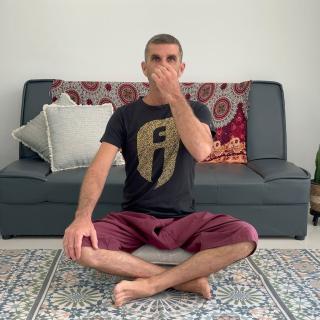
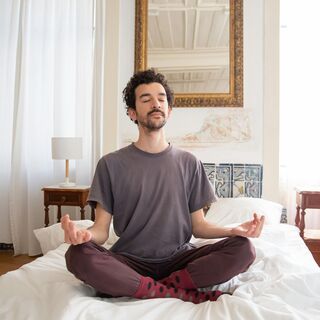
So take in your seat.
You can be sitting on the floor,
Sit in a chair.
Most important point here is building our foundation.
Just ensuring that your hips are slightly above the knees,
Whether you're in the chair or on the floor for optimal alignment.
And now bring your attention to the tailbone,
The bottom of the spine.
You want to just have a feeling of dropping the tailbone,
Not pushing it out,
Not physically trying to flatten the back and tuck in,
Just a gentle dropping.
At the same time,
The chest relaxes.
The third point of posture is the arms and hands.
Most importantly,
We want the armpits open.
The hands could rest comfortably on top of the knees,
Palms down,
Palms up.
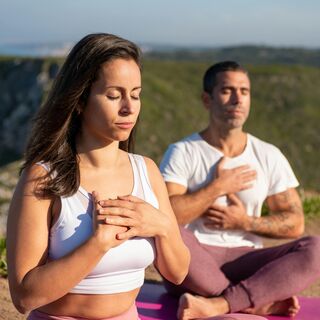
Or you could very gently just put the hands in front of the body,
Right in front of your abdomen,
One hand loosely on top of the other with the thumbs touching.
Whatever feels the most comfortable.
Now bring your awareness to the spine.
You want to have the feeling that the spine just rises,
Elongates.
As they say,
The spine rises like a string of pearls,
Each vertebra separating as you come up the spine,
Up through the upper back,
In the neck,
As if there's a string floating the head up.
A very dignified,
Majestic quality to your sitting posture.
Now bring in your attention to the shoulders.
The shoulders are down,
Away from the ears.
They're back,
Opposite of if you were on your computer or phone.
And you want to spread out the upper back.
You could even physically work on this by squeezing your scapula,
Shoulder blades towards your spine,
And then gently let the shoulder blades move away from the spine.
This feeling of the shoulder is the opposite of uptight,
Down and loose.
Now we bring the attention to the neck and the head.
You want to have a slight drop of the chin,
Slight tucking,
Where the eyes are actually looking down about 10 degrees.
Ears remain over the shoulders.
And finally,
The eyes.
You either want to close the eyes or just bring the eyes essentially out of focus,
Where they get very soft and relaxed.
Soften,
Relax the eyes,
Preferably closed or almost closed.
Where we connect to this feeling that we feel our body,
The spine rises,
The body softens and relaxes around that rising spine.
This optimal posture,
Set up the next step,
Next part of our meditation.
Part two of this meditation is a body scan.
We're going to scan through the body from the top of the head down through the soles of the feet,
All while maintaining this majestic,
Dignified,
Rising quality to our sitting alignment.
So bring your attention to the top of the head,
The forehead,
The skull.
And you can work with the breath here if you like,
Or inhale,
Just be with felt sensation.
Exhale,
Soften and relax.
Bring your awareness to the eyes,
The forehead,
The temples.
Inhale,
Just feel.
Exhale,
Relax and let go.
Bring your attention to the cheeks,
The mouth and jaw,
The ears,
Throat and neck.
Inhale,
Feel.
Exhale,
Just relax and let go.
Just like a gentle wave of relaxation dropping through the body.
Coming into the shoulders,
Upper chest and upper back.
Down to the mid torso,
The ribs,
Mid back,
The upper abdomen.
Finally,
Coming down to the lower abdomen,
The lower back,
The obliques.
Inhale and just feel this gentle expansion.
Exhale,
Just soften and relax.
Coming down to the pelvic region,
The hip bones,
The buttocks,
The groin.
Maintaining this feeling that the spine stays long,
You're feeling as tall as you can possibly be.
Yet now we're just softening the body around that rising.
Coming into the upper legs,
Thighs and the hamstrings.
Inhale and feel.
Exhale,
Relax.
Coming into the knees,
The lower legs.
Finally,
Coming down towards the feet,
The heels and ankles,
The arches of the feet,
Tops of the feet,
The soles of the feet.
It feels as if you're breathing directly into the soles.
Let it go.
Feeling all 10 toes,
Front,
Top and bottom,
The bone that attaches the toes to the feet.
Before we move into part three of this meditation,
Just bring your attention to the whole body.
Connecting to this optimal posture.
Dignified,
Majestic,
Aligned,
Tall,
Yet the body relaxed.
Moving into part three of this embodied meditation,
We come into the breath.
In this part,
We work with the five qualities of the breath.
During this practice,
I invite you to inhale through the nose.
Exhale is up to you.
Exhale through the nose.
Exhale can be through the mouth with the sound of a gentle sigh.
Or you can combine them,
Where you start with your exhale through the nose and finish with a gentle sigh through the mouth.
The first quality of the breath we want to cultivate is slow.
Slowing your breath down.
When we slow the breath down,
We connect to the relaxation response,
The sympathetic,
The parasympathetic nervous system goes online.
Focus.
Just being with the slowness.
The second quality of the breath is deep.
So not feeling the breath in the upper chest,
That's the shallow breath.
We want to drop our attention,
Our awareness,
And feel the breathing body in the lower belly,
The lower abdominal area.
As if you're diving deep into a lake.
Just feel the rise and fall in of the lower abdomen,
The expansion and contraction.
As the diaphragm engages,
Belly expands and contracts,
You drop your attention deep in the body.
The third quality of the breath is continuous.
We want to make the breath as circular as we can,
With just the gentlest of pauses at the top of the in and the bottom of the out.
It's very smooth like quality.
Slow,
Deep and smooth.
The fourth quality is quiet.
As you feel the body breathing,
Know when you're taking this diaphragmatic breath,
Accessing the full capacity of the lungs with this optimal oxygen and carbon dioxide exchange.
If someone came into the room with you,
They would not hear you breathing.
Quiet and soft.
The fifth quality is a feeling of softness.
This refers to not just the quality of the breath,
But the quality of the body.
There should be a cotton-like quality to the body now.
So if you feel that you're starting to get a little stiff,
See if you could connect to this feeling of softening the body.
That soft quality also refers to the mind.
Letting the mind soften.
So the breath,
Slow,
Deep,
Continuous,
Quiet and soft.
As we finish off this part of the meditation,
Pick one of those qualities,
Whichever speaks to you,
And take a last minute where you're just cultivating that one quality.
Whether it be slow or soft,
Quiet or deep,
Just be with this quality for the last minute of this part.
Now moving on to part four of this meditation,
We're going to bring our attention purely into the lower abdominal area.
Do what they call lower belly breathing,
The pelvic tilt.
So it's as if you're dropping all your attention out of the mind,
Up there in your head with the thoughts and feelings,
And as if it just drops and all your attention now is if there's just a spotlight and just the lower abdominal area,
Below the ribs,
Above the pelvic floor.
As you inhale,
Be with the belly expanding.
As you exhale,
Belly shrinks and contracts and you bring your navel to spine.
We're going to start off making this a little bit more active with the exhale,
Where you're actually going to tuck in that tailbone a teeny bit and really empty out on the exhales.
So on the inhale,
It's a feeling of about 70%.
Don't try too hard.
And in the exhale,
We're going to exhale really fully where the navel comes to the spine,
Slight tuck of the tailbone,
A real feeling of emptiness here in the lower belly.
Let's do this for about four more breaths.
Let's take one more breath like this.
So let's empty out.
And as you inhale,
Belly expands.
As you exhale,
Belly shrinks,
Contracts,
Navel to spine,
Empty out,
Empty everything out.
Just hold here for a couple seconds.
Now just breathing in.
Now you can let go of that effort with the pelvic bone and the shrinking of the navel to spine and just keep all the awareness on this expansion and contraction of the lower belly.
As you feel the belly rise and maybe a bit of movement to the sides,
Put your awareness in the lower back.
Just be with this very gentle,
Internal compression.
It's as if you're giving yourself a massage with this lower abdominal breathing.
Just feeling this gentle movement in the lower back with the inhale and exhale.
All right,
Great.
The next part of this meditation is what they call coming into the central channel,
Working with the energy of the spine.
So we're going to start in the lower belly,
But now we're bringing the awareness to this small tube or straw-like feeling just inside the spine.
So you bring your awareness to the back of the body.
And if you like,
You can work with the visualization as if it's a big straw or a very small tube that sits just inside the spine.
So as you start the breath in the lower abdomen,
And as if this feeling,
This energetic rising quality to the spine,
We work on this rising elongation of the spine.
And we're going to work very slowly from the bottom up.
So as we inhale,
Bring your awareness to the tailbone.
And you're just going to come up a bit with the inhale to about behind the navel,
The back of the body.
And on the exhale,
You just relax.
Start every breath in the lower belly.
And feel as if it's just guiding this rising energy up through the central channel just inside.
And just come up to the upper part of the abdomen.
And on the exhale,
Just relax.
And when we relax,
The quality of the spine continually stays upright.
We start with the breath in the lower abdomen.
And just feel this quality of rising energy,
Almost steam,
Coming up to the center of the chest,
The heart center.
Starting in the lower abdomen and the pelvic bone,
Now we rise.
Feel that rising quality connect to that big bone at the top of the back.
And feel that connection for three breaths at the pelvic bone to that bone at the upper back.
Inhale,
We rise.
Once again,
The spine elongates like a string of pearls.
Exhale,
Soften and let go.
Now bringing this quality up through the neck to the occiput,
That where this softness of the neck meets the hardness of the skull,
That point right there.
Once again,
Starting in the lower belly,
Rise with the inhale to the base of the skull.
Now bring that all the way up to the crown of the head.
See if you can connect to this ultimate state of embodiment,
Where you feel the spine rising and the body relaxed.
Rising up on the inhale through the central channel.
Softening the body with the exhale.
Now moving into the next part of this embodied meditation,
We work with whole body breathing.
As the body abides in this optimal state,
We should be connecting to a feeling of softness through the body.
With that softness,
The ability to open up the pores.
Feeling is now,
As we breathe in,
We're breathing in not just through the respiration system,
But we're taking in this oxygen,
This life force energy through the pores of our body.
Oxygenating the blood all the way down to the cellular level.
And as you exhale,
A complete letting go.
Dissolving with the exhale.
Dissolving the sense of self,
The ego,
This stiff and tight body.
We let everything go.
Letting go.
Most important practice for the mind and the body.
So inhale.
Breathing in,
Feeling.
Exhale,
Just completely let go.
Let your exhale just be a sound of a sigh.
As we finish up this embodied meditation,
Bring your attention to the body.
Be in this feeling.
Know that you can connect back to this optimal state of embodiment where the spine rises,
Yet the body is soft around that rising spine.
Completely in balance.
Dignified.
Majestic.
Yet soft and relaxed.
And as we finish up,
We just connect with a sense of gratitude.
We can start close to ourselves.
Giving some thanks to ourselves.
That we have the health.
We care enough about our own health and well-being to take care,
To actually engage in these type of self-care practices.
Meditation and breathwork and movement.
Eating well.
Being out in nature.
Being with good friends and family.
Being grateful for the people around us.
For the food.
Just giving ourselves this light challenge of every day.
Connecting with three things that we're thankful for in our lives.
And as you finish up,
Just bring a little movement to the fingers and the toes.
You need to stretch a little after this long sitting session.
Stretch however you feel your body needs.
And once again,
Take a bridge.
Don't go straight into getting back on your phone or on a device.
Take a little time.
Have a little water or tea.
Take a little time outside.
Take a bridge.
Before you go back into your everyday life.
Thanks for joining.