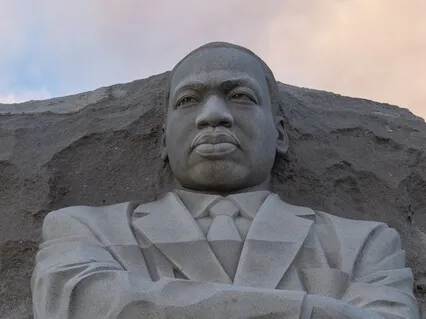
Spent Spring Day speeches with friends.
I think as the years go by,
Different parts of it add differently for me.
And this time around in particular,
The teachings about and the understanding of enemies really struck me.
He,
Of course,
Was coming from a Christian perspective in large measure from these sayings of Jesus,
These teachings of Jesus about love of enemies,
Which he translated,
Dr.
King translated into this notion of succeeding by both rendering justice for the oppressed,
But also with the end goal of winning over the oppressor and ultimately reconciling people with this notion or this joint recognition of our shared humanity.
I was also struck by the parallels between this sort of thinking and the practices that we do for loving kindness,
Which is meant to generate naturally this response of the heart with these repetition of these simple phrases about ease and peace and safety,
All the things that I think all of us desire most deeply for ourselves.
And then the classic practices being moving that circle of well-wishing out to first those for whom it comes quite naturally,
Those well-wishes,
The people who have always been in our corner and always supported us to people we're just neutral towards.
And then finally to what's usually called the difficult person.
And one of the ways that the teachings of Dr.
King really struck me was that this,
That this,
Extending these well-wishes out to the,
To the so-called difficult person has a way of,
Of not only of course seeking some benefit for that person,
But also seeking a benefit for ourselves because we're the ones who carry this with us.
You know,
This notion of opposition,
This notion of,
Of our enemy so that it's possible to free both,
Both of us,
Like both people,
The two people on both sides of this,
And to,
To try to cool these flames that burn inside of us when we think of those that we are opposed to.
There's a,
There is a saying from the Buddha who said,
Holding onto anger is like grasping a hot coal with the intent of throwing it at someone else,
But you are the one who gets burned.
I know what to do.
I'm going to throw this hot coal at the person and then you pick it up and you're the one who's,
And it,
And I think it turns this question back towards us about,
Well,
Who is it that we really want to be?
And it's not a question,
I think of forgetting what others have done or some,
Or trying to pretend that anger doesn't arise because it does,
But asking ourselves,
Well,
What do we do?
What do we do with that anger?
And,
And I'll just say that all this sort of work with the difficult person makes certain assumptions already that first,
That we,
We have taken care of ourselves,
That we're safe,
We're protected and in experimenting with these practices,
I think often the counsel is,
Don't start with the most difficult person,
You know,
Start with the kind of mid-range difficult person,
That person who just,
Maybe you don't really connect with,
Or you just find you're always disagreeing with,
Or just annoyed by,
And not the person who may have done you true harm,
Trauma,
Inflicted some sort of trauma.
One translation of these loving kindness phrases that we're all familiar with that we usually,
We use,
For example,
May you be well and may you be at ease,
Is broadly speaking,
Asking to be free from enmity and danger to,
To,
To asking that for yourself and others being free from enmity and danger.
And the enmity is not so much that sense that if you go out on the street,
You know,
You may be in danger,
But actually the enmity that we have inside,
Right?
It's like,
Can we,
Can we somehow protect ourselves from that?
So to,
To capture a little bit of this from Dr.
King,
I'd like to play this clip,
It's just three or four minutes,
And a little bit of background.
It's,
It's from a sermon he gave called Love Your Enemies.
It was delivered in 1957 at the Dexter Avenue Baptist Church,
And it was delivered just a few months after the Montgomery bus boycott ended,
Which famously Rosa Parks refused to give her seat in Montgomery.
And this led to 40,
000 black residents of Montgomery eventually boycotting the bus system and the eventual elimination of segregation on the buses.
And this was led by Martin Luther King,
A 26 year old new pastor of the Dexter Avenue Baptist Church.
He led it because other area clergy did not want to,
They did not want to be associated or have their name in the front of this.
If you think this is kind of a distant event,
Because it feels pretty long ago,
I'll just mention that Patrice Ficklin,
Our,
Our fair lending director,
Her mother and father,
As residents of Montgomery,
Alabama at the time,
Were supporters of the boycotts and actually helped to drive blacks to work during this period so they would not lose their jobs.
And in fact,
She just came back from visiting her mom still living in Montgomery.
So let me play this for you.
It is a love that seeks nothing in return.
It is an overflowing love.
It's what theologians would call the love of God working in the lives of men.
And when you rise to love on this level,
You begin to love men,
Not because they are likable,
But because God loves them.
You look at every man and you love him because you know God loves him and he might be the worst person you've ever seen.
And this is what Jesus means,
I think,
In this very passage,
When he says,
Love your enemy,
And it's significant that he does not say like your enemy.
Like is a sentimental something,
An affectionate something.
There are a lot of people that I find it difficult to like.
I don't like what they do to me.
I don't like what they say about me and other people.
I don't like their attitudes.
I don't like some of the things they're doing.
I don't like them.
But Jesus said,
Love them.
And love is greater than like.
Love is understanding,
Redemptive,
Goodwill for all men,
So that you love everybody because God loves them.
You refuse to do anything that will defeat an individual because you have a copy in your soul.
Here you come to the point that you love the individual who does the evil deed while hating the deed that the person does.
This is what Jesus means when he says,
Love your enemy.
This is the way through.
The opportunity presents itself for you to defeat your enemy.
Do not do it.
So Jesus said,
Love,
Because hate destroys the hater as well as the hated.
Now that is the final reason I think that Jesus says,
Love your enemies.
It is this,
That love has within it a redemptive power.
And that is a power there that eventually transforms individuals.
That's why Jesus says,
Love your enemies.
Because if you hate your enemies,
You have no way to redeem and to transform your enemies.
But if you love your enemies,
You will discover that at the very root of love is the power of redemption.
You just keep loving people and keep loving them even though they are mistreating you.
Here's a person who is a neighbor and this person is doing something wrong to you and all of that.
Just keep being friendly to that person.
Keep loving them.
Don't do anything to embarrass them.
Just keep loving them and they can't stand it too long.
Oh,
They react in many ways in the beginning.
They react with bitterness because they are mad because you love them like that.
They react with guilt feelings and sometimes they'll hate you a little more at that transition period.
But that's love.
And by the power of your love,
They will break down under the load.
That's love,
You see.
It is redemptive.
This is why Jesus says,
Love.
There's something about love that builds up.
And it's creative.
There is something about hate that tears down and is destructive.
Love your enemies.
I'll add to this only that we hear echoes of Dr.
King's message.
Also,
In other words,
Of the Buddha spoken five years ago,
Who said,
Hatred does not cease by hatred,
But only by love.
This is an eternal truth.
So let's give this a try together,
Thinking about extending these circles of of well-wishing to wider and wider groups to include the difficult person.
We can start,
As we often do in meditation,
Just checking our posture,
Making those adjustments that you might need to feel both alert and relaxed.
Feet on the floor,
Hands resting gently at your sides or in your lap and with your head and your spine aligned,
Feeling into a posture that's both receptive,
Open,
And relaxed.
You can close your eyes if you feel comfortable doing so.
And for a moment,
Sense that you're arriving right here.
Feel that release and ability to let go of whatever else is happening in your day right now,
Kind of freshness and interest,
Welcoming this new moment arising right now.
And in this opening,
You can feel the breath coming and going,
Aware of the breath,
Just like a wave coming in and then receding in a natural,
Organic way,
The way it continually continually revives and brings life to the body,
Feeling the rising and falling of the chest,
The body naturally opening with each in-breath and gently relaxing with each out-breath.
And now,
Bringing to mind someone who has always affirmed who you are,
Someone who has supported you,
Encouraged you,
Helped you in some way,
Could be a grandparent or another relative,
Could be a teacher,
Mentor,
Someone who has believed in you,
Seen you for who you are and who you could be.
And just bring that person to mind and sense the affirmation you feel,
Just being in their presence,
Silently directing these phrases to them.
May you be well,
May you be at ease,
May you be free from inner and outer harm,
May you be happy,
May you know deep peace.
And for a moment,
Feel that person receiving those phrases from you and feel their gratitude in this mutual exchange of love.
And now,
Calling to mind someone you don't know that well,
Could be just someone you passed in the hall today or a neighbor that you rarely see,
Someone you pass on the road.
Bring that anonymous person to mind,
Imagine who it is,
Silently direct these phrases to that person.
May you be well,
May you be at ease,
May you be free from inner and outer harm,
May you be happy,
May you know deep peace.
For a moment,
Feel the person receiving these phrases from you,
Just sense them landing,
Affect things,
Change things.
And now calling to mind a person you feel some discomfort around,
A difficult person.
Don't select anyone who has done you true harm,
But just for this meditation,
Someone who there's some tension or misunderstanding,
See that person as you call him or her to mind and into that space where you've sensed that tension or discomfort or being ill at ease,
Direct these phrases.
May you be well,
May you be at ease,
And may you be free from inner and outer harm,
May you be happy,
May you know deep peace.
For a moment,
Feel that person receive the phrases from you and feel how they might open up this space and sense how they might change things.
And again,
Bringing this person,
This difficult person to mind,
Not the things they have done,
But the person,
Him or herself to mind and seeing them as a person apart from their actions.
And once more,
Offering these phrases to them,
May you be well,
May you be at ease,
May you be free from inner and outer harm,
May you be happy,
May you know deep peace.
Pause to feel the movements in your heart right now,
Maybe different movements as you offer these well wishes.
And without trying to change anything about what this person does or says,
But just connecting with the individual.
Now bringing to mind some wisdom figure to help you in this work.
It could be Dr.
King,
Could be the Buddha,
Desmond Tutu,
Dalai Lama,
Jesus,
Any other figure or even just an elder or other person in your own life has served as a role model.
Feel their presence,
Their integrity,
The love that they demonstrated,
Even in the midst of conflict or division,
Violence,
Hatred,
And just ask this person to speak to your heart of the possibilities for you,
For us to break down some of these barriers or these confines,
See each other through this common humanity we share,
Explore this,
These frontiers of love,
Give them a moment just to speak to your heart,
Perhaps without words,
Just a feeling of encouragement or comfort or care for you as you explore these challenges in your own life.
A moment to thank this person,
Bowing to them in gratitude for helping you,
To show you the way,
To inspire you,
Including with the words of words of Dr.
King,
That love is creative and redemptive,
Love builds up and unites,
Hate tears down and destroys.
The aftermath of the fight fire with fire method is bitterness and chaos.
The aftermath of the love method is reconciliation and the creation of the beloved community.
Yes,
Love,
Which means understanding,
Creative,
Redemptive,
Goodwill,
Even for one's enemies,
Is the solution.
And with that,
I invite you to come gently back in your own time,
You can open your eyes.