First,
Just try to arrive fully here in this moment from wherever you're coming from.
You can check in with your body,
Feet resting on the floor,
Arms gently resting at your sides or in your lap and you can check the alignment of the spine and you might move your head from side to side a few times and then find a place where it can gently rest again aligned with the rest of your body assuming a noble posture but one in which you can be at ease.
You can gently close your eyes if you feel comfortable doing so.
You can take a few full deep breaths filling the lungs on the in breath,
Releasing,
Relaxing on the out breath,
Energizing the body with some full deep in breaths,
Sensing the chest expand and releasing on the out breath.
You can now allow the breath just to be natural,
Easy,
Feel the soothing nature of the breath as it enters and leaves the body.
See whether in each breath you can breathe relaxation and ease throughout the whole body,
Relaxing,
Releasing any tension you find.
Now bringing the mind to something during the last day that made you happy.
Could be your dog wagging its tail as it sees you,
The smell of your coffee,
Sound of the birds outside,
Openness of the sky,
Whatever it might be.
Recognize the goodness of whatever that small thing might be.
You might let an easy smile cross your face if you like.
Just pause for this brief moment of contentment.
Sense into the fact that it feels good.
Now bringing the mind to some experience you've had involving tension or difference or conflict in which you were unable to respond skillfully.
Where you might have said or done something that was not helpful,
Perhaps a sharp word,
Or you just felt unable to respond,
To say or do what you thought was best.
And sense how you're feeling at the beginning as the tension was rising,
In the middle as you struggled to respond afterward as you think back on what happened.
Just feel for a moment into the discomfort of not being able to be the person you wanted to be.
Not criticizing or being harsh with yourself,
But just touching into what that feels like on the inside.
Now wiping the slate clean,
Releasing those memories,
And calling to mind a different situation in which there was tension or conflict and you were able to respond wisely,
Expressing your truth,
Doing so in a kind and even way where the words felt right,
They landed in a good place.
And again sense how that felt in the beginning as the tension was rising and in the middle as you responded and then now as you think back on whatever happened.
And feel into the qualities of mind and heart that you experienced.
Sense how truth and integrity and kindness all met in that moment.
Experience what that feels like in the body where you sense it.
Maybe it's warmth around your heart or just stillness in the body or a sense of quiet,
Whatever it might be.
Hold that memory,
Just let it sink in,
Welcome it.
Now taking a few more deep cleansing breaths and coming gently back.
If you're on time you can open your eyes.
Although it's certainly not required if you want to turn your camera on.
I always love seeing people while I'm talking so welcome back to all of you.
I will be talking about mindful approach to difference and conflict.
We have an adversarial legal system and maybe you could say we're also moving towards an adversarial society in some ways that has a certain sort of addiction to conflict.
I'm very aware as I scan the Washington Post headlines in the morning that usually what makes the news is some kind of conflict somewhere.
Usually people agreeing with each other doesn't make news or maybe it's the thinking of the quote from Leo Tolstoy,
All happy families are alike but every unhappy family is unhappy in its own way.
She's a kind of fascination to conflict,
Difference.
We know that meditation opens up new worlds inside your head.
That's why we do meditation practice.
So many people find it so important and we know from the neuroscience that neuroplasticity means that meditation practice actually helps to rewire our brains to reinforce these wholesome patterns of thought and action.
So one inquiry is well if we can rewire our brains maybe we can rewire our relationships too,
Maybe we can rewire our society.
Why not?
So these approaches which I'm going to discuss elaborate on this theme a little bit and it's one I'm going to pick up later.
This is sort of a sampler,
Themes I'm going to return to.
Each one has a sort of a default which I recognize within myself and an alternative,
A mindful one.
The first one is the desire to win and the alternative is equanimity.
There's an old joke about there are two kinds of people in the world.
The first kind think they're right and the joke is there's no second kind.
Everyone thinks they're right and as a former litigator I certainly know that feeling,
That desire,
That push to win and of course if you never win then either your supervisor or your agency is going to start asking you what's going on.
But the question really becomes can we balance the need to put in the work with accepting whatever the outcome might be.
James Barras who's a meditation teacher started meditating back in the 70s and he was a huge New York Knicks fan,
Basketball.
And I think in his first long retreat with Joseph Goldstein,
Many of us know from his recordings,
He went in to see Joseph and he said you know I love this meditation thing,
It's just amazing but I'm a little concerned.
In fact I'm worried that if I really dive in with both feet then I'll end up not being a New York Knicks fan anymore.
And I want some advice and so Joseph said to him,
He says no you don't have to give up being a New York Knicks fan,
He said you'll just find the losses much easier to take.
So this is the question,
Can we be there for the gain as well as the loss.
Bhikhu Bodhi who's a very senior Western Buddhist monk said that equanimity is not indifference in the sense of unconcern for others.
As a spiritual virtue it means stability in the face of fluctuations of worldly fortune.
It's an evenness of mind,
Unshakable freedom of mind,
A state of inner equipoise that cannot be upset by gain or loss,
Honor or dishonor,
Praise or blame,
Pleasure or pain.
And I think this really resonates across all kinds of spiritual traditions from the Bhagavad Gita,
The Hindu sacred scripture refers to action without attachment to the fruits of action.
And then Mahatma Gandhi reflecting on these same scriptures clarified that the one who gives up action fails but the one who gives up only the reward rises.
Renunciation of the fruit of the action in no way means indifference to the result.
So this I think really focuses us on the quality of the journey or the process and of course not so much for the ultimate results.
So this is a theme I like to pick up on,
There's a lot more to say but that's number one.
So going on to number two,
The default and then the alternative.
So the default is the desire to have others think well of you and the alternative is to desire to speak and act on the basis of truth.
So we all know this from elementary school where the teacher asks you what would you like to be when you grow up and people say astronaut or veterinarian or maybe president of the United States or what have you.
I always answer I want to be a train engineer,
I want to drive the train and as a boy I was fascinated by trains.
I had train books,
I had LP recordings of train sounds,
I got to go on train trips any opportunity I could with my parents.
Anyway I'm still fascinated by trains by the way.
So things have changed a little bit today.
There was a poll asking kids what they want to be when they grow up now and then one of the top choices for 86% of the kids in the United States was to be a social media influencer.
So I guess this means that you want people to like you on social media.
For me I can imagine no better recipe for suffering if your self worth is pinned to how many followers you have on Instagram or whatever.
So back to Mahatma Gandhi for a moment.
So his guiding principle was something,
A term that he coined called Satyagraha which literally means truth force.
And it was an endeavor to uncover the truth and then act upon it fearlessly and this truth was spiritual as much as it was social.
In fact the two things were almost indistinguishable.
It's not so much about having kind of the right opinion about something but it being an organizing principle for both what happens inside and outside.
And it really points to a kind of circle that's well done in meditation which is you have the meditation practice itself,
You have the wisdom component that it's constantly feeding into,
Kind of better understanding of who you are and your place in the world and then,
Indispensable it has the action component,
The behavior because unless whatever is happening in those first two begins to be acted upon then it really doesn't take root.
It doesn't really get any traction.
And as I follow up on these themes also there's a fascinating interchange between East and West.
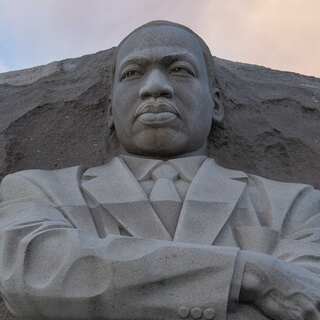
Gandhi himself was very much influenced by Thoreau and his essay on civil disobedience and then Martin Luther King Jr.
Said that Gandhi and Satyagraha was one of his guiding lights in his philosophy of nonviolence and then today a lot of Buddhist teachers in the West are looking very much to both Dr.
King and to Gandhi to develop these principles.
Alright,
Number three.
Number three is demonizing the enemy versus non-harming.
So how to perceive those we disagree with.
With hatred I think we all know from experience that it has a direct effect both on the relationship with the other but also on ourselves.
The Buddha said holding on to anger is like grasping a hot coal with the intent of throwing it at someone else.
You are the one who gets burned.
So it's this challenge of recognizing our shared humanity even with those we strongly disagree with.
I remember back in the 1980s when I participated in a lot of demonstrations and civil disobedience for the anti-nuclear movement and every week a bunch of friends and I went to a nuclear war research think tank in New York City and we would protest there we'd hand out flyers to the people going into work and one day one of the workers actually stopped to talk to me.
Most just took the fire or avoided us.
One stopped to talk to me and I was so angry that I think I just stuttered something about you're destroying the planet you're destroying the human race.
I sputtered and the person walked away and I thought to myself like this rage had just kind of overtaken me and it was not very effective.
This was not a very effective way to communicate to someone else particularly someone who might be sympathetic who would stop to talk to me.
So you know rage has this ability to make us feel very big and very powerful but it's often not very smart.
So non-harming,
Non-harming it applies to all living beings.
It's deeply rooted in Eastern philosophy and religion.
I remember when I was traveling in India I saw these Jain,
Jainist,
Jain the religion monks who were sweeping the path in front of them to ensure that no insect was harmed as they walked.
Or this greeting namaste we're all familiar with namaste in Sanskrit which literally means I bow to you and so you bow to everyone including those who may prefer a different presidential candidate or what have you you bow to them.
And this is very much tied up with wise speech that we've talked about before you know can you speak in a way that's truthful,
Helpful,
Comes from a kind heart and is delivered at the right time as being the qualities of mindful speech.
So for me reaction to all these things I have two reactions to what all the things first of all it's very exciting to me it's a map of this different way of living or new possibilities that can open up for us as you try to align these insights into this deep interconnectedness between people with what we see on the outside.
The other reaction is yikes.
But this is hard right that I'm going to fail that there's certainly times I'm not interested particularly if I'm you know in the thick of a hot conflict where I'm not my most scattered unmindful self.
So perspective on that that conflict can be our wisest teacher.
It can be the best teacher really.
The Tibetans say transforming difficulties into the path whatever your difficulty is transforming them into the path anytime you feel that tension or conflict you know you're about to learn something.
In the early 2000s someone went to visit Ram Dass the famous author of Be Here Now out in Hawaii and they saw he had an altar in his house with all of these deities a picture of his guru on there other venerable and a picture of Dick Cheney.
And someone asked him about this and he said well it's easy to revere my guru but how do I treat Dick Cheney was his question.
So anything outside our comfort zone is uncomfortable right.
And Jack Kornfield says you know when you feel fear that means that you're about to grow.
So why don't we just take this last moment to go back inside for a moment you can close your eyes if you like and just settle back again bringing back to mind that time from the meditation of disagreement and conflict where you were able to say something that felt right and true,
Honest and kind.
Help move the universe just a little bit in the right direction and just allow that to sink in.
Feel its goodness.
Recognizing that that's who you are,
That's your highest self already and you can come gently back and thank you all for your kind attention.
Look forward to seeing you again.