The world’s largest free audio library for everyday wellbeing
Sound-Based
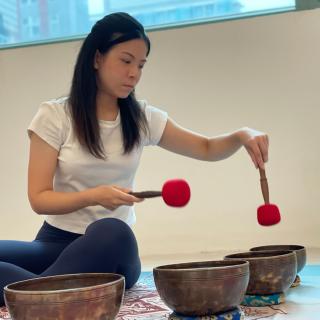
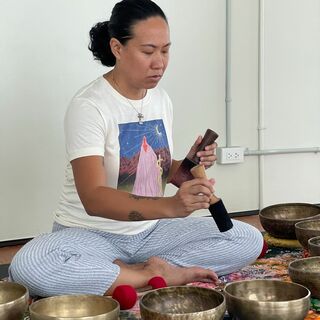
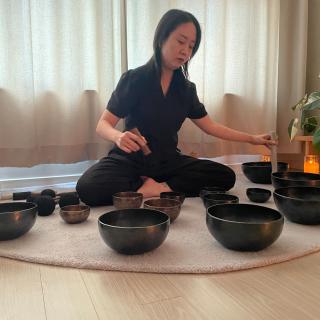
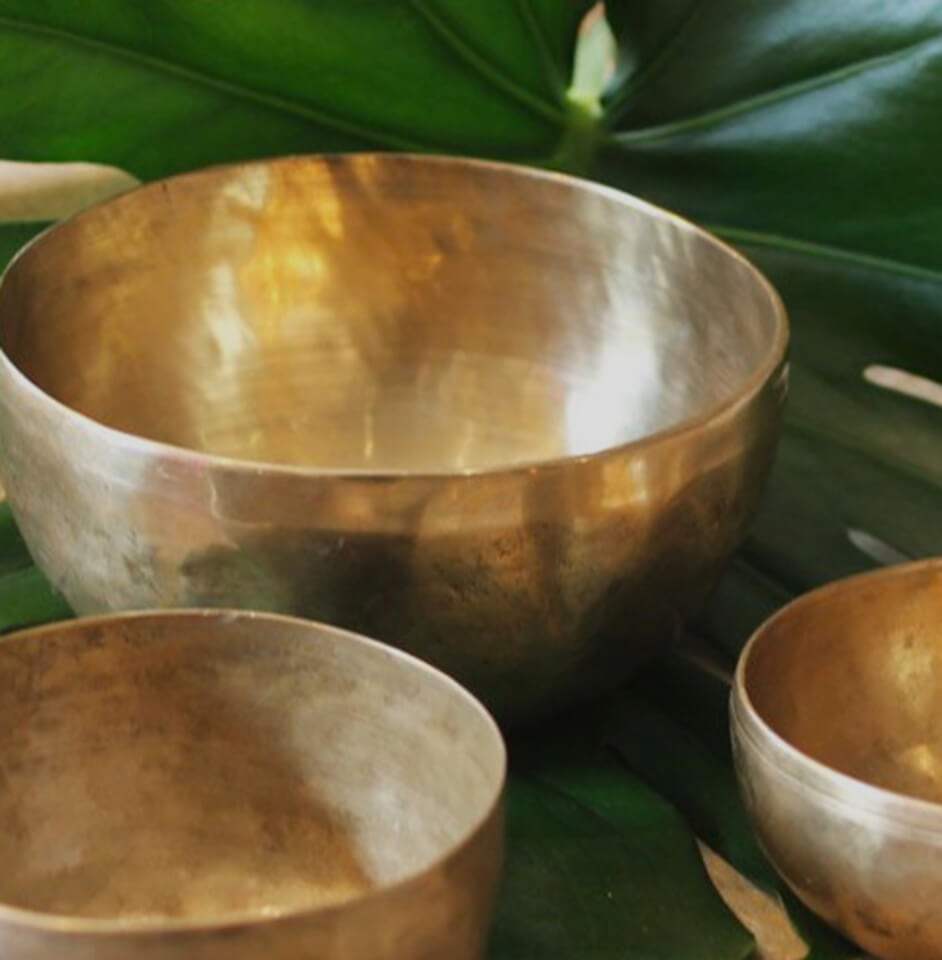
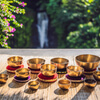
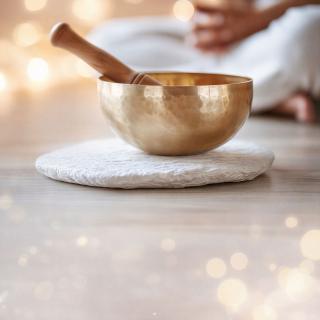
A Tibetan singing bowl sound bath is an immersive listening practice in which hand-hammered bronze bowls are sounded to produce sustained, overtone-rich tones and vibrations that guide the body toward rest (Terwagne & Bush, 2011).
Last Updated
4 Jul 2026
We are still reviewing this page. Our research team checks every technique page for accuracy and evidence quality before final release. Details may change as that review completes. The evidence badge shows our current reading of the published research.
RECOMMENDED DOSE
A randomized crossover study used a 12-minute Himalayan singing bowl segment, and a randomized controlled trial found that a single Tibetan singing bowl session produced an acute relaxation response — together supporting a short 10–15 minute introductory listen. A specific weekly frequency has not been directly tested, so 2–3 sessions per week is a conservative starting suggestion.
Related relaxation and meditation research had participants practice for 20 minutes a day over two weeks, and singing bowl studies paired roughly 12 minutes of bowls with a 20-minute relaxation period, supporting a 20–30 minute session practiced most days. This session length and frequency are extrapolated from these closely related relaxation protocols.
A peer-reviewed study analysed one-hour group Tibetan singing bowl sessions, so longer sessions are documented in practice; however, controlled dose-response evidence confirming additional benefit at this length is limited. Near-daily practice at this duration reflects a maintenance-level commitment rather than a directly tested frequency.
Session length
Session length: 10–15 minutes
10
MIN
How long each individual practice session should last from start to finish.
Frequency
Frequency: 2–3 days
2
DAYS
The number of days per week to fit a session into your routine.
Session length
Session length: 20–30 minutes
20
MIN
How long each individual practice session should last from start to finish.
Frequency
Frequency: 4–5 days
4
DAYS
The number of days per week to fit a session into your routine.
Session length
Session length: 45–60 minutes
45
MIN
How long each individual practice session should last from start to finish.
Frequency
Frequency: 5–7 days
5
DAYS
The number of days per week to fit a session into your routine.
About this card. Evidence for singing bowl dosing is drawn largely from single-session studies and closely related relaxation practices, so longer and more frequent recommendations are partly extrapolated. These recommendations are not a substitute for personalised guidance from a qualified practitioner.
Quick answers to what people most often ask. Each card links to the deeper section below.
evidence
A randomized trial of 50 anxious adults found one Tibetan singing bowl session relaxed them at least as much as progressive muscle relaxation and better than waiting. A 2025 review of 19 clinical studies reports consistent signals for anxiety, mood, and sleep, though most trials remain small, single-session, and early.
good for
Adults who feel stressed, anxious, or physically unable to wind down may benefit most from Tibetan singing bowls, and studies have focused on nonclinical adults in single sessions. They ease anxiety and prompt deep relaxation, but are not a substitute for care when anxiety, depression, sleep, or trauma symptoms are severe.
Read moresafety
Most healthy adults can enjoy a Tibetan singing bowl sound bath safely, and two systematic reviews searching for harms found no serious adverse effects. People sensitive to sound, including those with tinnitus or hyperacusis, may want lower volume and more distance. During pregnancy or with a pacemaker, avoid placing bowls directly on the body.
Read morehow it works
Sustained, overtone-rich tones give the nervous system a steady stream of sound to settle around, shifting the body from stress-ready arousal toward the rest-and-recovery branch that slows heart rate and raises heart-rate variability. Early EEG work suggests brain activity may fall into step with the bowls' beat, and the metal transmits vibration felt as a penetrating hum.
Read moreTibetan singing bowls are hand-hammered metal bowls that ring with rich, layered tones and vibrations when struck or rubbed, used in a sound bath as an immersive listening practice for relaxation (Terwagne & Bush, 2011).
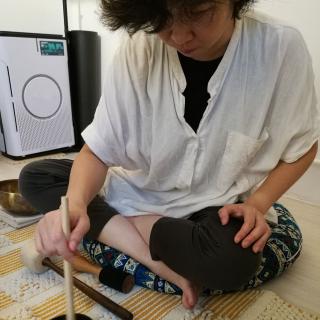
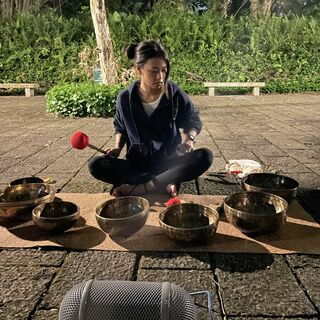
A facilitator strikes or rubs bronze-alloy bowls to create continuous, overtone-heavy tones with audible beating frequencies, while the listener rests still and lets attention follow the sound. Bowls may be placed on or near the body so the vibration can be felt directly. Sessions favour immersive, unhurried listening rather than a fixed sequence.
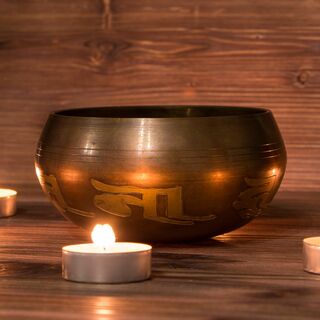
Tibetan singing bowls are hand-hammered bronze-alloy bowls whose complex overtones give a warmer, less pure tone than crystal singing bowls. This is a sound bath, an immersive listening and relaxation practice, not a music performance, a medical treatment, or a proven therapy for any diagnosed condition. Popular accounts sometimes describe the bowls as balancing the body's energy centres; that is an interpretive tradition rather than a measured physical effect.
Not to be confused with
Crystal Singing Bowls
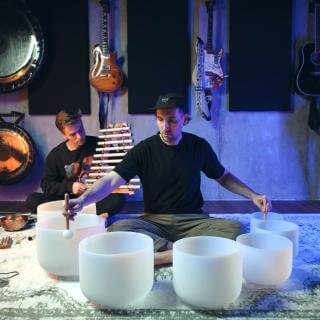
Crystal bowls are made of quartz and ring with a purer, more sustained single tone, while Tibetan bowls are hand-hammered bronze alloy and produce a richer, more complex sound with audible beating overtones. The instruments and the quality of the experience differ.
Gong Bath
A gong bath uses large struck gongs rather than bowls, producing sweeping, wave-like waves of sound that build and crash, a different sonic texture from the sustained, hummed tones of Tibetan bowls resting near or on the body.
Tibetan Sound Meditation (vocal chanting)
Vocal Tibetan sound meditation centres on chanted syllables and the practitioner's own voice, not struck metal bowls. It is a distinct contemplative practice even though both share Himalayan Buddhist roots.
Singing bowls appear to work by giving the nervous system a steady, immersive stream of sound to settle around, shifting the body from alert, stress-ready arousal toward the parasympathetic branch, which governs rest and recovery (Río-Álamos et al., 2023), (Trivedi & Saboo, 2019). As the bowls ring, early EEG work suggests brain activity may fall into step with their dominant beat frequency, a frequency-following response that some listeners experience as attention dropping into an easy rhythm rather than something they must hold in place (Kim et al., 2023), (Aarts et al., 2014). The dense metal also transmits vibration into the body, and animal research hints that this physical resonance may quiet brain circuits tied to anxiety, felt as a penetrating hum and muscles letting go (Misrani et al., 2023). These pathways are plausible but not yet confirmed in people.
Racing thoughts can loosen their grip when the steady beat of a struck bowl gives the brain a single rhythm to follow. Early EEG work suggests neural activity may fall into step with that beat, a frequency-following response that some listeners feel as attention settling into an easy, meditative rhythm rather than something they have to force (Kim et al., 2023), (Aarts et al., 2014).
The body settling under the bowls, a slower pulse and a softer breath, tracks with the parasympathetic branch of the nervous system, the rest-and-recovery side that counters fight-or-flight. Across single-session studies, listeners showed higher heart-rate variability and lower heart rate, physical signs of that shift toward calm (Río-Álamos et al., 2023), (Trivedi & Saboo, 2019), (Panchal et al., 2020).
That deep, penetrating hum you feel in the chest and belly during a bowl session is vibroacoustic resonance, the transfer of sound waves dense enough to travel into body tissue as physical vibration rather than something you only hear. Early animal research suggests this vibration may act on brain circuits tied to anxiety (Misrani et al., 2023), and in the body it often registers as muscles softening and attention loosening its grip.
The alert, keyed-up feeling can start to loosen as the bowls' steady tones give the nervous system something simple to organize around, a shift researchers call arousal downregulation, a move from high activation toward calm. Early work is suggestive rather than settled: one small EEG study links the bowl's beat frequency to relaxed brainwave activity (Kim et al., 2023), and animal research hints that the physical vibration may quiet anxiety-related brain circuits (Misrani et al., 2023).
The steadying many people feel during a singing bowl session may run through the vagus nerve, the body's main rest-and-recovery pathway that slows the heart and eases tension. Sessions have been linked to higher heart-rate variability, a marker of that vagal activity (Trivedi & Saboo, 2019), though the direct pathway is still being mapped (Misrani et al., 2023).
The most consistent bodily change is a shift toward physical calm. Across single-session studies, heart rate slows and heart-rate variability rises, both markers of the nervous system moving into rest (Walter & Hinterberger, 2022), (Río-Álamos et al., 2023), (Trivedi & Saboo, 2019). In one study, adding a bowl before a relaxation session was linked to modest drops in blood pressure and heart rate (Landry, 2013), and a singing bowl massage study measured lower overall brain-wave activity, a quieting of the fast, alert rhythms of busy thinking (Walter & Hinterberger, 2022). People tend to feel these changes as slower breathing, loosening muscles, and the day's urgency fading, though they are short-term shifts measured during and just after practice rather than proven lasting change.
During a singing bowl session the body tends to settle in a way you can both feel and measure: heart rate slows while you listen (Walter & Hinterberger, 2022), (Landry, 2013), alongside a rise in heart-rate variability, the beat-to-beat variation that signals the nervous system shifting into rest (Río-Álamos et al., 2023), (Trivedi & Saboo, 2019). Most people feel this as breathing slowing, muscles loosening, and the day's urgency quieting.
Blood pressure edged lower when a short singing bowl session was added before a guided relaxation practice (Landry, 2013). That downward shift is the body easing off high alert, which many people feel as loosening shoulders, slower breathing, and the day's pressure letting go.
During a singing bowl session, many people feel the chest loosen, the breath lengthen, and the body settle out of high alert. That easing reflects rising parasympathetic tone, the activity of the body's rest-and-recovery branch, which studies have measured as higher heart-rate variability and a slower heart rate (Río-Álamos et al., 2023), (Trivedi & Saboo, 2019), (Panchal et al., 2020).
Many people feel a tight, on-guard readiness draining away during a singing bowl session, the shoulders dropping and the breath coming more slowly and easily. This tracks a fall in sympathetic tone, the body's fight-or-flight branch, inferred from rising heart-rate variability and a lower stress index while people listen (Río-Álamos et al., 2023), (Trivedi & Saboo, 2019), (Panchal et al., 2020).
As a busy, alert mind starts to settle, the brain's faster thinking rhythm, called beta activity, eases, it was measured lower after a singing bowl sound massage (Walter & Hinterberger, 2022), felt as mental chatter quieting and effortful, vigilant thought loosening its grip.

When the bowls ring, many people feel their attention lock onto the tone while circling thoughts loosen their grip. EEG recordings capture part of this: the brain's hearing areas fall into step with the bowl's dominant beat frequency, with rhythmic activity rising sharply at that frequency during listening (Kim et al., 2023).
Moderate evidence supports Tibetan singing bowls for easing anxiety and prompting deep relaxation: a randomized trial found a single session relaxed anxious adults at least as much as progressive muscle relaxation (Río-Álamos et al., 2023), and a 2025 systematic review of 19 clinical studies reports consistent signals for anxiety, mood, and sleep (Cai et al., 2025). Emerging, lower-tier evidence links sessions to less tension, better mood, and briefly lighter fatigue, drawn from small before-and-after studies with no comparison group (Goldsby et al., 2016), (Goldsby et al., 2022). What is not yet supported: large well-controlled trials, lasting change beyond the session, and any claim that singing bowls treat a diagnosed condition.
That keyed-up, can't-settle feeling of anxiety can ease during a singing bowl session. In a randomized trial, one session left anxious adults feeling more relaxed, at least as much as a standard muscle-relaxation exercise (Río-Álamos et al., 2023), and reviews of the wider research point the same way while noting the evidence is still early (Cai et al., 2025).
The body loosens and sinks toward rest during a singing bowl session, as the sustained, layered tones give attention something steady to hold. In a trial of adults with high anxiety, a single session set off an acute relaxation response, the body's shift out of stress-ready alertness, at least as strong as a standard muscle-relaxation technique (Río-Álamos et al., 2023).
Heavy, worn-out feelings can lift a little after a singing bowl sound meditation. In an observational study, adults reported less fatigue right after a session, along with easing tension and lower mood (Goldsby et al., 2016), (Goldsby et al., 2022). It is an early finding, so treat it as a possible short-term shift rather than a dependable energy boost.
A randomized trial in 50 adults with high anxiety found that one Tibetan singing bowl session produced a relaxation response comparable to progressive muscle relaxation and better than simply waiting (Río-Álamos et al., 2023). Physiological studies point the same way, reporting higher heart-rate variability, lower heart rate, and calmer brain activity during or after sessions (Trivedi & Saboo, 2019), (Walter & Hinterberger, 2022), and two systematic reviews describe the whole field as promising but early, with few well-controlled trials (Cai et al., 2025), (Stanhope et al., 2020). Mechanism ideas such as brainwave entrainment and vibration effects rest on one small EEG study and animal work, so they stay exploratory rather than confirmed in people (Kim et al., 2023), (Misrani et al., 2023).
0
Meta-analyses
1
RCTs
2
Systematic reviews
2
Observational
11
Pilot
Studied populations
Acute Relaxation Response Induced by Tibetan Singing Bowl Sounds: A Randomized Controlled Trial
n = 50
Finding: In this randomized controlled trial, 50 adults with high anxiety were split into three groups: one received a single Tibetan singing bowl session, one did progressive muscle relaxation, and one simply waited. Both the singing bowl and muscle relaxation groups came away noticeably less anxious than those who waited, and the relaxing effect was more pronounced for the singing bowl group, which also showed higher heart-rate variability, a sign the body was settling into a calmer, rest-and-digest state. For someone curious about the practice, this suggests even one session may help you unwind at least as effectively as a standard relaxation technique. Keep in mind the trial was small, tested only a single session, and involved anxious but otherwise healthy adults, so it speaks to short-term calm rather than treating an anxiety disorder.
reported narratively
Vibration-reduced anxiety-like behavior relies on ameliorating abnormalities of the somatosensory cortex and medial prefrontal cortex
2023
Finding: Working with anxious mice, this study isolated the two parts of a singing bowl's output and found that the physical vibration, not the audible tone paired with it, was what lowered anxiety-like behavior. The vibration also tracked with measurable changes in brain regions tied to touch and emotion regulation and helped normalize disrupted low-frequency brain rhythms, pointing to a possible physical, vibration-based route by which bowls could calm the nervous system. This is early animal research, though, and it did not reproduce the soothing effect people often report from the sound itself, so it hints at how bowls might work rather than proving what they do for you.
Tibetan singing bowls trace to Himalayan Buddhist and Bon contemplative traditions, where hand-hammered bronze bowls have long been used for ceremonial, ritual, and meditative purposes (Jansen, 1990). These roots help explain the practice's form, its immersive, unhurried listening and its framing as a contemplative act, rather than proving any clinical effect. In some popular accounts the sound is described as balancing the body's energy centres, an interpretive worldview rather than a measured physical claim.
For most healthy adults, a Tibetan singing bowl sound bath is a low-risk, gently calming practice. Two systematic reviews that looked for harms as well as benefits found no serious adverse effects, though the studies were small enough that this is reassuring rather than conclusive (Cai et al., 2025), (Stanhope et al., 2020). A few situations call for mild, practice-informed caution. Loud or sustained tones can feel overwhelming if you are sensitive to sound, and lying still while drifting into a dreamy, half-asleep state may surface unexpected distress for some people carrying a trauma history. These are not dangers so much as reasons to adjust the volume, your distance from the bowls, or your position, and to tell your facilitator what you need.
A sound bath is a support for wellbeing, not a treatment for a medical or mental-health condition, and a few people will want to adapt it. If you have marked sound sensitivity, hyperacusis, where ordinary sounds can feel painfully loud, or tinnitus, a persistent ringing in the ears, lower volume and more distance from the bowls usually help; this is a practical caution rather than a documented harm. If a trauma history makes stillness or altered, dreamy states feel destabilising, or if vibration resting directly on the body feels uneasy, you may prefer to keep the bowls off the body and stay in a position you can easily shift or leave. During pregnancy, or with an implanted device such as a pacemaker, it is sensible to avoid placing bowls directly on the body, since no safety or efficacy data cover on-body vibration in these situations.
Loud or sustained tones can feel overwhelming if you have tinnitus, a persistent ringing in the ears, or hyperacusis, where everyday sounds feel painfully loud. Two systematic reviews that looked for harms found no serious adverse effects, but the studies were small, so safety in sound-sensitive people is reassuring rather than firmly established. Lower the volume, sit further from the bowls, keep them off the body, and step out whenever you need to. A sound bath supports relaxation; it does not treat tinnitus or any hearing condition.
| Technique | Best for | Use with care | Evidence strength | Distinction |
|---|---|---|---|---|
| Progressive Muscle Relaxation | People who prefer an active, equipment-free method they can practise anywhere on their own. | strong EVIDENCE | Progressive muscle relaxation asks you to actively tense and then release muscle groups in sequence, so calm is something you generate; a singing bowl sound bath asks nothing of you but to lie still and let the tones carry attention. Both aim at the same settled, rest-and-recovery state, and in a head-to-head trial they landed in similar territory. | |
| Quiet Rest in Silence | People who want simple, equipment-free downtime and are comfortable resting without external sound. | moderate EVIDENCE | Both involve lying still and letting the body settle, but a singing bowl session adds continuous, overtone-rich sound and gentle vibration to rest attention on, rather than leaving you alone with your thoughts. Comparative studies suggest the added sound may deepen the shift toward calm relative to silence alone. |
A Tibetan singing bowl sound bath is a sound-immersion practice in which hand-hammered bronze bowls are struck or rubbed nearby, or rested on the body, producing sustained, overtone-rich tones and vibrations you can feel as much as hear while you lie or sit still (Terwagne & Bush, 2011).
+
A Tibetan singing bowl sound bath is an immersive listening practice built around traditional hand-hammered metal bowls, typically a bronze alloy, that ring with layered, overtone-rich tones when struck or rubbed (Terwagne & Bush, 2011), (Terwagne & Bush, 2011). The tones carry prominent beating frequencies, the slow pulsing you hear when close overtones interact, and the bowls may be placed on or near the body so the vibration can be felt directly (Aarts et al., 2014). You usually lie or sit still and let attention settle onto the slowly fading sound; compared with crystal bowls, hammered metal gives a warmer, less pure tone.
They may help in the moment. A randomized trial of anxious adults found one singing bowl session eased anxious arousal at least as well as a standard relaxation exercise (Río-Álamos et al., 2023), and a 2025 review reports consistent signals for anxiety and mood (Cai et al., 2025). It can support an acute settling, but it is not a proven treatment for an anxiety disorder.
+
They may help ease anxious arousal in the moment. In a randomized trial of 50 adults with high anxiety, a single Tibetan singing bowl session produced a relaxation response at least as strong as progressive muscle relaxation and stronger than simply waiting (Río-Álamos et al., 2023), and a 2025 systematic review of 19 clinical studies found consistent signals for anxiety, mood, and sleep (Cai et al., 2025). The evidence is still early, though: most studies are small and single-session, so this is best seen as a support for calming anxious arousal rather than a replacement for care or an established treatment for a diagnosed anxiety condition (Stanhope et al., 2020).
An immersive session in which you usually lie still and rest while an instrument, such as singing bowls, is played continuously around you, letting the layered sound wash over you rather than doing anything active.
The way dense sound waves travel into body tissue as physical vibration rather than only being heard, often felt as a deep hum or buzz in the chest and belly.
Transfer of acoustic vibration directly into body tissues through contact or air-pressure waves, producing mechanical oscillation at the tissue level.
The brain's tendency to fall into step with the strongest rhythm in a sound, so neural activity tracks the bowl's beat and attention may drop into an easier, more absorbed state.
EEG spectral entrainment of auditory cortex to the dominant frequencies of an acoustic stimulus, also termed auditory-neural entrainment.
The small, natural variation in time between heartbeats. Higher variability generally signals the body is in a relaxed, recovery-ready state rather than braced for stress.
Increased activity in the body's rest-and-recovery branch of the nervous system, which slows the heart and eases tension, felt as breathing lengthening and the body settling out of high alert.
Increased activity in the parasympathetic (largely vagal) branch of the autonomic nervous system, shifting physiology away from fight/flight toward recovery.
A short-term shift out of stress-ready alertness into calm during and just after a session, experienced as muscles loosening, breathing slowing, and a sense of being able to let go.
The rhythmic pulsing you hear when two close tones from a bowl interact, layered over its many overtones to give hammered bronze bowls their rich, wavering character.
Cristóbal Río-Álamos, Rodrigo Montefusco‐Siegmund, Toñi Cañete, Joaquín Sotomayor, Alberto Fernández‐Teruel (2023). Acute Relaxation Response Induced by Tibetan Singing Bowl Sounds: A Randomized Controlled Trial. https://doi.org/10.3390/ejihpe13020024
Cited in: Benefits, Comparison, Faq, How it works, Research, What happens in the body
As the tones ring out, the mind can loosen its grip and attention softens into a drifting, half-asleep calm, a shift toward theta rhythms, the brain's slow waves that come forward as we sink into drowsy, deeply relaxed states. Singing bowl studies have measured calmer overall brain activity alongside a lower heart rate, though a theta-specific rise is expected from related sound-meditation research rather than isolated in the bowl studies themselves (Walter & Hinterberger, 2022).
The mind can feel like it slows down, with racing thoughts becoming less insistent and easier to let pass. In one study, a singing bowl sound massage was followed by lower overall electrical activity across the brain, or EEG power, a step away from busy, effortful thinking toward a quieter baseline (Walter & Hinterberger, 2022).
Outcomes measured
| Outcome | Effect size | 95% CI | N | Comparator | Source |
|---|---|---|---|---|---|
| global EEG power | Cohen's d = -0.46 | — | 34 | — | Walter & Hinterberger, 2022 |
| heart rate | reported significant; p<0.001 | — | — | — | Walter & Hinterberger, 2022 |
| tension, mood | reported significant; p<.001 | — | 62 | — | Goldsby et al., 2016 |
| sleepiness | reported significant; p=0.041 subjective; p=0.460 objective | — | — | — | Bergmann et al., 2020 |
| blood pressure and heart rate | reported significant; systolic p=.044; HR p=.003 | — | 51 | — | Landry, 2013 |
The research is useful for setting expectations, but study methods and participant groups vary. Treat the findings as general guidance rather than a promise about any single session, and not a replacement for clinical care.
Effects of Singing Bowl Sound Meditation on Mood, Tension, and Well-being: An Observational Study
n = 62
Finding: In this study, 62 adults (average age about 50) filled out mood questionnaires before and after a Tibetan singing bowl sound meditation, and afterward they reported clearly less tension, anger, fatigue, and low mood, along with a stronger sense of spiritual well-being. Interestingly, people new to the practice reported an even bigger drop in tension than seasoned practitioners, so you may notice a real shift the very first time you try it. Because this measured how people felt immediately before and after a single session with no comparison group, it points to a genuine in-the-moment calming effect rather than proof that the practice treats depression or anxiety over the long term.
reported significant; p<.001
A Comparative Study of the Impact of Himalayan Singing Bowls and Supine Silence on Stress Index and Heart Rate Variability
n = 33
Finding: In this small study of 33 adults, a single Himalayan singing bowl session raised heart-rate variability, a marker of nervous-system flexibility, and lowered participants' stress index more than simply lying quietly in silence. In plain terms, the bowls seemed to help people relax more deeply, and more consistently, than rest alone. That said, this was a one-time session with a small group, and the researchers did not report the size of the effect, so it points to a promising relaxation response rather than a proven or lasting benefit.
reported narratively
Does the Sound of a Singing Bowl Synchronize Meditational Brainwaves in the Listeners?
n = 17
Finding: In this small brain-activity study, 17 healthy adults (average age 25) listened to the pulsing beat of a singing bowl, and their brain waves synced up with the tone's rhythm of about 6.68 beats per second, growing markedly stronger at that frequency. That rhythm sits in the theta range, the slow brain-wave pattern linked with relaxed, meditative states, which points to the tones helping steer the mind toward calm. This measured how the brain responds to the sound rather than any health outcome, and with so few participants it's an early clue rather than proof the effect holds for everyone.
reported narratively
Impact of Himalayan Singing Bowls Meditation Session on Mood and Heart Rate Variability – An Observational Study
2020
Finding: In this small study, adults who took part in a Himalayan singing bowl sound bath showed a drop in heart rate and a rise in heart-rate variability, a sign that the body's rest-and-digest system was taking over, alongside improvements in mood. For someone trying the practice, that points to a genuine physical settling during a session, not just a subjective sense of calm. Keep in mind this was a single-session observation with only about 16 people in the bowl group compared to a similar number resting in silence, so it captures an in-the-moment shift rather than proof of lasting change.
See full citation in referencesTherapeutic effects of singing bowls: A systematic review of clinical studies
n = 19
Finding: This 2025 review gathered 19 clinical studies of singing bowl therapy, including 9 randomised trials, run across eight countries with a range of participants. Together they pointed toward possible benefits, less anxiety and lower mood distress, better sleep, sharper thinking, and measurable shifts in brainwave activity, which for a practitioner suggests the practice may genuinely help you settle and rest. The reviewers were careful to call these effects potential rather than proven, since many of the underlying studies were small and used weaker designs, so treat singing bowls as a promising relaxation tool rather than an established treatment for any condition.
reported narratively
Neurophysiological Effects of a Singing Bowl Massage
n = 34
Finding: In this study, 34 adults (average age 36) received a professional singing bowl sound massage while their brain activity, heart rate and breathing were recorded, and overall brain-wave activity dropped both during and after the session, with the steepest declines in the fast beta and gamma bands linked to alert, busy thinking. Heart rate slowed noticeably afterward while breathing rate rose, a pattern the researchers read as the body settling into a calmer, more meditative state. For someone curious about singing bowls, this hints that a session may help shift you out of a wound-up mental gear and toward relaxation in the moment. Keep in mind it was a small, single-session study with no comparison group, so it shows short-term changes rather than proof of lasting or therapeutic benefit.
Cohen's d = -0.46
Tibetan singing bowls
2011
Finding: This physics experiment looked at what actually happens when you strike or rub a Tibetan singing bowl, and found that the action sets the metal walls vibrating and produces layered, overlapping tones rather than a single clean note. When the bowl holds water, those wall vibrations ripple across the liquid's surface, a vivid demonstration of how much physical energy the sound carries. For anyone drawn to sound baths, this helps explain why the bowls feel as much as they sound, since the same vibrations can be sensed in the body when a bowl is placed nearby. Keep in mind this is an acoustics and fluid-dynamics study of how the bowls behave, not a test of any health or relaxation benefit.
See full citation in referencesThe human health effects of singing bowls: A systematic review.
n = 4
Finding: This review searched for all studies on the health effects of singing bowls and turned up only four that met the bar for inclusion, several of which used weaker designs open to bias. While the early results pointed in a positive direction for well-being, the reviewers concluded there simply isn't enough solid evidence yet to recommend singing bowl therapy as a proven health practice. If you're drawn to the sound and calm of singing bowls, that's a reasonable reason to explore them, but treat any wider health benefits as promising and unconfirmed rather than established.
reported narratively
Physiological and Psychological Effects of a Himalayan Singing Bowl in Meditation Practice: A Quantitative Analysis
n = 51
Finding: In this crossover study, 51 adults each did two relaxation sessions, one starting with 12 minutes of Himalayan singing bowl sound and one starting with silence. When the session began with the bowl, participants' systolic blood pressure and heart rate dropped more than when it began with silence, though the change in the lower (diastolic) blood pressure number was too small to be sure of. That points to the bowl as a helpful lead-in to relaxation rather than a treatment on its own, so if you enjoy the sound, a few minutes of it before settling into a calming practice may deepen the wind-down.
reported significant; systolic p=.044; HR p=.003
Sound Healing: Mood, Emotional, and Spiritual Well-Being Interrelationships
2022
Finding: In an observational study of 62 adults (average age about 50), a single Tibetan singing bowl sound meditation left participants reporting less tension, anger, fatigue, and low mood, along with a stronger sense of spiritual well-being, right after the session. People new to the practice saw the biggest drop in tension, suggesting the calming effect can arrive early rather than requiring months of practice. Because this was a before-and-after look with no comparison group, it captures how people felt after one session but can't confirm the bowls alone caused the shift, so treat it as an encouraging sign rather than proof it treats depression or anxiety.
See full citation in referencesAn Electro-Acoustic Implementation of Tibetan Bowls: Acoustics and Perception
2014
Finding: In a small study of 17 healthy young adults, the pulsing "beat" of a singing bowl (around 6.68 times per second) showed up in listeners' brain-wave recordings, with activity at that rhythm rising sharply, up to roughly two-and-a-half times its usual level. That beat rate sits in the theta range, the slower brain rhythm linked to calm, meditative states, which hints at why sitting with these tones can feel settling. Keep in mind this measured the brain's electrical response to the sound rather than any change in mood, stress, or health, and the group was small and made up of healthy adults, so it points to a plausible mechanism rather than a proven benefit.
See full citation in referencesThe Tibetan singing bowl: acoustics and fluid dynamics
2011
Finding: This physics experiment measured what actually happens when you strike or rub a Tibetan singing bowl: the metal walls vibrate at several frequencies at once, and when the bowl holds water, those vibrations ripple across the surface in visible waves. It confirms that the bowl's rich, layered sound comes from multiple overtones sounding and beating together, which is why a single bowl can feel so full and enveloping. This is a study of how the bowls make sound, not of any health or relaxation benefit, so it tells you why the tones and vibrations are real and complex, but not what they do for the body or mind.
See full citation in referencesEffects of singing bowl exposure on Karolinska sleepiness scale and pupillographic sleepiness test: A randomised crossover study
2020
Finding: In a study where 48 healthy adults relaxed above a struck singing bowl on one day and beside a silent bowl on another (a week apart), people rated themselves as less sleepy after the struck bowl, though the effect was modest and, once the numbers were broken down, held up only among the women. But an objective measure of drowsiness, based on subtle pupil movements, showed no real difference between the two conditions. So while a struck bowl may leave you feeling more awake and settled in the moment, this small study did not find a matching change in the body's physical signs of alertness.
reported significant; p=0.041 subjective; p=0.460 objective
Lying still while drifting into a dreamy, half-asleep state may surface unexpected distress for some people carrying a trauma history. This is a practice-informed caution, not a documented harm. If stillness or altered, dreamy states feel destabilising, keep the bowls off the body, stay in a position you can easily shift or leave, and open your eyes, sit up, or step out whenever you need to. Tell your facilitator what you need.
During pregnancy, or with an implanted device such as a pacemaker, keep the bowls off the body and listen from a comfortable distance instead. This is a sensible precaution rather than evidence of harm or a safety clearance: current research does not test on-body singing bowl vibration in these groups either way. Because that gap exists, avoid direct on-body contact, let your facilitator know, and check with your own clinician before a session.
A singing bowl sound bath is gentlest when you approach it as a chance to relax rather than achieve anything, in a spot where you can rest comfortably and move or leave without fuss if you need to. For most people a good starting point is a moderate volume with the bowls at a comfortable distance and not resting on the body, adjusting things as you go so the sound stays enveloping rather than overwhelming. If sound sensitivity, a trauma history, pregnancy, or an implanted device applies to you, letting your facilitator know beforehand helps them shape the session around what feels easy.
Lie down or sit somewhere that supports your head and back, and arrange yourself so you could shift or stand without disruption. Feeling free to move keeps the practice comfortable rather than confining.
Begin with the bowls at a moderate volume and a comfortable distance. If the tones feel too intense in your ears or chest, move further away or ask the facilitator to play more softly. The sound should feel enveloping, not overwhelming.
On-body bowls transmit a deeper physical hum that some people find soothing and others find too much. If you are pregnant, have an implanted device, or simply dislike the sensation, keep the bowls off the body and listen from nearby.
Allow the layered tones to hold your attention rather than straining to concentrate or to reach a particular state. If your mind wanders or you drift toward sleep, that is fine; there is nothing to achieve.
If lying still, the dreamy quality, or a particular tone brings up unease, open your eyes, sit up, or step out. Signalling the facilitator or pausing is always an appropriate choice, especially if stillness tends to feel destabilising for you.
At the end, take a minute or two to reorient before standing, since you may feel relaxed and slightly heavy. Treat sound baths as a complement to, not a replacement for, medical or psychological care, and speak with a professional about any ongoing anxiety, mood, sleep, or health concerns.
This information is educational and is not medical advice. This practice is not a substitute for professional care and should not replace prescribed medication or treatment for any medical or mental-health condition. If you are managing a health condition or taking medication, talk with a qualified health professional before changing your practice. If you are in distress or crisis, seek professional support.
| Binaural Beats | Solo listening through headphones for focus, sleep, or a private wind-down. | emerging EVIDENCE | Binaural beats play two slightly different frequencies through headphones, one to each ear, so the brain perceives a rhythmic beat that is never actually in the room. Singing bowls create their beating tones acoustically in open air, which you can also feel as physical vibration in the body, not only hear. |
| Mindfulness Meditation | People wanting to build a durable, transferable attention and awareness practice over weeks and months. | strong EVIDENCE | Mindfulness meditation trains attention inward, usually with no instrument, so the skill develops through repeated practice over time. A singing bowl sound bath gives an external anchor to rest on and is typically experienced as a receptive, in-the-moment immersion rather than a discipline you build session by session. |
Early and suggestive, not conclusive. One small randomized trial and several single-session physiological studies show real in-the-moment relaxation, and two systematic reviews report positive signals for anxiety, mood, and sleep while cautioning that the studies are small (Río-Álamos et al., 2023), (Cai et al., 2025), (Stanhope et al., 2020).
+
It is early and suggestive rather than conclusive. The strongest single study is a randomized controlled trial of 50 anxious adults, where one session relaxed people at least as much as a standard muscle-relaxation exercise (Río-Álamos et al., 2023), backed by single-session studies linking sessions to a slower heart rate and higher heart-rate variability, both signs of physical calming (Trivedi & Saboo, 2019), (Panchal et al., 2020). Two systematic reviews point the same way for anxiety, mood, and sleep but note the trials are mostly small and single-session, and findings are not uniform, e.g. one study found people felt subjectively less sleepy though objective measures did not change (Cai et al., 2025), (Stanhope et al., 2020), (Bergmann et al., 2020). That makes singing bowls a supported-but-not-definitive aid for relaxation, with no proven lasting change beyond the session.
Possibly, but the idea is suggestive rather than confirmed. One small EEG study found brain activity may partly fall into step with a bowl's dominant beat frequency, and a sound-massage study measured lower overall brain-wave activity (Kim et al., 2023), (Walter & Hinterberger, 2022). It is plausible but not yet established in people.
+
Possibly, but this is suggestive rather than confirmed. In a small EEG study of 17 adults, brain activity appeared to partly track the bowl's dominant beat frequency, a frequency-following response in which neural rhythms sync to a sound's strongest pulse (Kim et al., 2023), (Aarts et al., 2014). A separate cohort study of a singing bowl sound massage measured lower overall brain-wave activity, a quieting of fast, alert rhythms (Walter & Hinterberger, 2022). These findings make brainwave entrainment plausible, but larger controlled studies are needed before it counts as established, and it is not evidence that singing bowls treat any condition.
It may, at least briefly. Across small single-session studies, heart rate tends to slow and heart-rate variability rises during and just after a session, both signs of the nervous system settling toward rest (Río-Álamos et al., 2023), (Trivedi & Saboo, 2019).
+
It may, at least in the short term. In single-session studies, singing bowl sessions have been linked to a lower heart rate and higher heart-rate variability (HRV), the natural beat-to-beat variation that generally signals a relaxed, recovery-ready state (Río-Álamos et al., 2023), (Trivedi & Saboo, 2019), (Panchal et al., 2020). One crossover study also found that adding a bowl before a relaxation session was linked to modest drops in blood pressure and heart rate (Landry, 2013). These are short-term shifts measured during and just after practice, suggestive rather than proof of any lasting change or treatment of a condition.
Use care. Two systematic reviews that searched for harms found no serious adverse effects, though the studies were small, so this is reassuring rather than settled (Cai et al., 2025), (Stanhope et al., 2020). If you have tinnitus or sound sensitivity, you can ask for lower volume, sit further from the bowls, keep them off your body, and pause or leave anytime.
+
Use care. This is a practice-informed caution rather than a documented harm: two systematic reviews looking for adverse effects reported none serious, but the trials were small enough that safety in sound-sensitive people is not firmly established (Cai et al., 2025), (Stanhope et al., 2020). Loud or sustained tones can feel overwhelming if you have tinnitus, a persistent ringing, or hyperacusis, where everyday sounds feel painfully loud, so it can help to lower the volume, add distance, keep bowls off the body, and step out whenever you need to. A sound bath is a support for relaxation, not a treatment for tinnitus or any hearing condition.
Keep the bowls off your body as a precaution. During pregnancy or with an implanted device such as a pacemaker, it is safer to listen from nearby rather than resting bowls directly on you, since no safety data cover on-body vibration in these situations. Check with your clinician and tell your facilitator.
+
As a sensible precaution, it is best to keep the bowls off the body during pregnancy or if you have an implanted device such as a pacemaker, and to enjoy the sound from a comfortable distance instead. This is a practice-informed caution rather than evidence of harm or a safety clearance: current research simply does not test on-body singing bowl vibration in these groups either way. Because that gap exists, the safer choice is to avoid direct on-body contact, let your facilitator know, and check with your own clinician before a session.
Expect to lie or sit still while overtone-rich tones fill the room, letting attention rest on the sound. Some people may notice the body growing heavier, the breath slowing, and thoughts loosening, and some feel a gentle buzzing warmth if bowls are placed near or on the body. A first session can feel like little more than lying still, and the settling often deepens with repetition.
+
You will usually lie down or sit comfortably while hand-hammered bronze bowls are sounded around you, and there is nothing you need to actively do but let the layered, slowly fading tones hold your attention. Some people may notice the body feeling heavier, breathing slowing, circling thoughts easing their grip, and, when bowls are near or on the body, a distinct hum or warmth; in one randomized trial a single session helped anxious adults relax at least as well as a standard muscle-relaxation exercise (Río-Álamos et al., 2023). These experiences vary from person to person and are not certain, and a first session may feel simply like restful stillness that can deepen with repeated practice.
The main difference is the material and the sound. Tibetan bowls are hand-hammered bronze alloy that ring with warm, complex, overtone-rich tones and audible beating frequencies, while crystal bowls are made of quartz and produce a purer, more sustained single tone (Terwagne & Bush, 2011).
+
The difference is mainly one of material, timbre, and felt experience rather than one being clinically better. Tibetan bowls are hand-hammered from a bronze alloy, so they carry layered overtones and a wavering, pulsing quality, the beating frequencies, that many people also feel as vibration in the body (Terwagne & Bush, 2011), (Terwagne & Bush, 2011), (Aarts et al., 2014). Crystal bowls, made of quartz, tend toward a cleaner, more singular and sustained tone. No comparative research shows one type treats any condition or outperforms the other, so you can choose by the sound and sensation you prefer.
Cited in: How it works, Research
T. Goldsby, M. Goldsby, M. McWalters, P. Mills, Tamara L. Goldsby, Michael E. Goldsby (2016). Effects of Singing Bowl Sound Meditation on Mood, Tension, and Well-being: An Observational Study. https://doi.org/10.1177/2156587216668109
Gunjan Y Trivedi, Banshi Saboo (2019). A Comparative Study of the Impact of Himalayan Singing Bowls and Supine Silence on Stress Index and Heart Rate Variability. https://doi.org/10.14302/issn.2474-9273.jbtm-19-3027
Cited in: Comparison, Faq, How it works, Research, What happens in the body
Seong Chan Kim, Min-Joo Choi, Kim Seong-Chan, Choi Min-Joo (2023). Does the Sound of a Singing Bowl Synchronize Meditational Brainwaves in the Listeners?. https://doi.org/10.3390/ijerph20126180
Cited in: Faq, How it works, Research, What happens in the body
Saharsh Panchal, Fariburz Irani, Gunjan Y Trivedi (2020). Impact of Himalayan Singing Bowls Meditation Session on Mood and Heart Rate Variability – An Observational Study. https://doi.org/10.14302/issn.2574-612x.ijpr-20-3213
Cited in: Faq, How it works, Research, What happens in the body
Yiqing Cai, Guoyan Yang, Yibo Liu, Xiangyun Zou, Heng Yin, Xin-yan Jin (2025). Therapeutic effects of singing bowls: A systematic review of clinical studies. https://doi.org/10.1016/j.imr.2025.101144
Cited in: Benefits, Faq, Research, Use with care
Nike Walter, Thilo Hinterberger (2022). Neurophysiological Effects of a Singing Bowl Massage. https://doi.org/10.3390/medicina58050594
Cited in: Faq, Research, What happens in the body
Denis Terwagne, John W. M. Bush (2011). Tibetan singing bowls. https://doi.org/10.1088/0951-7715/24/8/r01
Cited in: Faq, What it is
Jessica Stanhope, Philip Weinstein, Stanhope Jessica, Weinstein Philip (2020). The human health effects of singing bowls: A systematic review.. https://doi.org/10.1016/j.ctim.2020.102412
Cited in: Faq, Research, Use with care
Jayan Marie Landry (2013). Physiological and Psychological Effects of a Himalayan Singing Bowl in Meditation Practice: A Quantitative Analysis. https://doi.org/10.4278/ajhp.121031-arb-528
Cited in: Faq, Research, What happens in the body
Tamara L. Goldsby, Michael E. Goldsby, Mary McWalters, Paul J. Mills (2022). Sound Healing: Mood, Emotional, and Spiritual Well-Being Interrelationships. https://doi.org/10.3390/rel13020123
Ronald M. Aarts, Okke Ouweltjes, Murtaza Bulut (2014). An Electro-Acoustic Implementation of Tibetan Bowls: Acoustics and Perception. https://doi.org/10.1260/0957-4565.45.1.12
Cited in: Faq, How it works, Research, What it is
Denis Terwagne, John W. M. Bush (2011). The Tibetan singing bowl: acoustics and fluid dynamics. https://doi.org/10.48550/arxiv.1106.5657
Cited in: Faq, What it is
Melanie Bergmann, Stefan Riedinger, Ambra Stefani, Thomas Mitterling, Evi Holzknecht, Peter Grassmayr (2020). Effects of singing bowl exposure on Karolinska sleepiness scale and pupillographic sleepiness test: A randomised crossover study. https://doi.org/10.1371/journal.pone.0233982
Eva Rudy Jansen (1990). Singing Bowls: A Practical Handbook of Instruction and Use.
Cited in: Roots and tradition
Editorially curated. Tracks are not themselves clinically studied; evidence on the page applies to Tibetan Singing Bowl Sound Bath as a technique.
Explore guided sessions to deepen your Tibetan Singing Bowl Sound Bath technique.
Beginner content for Tibetan Singing Bowl Sound Bath

★ 4.8
·
Music
·
45 min
33bowls
How hard is Tibetan Singing Bowl Sound Bath?
Tibetan Singing Bowl Sound Bath stays at effort 1 because the method is largely passive resonance listening, with minimal active task beyond staying present.
1
Mental Effort
1 / 4
▾Emotional Depth
1 / 4
▾Physical Intensity
1 / 4
▾Prior Knowledge
1 / 4
▾