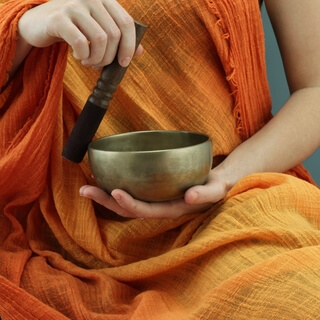
Ne do da da ya da la Sedepth yeah my Second another I'm in Ngara crashed and we can train by focusing on sound.
That's one way of training our mindfulness,
Just by focusing on the sound.
And trying to keep your mind on that sound.
And whenever it strays from the sound,
Whenever you're no longer focused on the sound,
You bring it back to that sound.
And that's all,
That's the exercise.
Or some people focus on the breath.
So you can focus just on the in-breath,
Or you can focus just on the out-breath,
Or you can focus on both.
There's many different ways,
People practice all of these ways.
Some people only focus on the out-breath,
Some people only focus on the in-breath,
Some people focus on the in-breath,
And then the time when the breath remains inside,
And then also on the out-breath.
That's another method.
Another method for those who perhaps practice Dharma is to focus on the mantra that you repeat mentally in your mind.
So you can just focus on this mental repetition of a mantra.
These are just three methods.
They're all different methods that we can use to cultivate mindfulness.
Or we can focus on compassion.
That's another object of focus that we can take just to cultivate this type of mindfulness.
All of these are just different methods we use to train the mind.
These days in our lives,
We just have so much work,
So much distractions,
That we're not able to work with our minds.
And when you don't work with your mind,
Your negative emotions just grow and develop and multiply.
So we're very attached,
We're very clingy.
A lot of us have anger issues,
Stress problems,
Or there's some people who have a lot of pride,
Some people who are very unaware,
Careless,
Ignorant.
All of these things are negative emotions that increase as we don't pay attention to our minds.
And these types of negative emotions are what create all our problems.
Fights within the family,
Between husband and wife,
Problems within your town,
Within your city.
Nowadays it's quite rare that everyone smiles at each other in the street and greets each other.
Most people scowl their way through life.
You may be sitting at a restaurant where everyone's eating really nice food and yet they don't look happy.
They're all scowling at each other.
And this is what creates all the conflict,
All the infighting,
The trouble that we perceive in the world.
This is what takes away our peace.
All of this is created actually by negative emotions.
And if we let these negative emotions run wild,
Then it will be very difficult for us to get any kind of happiness in our lives.
In fact,
It will just create suffering.
And if we let these negative emotions run wild,
Then it will be very difficult for us to get any kind of happiness in our lives.
And if we let these negative emotions run wild,
Then it will be very difficult for us to get any kind of happiness in our lives.
And if we let these negative emotions run wild,
Then it will be very difficult for us to get any kind of happiness in our lives.
And if we let these negative emotions run wild,
Then it will be very difficult for us to get any kind of happiness in our lives.
So,
If we don't just take attachment or clinging as an example,
If you cling to something very tightly,
It's like holding a knife really tight in your hand.
If you're holding a knife in your hand,
A sharp knife in your hand really tightly,
Then if someone tries to take it away,
It will cut your hand.
So,
This type of clinging is how we lose all our happiness and well-being to pain and suffering.
Because,
Just as in this example,
If you cling,
You get hurt when it gets taken away.
What do you have to do?
You need to let go.
If you're holding a knife and someone wants to take it,
You need to let go.
And then they can take it without hurting you.
So,
Letting go is extremely important.
And yet,
Generally speaking,
Our minds are so very attached,
So very clingy.
When dealing with a kind ofinfeld world like the oldribly A friend will periods of time will become a You cannot get moved Kotter at the foot of your arm and but I will promise you interesting lessons today.
Because the most fool No's choice.
No's choice.
Grealism.
.
.
Scaledlings.
.
.
1988.
.
.
Crafts.
.
.
Davis.
.
This is what we use all these meditation methods for.
It's to loosen that clinging that's why we practice by focusing on compassion or focusing on the breath or focusing on the sound works is that while you're meditating,
If an emotion comes up,
A strong emotion such as anger,
Let's say,
Well,
When that anger comes up,
Instead of going after that anger and grasping onto that anger,
You just,
With mindfulness,
You bring your attention back to your object of focus,
Whether it's your breath or sound,
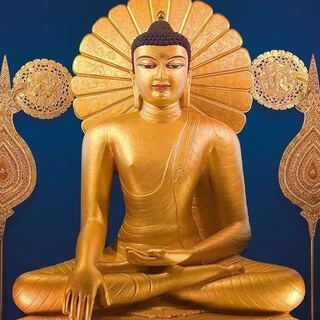
Or perhaps you have an object in front,
A visual object that you're focusing on.
So whatever your object of focus is,
Whenever something comes up in your mind,
You just direct your mind back towards the object of focus.
So instead of just following after that anger,
Latching onto it,
You just bring your mind back to your breath,
For example.
Or instead of latching onto that jealous thought that comes into your mind,
You bring your mind back to the sound or the image that you're focusing on.
And so this is what I mean when I was talking about mindfulness before.
This is the type of mindfulness,
Being mindful of the object of focus towards you bringing back your attention.
And this is how we create a habit,
A better habit.
These are just training methods to create a better habit,
To kind of diminish that clinging within our minds,
So that these negative emotions that create so much suffering for us have less sway,
So that they have less control,
Less power over us.
And this will definitely make your life easier and happier.