Hello dear ones and welcome to today's story.
The river that forgot its name.
There was once a river called Amara.
She had been given her name by the first people who had ever drunk from her waters,
A tribe who lived at the foot of the mountains where she was born.
They had knelt at her banks in the golden hours of early morning,
And whispered the name into her current.
And she had carried it with her ever since.
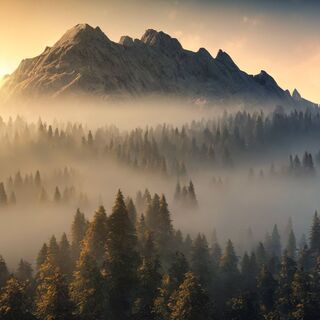
All the way down from the snow-capped peaks,
Through the pine forests,
Across the wide meadows.
And into the lowland country where rice grew in terraced steps and herons stood motionless in the shallows.
Amara was proud of her name.
She wore it the way a queen wears a crown.
Whenever the wind moved across her surface,
She felt herself ripple with identity.
She knew who she was.
She was Amara.
She was the river that fed the valley,
That reflected the moon.
That turned the millstone and watered the orchids.
And carried the dead leaves of autumn out toward the sea.
This was her story and she held it tightly.
The way roots hold the earth on a hillside.
But rivers are always moving.
And moving things cannot hold still forever.
One dry summer,
A drought crept into the land like a slow fever.
The snowpack in the mountains had been thin that year.
And the rains have not come as expected.
The streams that fed Amara's upper reaches slowed to a trickle.
She felt herself narrowing,
The banks drawing closer on either side.
The stones of her bed appearing above the surface,
Like the ribs of a creature,
Not yet dead but very hungry.
The people of the valley noticed.
They came to her banks and looked at her with worried faces.
They spoke in low voices about the harvest,
About the mill.
About what would happen if she ran dry.
And Amara heard them.
And for the first time in her long life,
She felt something she had never felt before.
Fear.
Not the fear of a great storm which she enjoyed in a wild elemental way.
But the quiet and terrible fear of loss.
The fear of ceasing to be what she was.
She clung to every drop.
She found herself angry at the roots along her banks,
Which she imagined were drinking more than their share.
She resented the herons for standing in her,
For taking the fish.
She begrudged the farmers their irrigation channels.
Every departure of water felt like a theft.
A subtraction from the self she was trying to preserve.
On the eastern bend of her course,
Where the land curved and a stand of tall reeds grew up along the bank,
There lived an old hermit named Bodhi.
He had come to that spot 40 years before.
A young man fleeing what he called the noise of wanting.
And he had built a small shelter of woven reed and river mud.
And had not left since.
He ate what the river offered,
Fish and watercress and the eggs of reed birds.
He drank the water.
He watched the light change hour by hour and season by season.
He was,
People said,
Either very wise or quite mad,
And possibly both.
Amara had known Bodhi her entire life.
She had heard him singing in the early mornings,
Formless songs without words.
And she had felt his feet in her shallows when he waded to bathe.
She liked him.
He asked nothing of her except what she naturally gained.
In the worst week of the drought,
When Amara's voice had dropped to a whisper.
And the children of the valley were being told not to play at the riverbank because there were sharp stones showing now.
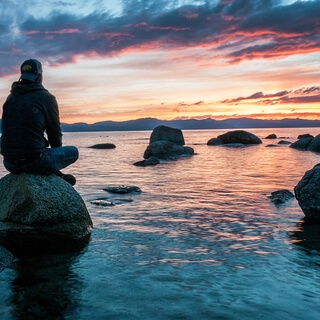
Body came to the water and sat down on a flat rock that had never before been above the surface.
He sat cross-legged and looked at the sky for a long time.
Then he said,
Quietly,
As if speaking to no one in particular.
You are suffering.
The river heard him.
She did not speak in words,
Of course.
Rivers speak in the language of motion and sound.
But in her current,
There was a note of anguish that anyone paying close enough attention could hear.
You are afraid of losing yourself,
Oddie said.
He opened his palms and rested them on his knees.
I was once afraid of the same thing.
I spent 20 years being afraid of it.
I thought that if I let go of my history,
My opinions,
My carefully constructed sense of who I was,
I would disappear.
That there would be nothing left.
He paused.
A dragonfly hovered over the water,
Its wings catching the light.
What I discovered,
He said,
Was the opposite.
Every time I let go I found more room,
More stillness.
More of what I actually was beneath all the names.
That night something strange happened to Amala.
A portion of her upper cores moving through a region of limestone hills.
Found a passage underground.
It was not the first time this had happened in the valley's geological history.
But it was the first time Amara had been present for it consciously.
She felt herself drawn down into darkness into earth The sunlight disappeared.
The sky disappeared.
Herons and the mill and the terraced rice fields were all above her now,
Unreachable.
She was still moving.
But she had no name here.
No one could see her.
No one could call her Amara.
No one was drinking from her,
Or irrigating from her,
Or milling grain with her.
She was just water.
Moving through stone in the dark.
And something in her relaxed.
There was no one to be for.
No one to provide for or disappoint.
No one to need her to be a river.
She was simply moving.
As water moves.
Because that is the nature of water.
She had not chosen to be Amara.
She had not chosen to be born in the snowpack of those particular mountains or to flow in that particular direction.
She had not asked for her name.
All of that had happened to her.
And she had gathered it up and called it herself.
And she had been afraid of losing it.
But here in the underground.
In the total dark.
She still existed.
She was still moving.
She was still,
Fundamentally and entirely,
Water.
The insight moved through her more powerfully than any flood.
It was like a loosening.
A release of a grip she had not known she was maintaining.
She had been holding herself so tightly all her life.
Terrified that if she did not hold on,
She would spill into formlessness.
But water is formlessness.
That was not the threat.
That was the truth.
Three days later,
Amara re-emerged from the earth.
She came up through a spring in a meadow she had never seen before.
A meadow on the far side of the limestone hills.
And she ran out across new ground,
New grasses.
New trees that have never known a river.
She was smaller now than she had been.
Much of her having been distributed into the earth during her underground passage.
That she moved differently.
Without the clinging.
The rains returned that autumn.
She swelled again.
She filled her banks.
The miller rebuilt his wheel.
And the herons return.
But she was not the same River.
Not in the way that matters.
The people still called her Amara and she did not object.
The name was a gift.
And she wore it lightly.
The way a tree wears its leaves.
Knowing that they will fall.
Knowing that the falling is part of the living.
Body noticed the change when he waded into her in October.
His breath clouding in the cold morning air.
She felt different.
Wider somehow.
Though her banks had not changed.
More spacious inside herself.
You found it,
He said.
And he stood there for a long time without speaking.
And the river moved around his ankles.
With the unhurried ease of something that has learned,
It does not need to arrive anywhere to already be there.
In the years that follow.
The people of the valley told a story about the drought.
They said the river had gone underground.
And come back changed.
And that since then the water tasted different.
Sweeter some said.
Lighter,
Said others.
Like it had forgotten its bitterness.
A young girl named Pri,
Who was seven years old when the drought ended.
Grew up to be the valley's water-keeper.
The one who maintained the irrigation channels and monitored the snowpack.
And prayed at the source each spring.
She asked Bodhi once,
When she was old enough to form the question.
What had changed the river.
He thought for a long moment.
Then he said,
She let go of her reflection.
Pre didn't understand.
A river can look at its own surface,
Bodhi said.
And see the sky and the trees and itself.
And call that its identity.
Or it can stop looking at the surface and simply be the moving when Amara stopped trying to hold her reflection still.
She became more fully what she had always been.
Water in motion.
Complete in each moment.
Not arriving.
Already there.
Pri went home and sat with that for a year.
Then she went back and asked another question.
How do you let go of your reflection?
Body smile.
By noticing,
He said,
Every time you are gripping it.
That is all.
You cannot force the letting go.
You can only become aware of the holding.
And in that awareness.
The grip softens on its own.
Pri returned to that conversation for the rest of her life.
In moments of fear.
In moments of grief.
In moments when she felt herself narrowing.
She would remember the river going underground.
Disappearing from everything it had named itself by.
And coming back.
Smaller and more spacious.
Moving without urgency across new ground.
In the teaching traditions of many lands.
This story is told to those who are suffering from attachment.
To a self-image,
A role.
A relationship.
Or a way of life.
It is not told to make suffering seem small.
It is told because water going underground is not death.
It is transformation.
And what seems like loss is sometimes the very passage that leads to more life.
The river does not stop being a river because it travels through stone.
It only stops being recognisable as one.
And in that invisibility.
In that namelessness.
It discovers what it was made of all along.