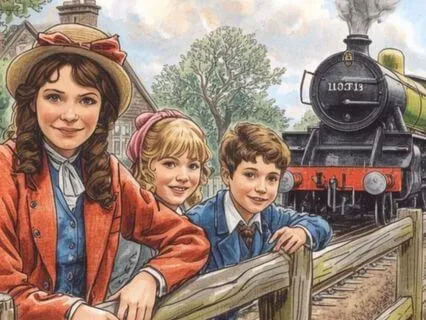
Hello dear ones and welcome to today's reading of The Railway Children.
Just take a moment now to arrive.
To slow down your breath.
To arrive fully in your body.
Noticing your breath,
Maybe taking a few longer inhales and exhales.
If you're in bed,
Allowing your body to sink into your mattress.
Making yourself comfortable for the next chapter in the story.
Chapter 7.
For Valour I hope you don't mind my telling you a good deal about Roberta.
The fact is I am growing very fond of her.
The more I observe her,
The more I love her.
And I notice all sorts of things about her that I like.
For instance,
She was quite oddly anxious to make other people happy.
And she could keep a secret,
A rare accomplishment.
Also,
She had the power of silent sympathy.
That sounds rather dull,
I know.
But it's not so dull as it sounds.
It just means that a person is able to know that you are unhappy.
And to love you extra on that account.
Without bothering you by telling you all the time how sorry she is for you.
That was what Bobby was like.
She knew that mother was unhappy.
And that mother had not told her the reason.
So,
She just loved mother more and never said a single word that could let mother know how earnestly her little girl wondered what mother was so unhappy about.
This needs practice.
It is not as easy as you might think.
Whatever happened,
And all sorts of nice,
Pleasant,
Ordinary things happened,
Such as picnics,
Games,
And buns for tea,
Bobby always had these thoughts at the back of her mind.
Mother's unhappy.
Why?
I don't know.
And she doesn't want me to know.
So,
I won't try to find out.
But she is unhappy.
And I don't know why.
But she doesn't.
And so on,
Repeating and repeating,
Like a tune that you don't know the stopping part of.
The Russian gentleman still took up a good deal of everybody's thoughts.
All the editors and secretaries of societies and members of parliament had answered mother's letters as politely as they knew how.
But none of them could tell where the wife and children of Mr.
Sierpanski would be likely to be.
Bobby had another quality,
Which you will hear differently described by different people.
Some of them call it interfering in other people's business.
And some call it helping lame dogs over styles.
And some call it loving kindness.
It just means trying to help people.
She racked her brains to think of some way of helping the Russian gentleman to find his wife and children.
He had learned a few words of English now.
He could say good morning and good night and please and thank you.
And pretty when the children brought him flowers.
And very good when they asked him how he had slept.
The way he smiled when he said his English was,
Bobby felt,
Just too sweet for anything.
She used to think of his face because she fancied it would help her some way in helping him.
But it did not.
Yet his being there cheered her because she saw that it made mother happier.
She likes to have someone to be good to,
Even besides us,
Said Bobby.
And I know she hated to let him have father's clothes.
But I suppose it hurt nice or she wouldn't have.
For many and many a night after the day when she and Peter and Phyllis had saved the train from wreck by waving their little red flags,
Bobby used to wake screaming and shivering.
Seeing again that horrible mound and the poor,
Dear,
Trustful engine rushing on toward it.
Just thinking that it was doing its swift duty and that everything was clear and safe.
And then a warm thrill of pleasure used to run through her at the remembrance of how she and Peter and Phyllis and the red flannel petticoats had really saved everybody.
One morning a letter came.
It was addressed to Peter and Bobby and Phyllis.
They opened it with enthusiastic curiosity,
For they did not often get letters.
The letter said,
Dear sir and ladies,
It is proposed to make a small presentation to you in commemoration of your prompt and courageous action in warning the train and thus averting what must,
Humanly speaking,
Have been a terrible accident.
The presentation will take place at the station at three o'clock on the 30th,
If this time and place will be convenient to you.
Yours faithfully,
Jabez Inglewood,
Secretary of Great Northern and Southern Railway Company.
There had never been a prouder moment in the lives of the three children.
They rushed to mother with the letter,
And she also felt proud and said so.
And this made the children happier than ever.
But if the presentation is money,
You must say thank you,
But we'd rather not take it,
Said mother.
I'll wash your Indian muslins at once,
She added.
You must look tidy on an occasion like this.
Fill and I can wash them,
Said Bobby,
If you'll iron them,
Mother.
Washing is rather fun.
I wonder whether you've ever done it.
This particular washing took place in the back kitchen,
Which had a stone floor and a very big stone sink under its window.
Let's put the bath on the sink,
Said Phyllis.
Then we can pretend we're out-of-doors washerwomen like mother saw in France.
But they were washing in the cold river,
Said Peter,
His hands in his pockets,
Not in hot water.
This is a hot river then,
Said Phyllis.
Not in hot water.
This is a hot river then,
Said Phyllis.
Lend a hand with the bath,
There's a deer.
I should like to see a deer lending a hand,
Said Peter,
But he lent his.
Now to rub and scrub and scrub and rub,
Said Phyllis,
Hopping joyously about as Bobby carefully carried the heavy kettle from the kitchen fire.
Oh no,
Said Bobby,
Greatly shocked.
You don't rub muslin,
You put the boiled soap in the hot water and make it all frothy,
Lathery,
And then you shake the muslin and squeeze it ever so gently and all the dirt comes out.
It's only clumsy things like tablecloths and sheets that have to be rubbed.
It's a nice drying day,
That's one thing,
Said Bobby,
Feeling very grown up.
Oh I do wonder what wonderful feelings we shall have when we wear the Indian muslin dresses.
Yes,
So do I,
Said Phyllis,
Shaking and squeezing the muslin in quite a professional manner.
Now we squeeze out the soapy water,
No we mustn't twist them,
And then rinse them.
I'll hold them while you and Peter empty the bath and get clean water.
A presentation,
That means presents,
Said Peter,
As his sisters,
Having duly washed the pegs and wiped the line,
Hung up the dresses to dry.
Whatever will it be?
It might be anything,
Said Phyllis.
What I've always wanted is a baby elephant,
But I suppose they wouldn't know that.
Suppose it was gold models of steam engines,
Said Bobby.
Or a big model of the scene of the prevented accident,
Suggested Peter,
With a little model train,
And dolls dressed like us,
And the engine driver,
And firemen,
And passengers.
Do you like us being rewarded for saving a train,
Peter?
Yes,
I do,
Said Peter,
And don't you try to come it over us that you don't like it too,
Because I know you do.
Yes,
Said Bobby,
I know I do,
But oughtn't we to be satisfied with just having done it,
And not ask for anything more?
But who did ask for anything more,
Silly,
Said her brother.
Victoria Cross soldiers don't ask for it,
But they're glad enough to get it all the same.
Perhaps it'll be medals.
Then,
When I'm very old indeed,
I shall show them to my grandchildren and say,
We only did our duty,
And they'll be awfully proud of me.
You have to get married first,
Peter,
Warned Phyllis,
Or you don't have any grandchildren.
I suppose I shall have to be I suppose I shall have to be married someday,
Said Peter,
But it will be an awful bother having her around all the time.
I'd like to marry a lady who has trances and only woke up once or twice a year,
Just to say that you were the light of her life,
And then go back to sleep again.
Yes,
That wouldn't be bad,
Would it?
Said Bobby.
When I get married,
Said Phyllis,
I shall want him to want me to be awake all the time,
So that I can hear him say how nice I am.
I think it would be nice,
Said Bobby,
To marry someone very poor,
And then you'd do all the work,
And he'd love you most frightfully.
I say,
We've got to answer that letter,
And say that the time and place will be convenient to us.
There's the soap,
Peter,
We're both as clean as clean,
That pink book of writing paper you had on your birthday,
Phil.
It took some time to arrange what should be said.
Mother had gone back to her writing,
And several sheets of pink paper with scalloped gilt edges and green four-leaved shamrocks in the corner were spoiled before the three had decided what to say.
Then,
Each made a copy and signed it with its own name.
The three-fold letter ran,
Dear Mr.
Jabez Inglewood,
Thank you very much.
We did not want to be rewarded,
But only to save the train,
But we are glad you think so,
And thank you very much.
The time and place,
You say,
Will be quite convenient to us.
Thank you very much,
Your affectionate little friend.
Then came the name,
And after it,
P.
S.
Thank you very much.
Washing is much easier than ironing,
Said Bobby,
Taking the clean dresses off the line.
I do love to see things come clean.
Oh,
I don't know how we shall wait until it's time to know what presentation they're going to present.
When at last,
It seemed a very long time after,
It was the day,
The three children went down to the station at the proper time,
And everything that happened was so odd that it seemed like a dream.
The station master came out to meet them in his best clothes and led them into the waiting room.
Where once they had played the advertisement game.
It looked quite different now.
A carpet had been put down,
And there were pots of roses on the mantelpiece and on the window ledges.
Green branches stuck up,
Like holly and laurel at Christmas,
Over the framed advertisements of Cook's Tours and the Beauties of Devon and the Paris Railway.
There were quite a number of people there beside the porter,
Two or three ladies in smart dresses and quite a crowd of gentlemen in high hats and frock coats,
Besides everybody who belonged to the station.
They recognised several people who had been on the train on the red flannel petticoat day.
Best of all,
Their own old gentleman was there,
And his coat and hat and collar seemed more than ever different from anyone else's.
He shook hands with them,
And then everybody sat down on chairs,
And a gentleman in spectacles,
They found afterwards that he was the district superintendent,
Began quite a long speech,
Very clever indeed.
I am not going to write the speech down.
First,
Because you would think it dull.
And secondly,
Because it made all the children blush so,
And get so hot about the ears,
That I am quite anxious to get away from this part of the subject.
And thirdly,
Because the gentleman took so many words to say what he had to say,
That I really haven't the time to write them down.
He said all sorts of nice things about the children's bravery and their presence of mind,
And when he had done,
He sat down and everyone who was there clapped and said,
Here,
Here.
And then the old gentleman got up and said things too.
It was very like a prize giving.
And then he called the children one by one by their names and gave each of them a beautiful gold watch and chain.
And inside the watches were engraved after the name of the watch's new owner.
From the directors of the Northern and Southern Railway,
In grateful recognition of the courageous and prompt action which averted an accident on 1905.
The watches were the most beautiful you can possibly imagine.
And each one had a blue leather case to live in when it was at home.
You must make a speech now and thank everyone for their kindness,
Whispered the station master in Peter's ear and pushed him forward.
Begin,
Ladies and gentlemen,
He added.
Each of the children had already said,
Thank you,
Quite properly.
Oh dear,
Said Peter,
But he did not resist the push.
Ladies and gentlemen,
He said.
Then there was a pause and he heard his heart beating in his throat.
Ladies and gentlemen,
It's most awfully good of you and we shall treasure the watches all our lives.
But really,
We don't deserve it because what we did wasn't anything really.
At least at least,
I mean,
It was awfully exciting.
And what I mean to say,
Thank you,
Thank you all very much.
The people clapped Peter more than they had done the district superintendent.
And then everybody shook hands with them.
And as soon as politeness would let them,
They got away and tore up the hill to three chimneys with their watches in their hands.
It was a wonderful day,
The kind of day that very seldom happens to anybody and to most of us,
Not at all.
I did want to talk to the old gentleman about something else,
Said Bobby,
But it was so public,
Like being in church.
What did you want to say,
Bobby?
Asked Phyllis.
I'll tell you when I've thought about it more,
Said Bobby.
So when she had thought a little more,
She wrote a letter.
My dearest old gentleman,
I want most awfully to ask you something.
If you could get out of the train and go by the next,
It would do.
I do not want you to give me anything.
Mother says we ought not to.
And besides,
We do not want any things.
Only to talk to you about a prisoner and captive.
Your loving little friend,
Bobby.
She got the station master to give the letter to the old gentleman.
And next day,
She asked Peter and Phyllis to come down to the station with her at the time when the train that brought the old gentleman from town would be passing through.
She explained her idea to them,
And they approved thoroughly.
They had all washed their hands and faces and brushed their hair and were looking as tidy as they knew how.
But Phyllis,
Always unlucky,
Had upset a jug of lemonade down the front of her dress.
There was no time to change,
And the wind happening to blow from the coal yard,
Her frock was soon powdered with grey.
It was decided that she should keep behind the others as much as possible.
Perhaps the old gentleman won't notice,
Said Bobby.
The aged are often weak in the eyes.
There was no sign of weakness,
However,
In the eyes or in any other part of the old gentleman as he stepped from the train and looked up and down the platform.
The three children,
Now that it came to the point,
Suddenly felt that rush of deep shyness which makes your ears red and hot,
Your hands warm and wet,
And the tip of your nose pink and shiny.
Oh,
Said Phyllis,
My heart's thumping like a steam engine,
Right under my sash too.
Nonsense,
Said Peter,
People's hearts aren't under their sashes.
I don't care,
Mine is,
Said Phyllis.
If you're going to talk like a poetry book,
Said Peter,
My heart's in my mouth.
My heart's in my boots,
If you come to that,
Said Bobby,
But do come on,
He'll think we're idiots.
He wouldn't be far wrong,
Said Peter,
Gloomily.
And they went forward to meet the old gentleman.
Hello,
He said,
Shaking hands with them all in turn.
This is a very great pleasure.
It was good of you to get out,
Bobby said.
He took her arm and drew her into the waiting room where she and the others had played the advertisement game the day they found the Russian.
Phyllis and Peter followed.
Well,
Said the old gentleman,
Giving Bobby's arm a kind little shake before he let it go.
Well then,
What is it?
Oh please,
Said Bobby.
Yes,
Said the old gentleman.
What I mean to say,
Said Bobby.
Yes,
Said the old gentleman.
It's all very nice and kind,
Said she.
But?
I wish I might say something,
She said.
Then say it,
Said he.
Well then,
Said Bobby.
And out came the story of the Russian who had written the beautiful book about poor people and had been sent to prison and to Siberia for just that.
And what we want more than anything in the world is to find his wife and children for him,
Said Bobby.
But we don't know how.
But you,
You must be horribly clever or you wouldn't be a direction of the railway.
And if you knew how,
And you would,
We'd rather have that than anything else in the world.
We'd go without the watches even,
If you could sell them and find his wife with the money.
And the others said so too,
Though not with as much enthusiasm.
Hmm,
Said the old gentleman,
Pulling down the white waistcoat that had the big gilt buttons on it.
What did you say the name was?
Frying-Pansky?
No,
No,
I'll write it down for you.
It doesn't really look at all like that except when you say it.
Have you a bit of pencil and the back of an envelope?
She asked.
The old gentleman got out a gold pencil case and a beautiful,
Sweet-smelling,
Green Russian leather notebook and opened it at a new page.
Here,
He said,
Right here.
She wrote down his name and said,
That's how you write it.
You call it Szypanski.
The old gentleman took out a pair of gold-rimmed spectacles and fitted them on his nose.
When he had read the name,
He looked quite different.
That man?
Why,
Bless my soul,
He said.
I've read his book.
It's translated into every European language.
A fine book,
A noble book.
And so your mother took him in like the good Samaritan.
Well,
Well,
I'll tell you something,
Youngsters,
Your mother must be a very good woman.
Of course she is,
Said Phyllis in astonishment.
And you're a very good man,
Said Bobby,
Very shy but firmly resolved to be polite.
Oh,
You flatter me,
Said the old gentleman,
Taking off his hat with a flourish.
And now,
Am I to tell you what I think of you?
Oh,
Please don't,
Said Bobby hastily.
Why?
Asked the old gentleman.
I don't exactly know,
Said Bobby.
Only,
If it's horrid,
I don't want you to.
And if it's nice,
I'd rather you didn't.
The old gentleman laughed.
Well then,
He said,
I'll only just say that I'm very glad you came to me about this.
Very glad indeed.
And I shouldn't be surprised if I found out something very soon.
I know a great many Russians living in London,
And every Russian knows his name.
Now,
Tell me all about yourselves.
He turned to the others,
But there were only two others.
And those were Peter and Bobby.
Phyllis had disappeared.
Tell me all about yourselves,
Said the old gentleman again.
And quite naturally,
They were stricken dumb.
All right,
We'll have an examination,
Said the old gentleman.
You two sit on the table,
And I'll sit on the bench and ask questions.
He did.
And out came their names and ages,
Their father's name and business,
How long they had lived at Three Chimneys,
And a great deal more.
The questions were beginning to turn on a herring and a half for three halfpence and a pound of lead and a pound of feathers,
When the door of the waiting room was kicked open by a boot.
As the boot entered,
Everyone could see that its lace was coming undone.
And in came Phyllis,
Very slowly and carefully.
In one hand,
She carried a large tin can,
And in the other,
A thick slice of bread and butter.
Afternoon tea,
She announced proudly,
And held the can and the bread and the butter out to the old gentleman,
Who took them and said,
Well,
Bless my soul.
Yes,
Said Phyllis.
This is very thoughtful of you,
Said the old gentleman.
Very.
But you might have got a cup,
Said Bobby,
And a plate.
Perks always drinks out of the can,
Said Phyllis,
Flushing red.
I think it was very nice of him to give it me at all,
Let alone cups and plates,
She added.
And so do I,
Said the old gentleman.
And he drank some of the tea and tasted the bread and butter.
And then it was time for the next train,
And he got into it with many goodbyes and kind last words.
Well,
Said Peter,
When they were left on the platform,
And the tail lights of the train disappeared round the corner.
It is my belief that we've lighted a candle today.
Like Latimer,
You know,
When he was being burned,
And there'll be fireworks for our Russian before long.
And so there were.
It wasn't 10 days after the interview in the waiting room,
That the three children were sitting on top of the biggest rock in the field below their home,
Watching the 515 steam away from the station along the bottom of the valley.
They saw too,
The few people who had got out at the station,
Struggling up the road toward the village.
And they saw one person leave the road and open the gate that led across the fields to three chimneys and to nowhere else.
Who on earth,
Said Peter,
Scrambling down.
Let's go and see,
Said Phyllis.
And so they did.
And when they got near enough to see who the person was,
They saw it was their old gentleman himself,
His brass buttons winking in the afternoon sunshine,
And his white waistcoat looking whiter than ever against the green of the field.
Hello,
Shouted the children,
Waving their hands.
Hello,
Shouted the old gentleman waving his hat.
Then the three started to run.
And when they got to him,
They hardly had any breath left to say,
How do you do?
Good news,
He said.
I found your Russian friend's wife and child,
And I couldn't resist the temptation of giving myself the pleasure of telling him.
But as he looked at Bobby's face,
He felt that he could resist the temptation.
Here,
He said to her,
You run on and tell him.
You run on and tell him.
The other two will show me the way.
Bobby ran.
But when she had breathlessly panted out the news to the Russian,
And mother sitting in the quiet garden,
When mother's face had lighted up so beautifully,
And she had said half a dozen quick French words to the exile,
Bobby wished that she had not carried the news.
For the Russian sprang up with a cry that made Bobby's heart leap and then tremble,
A cry of love and longing such as she had never heard.
Then he took mother's hand and kissed it gently.
And then he sank down in his chair,
Covered his face with his hands,
And sobbed.
Bobby crept away.
She did not want to see the others,
Just them.
But she was as gay as anybody when the endless French talking was over,
When Peter had torn down to the village for buns and cakes,
And the girls had got tea ready and taken it out into the garden.
The old gentleman was most merry and delightful.
He seemed to be able to talk in French and English almost at the same moment,
And mother nearly as well.
It was a delightful time.
Mother seemed as if she could not make enough fuss about the old gentleman,
And she said yes at once when he asked if he might present some goodies to his little friends.
The word was new to the children,
But they guessed that it meant sweets,
For the three large pink and green boxes tied with green ribbons,
Which he took out of his bag,
Held unheard of layers of beautiful chocolates.
The Russian's few belongings were packed,
And they all saw him off at the station.
Then mother turned to the old gentleman and said,
I don't know how to thank you for everything.
It has been a real pleasure to me to see you,
But we live very quietly.
I am so sorry that I can't ask you to come and see us again.
The children thought this very hard.
When they had made a friend,
And such a friend,
They would dearly have liked him to come and see them again.
What the old gentleman thought,
They couldn't tell,
As he only said,
I consider myself very fortunate,
Madam,
To have been received once at your house.
Ah,
Said mother,
I know I must seem very surly and ungrateful,
But you could never seem anything but a most charming and gracious lady,
Said the old gentleman,
With another of his bowels.
And as they turned to go up the hill,
Bobby saw her mother's face.
How tired you look,
Mammy.
Lean on me.
It's my place to give mother my arm,
Said Peter.
I'm the headman of the family when father's away.
Mother took the arm of each.
How awfully nice,
Said Phyllis,
Skipping joyfully,
To think of the dear Russian embracing his long lost wife.
The baby must have grown a lot since he saw her.
Yes,
Said mother.
I wonder where the father will think I've grown,
Phyllis went on,
Skipping more gaily.
I have grown already,
Haven't I,
Mother?
Yes,
Dear,
Said mother.
And Bobby and Peter felt her hands tighten on their arms.
Poor old mammy,
You are tired,
Said Peter.
Bobby said,
Come on,
Phyllis,
I'll race you to the gate.
And she started the race,
Though she hated doing it.
You know why Bobby did that?
Mother only thought that Bobby was tired of walking slowly.
Even mothers who love you better than anyone else ever will,
Don't always understand.