Crocus,
Hope and new beginnings.
InBulk,
Brigitte.
Welcome.
So let's start by taking a soft breath in with me.
And then out.
And as you let your shoulders drop,
Just a fraction.
Today we are meeting a little plant that somehow carries a huge medicine in a tidy body.
Crocus.
Crocus is one of those first brave blooms that can show up when winter still has opinions.
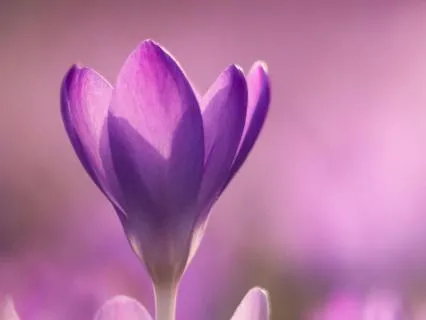
The flowers are often goblet-shaped,
White,
Yellow,
Lilac,
Purple.
And they pop up in long to the ground,
So their little lamps lit from the inside.
And if you ever look closely at the leaves,
You may notice a pale silver stripe down the center,
Like a quiet signature.
A crocus grows from a corm,
An undergrown storage bulb-like structure.
So before you've ever seen beauty above the ground,
These seasons of unseen preparation belong.
And that matters for our spiritual lens.
We'll come back to that.
In the simplest language,
Crocus is a messenger of the threshold.
Not everything is fixed now.
Not the hard part never happened.
But something is turning.
A crocus tends to appear at the hinge of season.
Late winter,
Early spring,
For many types.
So spiritually,
The crocus often brings hope that is practical,
Not fluffy.
Grounded hope.
Renewal that is gently.
Small steps.
Not a big personal makeover.
And permission to begin again,
Even if you are not fully ready yet.
If crocus is showing up in your life,
In your garden,
In your dreams,
In repeated messages,
In your attention,
It can be a nudge to ask,
What is trying to come back into life with me?
Or,
Where am I ready?
For what honest step forward?
And what part of me needs warmth before I can open?
So to have a little look at this crocus,
Let's have a look at the two unique features.
Number one,
Crocus is the source of saffron,
The most expensive spice in the world.
And saffron comes from the stigmas of the saffron crocus,
The crocus satifus.
And each flower has only three stigmas.
And that's why saffron is so precious.
It's intensely harvested and the yields are tiny.
So it takes roughly 170 flowers to make one grams of saffron.
In the research I've done in the Britannica,
I even noticed that a hound of saffron represents about 75,
000 blossoms.
Let that land for a second.
Can you imagine a field with so many blossoms?
That must be amazing.
Looking at that,
So the crocus teaches us that small things can carry immense value.
Not loud,
Not big,
Not flashy,
But potent.
And the second is that the crocus is an early season light bearer.
For many gardens are still quiet,
Crocus offers color and life.
A visible sign that nature hasn't forgotten about to move forward.
And this is why people experience the crocus as an emotional relief.
It's proof in its petals that the cycle is in turn.
There is this one story in the Greek and Roman myths about crocus.
And it's a mortal youth that becomes the crocus flower.
In the version he is in a love story with a nymph,
Similax.
And in another he becomes the companion of purpose and is accidentally killed during a discus game.
And the flower rises where his blood falls.
So why does a story like this get shared again and again?
It's because it speaks to something humans never stop needing.
That grief can become beauty,
That love changes but it doesn't disappear.
And that what feels like an end can become a beginning in a different shape.
So crocus in this mythical lens is not just springtime pretty,
It's an alchemical heartbreak meaning loss,
Transformation,
Ending,
New life.
And here in that sense is the connection with Saint Bridget.
Because the crocus is not officially the flower of Saint Bridget but everywhere it is in a very real seasonal and cultural way connected to the time and what she represents.
So Saint Bridget's day,
February 1st,
Is very intimately tied to Imbolc,
The turning towards spring.
And in a lot of the reflections and local traditions people often mention the snow drop in the crocus as an early sign of that turning.
There are even communities planting in Counting Kildare,
Which is Bridget's heartland,
And that includes white crocuses bulbs as part of honoring Saint Bridget through the early spring flowers.
So if you work with Bridget as a saint or as a goddess or as a symbol of hearth,
Fire,
Healing,
Poetry,
And of course the forge,
The crocus really beautiful fits here because the crocus as first light,
Bridget as returning light,
The crocus as tender courage,
And Bridget as the steady in our flame.
This brings us to a beautiful talk that is linked around this topic,
And that is the shadow side.
So let's talk shadow,
Not as a bed,
But as a what's hidden unspoken while waiting underneath.
The crocus grows from a curm,
An energy stored in the dark,
In the unseen,
In the underworld of soil.
And that's shadow territory.
The crocus can gently guide shadow work like this.
Stop shaming the part of you that went quiet.
The quiet might have been storage,
Not failure.
Let the tenderness be sacred.
New growth is sensitive.
It doesn't need force.
It needs contribution.
And honor the timing of opening.
So if crocus is your guide today,
Your shadow questions might be,
Where am I rushing my healing?
What part of me is still on the ground and needs patience and not pressure?
And what grief or old story is ready to transform into wisdom?
What small part of me have I dismissed that is actually powerful?
And this is here where Bridget's thread comes in again.
The forge doesn't shame raw metal.
It heats it.
It holds it.
And it shapes it.
With care and with time.
So as we leave crocus today,
I want you to take this with you.
May you trust the slow work happening beneath the surface.
May you let small beginnings be enough.
May you recognize that what is tender in you is not weak.
It's new.
And may your inner flame return in a way that feels kind,
Steady,
And real.
And if you want to end and close your connection with crocus,
You can say.
Crocus reminds us life returns quietly,
Faithfully,
And it starts slow.