Welcome to the mindfulness meditation podcast presented by the Rubin Museum of Art.
We are a museum in Chelsea,
New York City that connects visitors to the art and ideas of the Himalayas and serves as a space for reflection and personal transformation.
I'm your host,
Dawn Eshelman.
Every Monday we present a meditation session inspired by a different artwork from the Rubin Museum's collection and led by a prominent meditation teacher from the New York area.
This podcast is a recording of our weekly practice currently held virtually.
In the description for each episode,
You will find information about the theme for that week's session,
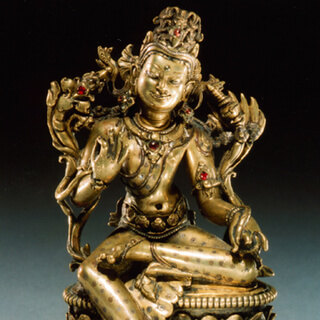
Including an image of the related artwork.
Our mindfulness meditation podcast is presented in partnership with Sharon Salzberg and teachers from the New York Insight Meditation Center,
The Interdependence Project,
And Parabola Magazine.
And now,
Please enjoy your practice.
Hi,
Everybody.
Welcome to mindfulness meditation online here with the Rubin Museum of Art.
I'm Dawn Eshelman,
And it's so nice to have so many of you joining from all over Jackson Heights,
San Francisco,
And even just right around the corner from the Rubin Museum.
I see.
So great to have you with us for our weekly program where we combine art and meditation online.
And of course,
If you're new to us,
We're a museum of Himalayan art and ideas in New York City.
We're going to today take a look at a work of art from our collection.
Then we will bring on our wonderful teacher.
Today is Rebecca Lee,
And then we'll have a short talk from our teacher.
We'll sit for a short time,
15 to 20 minutes,
Guided by Rebecca.
So we're looking at some art today,
And we're talking about resilience.
That's what we've been talking about this month.
And go ahead and bring up our artwork,
Which I'll describe to you in just a moment,
But I thought we could look at it here together as we talk about resilience.
And those of you who have been with us for a while here know that we've been really taking this close look at this idea of impermanence,
Which is the concept that things change.
And resilience is something that we need in order to help us deal with change.
And in many ways,
I don't know about you,
But I'm feeling tested lately,
Especially just with our current situation,
With the global pandemic and with holiday season approaching.
My resilience in my steadfastness in being in quarantine,
More or less,
And not being able to see my family this time of year and all of that,
I'm really feeling that resilience being tested as Thanksgiving and other holidays approach.
So it's helpful to just revisit that idea.
And also,
What comes to mind for me around this is that meditation itself is a resilience practice,
And we're always letting go and starting over again and just building that muscle of kindness to ourselves around that.
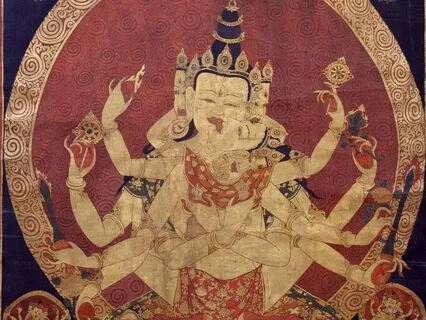
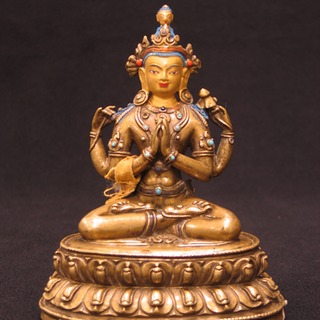
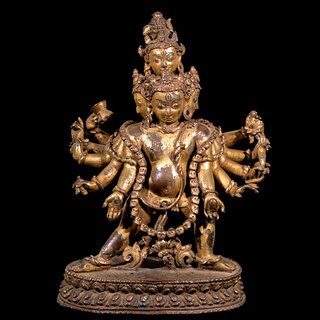
So the object that we're looking at today is akshopya vajra.
And this is a tantric meditation deity.
So this is really a deity that practitioners would turn to in aid for meditation.
And akshopya vajra symbolically unites the five Buddha families and is one of the five wisdom buddhas and represents consciousness.
And we see here three heads,
Six arms,
Holding a variety of tools here,
Including the vajra and the bell and embracing a consort.
He represents the ultimate form of Buddha akshopya and the unification of method and wisdom,
Right,
Those two yin and yang almost that come together to allow us to overcome duality,
That allow practitioners to overcome duality.
And the enlightened qualities and wisdom of the five constituents of the human body and mind,
They're all developed through this practice of resilience and practice of visualization and meditation and ritual.
And so while we won't be practicing in this tradition today,
It's great to be able to see how the artwork in our collection speaks very directly to our practices and to resilience.
So let's bring on our teacher today,
Rebecca Lee.
Dr.
Rebecca Lee is a Dharma heir in the lineage of Chan Master Sheng Yan and has started practicing meditation in 1995.
She began her teacher training,
Hi Rebecca,
With Master Sheng Yan in 1999 to become a Dharma and meditation instructor and trained with Simon Child and received full Dharma transmission in 2016.
You can find all about her talks and her writings at RebeccaLee.
Org.
She's the founder and guiding teacher of Chan Dharma community and sociology professor at the College of New Jersey where she also serves as faculty director of the Ellen Dolly Center for the Study of Social Justice.
Rebecca Lee,
It's so nice to have you back.
Welcome.
Thank you.
Thank you.
It's so wonderful to be back and practicing with everyone and seeing everyone here.
And yes,
Even though I don't see you,
I have you in my mind.
I see you in the auditorium.
Yes,
We can feel you.
So thank you,
Rebecca.
Very much so.
Thank you,
Dawn.
I'll let you take it from here.
And yes,
This is a really good time to be talking about resilience.
And I would like to share about how the practice of silent illumination,
The cultivation of total clear awareness helps us to be more resilient in the face of uncertainty in this very difficult weeks and months that are coming with the rise in number of COVID cases coinciding with the holiday season when we usually get together with our loved ones.
In particular,
I'd like to invite us to use the practice to examine,
To examine how our time to fixed ideas we hold about how the world is supposed to be,
How things are supposed to work,
Get in the way of our being more resilient,
Being able to embrace change,
To live through a difficult period of time,
Moment after moment.
So if you've been reading the news or any kind of publication,
You probably had noticed a lot of advice and suggestions on how to cope with the holiday season in COVID.
Okay,
What do we do now?
Maybe you cook a smaller turkey and what do you do instead of being able to travel to celebrate the holiday season with our family?
And some of you may notice that,
Yeah,
That sounds like a good idea,
But you might notice this resistance in you.
It's like,
But that is not,
That's not real Thanksgiving because Thanksgiving in our mind,
It's about the whole ritual of being able to get together with our loved ones and including packing our bags,
Getting to the airport maybe,
Or taking the drive,
Packing stuff into our car and drive those hours to go to the home of our loved one.
So that we can all spend hours to prepare meals,
Get together,
Hug each other,
And spend a day celebrating.
That's the whole big ritual.
That's what Thanksgiving is in our mind.
So the idea of doing it in our small nuclear family or those of us living alone,
Far,
Far away from our family,
We feel this resistance that that is not the,
That's not the Thanksgiving,
That's not a holiday celebration.
And perhaps this is,
Of course,
It is important to acknowledge that ritual is important,
As how Dawn had explained in this artwork,
The ritual is also a resilient practice.
Many of our holiday celebrations are some form of rituals.
And it is also important for us to use this opportunity to recognize and remember that yeah,
The fact that we were able to engage in this holiday season celebration in the past years have been the coming together of many,
Many causes and conditions that are constantly changing.
But in past years,
Those causes and conditions made it possible for us to travel long distance and gather with our loved ones to celebrate the holiday together.
And one of those causes and conditions was that we were not in a pandemic.
So we did not need to worry about getting sick from traveling,
Getting sick from gathering in crowds of people,
Not having to worry about bringing the virus to our loved ones.
That would be the last thing we want to do.
So in this way,
We have this precious opportunity to recognize those past many years of gathering with our family were really quite a miracle,
Because those causes and conditions were here.
And with what's going on now,
They will come together again,
As we have this pandemic under control.
We also notice that when we give rise to this resistance to these advice and suggestions,
It is a form of tension in the mind,
In our heart,
Resisting the reality of the present moment.
When we hold a fixed idea of how things are supposed to be.
Always,
We are resisting the true nature of reality,
Which is that everything is constantly changing.
And everything is the coming together of many causes and conditions.
And in this holiday season,
The causes and conditions that allow us to gather,
Not really here for many of us.
So we will have to celebrate this holiday season a little differently.
We'll notice that when we are firmly attached to our fixed idea of how things are supposed to be in this case,
I'm staying with the example of how holiday season celebration is supposed to be,
That is suffering,
Because we are resisting,
We are resisting what is going on,
Whenever we are rejecting what is and wishing what is to be otherwise,
This kind of unsatisfactoriness that's suffering.
And usually,
We notice that when we attach to this fixed idea,
What we do is we focus on what is lost,
I couldn't do what I usually do.
And of course,
That is taking for granted what we were able to do as something that always will come together.
And so,
When we are able to recognize that we are,
Our suffering is caused by our attachment holding very tightly in our heart and mind,
This set of fixed idea about how the holiday season is supposed to be,
In that moment,
We're able to relax the mind,
Because we ask ourselves,
Do I want to suffer more?
If the answer is not,
Then we can make the choice to release,
To release this tight attachment to our fixed idea of how things are supposed to be.
And we'll notice that when we cultivate this clear total awareness,
Allowing our mind to relax,
We will focus less on what is lost,
We will recognize that yeah,
I'm unable to do what I usually do to hug and see my loved one.
But as we open our heart,
And allowing our awareness to open,
We will be able to notice the opportunity for different ways to connect with our loved ones.
Because after all,
Celebrating the holiday season is really about celebrating our love for our family and our dear friends and our loved ones.
So when we allow ourselves to release this firm attachment to our fixed idea of how things are supposed to be,
And then we are able to open up our awareness and tell ourselves perhaps,
Okay,
Well,
I never had any time to call these people one by one because I'm too busy this year,
I don't need to spend the time traveling,
Go to the airport,
Standing in long security lines and doing their flights.
And so I have all those hours,
Maybe this week,
I can spend one hour,
Two hours each day to call up the loved ones I'm unable to see this time,
Or maybe even more.
So when we are doing this,
Maybe we also find different ways to connect with our loved ones.
Besides being able to call them,
Now we have the opportunity to talk with them one by one to one,
Which may not be possible when we all gather in a big family home,
Where everyone's sitting in front of the television,
Maybe watching football or something like that.
And you might find it possible to connect with members of your family,
Extended family,
Or your friends if you usually get together with them.
The more quiet ones,
The introverts who usually sit there quietly in these big gatherings,
Maybe you finally have a chance to really talk with them one by one.
So instead of focusing on what is lost,
As we use the practice to settle our mind and open our awareness,
We'll identify that this presents an opportunity for us to celebrate and connect with our loved ones in a different way.
And it is a different way to celebrate our love for our family.
It doesn't mean that we won't gather again for Thanksgiving.
It doesn't mean that we completely let go of this important tradition,
This ritual of getting together around our favorite holiday meals.
But right now,
We work with the current causes and conditions.
And as we allow our total awareness to open up,
We can make good use of the opportunities presented by this current situation and still have a good,
Meaningful holiday season.
So I'd like to invite you to join me to engage in a session of meditation to practice cultivating this clear awareness.
So I'd like to set up the body in this posture that is comfortable and stable,
Allowing the lower back to fall into its natural curvature,
Letting the skeletal structure to do the work of holding up the body,
Allowing the muscles to relax,
And then allow the mind to relax.
Can I take you through a whole body relaxation?
Feel the relaxation of the top of the head.
Directly experience the subtle sensations as we allow the tension in the crown to melt away.
And feel the relaxation spread to the forehead.
Check to see if we are holding tension in this area by habit,
Maybe from worrying,
And allow,
Allow the tension to melt away.
And feel the relaxation spread to the eyeballs and eye muscles,
Allowing the tension we hold in these muscles to melt away.
And feel the relaxation spread to the facial muscles.
Check to see if we are holding tension in these muscles by habit,
Perhaps to hold a certain facial expression for the world to see,
To meet their expectations,
Perhaps.
And right here,
Right now,
There is no need to do that.
You can give these muscles a vacation.
Allow,
Allow the tension to melt away.
And feel the relaxation spread to the entire head.
And feel the relaxation spread down the neck muscles.
We hold a lot of tension in these neck muscles in our daily life,
Allowing,
Allowing the tension to melt away,
And directly experience the subtle sensations of these muscles softening,
Like melting butter.
And feel the relaxation spread down to the shoulders,
And down the arms,
And the forearms,
And all the way down to the fingertips.
And feel the relaxation spread to the chest area.
Check to see if we're holding tension in this area by habit,
Maybe from anxiety,
Or sadness,
Worry,
Or grief.
Right here,
Right now,
You can give them a rest and allow,
Allow the tension to melt away.
And feel the relaxation spread down the torso to the lower abdomen.
Trust that the skeletal structure can hold up the body.
And these lower abdominal muscles don't need to work so hard.
You can give them a vacation,
And allow,
Allow the tension to melt away.
And feel the relaxation spread from the upper back to the upper back,
In the muscles between the shoulder blades,
Allowing the tension we hold in these muscles to melt away.
And feel the relaxation spread down the back to the lower back,
And all the way down to the buttocks,
Where we feel the sensations of the body sitting on the chair or our cushion.
And feel the relaxation spread down to the thigh muscles,
And all the way down to the toes.
And feel the relaxation spread to the entire body,
Sitting right here,
Right now,
Moment to moment.
Allow ourselves to relax into every emerging present moment.
And we may notice subtle sensations,
Changing sensations of the body,
Breathing.
Allow the body to breathe on its own.
The body knows how to breathe.
It's been doing so since the moment we were born.
It's not necessary for us to get involved with the breathing.
Take over.
All we need to do is to allow,
Allow the body to breathe,
And stay with the changing sensations of the body breathing.
Gently rest our attention on the subtle changing sensations of the body breathing to gently anchor us to the emerging present moment,
Moment after moment.
And if we notice thoughts,
Or feelings,
Or memory coming through,
Regardless of what they are,
Maybe sadness,
Maybe happy memories,
Allow it to be here.
Already in your mind,
No need to fight against it,
No need to block them out.
And allow them to be fully seen and felt and experienced on their own.
When it's time to leave,
Allow them to move on,
Moment after moment.
And practice this way to cultivate this total,
Clear awareness of our body-mind.
If we notice our attention drifting off,
Losing contact with our body-mind,
No problem.
Make use of that as an opportunity to practice remembering to come back,
To come back to the direct experience of the changing sensations of the body breathing.
It doesn't matter how often or how long the mind drifts off,
As long as you eventually find your way back,
You're practicing well.